

Rekha started investing in early 2020, right before the COVID crash sent the Nifty tumbling over 30 percent in a matter of weeks. She panicked, sold everything near the bottom, and sat in cash for the next year, watching the market more than double from those lows without her in it. Three years later, in a strong bull phase, she did the opposite, pouring extra money into whatever stock had rallied hardest that week, convinced the good times would simply keep going. Neither instinct served her well. She’d gotten the market’s direction roughly right both times. She’d gotten her own behavior backwards both times too.
This is the real challenge with bull market and bear markets. Recognizing which one you’re in isn’t actually the hard part, indices and news headlines make that fairly obvious. The hard part is behaving sensibly once you know, since the emotionally natural response in each phase is usually the wrong one.

What Actually Defines a Bull Market or Bear Market
A bull market describes a sustained period of rising prices, typically accompanied by strong investor confidence, healthy corporate earnings growth, and generally positive economic conditions. There’s no single official percentage threshold universally agreed upon, but it’s generally characterized by indices like the Nifty or Sensex trending upward over an extended period, often measured in years rather than weeks.
A bear market is more precisely defined: a fall of 20 percent or more from a recent peak in a major index, typically driven by economic slowdown, high inflation, global uncertainty, or a genuine crisis. Anything short of that 20 percent threshold, even a sharp, scary-feeling drop, is usually classified as a correction rather than a full bear market, an important distinction, since corrections are considerably more frequent and usually resolve faster.
India’s Market Has Lived Through Both, Repeatedly
Looking at Indian market history gives useful perspective on just how normal these cycles actually are. Between 2002 and 2007, the Nifty rose roughly sixfold in one of India’s most dramatic bull runs, driven by economic reforms and strong corporate earnings growth. That was followed by a prolonged, largely stagnant bear phase from 2007 to 2013, including the brutal 2008 Global Financial Crisis, during which the Sensex fell by nearly 50 to 60 percent. From 2013 to 2019, the market delivered more moderate, steady growth, doubling over six years. Then came the sharp COVID crash in early 2020, followed by one of the strongest post-crash recoveries in Indian market history, with the Nifty more than doubling off its March 2020 lows.
Historically, Indian bull markets have tended to run considerably longer than bear markets, often stretching several years, while bear markets, though painful, have generally been shorter, commonly resolving within roughly 9 to 18 months, though individual cycles vary considerably. The point isn’t to memorize these specific numbers, it’s to internalize that both phases are a completely normal, recurring part of investing in equities, not a rare or unusual event either time it happens.
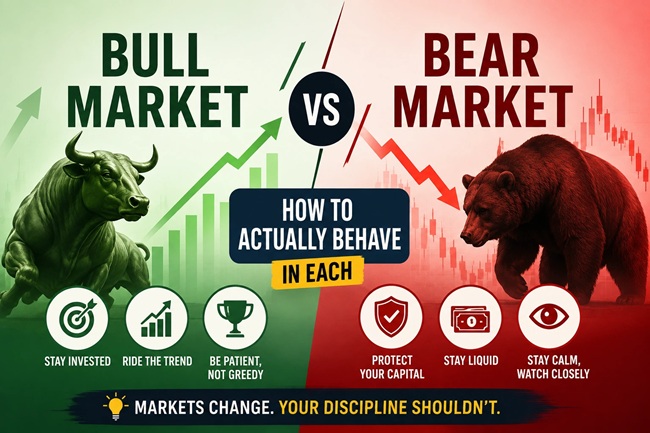
How to Actually Behave in a Bull Market
The instinct in a strong bull market is to chase whatever’s rallying hardest, and to feel like every dip is a buying opportunity regardless of the underlying company’s actual fundamentals. This is exactly where discipline matters most, precisely because everything feels like it’s working, which makes sloppy decisions feel temporarily harmless.
The most useful habit in a bull market is resisting the urge to abandon your original investment plan just because momentum stocks are outperforming it. If you’ve built a diversified portfolio based on your actual goals and risk tolerance, a raging bull market isn’t a good reason to suddenly concentrate everything into whatever sector is hottest that quarter. It’s also worth periodically rebalancing, if equity gains have pushed your portfolio’s allocation well beyond your original target mix, trimming back toward that target locks in some gains rather than leaving your entire portfolio exposed to a correction that eventually, inevitably, follows every bull run.
Valuation discipline matters more in a bull market, not less. Rising prices don’t automatically mean rising value, and buying purely because “it’s going up” without checking whether a stock’s price still makes sense relative to its earnings is precisely how investors end up overexposed right before a downturn.
How to Actually Behave in a Bear Market
The instinct in a bear market is to sell, to stop the visible bleeding in your portfolio statement, and Rekha’s 2020 reaction is an extremely common one. The problem is that this instinct almost always triggers at close to the worst possible moment, locking in losses right before markets historically tend to recover, rather than riding out the decline.
For long-term investors, particularly anyone running a SIP, a bear market is usually the point where staying the course matters most, not least. Continuing your SIP through a downturn means you’re buying more units at lower prices, which directly benefits your average purchase cost once the market eventually recovers, a benefit that completely disappears if you stop contributing right when prices are cheapest.
If you have surplus cash and a genuinely long time horizon, a bear market can also be a reasonable window to increase equity allocation gradually, not by trying to precisely time the exact bottom, which is essentially impossible to do consistently, but by accepting that meaningfully lower valuations across quality companies don’t come around often, and spreading additional investment across the downturn rather than waiting for a single “perfect” entry point.
It’s equally important to distinguish a temporary, sentiment-driven decline from a genuine, fundamental deterioration in a specific company or sector you’re holding. Broad bear markets pull almost everything down together, including fundamentally sound businesses, which is very different from a stock falling because the underlying company’s actual prospects have genuinely worsened.
Get the regular financial updates on Financechecks.com. Follow us on Instagram and Youtube.
The Behavioral Flip That Trips Most Investors Up
Here’s the pattern worth internalizing above everything else: the emotionally comfortable action in each phase is usually the financially costly one. In a bull market, the comfortable feeling is chasing momentum and abandoning caution, precisely when discipline matters most. In a bear market, the comfortable feeling is selling to escape the pain, precisely when staying invested, or even adding, tends to serve long-term investors best. Recognizing this gap between what feels right in the moment and what actually tends to work out is, honestly, most of what separates investors who compound wealth steadily over decades from those who buy high out of excitement and sell low out of fear, cycle after cycle.
Bull Market vs Bear Market at a Glance
| Aspect | Bull Market | Bear Market |
|---|---|---|
| Definition | Sustained rising prices, strong sentiment | 20%+ decline from a recent peak |
| Typical duration in India | Often several years | Commonly 9-18 months, though it varies |
| Common investor instinct | Chase momentum, abandon caution | Sell to stop losses |
| Better response | Stick to your plan, rebalance periodically, maintain valuation discipline | Continue SIPs, consider gradual accumulation, avoid panic-selling |
| Biggest risk | Overexposure right before a correction | Locking in losses right before a recovery |
About This Guide
This article references historical Indian market cycles, including the 2002-2007 bull run, the 2007-2013 bear phase, the 2008 Global Financial Crisis, and the post-2020 recovery, based on publicly available Nifty and Sensex historical data. Past market cycles and their durations don’t predict future ones, and every cycle has been driven by a different mix of economic and global factors. This article does not identify or recommend the current market phase; please refer to live market data and a financial advisor for guidance specific to present conditions.
Common Mistakes People Make in Each Phase
In bull markets, the most common mistake is mistaking a rising market for personal investing skill, leading to overconfidence, reduced diversification, and larger risk-taking right as valuations get stretched and the eventual correction gets closer, not further away.
In bear markets, the most common mistake, by a wide margin, is panic-selling near the bottom, converting a paper loss into a permanent, realized one, and then often re-entering the market much later, well after most of the recovery has already happened.
Across both phases, a frequent mistake is trying to precisely time entries and exits based on predicting the top or bottom, something even professional fund managers consistently struggle to do reliably, rather than focusing on a consistent, disciplined strategy that performs reasonably well across both types of markets without requiring perfect timing.
Finally, checking portfolio value excessively during volatile bear market stretches tends to amplify anxiety and increase the odds of an emotionally driven, poorly timed decision, compared to a more measured, periodic review approach.
My Take
If there’s one thing worth taking from India’s market history, it’s that every single bear market on record has eventually been followed by a recovery and a new high, and every bull market has eventually given way to a correction or a bear phase. Neither state has ever been permanent. The investors who’ve done well across these cycles generally aren’t the ones who correctly predicted every turn, they’re the ones who built a plan suited to their actual timeline and risk tolerance, and stuck to it through both the exciting years and the painful ones, without letting either extreme talk them into abandoning it.
Frequently Asked Questions
1. What percentage decline officially defines a bear market? A decline of 20 percent or more from a recent peak in a major index is generally used to define a bear market. Declines smaller than that are typically classified as a correction instead.
2. How long do bull and bear markets typically last in India? Historically, Indian bull markets have tended to last several years, while bear markets have more commonly resolved within roughly 9 to 18 months, though actual durations have varied considerably across different cycles.
3. Should I stop my SIP during a bear market? Generally, no. Continuing a SIP through a bear market means buying more units at lower prices, which can improve your average purchase cost once the market recovers, a benefit that’s lost if contributions stop during the downturn.
4. Is it a good idea to invest more money during a bear market? For investors with a long time horizon and surplus funds, gradually increasing investment during a bear market can be a reasonable strategy, though trying to precisely time the exact bottom is generally not realistic or necessary.
5. How do I know if a market decline is a correction or a full bear market? The key distinguishing factor is the size of the decline. Corrections are typically smaller drops that recover faster, while a bear market specifically refers to a 20 percent or greater decline from a recent peak.
6. What was the biggest bear market in Indian stock market history? The 2008 Global Financial Crisis triggered one of the sharpest declines, with the Sensex falling nearly 50 to 60 percent, followed by a prolonged, largely stagnant period through to around 2013.
7. Why do investors often sell at the worst possible time during a bear market? This is largely driven by loss aversion and fear, an emotional response to seeing portfolio values decline sharply, which often triggers selling near the bottom rather than staying invested through the recovery that historically tends to follow.
8. Does a bull market mean every stock will go up? No. Even in a strong bull market, individual stocks can underperform or decline due to company-specific issues, which is why valuation discipline and diversification remain important even during broadly positive market conditions.
9. How can I tell if the market is currently in a bull or bear phase? This is generally assessed by looking at how major indices like the Nifty and Sensex have moved over recent months to years relative to their prior peaks, along with broader indicators like corporate earnings trends and overall investor sentiment.
10. Is it possible to accurately time the top of a bull market or bottom of a bear market? Consistently predicting exact market tops and bottoms has proven extremely difficult, even for professional investors, which is why most long-term strategies focus on disciplined, consistent investing rather than attempting precise market timing.
Disclaimer
This article is for informational and educational purposes only and does not constitute investment advice. Historical market cycle data reflects past Indian market performance and does not predict future market behavior. Equity investments are subject to market risk, including potential loss of principal, particularly during bear market phases. Please consult a qualified financial advisor before making investment decisions based on market conditions.

Shuchi founded Finance Checks after spending 16+ years working in corporate, managing operations and distribution. She managed her own finances, learned and read regularly and helped people make sense of their savings, loans, insurance, and investments.
She started this site to offer the kind of clear, honest financial guidance she wished was more available when she was learning to manage her own money. Every article is researched personally, checked against official sources such as the Reserve Bank of India, SEBI, or the Income Tax Department, and revisited whenever regulations or figures change. She is upfront about how the site earns money through ads and select affiliate partnerships, and she does not let either influence what she actually recommends to readers.