
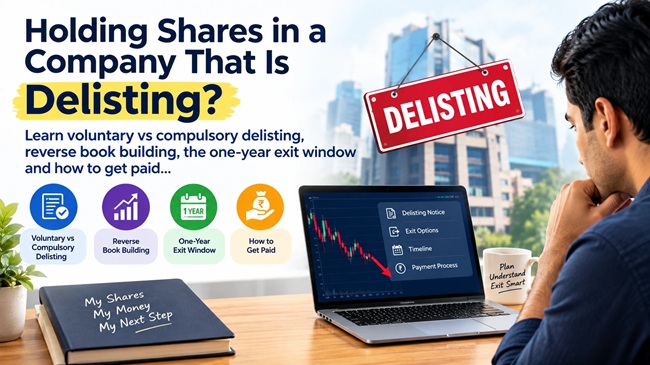
Holding Shares in a Company That Is Delisting? What Happens to Your Investment and How to Get Your Money Back

By the FinanceChecks.com Editorial Team | Published October 10, 2026 | Last reviewed October 10, 2026 | 11-minute read
Few notifications from a stock exchange cause as much quiet panic as the word “delisting.” If you see it next to a company you own, your first thought may be that your money is about to disappear. That fear is understandable, but it is often wrong. What happens to your shares depends almost entirely on how the company is being delisted, and in one common route the law gives you a guaranteed way to get paid. In another, the picture is far less comforting.
This guide explains the two kinds of delisting, what you can expect in each, the exact steps to get your money out, how the money is taxed, and the mistakes that cost investors the most.

Quick Answer
Delisting means shares are permanently removed from trading on a stock exchange. In a voluntary delisting, which is started by the promoters or an acquirer, the SEBI Delisting Regulations, 2021 require an exit offer: public shareholders bid in a reverse book building process, the offer only succeeds if the acquirer reaches 90% ownership, and anyone who does not tender can still sell to the acquirer at the same price for at least one year after delisting. In a compulsory delisting, which an exchange imposes as a penalty for serious non-compliance, an independent valuer sets a fair value and the promoters must buy out public shareholders at that value within three months, with interest at 10% a year if they pay late, but if the valuer finds the shares have no positive value the exit can be nil. Either way, your shares stay in your demat account after delisting, they just stop trading on the exchange, so check which route applies and act before the deadline.
About This Guide
This guide was compiled by the FinanceChecks.com editorial team using the SEBI (Delisting of Equity Shares) Regulations, 2021, SEBI’s investor FAQs on delisting, and commentary from legal and tax publishers. The regulations were amended in November 2024, and exchanges publish the facts of each offer, so the exact timetable, floor price and conditions for any company will be in its own offer documents. This is general information, not advice on a specific stock.
What Delisting Actually Means
A listed company’s shares trade on a stock exchange where anyone can buy or sell them in seconds. Delisting removes that facility. The shares still exist, you still own them, and they still sit in your demat account, but you can no longer sell them through your broker at a market price. Their value becomes a question of whether anyone will buy them, and at what price.
Companies are delisted in two broad ways.
Voluntary delisting happens when the promoters or an acquirer decide to take the company private, often after buying most of the shares already. Compulsory delisting happens when the exchange removes a company for reasons such as long-running regulatory violations, failure to meet listing requirements, or financial distress. These two routes lead to very different outcomes for the small shareholder.
Voluntary vs Compulsory Delisting at a Glance
| Feature | Voluntary delisting | Compulsory delisting |
|---|---|---|
| Who starts it | Promoter or acquirer | The stock exchange |
| Exit price | Discovered through reverse book building, or by a fixed or negotiated route where allowed | Fair value set by an independent valuer appointed by the exchange |
| Success condition | Acquirer must reach 90% ownership | Not applicable; the exchange decides |
| Your right to get paid | Strong; an exit offer is required | Promoter must buy at fair value if the value is positive |
| Window to tender after delisting | At least one year at the same price | Within the time fixed for the compulsory offer |
| Main risk | Price lower than you hoped | Little or no value, and limited exit options |
How a Voluntary Delisting Works
The offer follows a defined sequence. First, the shareholders approve the delisting by special resolution, and the exchange and SEBI processes follow. Then a bidding window opens and public shareholders can offer their shares at a price they choose, subject to a floor price set by the regulations. This process is called reverse book building because the sellers, not the buyer, name the price.
The price that results is the lowest price at which enough shares are tendered for the acquirer’s holding to reach 90% of the company. Everyone whose bid is at or below that final price is paid that final price, which is called the exit price. If the 90% threshold is not reached, or the acquirer decides not to accept the discovered price, the offer can fail and your shares simply come back to you. In some cases the acquirer may also make a counter offer.
A simplified illustration shows how this works. Suppose promoters hold 75% and need 15% more to reach 90%. The floor price is ₹100. Bids come in so that shares offered at ₹120 or below add up to 6% of the company, at ₹130 or below to 11%, and at ₹140 or below to 15%. The price at which the target is first reached is ₹140, so ₹140 becomes the exit price, and every shareholder who bid ₹140 or less receives ₹140 per share. Someone who bid ₹150 gets nothing from this round and keeps the shares. Real offers have many more price points, but the logic is the same.
A few routes skip reverse book building, including some small-company, insolvency and scheme-of-arrangement cases, where the exit price is negotiated or set by the process, so read the offer document to see which route applies.
You May Also Like To Read About:
What If You Do Nothing?
This is a protection many investors miss. Under the regulations, shareholders who did not tender, or whose bids were not accepted, can still sell to the acquirer at the same exit price for at least one year from the date of delisting, and the promoter must set aside the money in an escrow account for that period. After that year, your only option is a private, off-market sale.
That safety net is useful, but it is not a reason to ignore the window. The one-year route requires paperwork with the company’s registrar, can be slower than a simple tender through your broker, and you may need to chase it.
How a Compulsory Delisting Works
Compulsory delisting is a penalty, and it is where investors tend to be hurt. The exchange appoints an independent valuer to determine the fair value of the shares. Where that value is positive, the promoters have to buy the shares of public shareholders at that fair value within three months, and if they pay late they owe interest at 10% a year to the shareholders who offered their shares.
The weak point is the valuation. If the company is in serious distress, the valuer may find the shares are worth little or nothing, and there may be no meaningful exit offer. In that case the shares sit in your demat account with no market to sell them in, a situation commentators describe as limited exit options and higher risk. This is also why a long trading suspension or a stock sitting in a restricted trading category is a warning sign worth taking seriously.
What If It Is Only Delisted From One Exchange?
Some companies delist from one exchange while staying listed on another nationwide exchange such as the BSE or NSE. In that case your shares generally keep trading, and an exit offer is not normally required, so a delisting notice from a regional exchange is not the same as a full delisting. Always check whether the company remains listed anywhere.
How to Get Your Money Back: A Step-by-Step Guide
| Step | What to do |
|---|---|
| 1. Identify the type | Read the exchange notice: is it voluntary, compulsory, or delisting from only one exchange? |
| 2. Read the offer documents | Check the floor price, the bidding window, the record date and the acceptance conditions |
| 3. Decide your bid | In a voluntary offer, choose whether to bid at the floor or higher; remember accepted bids are paid the final exit price |
| 4. Place the bid through your broker | Use the exchange’s offer window before the deadline, and note that shares may be blocked in your demat account |
| 5. Watch the outcome | If the offer succeeds, you are paid the exit price; if not, your shares are released |
| 6. If you missed it | In a voluntary delisting, tender to the acquirer within the one-year exit period, through the registrar or as instructed |
| 7. Keep records | Save contract notes and the offer paperwork for tax purposes |
For a compulsory delisting, watch for the fair value announcement and the promoter’s offer, and keep your demat details current so the company’s registrar can reach you.
How the Money Is Taxed
The tax depends on how you sell. Gains from shares sold in an exit offer are treated as capital gains. The detail that surprises people is that the ₹1.25 lakh annual exemption on long-term gains under Section 112A applies only to listed shares on which securities transaction tax was paid. Many exit offers run through an offer window rather than the regular trading screen, so STT may not be charged, in which case that exemption may not be available and long-term gains may be taxed at 12.5% without it. Your broker’s contract note shows whether STT was charged, and a tax professional can confirm how your sale is treated.
Once a company is unlisted, the rules change. Gains on unlisted or delisted shares are long-term only after 24 months of holding, and they are taxed at 12.5% with no indexation and no ₹1.25 lakh exemption, while shorter holdings are taxed at your slab rate. If you end up selling at a loss, a loss on shares of an unlisted company generally arises only when you actually transfer them, and capital losses can be set off against capital gains and carried forward, subject to the usual rules. The practical takeaway is that holding worthless delisted shares in your demat account does not create a loss you can claim until they are sold or otherwise transferred.
Common Mistakes Investors Make
The most expensive mistake is assuming delisting always means a total loss and dumping the shares at a deep discount in the market before the offer even opens. In a voluntary delisting the exit price is often higher than where the stock trades once the announcement shakes sentiment. Another mistake is ignoring the notices because the demat mobile number or email is out of date, which means the offer letter never arrives. Investors also confuse voluntary and compulsory delistings and expect a guaranteed buyer where none exists. Some bid too high in reverse book building and miss out when the final price lands below their bid. Others forget to keep records, then struggle with the tax calculation later. And many forget that the shares remain theirs after delisting and never claim the money during the one-year window.
My Take
The most useful thing to remember is that delisting is a process, and the first question is always which one. A voluntary delisting comes with legal rights to an exit price and a safety net window. A compulsory delisting is a different matter and deserves real caution, especially for distressed companies, because the right to a buyout is only as valuable as the shares are.
For ordinary investors, the practical safeguard is boring but effective: keep your demat contact details updated, read the exchange announcements for anything you hold, and treat a long trading suspension as a warning to look into the company before it turns into a delisting notice.
Frequently Asked Questions
1. What happens to my shares if a company is delisted? You keep owning them and they stay in your demat account, but they no longer trade on the exchange. What they are worth depends on whether an exit offer is available and at what price.
2. Will I lose all my money in a delisting? Not necessarily. In a voluntary delisting, SEBI’s rules require an exit offer at a price discovered through reverse book building. In a compulsory delisting, the outcome depends on the independent valuer’s fair value, which can be low or nil for distressed companies.
3. What is reverse book building? It is a price discovery process in which public shareholders bid the price at which they are willing to sell. The exit price is the lowest price at which enough shares are offered for the acquirer to reach 90%, and accepted bidders receive that price.
4. What if I did not tender my shares during the offer? In a voluntary delisting, you can still sell to the acquirer at the same exit price for at least one year after the date of delisting. After that, only a private off-market sale is possible.
5. How long does the promoter have to pay in a compulsory delisting? Where the fair value is positive, the promoter must buy the shares from public shareholders within three months, and must pay interest at 10% a year to those who offered their shares if it pays late.
6. What if the company is delisted from only one exchange? If it remains listed on another nationwide exchange such as the BSE or NSE, trading generally continues and an exit offer is typically not required.
7. Can I still sell delisted shares in the market? Not through the exchange. You can use the exit offer, the one-year window in a voluntary delisting, or a private off-market sale.
8. How are delisting offer gains taxed? They are capital gains. Whether the ₹1.25 lakh long-term exemption applies depends on whether STT was paid on the sale. Once the shares are unlisted, long-term gains are taxed at 12.5% without that exemption.
9. Can I claim a loss on shares of a delisted company? A capital loss generally arises only when the shares are sold or transferred, so worthless shares sitting in your demat account do not give you a claimable loss until then.
10. How do I find out whether a company I own is being delisted? Check the exchange’s corporate announcements for the company, watch for messages from your broker or depository, and keep your demat contact details up to date so offer documents reach you.
How We Verified This Information
This guide was researched using the SEBI (Delisting of Equity Shares) Regulations, 2021, SEBI’s investor FAQs on delisting, and commentary from legal and tax publishers. Secondary sources sometimes simplify the rules, so where details such as counter offers, special routes and the tax treatment of exit offers vary, we described them in general terms and recommend reading the offer document and confirming the tax position with a professional.
Disclaimer
This article is for general informational purposes only and does not constitute investment, legal or tax advice. Delisting rules, offer terms and tax treatment can change and differ for each company. Readers should read the official offer documents and exchange notices for the specific company and consult a SEBI registered investment adviser or tax professional before acting. FinanceChecks.com is not a SEBI registered investment adviser.
Last reviewed and fact-checked on October 10, 2026 by the FinanceChecks.com Editorial Team.

Shuchi founded Finance Checks after spending 16+ years working in corporate, managing operations and distribution. She managed her own finances, learned and read regularly and helped people make sense of their savings, loans, insurance, and investments.
She started this site to offer the kind of clear, honest financial guidance she wished was more available when she was learning to manage her own money. Every article is researched personally, checked against official sources such as the Reserve Bank of India, SEBI, or the Income Tax Department, and revisited whenever regulations or figures change. She is upfront about how the site earns money through ads and select affiliate partnerships, and she does not let either influence what she actually recommends to readers.