
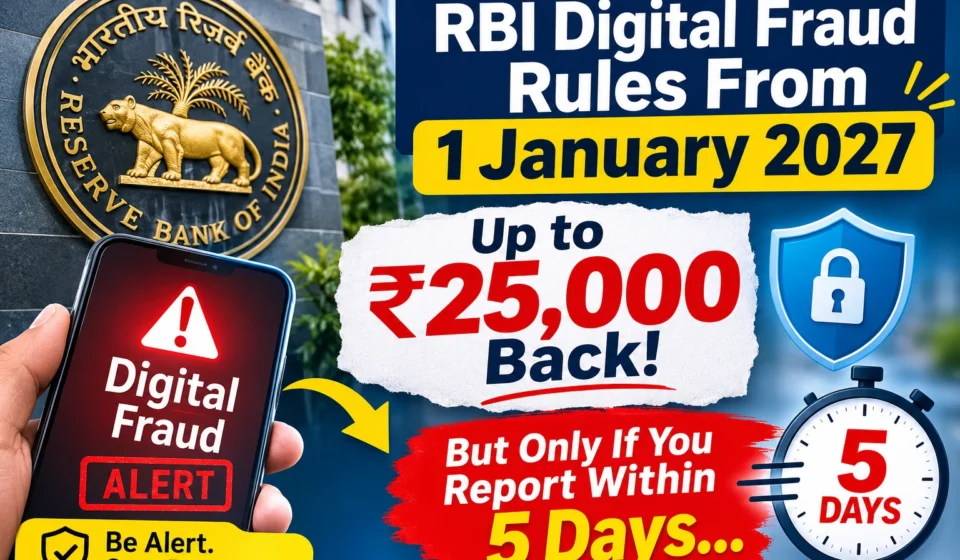
RBI Digital Fraud Rules From 1 January 2027: Up to ₹25,000 Back, But Only If You Report Within 5 Days

By Shuchi, FinanceChecks.com | Published 31 October 2026 | Category: Banking Insurance and Loans | Reading time: about 5 minutes
Imagine Kavita, a nurse in Jaipur. In March 2027, a caller claiming to be from “bank security” scares her into sending ₹32,000 through UPI. She is too embarrassed to tell anyone and finally reports it on day nine. Under the new RBI rules, she would get nothing from the new compensation scheme. If she had reported within five days, she would have received ₹25,000.
That gap between day five and day nine is the most important detail in RBI’s new framework for digital fraud. Here is what changes, who qualifies, and what to do in those first five days.

Quick Answer
From 1 January 2027, an individual who loses up to ₹50,000 in a digital banking fraud can claim 85 percent of the net loss or ₹25,000, whichever is lower. It can be claimed once in a lifetime. To qualify, you must report the fraud to both your bank and the National Cyber Crime Reporting Portal or helpline 1930 within five calendar days of the fraud. The rules apply to transactions on or after 1 January 2027, and the compensation covers frauds occurring within one year of that date.
About This Guide
This article is written by the editorial desk of FinanceChecks.com, an independent Indian personal finance publication. It is based on RBI’s seven Amendment Directions issued on 24 June 2026 (RBI/2026-27/167 to 173) as summarised by CorpLawUpdates.in, plus reports from The Federal, Ujjivan Small Finance Bank and others. I could not read the original RBI text, so please confirm details on rbi.org.in. This is educational content and not legal advice.
What Is Changing
RBI is widening the old “unauthorised transaction” rule to cover “fraudulent electronic banking transactions”. That now includes scams where you are tricked or pressured into approving a payment yourself. Three other changes matter:
- Banks must resolve fraud complaints within 45 calendar days (60 for cross-border cases).
- Your liability is zero when the fraud is the bank’s fault. In third-party breach cases it is also zero if you report within five calendar days.
- Banks must send an SMS alert for every electronic transaction above ₹500 and keep a 24×7 channel to report fraud.
The Compensation Rules at a Glance
| Point | What the rules say |
|---|---|
| Who can claim | A genuine individual customer, including a sole proprietor |
| Maximum loss covered | Gross loss up to ₹50,000 |
| Amount | 85% of net loss, or ₹25,000, whichever is lower |
| How often | Once in a lifetime |
| Deadline | Report to your bank and to 1930 or the cyber crime portal within 5 calendar days of the fraud |
| Joint accounts | Only one holder can claim, and the choice is permanent |
| Coverage period | Frauds occurring within one year of 1 January 2027 |
| Bank’s timeline | Pay within 5 calendar days of getting your completed claim form |
For losses below ₹29,412 you get 85 percent. From ₹29,412 to ₹50,000 you get a flat ₹25,000. So a ₹20,000 loss returns ₹17,000, and a ₹50,000 loss returns ₹25,000. If you lose ₹40,000 but ₹15,000 is recovered, the net loss is ₹25,000 and the compensation is ₹21,250.
You May Also Like To Read About:
- PNB Greater Noida Fraud: Is Your Fixed Deposit Safe? What Happened, What PNB Says and 10 Checks to Do Today
- ₹14 Crore Banking Fraud: 187 Unauthorised Transfers Reported — Is UPI the Next Target?
- ICICI Bank Cash Deposit and Withdrawal Charges From 1 December 2026: Old vs New Rates, Free Limits and Other Changes
- Never Google a Bank’s Customer Care Number: SBI’s Warning and How to Stay Safe
- Government Plans to Cut Stakes in 4 PSU Banks to 75%: Is Privatisation Next After IDBI Bank?
Your First 5 Days: What to Do
- Call your bank at once to block your card, UPI or net banking, and note the complaint number.
- Call 1930 or file at cybercrime.gov.in the same day. Reporting to the bank alone is not enough.
- Write down the date and time of the fraud and of each report, because the five days are counted from the fraud.
- Save evidence: screenshots, transaction IDs, call logs and messages.
- Ask the bank for the compensation claim form once it confirms your complaint is genuine.
Who May Not Benefit
The scheme is for individuals, not companies. Losses above ₹50,000 fall outside it, according to most reports, although The Federal says the cap stays at ₹25,000 for larger losses, so check the RBI text. Frauds before 1 January 2027 are not covered. The bank decides whether you are a “bona fide” victim, and the rules list customer negligence as sharing your OTP or PIN carelessly, ignoring clear scam warnings, downloading malicious apps and not keeping your registered mobile number and email up to date.
Common Mistakes to Avoid
The usual mistakes are waiting out of embarrassment, reporting only to the bank or only to the portal, sharing an OTP with a “bank officer”, installing an app a caller recommends, and leaving an old mobile number registered, so alerts never reach you. Treat the five days as a hard deadline.
My Take
I think this is a real step forward. Until now, victims of scams where they pressed the button themselves were largely on their own. But the scheme is small: ₹25,000 maximum, once in a lifetime, for one year, and it will not make anyone whole after a big scam. Prevention still beats compensation. Save your bank’s real number, keep your mobile number current, and never share an OTP, whatever the caller knows about you. If something goes wrong, report in hours, not days.
Frequently Asked Questions
1. How much compensation can I get for digital fraud from 1 January 2027? You can get 85 percent of your net loss or ₹25,000, whichever is lower, for a gross loss of up to ₹50,000. It is available once in a lifetime.
2. What is the deadline to file a complaint? You must report to both your bank and the National Cyber Crime Reporting Portal or helpline 1930 within five calendar days of the fraud.
3. Does it cover frauds that happen before 1 January 2027? No. It applies to electronic banking transactions on or after that date, and the compensation covers frauds within one year of it.
4. What if I lose more than ₹50,000? This compensation is meant for losses up to ₹50,000. Other liability rules still apply, and you should report quickly and ask your bank how your case is treated.
5. Can both holders of a joint account claim? No. Only one holder can claim, and that choice is permanent.
Disclaimer
This article is for general information and education only. It is not legal or financial advice. RBI rules, bank procedures and reporting channels can change, and details here come from secondary summaries of RBI’s directions. Confirm everything with RBI and your bank, and report any fraud to your bank and the police immediately.
Sources Consulted
CorpLawUpdates.in summary of RBI’s Amendment Directions dated 24 June 2026 (RBI/2026-27/167 to 173). The Federal, “RBI digital fraud rules 2027: Who can claim compensation and who can’t.” Ujjivan Small Finance Bank, “RBI’s New Digital Fraud Rules.” Dhyeya IAS and Boroktimes explainers on the compensation framework.

Shuchi founded Finance Checks after spending 16+ years working in corporate, managing operations and distribution. She managed her own finances, learned and read regularly and helped people make sense of their savings, loans, insurance, and investments.
She started this site to offer the kind of clear, honest financial guidance she wished was more available when she was learning to manage her own money. Every article is researched personally, checked against official sources such as the Reserve Bank of India, SEBI, or the Income Tax Department, and revisited whenever regulations or figures change. She is upfront about how the site earns money through ads and select affiliate partnerships, and she does not let either influence what she actually recommends to readers.

