

SIP vs SWP: Which Mutual Fund Strategy Is Right for You? (Complete Guide 2026)

Introduction
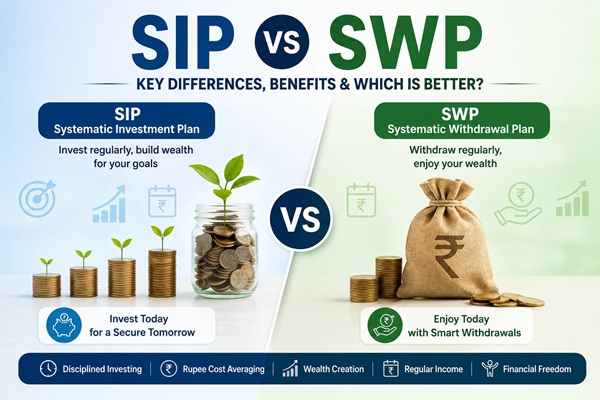
If you’ve spent any time researching mutual funds, you’ve almost certainly come across two acronyms that sound similar but do very different jobs: SIP (Systematic Investment Plan) and SWP (Systematic Withdrawal Plan). Both are automated, disciplined strategies for managing money in mutual funds — but one is built for accumulating wealth, and the other is built for generating regular income.
Understanding the difference between SIP and SWP isn’t just academic. Choosing the right one — or knowing when to switch from one to the other — can make a real difference to your long-term financial plan, whether you’re a 25-year-old just starting your investing journey or a 60-year-old retiree looking for a steady monthly cash flow.
In this guide, we’ll break down SIP vs SWP in detail: how each works, their pros and cons, taxation, real-world use cases, and how to decide which one (or combination of both) fits your financial goals.
What Is a SIP (Systematic Investment Plan)?
A Systematic Investment Plan (SIP) is a method of investing a fixed amount of money into a mutual fund scheme at regular intervals — typically monthly, though weekly, quarterly, or even daily SIPs exist with some fund houses.
Instead of investing a lump sum all at once, SIP lets you invest small, regular amounts over time. This approach is widely popular among salaried individuals and first-time investors because it fits naturally with a monthly income cycle.
How SIP Works
- You choose a mutual fund scheme (equity, debt, hybrid, index fund, etc.)
- You set a fixed amount (e.g., ₹5,000) and a frequency (usually monthly)
- On the chosen date, the amount is auto-debited from your bank account and used to purchase units of the fund at the prevailing Net Asset Value (NAV)
- Over time, you accumulate more units, and your investment grows through the power of compounding
Key Benefits of SIP
- Rupee Cost Averaging: Since you invest a fixed amount regularly, you automatically buy more units when prices are low and fewer units when prices are high. This averages out your purchase cost over time and reduces the impact of market volatility.
- Power of Compounding: Returns generated on your investment start earning their own returns, which can significantly boost wealth over long horizons.
- Disciplined Investing: SIP removes the guesswork and emotional decision-making of “timing the market.” You invest consistently, regardless of market conditions.
- Affordability: You can start a SIP with as little as ₹100–₹500 per month, making it accessible to nearly everyone.
- Flexibility: You can increase, decrease, pause, or stop your SIP at almost any time without heavy penalties.
Who Should Consider SIP?
SIP is ideal for individuals in the wealth accumulation phase of life — typically younger investors, salaried professionals, or anyone with a long-term goal such as buying a house, funding a child’s education, or building a retirement corpus.
Read More About:
What Is an SWP (Systematic Withdrawal Plan)?
A Systematic Withdrawal Plan (SWP) works in the opposite direction of a SIP. Instead of putting money into a mutual fund regularly, you withdraw a fixed (or variable) amount from your existing mutual fund investment at regular intervals.
SWP is commonly used by retirees, or anyone who wants to convert a lump-sum mutual fund corpus into a steady stream of “salary-like” income, while the remaining balance stays invested and continues to grow (or at least has the potential to).
How SWP Works
- You invest a lump sum into a mutual fund scheme (or already have one)
- You set up an SWP instructing the fund house to redeem a fixed amount (or a fixed number of units) at regular intervals — monthly, quarterly, etc.
- On each withdrawal date, the requisite number of units are sold, and the proceeds are credited to your bank account
- The remaining invested amount continues to earn market-linked returns
Key Benefits of SWP
- Regular Income: Ideal for retirees or anyone needing a predictable cash flow, similar to a pension or salary.
- Capital Stays Invested: Unlike fixed deposits where the entire amount may be locked, your remaining corpus in an SWP continues to be invested and can keep growing.
- Tax Efficiency: Withdrawals under SWP are treated as partial redemptions, and only the capital gains portion is taxed — not the entire withdrawal amount. This is often more tax-efficient than interest income from fixed deposits, which is fully taxable.
- Flexibility: You can modify the withdrawal amount or frequency based on your changing needs.
- Rupee Cost Averaging in Reverse: Just as SIP averages purchase cost, SWP can help average out the redemption value across market cycles if amounts are moderate relative to the corpus.
Don’t miss the regular updates on daily finance , follow us on Instagram @financechecks13 and Youtube @financechecks
Who Should Consider SWP?
SWP suits individuals in the income/decumulation phase of life — typically retirees, people who’ve taken a career break, or investors who’ve built a large corpus through SIP and now want to convert it into regular payouts without withdrawing everything at once.
SIP vs SWP: Key Differences at a Glance
| Parameter | SIP (Systematic Investment Plan) | SWP (Systematic Withdrawal Plan) |
|---|---|---|
| Purpose | Wealth accumulation | Regular income generation |
| Cash Flow Direction | Money flows FROM you INTO the fund | Money flows FROM the fund TO you |
| Ideal Life Stage | Earning/accumulation phase | Retirement/decumulation phase |
| Effect on Corpus | Corpus grows over time | Corpus reduces over time (unless returns outpace withdrawals) |
| Taxation | No tax on investment; tax applies only on eventual redemption | Tax applies on the capital gains portion of each withdrawal |
| Market Volatility Impact | Rupee cost averaging reduces purchase cost | Can average out redemption value, but sequence-of-returns risk exists |
| Typical User | Young/salaried investors, long-term goal planners | Retirees, pensioners, income-seeking investors |
| Minimum Requirement | Can start small (₹100–₹500/month) | Requires an existing lump-sum corpus |
SIP vs SWP: Taxation Explained
Taxation is one of the most misunderstood aspects of both strategies, so let’s simplify it.
Taxation on SIP
- There is no tax at the time of investment.
- Tax is triggered only when you redeem your units.
- For equity mutual funds: Units held for more than 12 months qualify for Long-Term Capital Gains (LTCG) tax; units held for less than 12 months attract Short-Term Capital Gains (STCG) tax.
- For debt mutual funds: Gains are added to your income and taxed as per your applicable income tax slab (post the tax rule changes effective April 2023).
- Since each SIP installment is treated as a separate investment, each has its own holding period for tax purposes (this is important when calculating LTCG/STCG on redemption).
Taxation on SWP
- Every withdrawal under an SWP is treated as a partial redemption of units.
- Only the capital gains component of each withdrawal is taxed — not the full withdrawal amount. This is a major advantage over interest-bearing instruments like fixed deposits, where 100% of the interest is taxable.
- The gains are classified as short-term or long-term based on how long those specific units were held, and taxed accordingly (equity vs debt fund rules apply as above).
Note: Tax rules for mutual funds in India have changed multiple times in recent years. Always verify current tax slabs, holding period definitions, and applicable rates with a tax professional or the latest government notifications before making decisions.
SIP vs SWP: Which One Should You Choose?
The honest answer: it’s not really an either/or decision — it depends on your life stage and financial goal.
Choose SIP if:
- You are earning a regular income and want to build wealth for a future goal
- You have a long investment horizon (5+ years)
- You want to benefit from rupee cost averaging and compounding
- You’re building a retirement corpus, education fund, or house down payment
Choose SWP if:
- You have already accumulated a lump sum (through SIP, inheritance, bonus, retirement benefits, property sale, etc.)
- You need regular, predictable cash flow — for living expenses, EMIs, or supplementing a pension
- You want your capital to remain partially invested and continue growing while you draw an income
- You’re looking for a tax-efficient alternative to traditional income options like fixed deposits or annuities
The SIP + SWP Combination Strategy
Many financial planners recommend a two-phase approach:
- Accumulation Phase (SIP): During your working years, invest consistently via SIP to build a substantial corpus over 15–30 years.
- Distribution Phase (SWP): Once you retire or need regular income, transfer that corpus (or a portion of it) into an SWP to generate a monthly “paycheck” from your investments, while the remaining amount stays invested for potential growth.
This SIP-to-SWP transition is a popular retirement planning strategy in India, often used alongside the Systematic Transfer Plan (STP) — a related tool that gradually moves money from one fund (like a debt fund) to another (like an equity fund) at regular intervals, useful for managing lump sums or transitioning risk exposure.
SIP vs SWP : Common Mistakes to Avoid
- Withdrawing more than your corpus can sustain in an SWP — this can deplete your capital faster than expected, especially in falling markets (sequence-of-returns risk).
- Stopping SIP during market downturns — this defeats the purpose of rupee cost averaging; downturns are often when SIP works hardest for you.
- Ignoring fund performance and expense ratio — both SIP and SWP returns depend heavily on the underlying fund’s performance and costs.
- Not aligning the strategy with your risk profile — equity-heavy funds may not be suitable for someone relying entirely on SWP income with a short time horizon.
- Overlooking tax implications — not accounting for capital gains tax can lead to unpleasant surprises at withdrawal or redemption.
SIP vs SWP : Conclusion
SIP and SWP are two sides of the same coin — one helps you build wealth, the other helps you use it. Rather than viewing them as competing options, think of them as complementary tools that can work together across different stages of your financial life. A well-planned strategy often starts with disciplined SIP investing during your earning years and transitions into a structured SWP during retirement or whenever regular income is needed.
As always, the “right” choice depends on your personal financial goals, risk appetite, time horizon, and cash flow needs — so it’s worth evaluating your specific situation, ideally with the help of a qualified financial advisor, before making a decision.
SIP vs SWP : Frequently Asked Questions (FAQ)
1. What is the main difference between SIP vs SWP? SIP involves investing money regularly into a mutual fund to build wealth, while SWP involves withdrawing money regularly from an existing mutual fund investment to generate income.
2. Can I run SIP and SWP at the same time? Yes. Some investors run a SIP in one fund (to continue building wealth) while simultaneously running an SWP in another fund (to generate income), depending on their overall financial plan.
3. Is SWP taxable? Yes, but only the capital gains portion of each withdrawal is taxed, not the entire withdrawal amount. The tax treatment depends on whether the fund is equity or debt-oriented and the holding period of the units withdrawn.
4. Is SIP better than SWP? Neither is inherently “better” — they serve different purposes. SIP is for accumulating wealth; SWP is for generating income from wealth already accumulated. The right choice depends on your life stage and financial goals.
5. Can SWP run out of money? Yes. If the withdrawal amount exceeds the fund’s returns over time, the corpus can deplete faster than expected, especially during periods of poor market performance. It’s important to plan withdrawal rates carefully.
6. What is the minimum amount needed to start an SWP? This varies by fund house, but generally, you need an existing lump-sum investment in a mutual fund scheme before you can set up an SWP from it. Minimum withdrawal amounts and frequencies vary by AMC (Asset Management Company).
7. Does SIP guarantee returns? No. SIP is a method of investing, not a guarantee of returns. Returns depend entirely on the performance of the underlying mutual fund scheme and market conditions, and mutual fund investments are subject to market risk.
8. What is the difference between SWP and a pension plan? A pension plan is typically a fixed, guaranteed payout (depending on the plan type), while SWP payouts depend on the mutual fund’s market value and the withdrawal amount you set — meaning SWP income is market-linked and not guaranteed.
9. How is SIP different from a Recurring Deposit (RD)? While both involve regular fixed contributions, an RD offers fixed, guaranteed interest (bank deposit), whereas SIP invests in mutual funds where returns are market-linked and not guaranteed, offering potentially higher (but variable) returns.
10. Can I change my SWP withdrawal amount later? Yes, most mutual fund houses allow you to modify, pause, or stop your SWP instructions, subject to their specific terms and processing timelines.
SIP vs SWP : Disclaimer
This blog post is for educational and informational purposes only and does not constitute financial, investment, tax, or legal advice. Mutual fund investments, including SIP vs SWP strategies, are subject to market risks, and past performance is not indicative of future results. The tax treatment described above is based on rules understood to be applicable as of the time of writing and is subject to change based on government regulations; readers should verify current tax laws with a qualified tax professional. Please read all scheme-related documents carefully and consult a SEBI-registered financial advisor or tax consultant before making any investment decisions. The author and publisher are not liable for any financial loss or decision made based on the information provided in this article.

Shuchi founded Finance Checks after spending 16+ years working in corporate, managing operations and distribution. She managed her own finances, learned and read regularly and helped people make sense of their savings, loans, insurance, and investments.
She started this site to offer the kind of clear, honest financial guidance she wished was more available when she was learning to manage her own money. Every article is researched personally, checked against official sources such as the Reserve Bank of India, SEBI, or the Income Tax Department, and revisited whenever regulations or figures change. She is upfront about how the site earns money through ads and select affiliate partnerships, and she does not let either influence what she actually recommends to readers.



[…] SIP vs SWP […]
[…] SIP vs SWP: Which Mutual Fund Strategy Is Right for You? (Complete Guide 2026) […]