
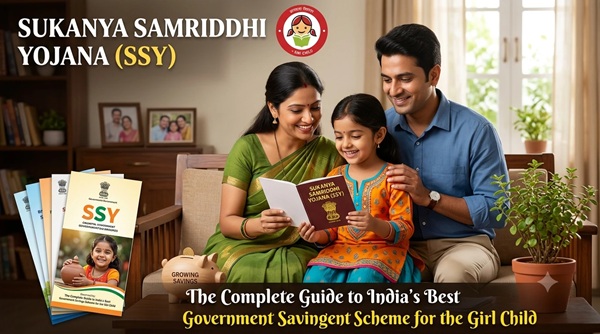
Sukanya Samriddhi Yojana: The Most Popular Savings Scheme for a Girl Child

Written by the Financechecks.com Editorial Team, Personal Finance Researchers Last updated: July 2026
I still remember the conversation with my cousin the day her daughter was born. Between the sleepless nights and the endless stream of relatives dropping by with gifts, she asked me one simple question. “Where do I put money aside for her, something safe, something that actually grows, something the government stands behind?” That question is what SSY was built to answer, and it is probably the same question that brought you here.
Sukanya Samriddhi Yojana, or SSY, has quietly become one of the most trusted names in Indian household finance. Ask any parent of a daughter under ten what they have done to secure her education or her wedding fund, and there is a good chance SSY comes up within the first minute. It is not flashy. It does not promise to double your money in five years. What it offers instead is something harder to find in today’s investment world: certainty, backed directly by the Government of India, with a return that has consistently beaten fixed deposits and the Public Provident Fund.
In this guide, we are going to walk through everything a first time parent, grandparent, or guardian needs to know before opening an account, along with the details that seasoned investors ask about once they are already in the scheme. No jargon dumps, no confusing tables you have to decode on your own. Just a clear, honest explanation of how SSY works and whether it deserves a place in your daughter’s financial plan.
What Exactly Is Sukanya Samriddhi Yojana
SSY is a small savings scheme launched in 2015 under the Beti Bachao Beti Padhao initiative. The idea behind it was straightforward. Give parents a dedicated, high interest, tax free avenue to build a corpus specifically for a girl child’s higher education and marriage expenses, and remove the excuse that “we could not afford to save for her.”
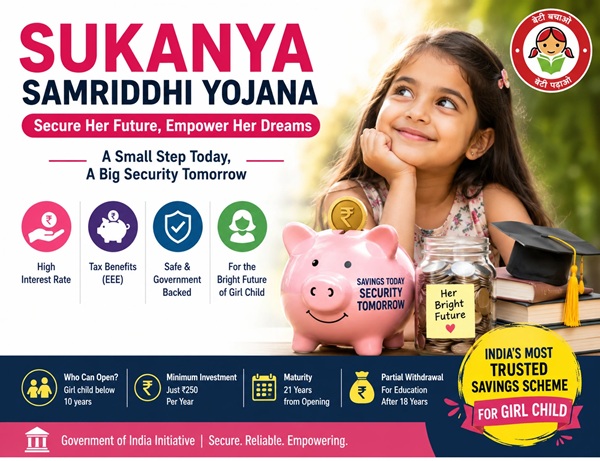
A parent or legal guardian opens the account in the name of a girl child who is below ten years of age. The account can be opened at any post office or at authorised banks such as SBI, HDFC, ICICI, and several others. Once opened, the account runs for twenty one years from the date of opening, though you are only required to make deposits for the first fifteen years. After that, the account continues to earn interest on the accumulated balance until it matures, even without fresh deposits.
Why Sukanya Samriddhi Yojana Scheme Keeps Coming Up in Every Parenting and Finance Conversation
If you have searched for “best investment for girl child,” “how to save for daughter’s education,” or “SSY vs PPF,” you already know how crowded this space is. Insurance companies, mutual fund houses, and banks all want a share of the money parents set aside for their daughters. SSY holds its own against all of them for a few concrete reasons.
The interest rate is genuinely competitive. For the July to September 2026 quarter, SSY is offering 8.2% per annum, compounded annually. Compare that with the Public Provident Fund, which sits around 7.1% percent, or with most bank fixed deposits, which rarely cross seven percent for retail depositors in the current environment. The government reviews and announces this rate every quarter, and it has stayed unchanged at 8.2% for eight consecutive quarters now, which tells you it has been the most stable and rewarding rate among small savings schemes for over two years running.
Then there is the tax treatment, which honestly is as good as it gets in India. SSY falls under what is called the EEE category, meaning exempt, exempt, exempt. Your annual deposit up to one and a half lakh rupees qualifies for a deduction under Section 80C. The interest that accumulates every year is completely tax free. And when the account matures and the money is paid out, that final amount is tax free too. There are very few instruments left in the country that give you this three way exemption.
And finally, there is the safety factor. This is not a market linked product. Your daughter’s future is not riding on how the stock market performs or how well a fund manager picks stocks. It is a sovereign guarantee, backed by the same government that backs your currency notes.
Who Can Open an Sukanya Samriddhi Yojana (SSY) Account, and What Are the Rules Around It
The eligibility conditions are simple, but they trip people up more often than you would expect.
The girl child must be below ten years of age at the time the account is opened. There is no minimum age, so you can walk into a post office or bank the week she is born and open the account immediately.
A family can open a maximum of two SSY accounts, one per girl child. There is an exception for twins or triplets born after the first girl child, in which case a third account is permitted with proper documentation, such as a birth certificate confirming multiple births.
Only a parent or a legal guardian can open and operate the account on behalf of the girl child, until she turns eighteen, at which point she can take over operation of the account herself.
The girl child must be a resident Indian at the time the account is opened. If her residency status changes later, for example if the family relocates abroad permanently, interest stops accruing from the date that change is confirmed, and the account typically needs to be closed.
Documents Required to Open the Sukanya Samriddhi Yojana Account
Most parents are surprised at how light the paperwork actually is. You will need the girl child’s birth certificate, identity and address proof of the parent or guardian such as Aadhaar or PAN, a recent passport size photograph of the child, and the SSY account opening form, which is available at any post office or participating bank branch. Aadhaar and PAN details are now mandatory as per the current small savings scheme rules, so keep both handy before you go.
How Much You Need to Deposit in Sukanya Samriddhi Yojana and How the Rules Work
This is where SSY becomes genuinely accessible to almost every income bracket. The minimum deposit required to keep the account active is just two hundred fifty rupees a year. The maximum you can deposit in a single financial year is one and a half lakh rupees. You can make deposits in any amount and any number of times through the year, as long as you stay within these limits, whether that is a single lump sum in April or smaller monthly contributions of your choosing.
Deposits are required for the first fifteen years from the date of account opening. After that fifteen year window closes, you do not need to deposit anything further, but the money already sitting in the account continues to earn interest at the prevailing rate all the way until maturity.
One quirky but important detail about interest calculation: it is based on the lowest balance in the account between the fifth day and the last day of each calendar month. In simple terms, if you want your deposit for a particular month to earn interest for that entire month, make sure it reaches the account on or before the fifth. Deposit it on the tenth instead, and you lose out on interest for that month. It is a small detail, but over fifteen years of contributions, timing your deposits properly can add up to a noticeably larger corpus.
If you miss the minimum deposit of two hundred fifty rupees in any year, the account does not close. It simply becomes what is called a “default account,” and a penalty of fifty rupees per missed year is added, along with the minimum deposit itself, whenever you decide to regularise it. Importantly, the account keeps earning the full applicable interest rate even during the default period, so a missed year or two will not derail your daughter’s fund, it just needs a small top up later.
Read About CBSE Udaan Scheme For Girl Child
What Your Money Actually Grows Into
Numbers make this real in a way percentages alone cannot. Say you open the account for your daughter and commit to depositing five thousand rupees every month, which works out to sixty thousand rupees a year. If you keep this up consistently for the full fifteen year deposit window, your total contribution across those years comes to nine lakh rupees. At the current eight point two percent rate held constant for illustration, that account is projected to be worth somewhere around twenty six to twenty seven lakh rupees by the time it matures when your daughter is twenty one. That is roughly seventeen to eighteen lakh rupees of pure, tax free growth on top of what you put in, something almost no other guaranteed instrument in India offers at this level of safety.
Of course, this figure assumes the rate stays at eight point two percent for the entire tenure, which is not guaranteed since the government revises it every quarter based on government security yields. But even accounting for some fluctuation over twenty one years, SSY has historically stayed ahead of comparable safe options.
When and How You Can Withdraw the Money
Parents often assume this money is completely locked away until the daughter turns twenty one, but that is not entirely accurate.
Once your daughter turns eighteen, or has completed the tenth standard, whichever happens earlier, you are allowed a partial withdrawal of up to fifty percent of the balance that existed at the end of the previous financial year. This withdrawal is meant specifically for higher education expenses, things like admission fees, tuition costs, or hostel charges. You cannot use this partial withdrawal for anything else, including a wedding, and you will typically need to submit proof such as a confirmed admission offer from an educational institution.
Full closure of the account before the twenty one year maturity is permitted only in specific situations. Marriage of the account holder after she turns eighteen is one valid reason, though the account can only be closed within three months before or after the wedding date, not any time after. The death of the account holder is another. Extreme compassionate grounds, such as a life threatening medical condition of the girl child or the death of the guardian, where continuing the account would cause genuine hardship, can also justify early closure, subject to government approval.
Outside of these specific situations, the account genuinely runs its full course, either twenty one years from opening or until marriage after eighteen, whichever comes first.
Sukanya Samriddhi Yojana (SSY) Compared to Other Popular Options
A lot of parents ask us whether SSY is really better than putting the same money into a PPF account, a fixed deposit, or a child specific insurance plan, and honestly, the answer depends on what you are optimising for.
Against PPF, SSY currently wins on the interest rate, roughly a full percentage point higher, and it is purpose built for a daughter’s future, which gives many parents an emotional as well as financial reason to prefer it. PPF, on the other hand, is open to anyone regardless of gender and has a slightly shorter effective lock in for full maturity.
Against bank fixed deposits, SSY wins comfortably on both rate and tax treatment. Fixed deposit interest is fully taxable at your income slab, which for many parents in the twenty or thirty percent bracket eats a meaningful chunk of the return. SSY’s interest never gets taxed at all.
Against child insurance or ULIP style plans that promise to combine insurance and investment, SSY tends to win on pure transparency and cost. Insurance linked plans often carry charges you do not immediately see, and returns are frequently linked to market performance rather than being guaranteed. SSY has none of that complexity. What you see quoted is what you get.
That said, SSY is not designed to be your only investment for your daughter. Because deposits are capped at one and a half lakh rupees a year, families with larger surplus income often use SSY as the guaranteed, risk free foundation of their daughter’s fund, and supplement it with equity mutual funds or other growth oriented instruments for the portion of savings they can afford to take some risk with. If you are weighing how to split contributions between SSY and equity investing for a long term goal like this, our comparison piece on building a child’s education corpus on Financechecks.com goes deeper into how much of each to allocate based on your daughter’s current age.
Common Mistakes Parents Make With This Scheme
After looking at hundreds of these accounts and the questions parents ask us, a handful of mistakes come up again and again.
The most common one is depositing money after the fifth of the month and wondering why the maturity projection does not quite match what a calculator promised. As covered earlier, that timing genuinely matters for interest calculation.
The second is opening the account but then treating it inconsistently, skipping years here and there without realising the account has quietly gone into default status. It does not hurt the account long term, but it does mean a bit of extra paperwork and a small penalty later that could have been avoided.
The third, and possibly the most costly mistake, is delaying account opening. Every year you wait after your daughter’s birth is a year of compounding you do not get back. Opening the account when she is one year old instead of the day she is born may not sound like a big difference, but stretched across twenty one years of compounding, it genuinely changes the final corpus.
The fourth is not linking Aadhaar and PAN promptly, which under current small savings rules can cause processing delays or, in some cases, a temporary freeze on operations until the documentation is completed.
Step by Step: How to Actually Open the Sukanya Samriddhi Yojana Account
Walk into your nearest post office, or if you would prefer a bank, any branch of SBI, HDFC Bank, ICICI Bank, Axis Bank, Punjab National Bank, or most other major nationalised and private banks that participate in the scheme. Carry your daughter’s birth certificate, your own identity and address proof, a passport size photograph of your daughter, and your Aadhaar and PAN details.
Fill out the SSY account opening form, which is usually a single page. Make your first deposit right there, anywhere between two hundred fifty rupees and one and a half lakh rupees, whatever fits your budget for the year. The bank or post office will issue you a passbook, which is your primary record of every deposit and the interest credited each year.
If your bank offers net banking access for SSY, such as HDFC, Axis, or India Post Payments Bank, you can typically set up subsequent deposits online without repeat branch visits. Other banks and most post offices still require you to walk in for each deposit, so factor that into which institution you choose if convenience matters to you.
A Note on Trust and Transparency
We want to be upfront about something. This article exists to genuinely help you understand SSY, not to sell you anything. Financechecks.com does not manage SSY accounts, we are not a bank, and we do not earn a commission if you open one. The figures used here, the eight point two percent rate for the July to September 2026 quarter, the historical rate trend, and the scheme rules, are drawn from Ministry of Finance notifications and official India Post documentation, cross checked against multiple sources at the time of writing. Because the government revises this rate every quarter, we recommend confirming the current rate on the India Post or your bank’s official page before making a large deposit decision, especially if you are reading this several months after publication.
Frequently Asked Questions About Sukanya Samriddhi Yojana
What is the current Sukanya Samriddhi Yojana interest rate in 2026?
The rate is eight point two percent per annum, compounded annually, for the April to September 2026 period. This has remained unchanged for eight consecutive quarters, making it one of the most stable rates among government savings schemes right now.
Can I open an SSY account for my daughter if she is already nine years old?
Yes, as long as she has not yet turned ten at the time you open the account, she is eligible. There is no minimum age, so this applies from birth right up to just before her tenth birthday.
How many SSY accounts can one family open?
A maximum of two, one for each girl child. A third account is permitted only in the case of twins or triplets where the second birth resulted in more than one girl child.
Is the maturity amount from SSY really tax free?
Yes. SSY falls under the exempt, exempt, exempt tax category. Your deposits qualify for deduction under Section 80C up to one and a half lakh rupees a year, the interest earned every year is tax free, and the final maturity payout is also completely tax free.
What happens if I cannot deposit money in a particular year?
The account does not close. It becomes a default account, and you will need to pay a penalty of fifty rupees for each missed year, along with the minimum deposit of two hundred fifty rupees, to bring it current. Interest continues to accrue at the full rate even during the default period.
Can my daughter withdraw money before the account fully matures?
Partially, yes. Once she turns eighteen or completes tenth standard, whichever is earlier, up to fifty percent of the previous year’s closing balance can be withdrawn specifically for higher education expenses. Full withdrawal before maturity is otherwise restricted to marriage after eighteen, death of the account holder, or approved compassionate grounds.
Is SSY better than PPF for a girl child?
For a daughter’s dedicated fund, SSY generally offers a higher interest rate than PPF currently, along with a purpose built structure. PPF remains a solid, gender neutral option if you want more flexibility around who the account is for or want a slightly different lock in structure. Many families use SSY as their daughter specific vehicle and PPF for broader family retirement savings.
Where can I open an SSY account?
Any post office across India, or at authorised banks including SBI, HDFC Bank, ICICI Bank, Axis Bank, Punjab National Bank, and most other major banks. Online account opening is available at select banks for existing customers, while others require an in-person visit for the initial account opening.
Does the interest rate change every year for existing accounts?
Yes, the government reviews and can revise the rate every quarter, and whatever rate is in effect applies to the balance in your account for that period, not the rate at the time you originally opened it. Your existing balance is not locked into the rate you started with.
What documents do I need to open the account?
The girl child’s birth certificate, identity and address proof of the parent or guardian such as Aadhaar and PAN, and a recent passport size photograph of the child, along with the completed account opening form.
Disclaimer
This article is intended for general informational and educational purposes only and does not constitute financial, tax, or legal advice. While every effort has been made to ensure the interest rate, eligibility conditions, and scheme rules described above are accurate as of the date of publication, government schemes such as Sukanya Samriddhi Yojana are subject to periodic revision by the Ministry of Finance and India Post, and rules or rates may have changed since this article was last updated. Readers are strongly encouraged to verify current details directly with an authorised bank, post office, or the official India Post website before making any financial decisions. Financechecks.com is not affiliated with the Government of India, India Post, or any bank offering this scheme, and does not earn any commission or compensation related to SSY account openings. Please consult a qualified financial advisor for guidance specific to your personal financial situation.

Shuchi founded Finance Checks after spending 16+ years working in corporate, managing operations and distribution. She managed her own finances, learned and read regularly and helped people make sense of their savings, loans, insurance, and investments.
She started this site to offer the kind of clear, honest financial guidance she wished was more available when she was learning to manage her own money. Every article is researched personally, checked against official sources such as the Reserve Bank of India, SEBI, or the Income Tax Department, and revisited whenever regulations or figures change. She is upfront about how the site earns money through ads and select affiliate partnerships, and she does not let either influence what she actually recommends to readers.



-
-
-
-
-
Show Comments[…] there is one scheme almost every parent has heard of, it is Sukanya Samriddhi Yojana, widely known by its acronym SSY. It is a small savings scheme run through post offices and […]
[…] Sukanya Samriddhi Yojana is the scheme most middle class parents reach for today, Balika Samriddhi Yojana was the one that […]
[…] was born in March, and by June, his mother-in-law had already asked whether he’d opened a Sukanya Samriddhi account. What she hadn’t asked, because most people don’t think to, was whether […]
[…] for families with a girl child under 10, Sukanya Samriddhi Yojana (SSY) offers one of the highest guaranteed, government-backed interest rates among small savings schemes, […]
[…] answer: PPF and Sukanya Samriddhi Yojana are the most tax-efficient post office schemes, both carrying EEE status, meaning your […]