

Hidden Bank Charges: The Fees Your Bank Rarely Explains Upfront

A few weeks ago, I was going through my bank statement out of pure habit, the kind of scroll you do without really expecting to find anything. And there it was. A small debit labeled with a code I did not recognize, repeated month after month, for an amount that individually looked harmless but added up to a few thousand rupees over the year. When I called customer care, I was told it was an SMS alert charge I had technically agreed to somewhere in the account opening paperwork I signed years ago and never read line by line.
I am willing to bet almost everyone reading this has a similar story, or is about to discover one the moment they actually sit down and read their statement closely. Banks are not doing anything illegal when they charge these fees, most of them are disclosed somewhere in the terms and conditions or the official fee schedule on the bank’s website. But disclosed in a forty page document is very different from disclosed in a way an average customer will actually notice before it starts eating into their balance every single month. This post is about pulling all of those hidden bank charges into one place so you know exactly what to look for on your own statement.
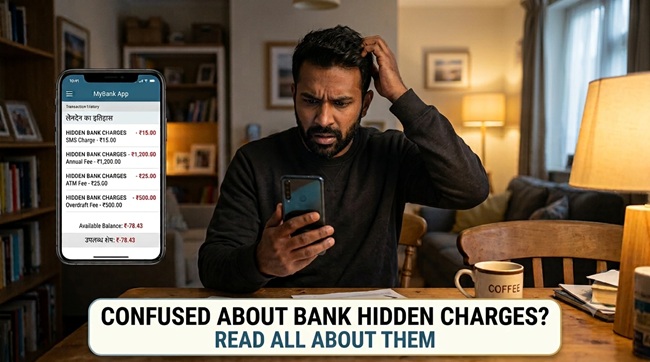
Why These Hidden Bank Charges Feel Hidden Even Though They Are Technically Disclosed
Banks are required by regulation to publish their fee schedules, and most do exactly that, usually in a document buried a few clicks deep on their website. The problem is not that the information does not exist, it is that almost nobody reads a fee schedule before opening an account, and banks have very little incentive to proactively remind you once the account is open and the charges are quietly running in the background.
There is also the issue of these charges being small individually. A rupee amount that looks trivial on its own rarely triggers a second look, which is exactly why so many of them survive unnoticed for years. It is only when you add them all up across twelve months that the real number becomes uncomfortable.
The Most Common Hidden Bank Charges to Look For on Your Statement
Minimum balance non maintenance charges
This is probably the single most common charge people are surprised by. Most savings accounts require you to maintain a minimum monthly or quarterly balance, and falling short of that number even for a few days can trigger a penalty. What catches people off guard is that this charge is not a one time thing, it repeats every single period you fall short, which means a temporarily low balance during a tight month can quietly cost you multiple times over.
SMS and email alert charges
Many banks charge a small recurring fee for transaction alerts sent via SMS, something most customers assume is a free security feature rather than a paid service. This is usually a small quarterly amount, but since it renews automatically and rarely shows up as a distinct, easy to spot line item, it tends to go unnoticed for years.
Debit card annual maintenance fees
Your debit card is not free to maintain, even though it often feels that way since you never actively pay for it at a counter. Most banks charge an annual fee for issuing and maintaining a debit card, and this is deducted automatically from your account, usually once a year, which makes it easy to miss since it does not appear on your radar as a monthly pattern.
ATM usage charges beyond the free limit
Banks typically allow a limited number of free ATM transactions per month, both at their own ATMs and at other banks’ ATMs, and the free limit is often lower than people assume, especially for other bank ATMs. Every transaction beyond that free limit, whether it is a withdrawal or even a balance inquiry, can attract a charge that quietly adds up if you are someone who uses ATMs frequently.
Cheque book charges beyond the free limit
Most accounts come with a certain number of free cheque leaves per year, after which every additional cheque book requested carries a charge. In an age where fewer people use cheques regularly, this fee often surprises those who request a cheque book without realizing they have already used up their free quota for the year.
Physical statement and duplicate document charges
Requesting a printed statement, a duplicate passbook, or an old transaction history often comes with a fee, especially if the request goes beyond a certain number of free requests per year. Many customers assume basic account documentation is free indefinitely, which is not always the case.
Dormant or inactive account charges
If an account has no customer initiated transaction for a certain period, usually around a year, it can be marked as dormant or inoperative, and some banks levy a fee or apply reduced services on such accounts. People who maintain a secondary account they rarely touch are the most likely to get caught out by this one.
Fund transfer charges outside free limits
While many digital transfers like UPI are typically free, other modes such as NEFT, RTGS, or IMPS may carry charges beyond a certain number of free transactions per month, particularly when done through a bank branch rather than net banking or a mobile app. The channel you use to make the transfer can significantly change whether it is free or charged.
Foreign transaction and currency conversion markup
If you use your debit or credit card for an international transaction, or even for an online purchase from a foreign website, banks typically add a currency conversion markup on top of the exchange rate, which is rarely visible until you look closely at the transaction amount charged compared to the actual exchange rate on that day.
Account closure charges
Closing an account within a certain period of opening it, often within the first six to twelve months, can attract a closure charge in many banks. This is designed to discourage frequent account switching, but it catches people off guard who assume walking away from an account is always free.
You May Also Like To Read About:
- Tax Planning for Salaried Employees: A Complete Guide to Saving More of What You Earn (FY 2026-27)
- New HRA Rules 2026: Bengaluru, Pune, Hyderabad and Ahmedabad Finally Get the 50 Percent Exemption
- Your First Salary, Your First ITR: A No-Nonsense Guide to Income Tax, Sections, and Smart Tax-Saving in 2026
- UPI and Personal Loans Are Quietly Replacing Credit Cards in Indian Wallets
- How Your CIBIL Score Affects Loan Approval: A Complete Guide
- GST Exemption on Health and Term Insurance in India (2026): Did You Actually Get the Full 18% Discount?
A Quick Reference Table of Common Hidden Bank Charges
| Charge Type | How Often It Applies | Why People Miss It |
|---|---|---|
| Minimum balance penalty | Monthly or quarterly | Balance dips are often temporary and unnoticed |
| SMS alert fee | Quarterly or annually | Assumed to be a free security feature |
| Debit card annual fee | Once a year | Deducted automatically, easy to forget |
| ATM charges beyond free limit | Per transaction | Free limit is lower than most people assume |
| Cheque book charges | Per book beyond free quota | Rarely tracked since cheque use has declined |
| Duplicate statement or passbook fee | Per request beyond free quota | Assumed to be free indefinitely |
| Dormant account fee | Annually if inactive | Applies mostly to rarely used secondary accounts |
| NEFT or RTGS charges | Per transaction beyond free limit | Varies by channel used, easy to miss |
| Foreign transaction markup | Per international transaction | Buried inside the converted amount, not shown separately |
| Early account closure fee | Once, if closed early | Assumed all account closures are free |
How to Actually Check What You Are Being Charged
The most reliable way to find these charges is to pull your last twelve months of statements and go through every small recurring debit that is not a purchase or a transfer you personally recognize. Cross reference anything unclear against your bank’s official fee schedule, usually found under a section labeled service charges or schedule of charges on the bank’s website. If a charge still does not make sense after that, calling customer care and asking for a line by line explanation is completely reasonable and something banks are required to provide.
It is also worth doing this exercise once a year rather than once and forgetting about it, since banks periodically revise their fee schedules, and a charge that did not apply to you last year can quietly start applying this year without any dramatic announcement.
How to Reduce or Avoid These Hidden Bank Charges
Many of these charges can be minimized with a bit of awareness. Maintaining the required minimum balance consistently, opting for e-statements instead of physical ones, staying within free ATM and cheque book limits, and using digital transfer modes that are typically free can eliminate a large chunk of these fees entirely. Some banks also offer zero balance or fee-waived account variants for specific customer categories such as students, salaried employees with salary accounts, or senior citizens, which is worth checking if you consistently struggle to avoid these charges on a standard account.
A Personal Note on This One
What strikes me most about hidden bank charges is that none of them are dishonest in a legal sense, but almost all of them rely on customer inattention to keep collecting quietly in the background. I do not think the answer is to distrust your bank, most of these charges exist for legitimate operational reasons. But there is a real difference between a charge you knowingly accept and one that only gets your attention after you go looking for it. Spending twenty minutes with your last year of statements is one of the highest return activities you can do for your personal finances, and it costs nothing but a bit of your time.
Follow us on Instagram and Youtube to get the regular updates
Frequently Asked Questions About Hidden Bank Charges
Are hidden bank charges actually legal?
Yes, in almost all cases these charges are disclosed in the bank’s official fee schedule and terms and conditions, which makes them legal even though most customers are unaware of them in practice. They are hidden in the sense of being poorly communicated, not in the sense of being concealed illegally.
How can I find my bank’s complete fee schedule?
Most banks publish a document usually titled schedule of charges or service charges on their official website, often under a customer service or downloads section. You can also request a copy directly from your branch or customer care.
Can I get a wrongly charged fee reversed?
In many cases yes, especially if the charge was applied incorrectly or if you can demonstrate you were eligible for a waiver you were not given. Raising a formal complaint through the bank’s grievance redressal channel is the right first step.
Do all banks charge the same fees?
No. Fee structures vary significantly between banks and even between different account types within the same bank. Comparing fee schedules before opening an account is worth doing just as much as comparing interest rates.
Is there a way to have an account with no hidden charges at all?
Some banks offer zero balance accounts or fee-waived accounts for specific groups such as students, salary account holders, or senior citizens, which eliminate many of the most common charges. However, very few accounts are completely free of every possible fee, so it is worth reading the specific terms even for these accounts.
How often should I review my account for hidden charges?
At least once a year is a reasonable minimum, though reviewing your statement monthly as a habit will catch most unusual charges much sooner and make it easier to dispute anything incorrect before too much time has passed.
Disclaimer
This article is intended for general informational and educational purposes only and does not constitute financial or legal advice. Bank fees, charges, free transaction limits, and account terms vary significantly between banks, account types, and regions, and are subject to change at the bank’s discretion. The charges listed in this article are common examples and may not apply to every bank or every account. Please refer to your specific bank’s official fee schedule or contact their customer service directly for accurate and current information regarding charges applicable to your account. The author and publisher of this content are not liable for any financial decisions made based on the information provided in this article.

Shuchi founded Finance Checks after spending 16+ years working in corporate, managing operations and distribution. She managed her own finances, learned and read regularly and helped people make sense of their savings, loans, insurance, and investments.
She started this site to offer the kind of clear, honest financial guidance she wished was more available when she was learning to manage her own money. Every article is researched personally, checked against official sources such as the Reserve Bank of India, SEBI, or the Income Tax Department, and revisited whenever regulations or figures change. She is upfront about how the site earns money through ads and select affiliate partnerships, and she does not let either influence what she actually recommends to readers.