

Recurring Deposit vs SIP: Which Builds Wealth Faster for Beginners

A cousin of mine asked me something last year that I think a lot of people quietly wonder about but rarely ask out loud. She had just started her first job and wanted to begin saving a fixed amount every month. Her father had always sworn by recurring deposits, calling them the safest way to build discipline and savings. A colleague at her new office kept talking about starting a SIP instead, throwing around terms like equity exposure and compounding that honestly meant very little to her at the time. She wanted to know which one was actually going to build wealth faster.
This is one of those questions that does not have a single universal answer, but it does have a very clear framework once you understand what each option is actually doing with your money. A recurring deposit and a SIP are not just two flavors of the same thing, they work in fundamentally different ways, carry different levels of risk, and are suited to different goals. This post breaks down exactly how each one works, what kind of returns you can realistically expect, and how to figure out which one, or which combination, makes sense for where you are starting from.
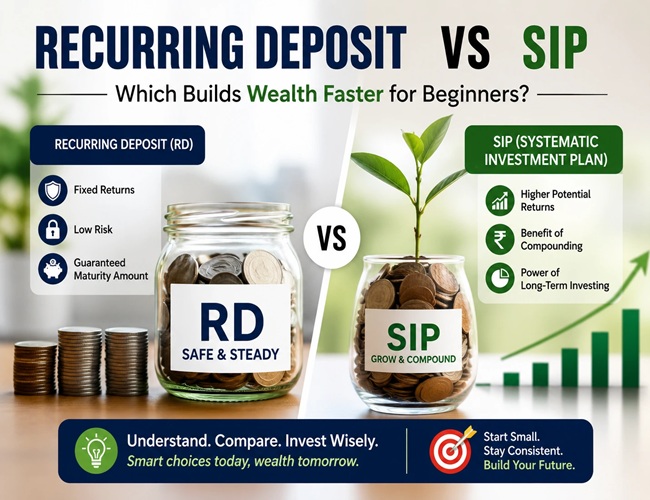
What a Recurring Deposit Actually Is
A recurring deposit, usually shortened to RD, is a fixed deposit style savings instrument offered by banks and post offices where you commit to depositing a fixed amount every month for a chosen tenure, typically ranging from six months to ten years. The bank pays you a fixed rate of interest on this, similar to a fixed deposit, and at the end of the tenure you receive your total deposited amount plus the interest earned, usually compounded quarterly.
The defining feature of an RD is predictability. You know exactly what interest rate you are getting at the time you open the account, and that rate does not change for the life of that particular RD regardless of what happens in financial markets. There is no risk of your principal amount losing value, and the returns, while modest, are guaranteed as long as the bank itself remains solvent, which is generally considered extremely low risk for well established banks.
What a SIP Actually Is
A SIP, or systematic investment plan, is not an investment product in itself, it is simply a method of investing a fixed amount regularly, usually monthly, into a mutual fund of your choice. The mutual fund could be an equity fund, a debt fund, a hybrid fund, or something more specialized, and the underlying investments of that fund determine your actual risk and return profile.
Unlike an RD, a SIP does not offer a guaranteed return. If you are investing in an equity mutual fund through a SIP, your money is essentially buying units of a fund that itself owns shares in various companies, and the value of those units moves up and down with the market. Over long periods, equity markets have historically delivered stronger returns than fixed income instruments like RDs, but this comes with the possibility of negative returns in any given year, sometimes for several years in a row during prolonged downturns.
The Core Difference: Guaranteed Returns vs Market Linked Growth
This is really the heart of the RD versus SIP decision. An RD is built around certainty. You know your rate, you know your maturity amount, and short of a bank failure, there is essentially no risk to your principal. A SIP into an equity fund is built around growth potential in exchange for accepting uncertainty. Your money could be worth meaningfully more than an equivalent RD over a long horizon, or it could be worth less than what you put in in the short term, depending entirely on market conditions at the time you need the money.
Neither of these is inherently the better choice. It depends entirely on your time horizon, your comfort with seeing your investment value fluctuate, and what the money is actually meant for.
Comparing RD and SIP Side by Side
| Factor | Recurring Deposit | SIP in Equity Mutual Fund |
|---|---|---|
| Return type | Fixed and guaranteed at account opening | Market linked, not guaranteed |
| Risk to principal | Very low, backed by the bank | Can fluctuate, including short term losses |
| Typical time horizon | Best for short to medium term, 6 months to 5 years | Best for long term, 5 years and beyond |
| Liquidity | Premature withdrawal usually allowed with a penalty | Can typically be redeemed anytime, subject to exit load in some funds |
| Taxation | Interest is fully taxable as per your income slab | Gains are taxed based on holding period and fund type, often more tax efficient long term |
| Best suited for | Emergency funds, short term goals, risk averse savers | Long term wealth building, goals more than 5 years away |
| Discipline required | Automatic once set up, low emotional involvement | Automatic setup, but requires discipline to not panic during market dips |
You May Also Like:
Why SIPs Tend to Build More Wealth Over Long Periods
The reason financial planners often lean toward recommending SIPs in equity funds for long term goals comes down to a concept most people have heard of but do not always fully internalize, which is the power of compounding combined with equity market growth. Historically, equity markets over long stretches of a decade or more have delivered higher average returns than fixed income instruments like RDs, even after accounting for the periods of decline in between. The important word here is historically, since past performance is never a guarantee of future results, and market linked investments always carry the risk of underperforming or losing value, especially over shorter time frames.
The other advantage of SIPs is rupee cost averaging. Because you are investing a fixed amount every month regardless of whether the market is up or down, you automatically buy more units when prices are low and fewer units when prices are high, which smooths out the impact of market volatility over time compared to investing a lump sum all at once.
Why RDs Still Make Sense for Certain Goals
None of this means SIPs are automatically the better choice for everyone. If you are saving for a goal that is only a year or two away, like a wedding, a short term travel plan, or building an emergency fund, the last thing you want is for that money to be sitting in something that could lose value right when you need it. This is exactly the scenario where an RD shines. You know precisely what you will have at the end of the term, and there is no risk of the market working against your timeline.
RDs are also a genuinely good starting point for people who are new to saving and want to build the habit of setting money aside every month without the added complexity or emotional weight of watching market movements. There is real value in starting simple, and an RD is about as simple and stress free as disciplined saving gets.
A Realistic Way to Think About Which One Fits You
Rather than treating this as an either or decision, it helps to map your money against your goals and timelines. Money you might need within the next one to three years, including your emergency fund, is generally better placed in something stable like an RD or a similar fixed income option, since market linked investments are not well suited for money you cannot afford to see temporarily drop in value.
Money you are setting aside for goals five years or more into the future, such as retirement, a child’s future education, or long term wealth building, is where SIPs into equity mutual funds tend to have the room to ride out short term volatility and benefit from long term growth potential. Many people end up doing both simultaneously, an RD or similar instrument for near term needs and safety, and a SIP for long term growth, rather than picking one exclusively over the other.
A Word on Risk Tolerance, Because It Matters More Than People Admit
Something that rarely gets discussed honestly in these comparisons is that the right answer also depends on how you personally react to seeing your investment value drop. Some people can watch a market decline of twenty percent and feel completely unbothered, confident it will recover over time. Others lose sleep over a much smaller dip and end up making panicked decisions, like withdrawing at the worst possible time. If you know yourself to be someone who gets anxious about market movements, this is worth factoring into how much of your savings you route into SIPs versus safer instruments like RDs, regardless of what the historical return numbers suggest is mathematically optimal.
Don’t miss the regular Finance Tips and Updates by following us on Instagram and Youtube
A Personal Note on This One
If I am being honest, the RD versus SIP question that my cousin asked me does not really have a winner in the way she was expecting. What I told her, and what I would tell anyone starting out, is to figure out what the money is actually for and when you will need it, before deciding where it should sit. The instrument should follow the goal, not the other way around. Starting small with either option and staying consistent will always matter more than picking the theoretically perfect choice and then abandoning it after a few months.
Frequently Asked Questions
Is a SIP always better than a recurring deposit?
Not always. SIPs in equity mutual funds have historically shown stronger long term growth potential, but they come with market risk and are not guaranteed. For short term goals or money you cannot afford to see temporarily drop in value, a recurring deposit is often the more suitable choice.
Can I lose money in a SIP?
Yes, if you are investing in a market linked fund such as an equity fund, the value of your investment can go down, especially in the short term. This is different from a recurring deposit, where your principal is not at risk under normal circumstances.
How is interest from a recurring deposit taxed?
Interest earned on a recurring deposit is added to your total income and taxed according to your applicable income tax slab, similar to how fixed deposit interest is treated.
How are SIP returns taxed?
Taxation on SIP returns depends on the type of fund and how long you hold your investment before redeeming it, with different rules typically applying to equity funds versus debt funds, and to short term versus long term holdings. Because tax rules can change, it is worth checking the current regulations or consulting a tax professional before making decisions based on tax treatment alone.
Can I withdraw money from an RD or SIP before the tenure ends?
Most recurring deposits allow premature withdrawal, though usually with a reduced interest rate or a penalty. SIP investments in mutual funds are generally more liquid and can typically be redeemed at any time, though some funds may apply an exit load if redeemed within a specified period.
Should a complete beginner start with an RD or a SIP?
There is no single right answer, since it depends on your goals, timeline, and comfort with risk. Many beginners choose to start with a recurring deposit to build the habit of saving consistently, then gradually introduce a SIP for longer term goals once they are more comfortable with the idea of market linked investing.
Disclaimer
This article is intended for general informational and educational purposes only and does not constitute financial or investment advice. Recurring deposit interest rates, mutual fund returns, and tax regulations vary over time and are subject to change, and past performance of any investment, including equity markets, is not indicative of future results. Investments in mutual funds, including through a SIP, are subject to market risk and may result in loss of principal. Before making any investment or savings decisions, please consult a qualified and registered financial advisor who can assess your individual financial situation, goals, and risk tolerance. The author and publisher of this content are not liable for any financial decisions made based on the information provided in this article.

Shuchi founded Finance Checks after spending 16+ years working in corporate, managing operations and distribution. She managed her own finances, learned and read regularly and helped people make sense of their savings, loans, insurance, and investments.
She started this site to offer the kind of clear, honest financial guidance she wished was more available when she was learning to manage her own money. Every article is researched personally, checked against official sources such as the Reserve Bank of India, SEBI, or the Income Tax Department, and revisited whenever regulations or figures change. She is upfront about how the site earns money through ads and select affiliate partnerships, and she does not let either influence what she actually recommends to readers.



[…] RD vs SIP […]
[…] RD vs SIP […]