

SIP vs PPF: Which One Actually Makes More Sense for You?

Last updated: July 2026
About This Guide: Written by the Financechecks.com Editorial Team, Personal Finance Researchers. This article has been researched using official PPF interest rate notifications, AMFI mutual fund data, and Income Tax Act provisions, and is reviewed for accuracy as rates and rules change.
My father had a PPF account since before I was born. Every year, without fail, he deposits the same amount in March, and every year, without fail, he tells me it’s the “safest thing you’ll ever own.” I, on the other hand, started a SIP the month I got my first job, mostly because a colleague told me it was what “smart young people do with their salary.” Neither of us has ever really explained our choice to the other beyond a shrug and “it just makes sense to me.”
That’s roughly how most people in India end up choosing between SIP and PPF — inherited instinct, not an actual comparison. And the frustrating part is that both instruments are genuinely good at what they do. The real question was never “which one is better,” it’s “which one is better for what you’re actually trying to achieve, and at what point in your life.”
Let’s actually compare them properly, so your choice is a decision, not a shrug.
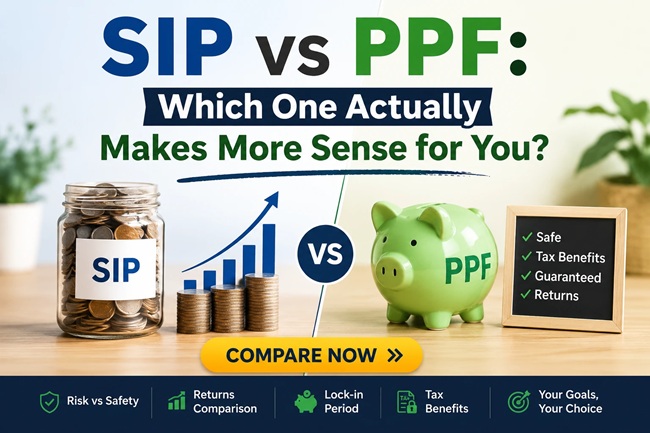
First, What Are We Even Comparing?
SIP (Systematic Investment Plan) isn’t an investment product itself — it’s a method of investing a fixed amount regularly, usually monthly, into a mutual fund. If you’ve read our earlier posts on what a mutual fund is and how mutual funds work, you already know the basics: your money is pooled with other investors and professionally managed according to the fund’s strategy, whether that’s equity, debt, or a mix of both.
PPF (Public Provident Fund) is a specific, single government-backed savings scheme. You open one account, deposit into it (anywhere from ₹500 to ₹1.5 lakh a year), and the government pays you a fixed interest rate on your balance, declared quarterly.
The comparison that actually matters here is almost always PPF vs an equity mutual fund SIP, since that’s where the real difference in risk and return philosophy shows up — a debt fund SIP would behave much more like PPF in terms of risk, just without the guarantee.
The Core Philosophical Difference
PPF is built on certainty. You know, right now, exactly what interest rate you’re earning, and the government guarantees your principal. There’s no version of events where your PPF balance goes down.
An equity SIP is built on growth potential through market participation. Your money is invested in real businesses through the stock market, and its value moves with those businesses’ performance and overall market sentiment — which means it can grow significantly faster than PPF over the long run, but it can also lose value in the short-to-medium term.
Neither of these is “better” in the abstract. They’re built for different jobs.
Side-by-Side Comparison between SIP vs PPF
| PPF | Equity SIP | |
|---|---|---|
| Returns | Fixed, government-declared — currently 7.1% p.a. (FY 2026-27) | Market-linked, historically averaging roughly 10-12% p.a. over long periods for diversified equity funds, though not guaranteed |
| Risk | Virtually none — sovereign-guaranteed principal | Market risk — value can fall, especially over shorter periods |
| Lock-in | 15 years (partial withdrawal allowed from year 7) | None, unless it’s an ELSS tax-saving fund (3-year lock-in) |
| Annual Investment Limit | ₹500 minimum, ₹1.5 lakh maximum | No upper limit |
| Tax Treatment | EEE — contribution, interest, and maturity all fully tax-exempt | Contribution not deductible (except ELSS under 80C); LTCG above ₹1.25 lakh/year taxed at 12.5% |
| Liquidity | Low — loans against balance available after year 3, partial withdrawal after year 7 | High — can typically redeem within a few working days, barring ELSS lock-in |
| Who Manages It | Government-administered, fixed formula | Professional fund manager, active investment decisions |
| Best Suited For | Capital protection, guaranteed long-term goals, conservative investors | Long-term wealth creation, investors comfortable with volatility |
Let’s Talk Real Numbers
Here’s where the difference becomes concrete rather than theoretical. Suppose you invest ₹10,000 a month for 15 years, matching PPF’s natural lock-in horizon.
At PPF’s current 7.1% (compounded annually), your corpus would grow to a healthy, entirely risk-free sum — a genuinely respectable outcome for a government-guaranteed instrument.
At a long-term equity SIP average closer to 12%, the same monthly amount over the same 15 years would compound to a meaningfully larger corpus — the gap between the two, even at a difference of under 5 percentage points annually, becomes substantial once compounded over 15 years, simply because compounding rewards a higher rate disproportionately over long horizons.
This is the number most “SIP vs PPF” comparisons lead with, and it’s real. But it’s also incomplete on its own, because it treats the two as pure return-maximisation tools, when they’re actually solving different problems.
Why PPF’s Certainty Is Worth More Than It Looks
That 12% equity SIP average is a long-term historical average, not a promise. In any given year, an equity fund can just as easily deliver a strongly negative return as a strongly positive one — markets don’t move in a straight line, and short-to-medium-term volatility is real, not theoretical. PPF’s 7.1% is guaranteed, every single year, regardless of what the stock market or the broader economy is doing.
This matters enormously depending on when you’ll need the money. If you’re investing for a goal 15-20 years away, short-term volatility barely matters, since you have time to ride out downturns. If you’re investing for a goal in the next 3-5 years, that same volatility becomes a real risk — you could need the money exactly when the market happens to be down.
The Tax Angle Most People Underweight
PPF’s EEE (Exempt-Exempt-Exempt) status is genuinely one of the most generous tax structures available in Indian personal finance. Your contribution (up to ₹1.5 lakh) is deductible under Section 80C, the interest earned every year is completely tax-free, and the maturity amount is also entirely tax-free. No other common instrument matches all three of these simultaneously with this level of safety.
A regular equity SIP doesn’t get the 80C deduction (unless it’s specifically an ELSS fund), and while long-term capital gains up to ₹1.25 lakh a year are exempt, anything above that is taxed at 12.5%. If you’re specifically SIP-ing into an ELSS fund, you do get the 80C deduction, but with a shorter 3-year lock-in instead of PPF’s 15 years, and market-linked, non-guaranteed returns.
For readers who’ve gone through our capital gains ITR guide, this is the same core principle at play again: your real, after-tax return is what actually matters, not just the headline growth rate.
Where Liquidity Genuinely Separates Them
This is the part people underestimate until they actually need money urgently. PPF locks your money in for 15 years, with only limited flexibility even within that window — a loan facility against your balance from the 3rd year, and partial withdrawals permitted only from the 7th year onward, capped at specific formulas tied to your balance. Premature closure is allowed only under narrow conditions like critical illness, higher education needs, or a change in residency status, and typically comes with an interest penalty.
An equity SIP, by contrast, offers genuine liquidity — outside of ELSS funds, you can redeem your units and have the money back in your bank account within a few working days, for any reason, at any time.
If there’s a real chance you’ll need access to this money before 15 years are up, PPF’s illiquidity isn’t a minor inconvenience — it’s a structural mismatch with your actual situation.
So, Which One Actually Makes More Sense?
Rather than picking a single winner, it helps to match each instrument to what it’s genuinely good at:
PPF makes more sense when:
- You want a portion of your portfolio that is completely protected from market risk, with a government guarantee
- You’re already comfortable using your Section 80C limit through PPF specifically, rather than other 80C instruments
- You have a long, stable time horizon (15+ years) and won’t need this specific money for anything sooner
- You’re a genuinely risk-averse investor who would panic-sell during a market downturn if that money were in equity instead
An equity SIP makes more sense when:
- Your goal is long-term wealth creation and you’re comfortable with your investment’s value fluctuating along the way
- You want liquidity — the ability to redeem your money without waiting out a multi-year lock-in
- You want your investment amount to scale beyond ₹1.5 lakh a year, which PPF’s ceiling doesn’t allow
- You’re investing for a goal genuinely more than 7-10 years away, giving equity volatility enough time to average out
Realistically, for most people, this isn’t actually an either-or decision. A combination — using PPF for the guaranteed, tax-efficient portion of your long-term savings, and running an equity SIP for the growth-oriented portion — is what most financial planners actually recommend, precisely because it captures both certainty and growth potential rather than betting everything on one philosophy.
Common Mistakes People Make in This Comparison
- Comparing PPF’s guaranteed 7.1% directly against SIP’s best-case historical returns, without accounting for the fact that SIP returns are neither guaranteed nor smooth year to year
- Locking money into PPF that they’ll actually need before 15 years are up, only to discover how limited early access really is
- Assuming SIP always outperforms PPF over any time horizon. Over shorter periods, particularly if equity markets go through a prolonged weak stretch, PPF’s steady, guaranteed rate can genuinely outperform a volatile SIP
- Treating this as a strict either-or choice, when using both for their respective strengths is often the more sensible approach
- Forgetting to actually use the Section 80C deduction PPF offers, if 80C room hasn’t already been used elsewhere
Frequently Asked Questions
1. Which gives better returns, SIP or PPF? Over long periods, equity SIPs have historically delivered higher average returns (around 10-12% annually) compared to PPF’s guaranteed 7.1%. However, SIP returns are market-linked and not guaranteed, while PPF’s return is fixed and risk-free, so “better” depends on how much risk you’re willing to accept for potentially higher growth.
2. Is PPF completely risk-free? Yes, in terms of your principal and declared interest — PPF carries a sovereign guarantee, meaning the Government of India backs your deposits. The only real “risk” with PPF is opportunity cost, since your money is locked in and earning a fixed rate rather than potentially higher market-linked returns.
3. Can I invest in both SIP and PPF? Yes, and many financial planners specifically recommend this. Using PPF for the safe, tax-efficient, guaranteed portion of your savings while running an equity SIP for long-term growth gives you a balance of stability and higher return potential.
4. What is the current PPF interest rate? For the July-September 2026 quarter (Q2, FY 2026-27), the PPF interest rate stands at 7.1% per annum, compounded annually. This rate is reviewed and can be revised by the government every quarter.
5. What is the maximum I can invest in PPF each year? ₹1.5 lakh per financial year is the maximum, with a minimum of ₹500 required to keep the account active. There’s no upper limit on how much you can invest through an equity SIP.
6. Does SIP offer any tax benefit like PPF? A regular equity SIP doesn’t offer a tax deduction on the amount invested, unless it’s specifically an ELSS (tax-saving) mutual fund, which qualifies under Section 80C with a 3-year lock-in. PPF, by contrast, offers a full EEE tax benefit — deduction on contribution, tax-free interest, and tax-free maturity.
7. How long is the PPF lock-in period? 15 years from account opening. Partial withdrawals are permitted from the 7th year onward under specific rules, and a loan against your balance is available from the 3rd year, but full, unrestricted access to your funds only comes at the 15-year maturity.
8. Is SIP a safer option than PPF for a beginner? Not necessarily — PPF is actually the safer option in terms of guaranteed capital protection, since it carries no market risk. SIP, particularly in equity funds, carries market risk and can see its value decline in the short term, which beginners should understand clearly before starting.
9. Which is better for retirement planning, SIP or PPF? Both can play a role. PPF offers a guaranteed, tax-free portion of a retirement corpus with zero market risk, while an equity SIP can meaningfully grow a larger retirement corpus over a long horizon (20-30+ years), given enough time for market volatility to average out. Many long-term retirement plans use both together.
10. What happens if I miss a year’s PPF deposit? Your PPF account becomes inactive if you fail to deposit the minimum ₹500 in any financial year. It can be reactivated by paying the minimum deposit for each missed year, along with a small penalty, but it’s worth setting up a reminder or auto-debit to avoid this altogether.
Final Thoughts
The SIP versus PPF debate isn’t really a rivalry — it’s two different tools solving two different problems, and the “right” answer depends entirely on what you’re building toward and how much uncertainty you’re willing to sit with along the way. PPF hands you certainty and a genuinely unmatched tax structure, in exchange for patience and limited access. An equity SIP hands you growth potential and full liquidity, in exchange for accepting that the road there won’t be smooth.
If you’re starting from zero and unsure where to begin, there’s a reasonable, low-drama answer: use PPF for the portion of your savings you genuinely cannot afford to see shrink, and use a SIP for the portion you’re building for growth over a decade or more. You don’t have to pick a side — you just have to know which job each one is doing for you.
Disclaimer: This article is for general informational and educational purposes only and should not be treated as investment advice. Interest rates, return figures, and tax provisions mentioned above are illustrative and based on publicly available data current as of the stated dates; PPF rates are revised quarterly by the government, and mutual fund returns are market-linked and not guaranteed. Mutual fund investments are subject to market risk. Please read all scheme-related documents carefully and consult a qualified financial advisor before making investment decisions.

Shuchi founded Finance Checks after spending 16+ years working in corporate, managing operations and distribution. She managed her own finances, learned and read regularly and helped people make sense of their savings, loans, insurance, and investments.
She started this site to offer the kind of clear, honest financial guidance she wished was more available when she was learning to manage her own money. Every article is researched personally, checked against official sources such as the Reserve Bank of India, SEBI, or the Income Tax Department, and revisited whenever regulations or figures change. She is upfront about how the site earns money through ads and select affiliate partnerships, and she does not let either influence what she actually recommends to readers.