

Types of Mutual Funds in India (Equity, Debt, Hybrid & More Explained)

If you’ve read our earlier posts on what mutual funds are and how mutual funds actually work, you already know the basics — your money gets pooled with thousands of other investors and handed to a professional fund manager who invests it on your behalf. Simple enough.
But here’s where most beginners get stuck. You open any investment app, search “mutual funds,” and you’re staring at a wall of names — large cap, small cap, liquid fund, hybrid fund, ELSS, index fund — and none of it means anything yet. It feels less like investing and more like decoding a menu written in a language you don’t speak.
I remember hitting this exact wall myself. I picked my first mutual fund based on a “5-star rating” I saw on an app, with zero clue whether it was even the right category for what I was trying to do. It worked out fine, mostly by luck, but I’ve since learned that picking a fund without understanding its type is like buying a car without knowing if it’s a hatchback, an SUV, or a truck — they’re all “vehicles,” but they serve completely different purposes.
So let’s fix that today. This post breaks down every major type of mutual fund available in India, what each one is actually built for, and — more importantly — how to figure out which category fits your own goals. No jargon dump, just a practical map.
How Mutual Funds Are Actually Classified
Before we get into individual types, it helps to know that SEBI (the Securities and Exchange Board of India) has laid down a standard classification system that every fund house has to follow. This is actually great news for you as an investor, because it means a “large cap fund” from one AMC follows the same basic rules as a “large cap fund” from another. You’re comparing apples to apples, not marketing labels.
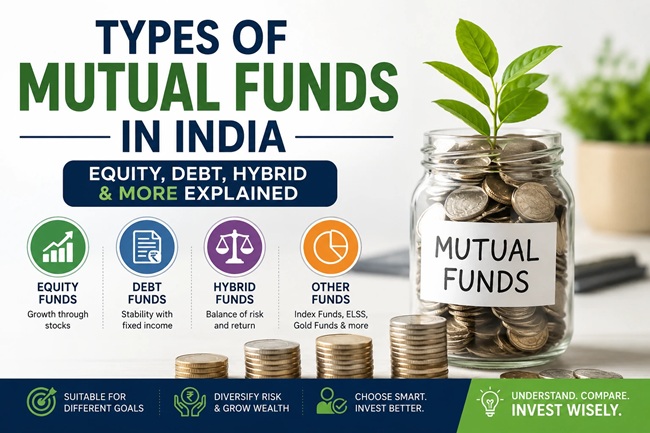
Broadly, mutual funds in India are grouped based on what they invest in. That gives us four big buckets: equity funds, debt funds, hybrid funds, and a smaller group of solution-oriented and other funds. Let’s go through each one.
Equity Mutual Funds — For Long-Term Wealth Building
Equity funds put your money into stocks. That’s it, that’s the core idea. Because stock prices move up and down with company performance and market sentiment, these funds carry more risk in the short term — but historically, they’ve also delivered the highest returns over long stretches of time, which is why they’re the go-to choice for goals that are five, ten, or twenty years away.
Within equity funds, you’ll find several sub-categories based on the size of the companies they invest in:
- Large cap funds invest in India’s biggest, most established companies — think the top 100 by market value. These are relatively steadier, since large companies tend to weather market storms better than smaller ones.
- Mid cap funds invest in companies ranked roughly 101st to 250th by size. These are businesses that have already proven themselves but still have real room to grow, which means higher potential returns paired with higher volatility.
- Small cap funds go even further down the size ladder. This is where you’ll find tomorrow’s big companies — and also where you’ll feel the sharpest swings in your portfolio value. Small cap funds suit investors with a long time horizon and a stomach for volatility.
- Multi cap and flexi cap funds don’t restrict themselves to one size category. A fund manager here can shift between large, mid, and small cap stocks depending on where they see opportunity, giving you built-in diversification across company sizes.
- Sectoral and thematic funds bet on a specific slice of the economy — banking, IT, pharma, infrastructure, and so on. These can deliver outsized gains when their sector is in favor, but they lack diversification, so a downturn in that one sector hits your entire investment.
- ELSS (Equity Linked Savings Scheme) deserves a special mention because it does double duty — it invests like an equity fund but also qualifies for a tax deduction under Section 80C, up to ₹1.5 lakh a year. The catch is a mandatory three-year lock-in, the shortest lock-in among all 80C tax-saving options.
Debt Mutual Funds — For Stability and Predictable Returns
If equity funds are about growth, debt funds are about steadiness. Instead of buying company shares, debt funds lend money — to the government, to companies, or to banks — through instruments like bonds, treasury bills, and commercial paper. In return, they earn interest, which is passed on to you.
Debt funds are generally far less volatile than equity funds, which makes them useful for short-term goals, emergency funds, or simply balancing out the riskier parts of your portfolio. Common types include:
- Liquid funds, which invest in very short-term instruments maturing within days or weeks. These are often used as a parking spot for money you might need on short notice, offering better returns than a regular savings account with similar accessibility.
- Short duration and low duration funds, which hold instruments maturing in a few months to a couple of years, suited for goals roughly one to three years out.
- Corporate bond funds, which primarily lend to companies with strong credit ratings, aiming for a reasonable balance between safety and return.
- Gilt funds, which invest only in government securities. Since the government is considered the safest borrower, these funds carry essentially no default risk — though their prices still move with interest rate changes.
One thing worth understanding early: debt funds aren’t risk-free just because they’re “less risky” than equity. They carry interest rate risk (bond prices fall when rates rise) and credit risk (the borrower might delay or default on payments). Choosing a debt fund still means checking what it actually holds, not just assuming “debt equals safe.”
Hybrid Mutual Funds — A Bit of Both Worlds
Hybrid funds mix equity and debt in a single portfolio, aiming to give you growth potential along with some cushioning against sharp downturns. They’re a popular starting point for investors who want equity-like returns without full equity-like anxiety.
- Aggressive hybrid funds lean more toward equity, typically keeping 65 to 80 percent in stocks and the rest in debt.
- Conservative hybrid funds flip that ratio, keeping the bulk of the portfolio in debt with a smaller equity allocation for some upside.
- Balanced advantage funds, also called dynamic asset allocation funds, actively shift the equity-debt mix based on market valuations — buying more equity when markets look cheap and pulling back when they look expensive.
- Multi-asset allocation funds go a step further, adding a third asset class like gold into the mix, spreading your risk across even more fronts.
Solution-Oriented and Other Fund Types
Beyond equity, debt, and hybrid, there are a few categories built around specific goals or structures rather than pure asset allocation.
- Retirement funds and children’s education funds are solution-oriented schemes with a mandatory lock-in, designed to keep you from withdrawing early and derailing a long-term goal.
- Index funds don’t try to beat the market — they simply mirror a market index like the Nifty 50 or Sensex by holding the same stocks in the same proportion. Because there’s no active stock-picking involved, their costs are typically much lower than actively managed funds.
- Fund of Funds (FoFs) invest in other mutual funds rather than directly in stocks or bonds, often used to access international markets or gold through a single, simple structure.
- International funds give you exposure to companies listed outside India — a way to diversify beyond the Indian market and participate in global growth stories.
A Quick Comparison to Help You Place Each Type
| Fund Type | Primary Investment | Risk Level | Typical Time Horizon |
|---|---|---|---|
| Large Cap Equity | Top 100 companies | Moderately High | 5+ years |
| Mid/Small Cap Equity | Growing/emerging companies | High | 7+ years |
| ELSS | Diversified equity + tax benefit | Moderately High | 3 years (lock-in) |
| Liquid Fund | Very short-term debt | Low | Days to a few months |
| Corporate Bond Fund | Company debt instruments | Low to Moderate | 1-3 years |
| Gilt Fund | Government securities | Low (no default risk) | 3+ years |
| Aggressive Hybrid | Equity-heavy mix | Moderately High | 5+ years |
| Conservative Hybrid | Debt-heavy mix | Low to Moderate | 2-4 years |
| Index Fund | Market index stocks | Moderately High | 5+ years |
So Which Type Should You Actually Choose?
Here’s the honest answer: there’s no universal “best” mutual fund type. There’s only the type that fits your goal, your timeline, and how you personally react to your investment value dropping ten percent in a bad month.
If you’re investing for something far off, like retirement or a child’s future two decades away, equity funds — particularly diversified ones like flexi cap or index funds — have historically rewarded patience the most. If you’re saving for a goal that’s two to three years away, like a wedding or a car, debt or conservative hybrid funds protect you from the risk of equity markets dipping right when you need the money. And if you just want a single fund that handles the equity-debt balancing act for you, an aggressive hybrid or balanced advantage fund does that job without you having to manage multiple schemes.
Most seasoned investors don’t stick to one fund type anyway — they build a mix, matching each fund to a specific goal rather than chasing whatever had the best return last year.
Frequently Asked Questions
Which type of mutual fund gives the highest return? Historically, small cap and mid cap equity funds have delivered the highest long-term returns in India, but they also come with the sharpest short-term swings. Higher return potential and higher risk tend to move together, so “highest return” shouldn’t be the only factor you weigh.
Are debt funds completely safe? No. Debt funds are lower-risk compared to equity funds, but they’re not risk-free. They’re exposed to interest rate movements and the credit quality of whoever they’re lending to. A gilt fund investing only in government securities is safer than a fund holding lower-rated corporate bonds.
What’s the difference between a hybrid fund and investing in equity and debt funds separately? A hybrid fund handles the equity-debt allocation and rebalancing automatically within one scheme. Investing separately gives you more control over the exact split, but you’ll need to manage and rebalance it yourself over time.
Can I lose money in an index fund? Yes. An index fund mirrors the market it tracks, so if that index falls, your investment falls with it. It removes fund-manager selection risk, not market risk.
Is ELSS better than other tax-saving options under Section 80C? ELSS has the shortest lock-in period among 80C options at three years, compared to five years or more for options like tax-saving fixed deposits or PPF, and it comes with equity market growth potential. Whether it’s “better” depends on your risk appetite, since options like PPF offer guaranteed, fixed returns while ELSS returns are market-linked.
How many mutual funds should a beginner start with? There’s no fixed number, but most financial planners suggest starting simple — one or two funds that match your primary goal, rather than spreading thin across many overlapping schemes. You can always add more as your goals diversify.
Do I need a demat account to invest in mutual funds? No. Unlike stocks, mutual funds can be bought directly through an AMC’s website, a registered platform, or an app, without needing a demat account, though having one doesn’t hurt if you’re investing in both stocks and funds.
About This Guide
This guide is part of FinanceChecks’ ongoing series on mutual fund investing in India, written to help everyday investors understand fund categories in plain language before putting their money to work. It draws on publicly available SEBI classification norms and standard industry practice, and is updated periodically to reflect current regulations.
Disclaimer
The information in this article is for educational purposes only and should not be considered personalized financial or investment advice. Mutual fund investments are subject to market risks; please read all scheme-related documents carefully before investing. Past performance is not indicative of future results. Readers are encouraged to consult a SEBI-registered investment advisor or financial planner before making any investment decisions based on their individual financial situation and goals.

Shuchi founded Finance Checks after spending 16+ years working in corporate, managing operations and distribution. She managed her own finances, learned and read regularly and helped people make sense of their savings, loans, insurance, and investments.
She started this site to offer the kind of clear, honest financial guidance she wished was more available when she was learning to manage her own money. Every article is researched personally, checked against official sources such as the Reserve Bank of India, SEBI, or the Income Tax Department, and revisited whenever regulations or figures change. She is upfront about how the site earns money through ads and select affiliate partnerships, and she does not let either influence what she actually recommends to readers.



[…] Equity mutual funds pool money from investors and put it into a diversified basket of stocks, with returns that are entirely market-linked, meaning there’s no guarantee attached to them at all. Historically, well-managed equity funds and index funds in India have delivered returns in a wide range over long periods, often cited in the 10 to 15 percent range over 15 to 20 year stretches, though this varies significantly depending on the specific period, fund, and market cycle you’re looking at. […]
[…] STP and SWP are three related but distinct mutual fund facilities, each solving a different […]
[…] first reaction was suspicion. An equity fund for money she could not afford to lose? That sounded like exactly the kind of advice that ends […]