
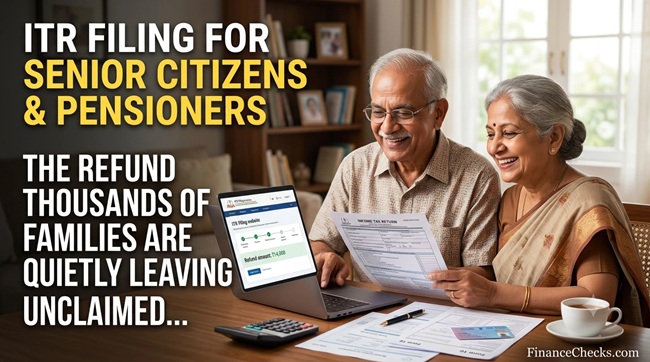
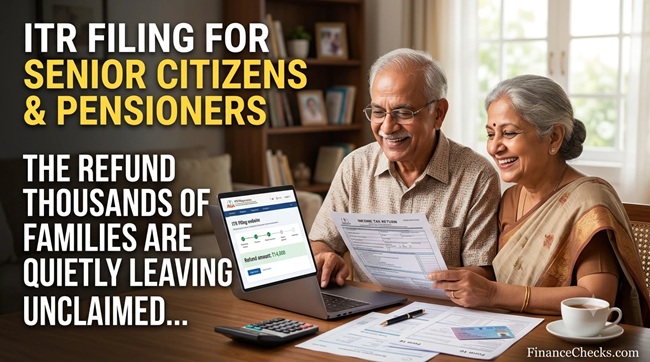
ITR Filing for Senior Citizens and Pensioners: The Refund Thousands of Families Are Quietly Leaving Unclaimed

Last updated: July 2026
About This Guide: Written by the Financechecks.com Editorial Team, Personal Finance Researchers. This article reflects income tax provisions applicable to senior citizens, pensioners, and family pensioners for FY 2025-26 (AY 2026-27) under the Income-tax Act, 1961, as amended by the Finance Act, 2025, and is reviewed for accuracy as new CBDT notifications are issued.
There’s a story that comes up more often than it should among tax professionals — a retired government employee, invalided out of service with a disability pension, who quietly paid tax on that pension for four years straight. His bank deducted TDS every year. He filed dutifully every year. Nobody ever told him that a disability pension carries a specific tax exemption under the law. He assumed that because the bank deducted it, it must have been correct. It wasn’t. He eventually recovered some of it, though not all — you can only revise a return so far into the past.
That story captures almost everything wrong with how ITR filing gets handled for senior citizens and pensioners in India. It isn’t usually about people trying to avoid tax. It’s about genuinely confusing, poorly explained rules — different treatment for a pension versus a family pension, an exemption at 75 that almost nobody uses correctly, deductions that quietly changed in recent budgets — leaving both retirees and the families of those who’ve passed away either overpaying tax they didn’t owe, or unknowingly stepping into compliance trouble they never intended.
This guide covers every part of it, in full detail: retirees drawing their own pension, family members receiving a deceased person’s pension, and what the government’s actual policy stance is toward each of these groups.
Who Counts as a “Senior Citizen” for Tax Purposes?
Before anything else, it’s worth getting the definitions exactly right, since almost every benefit in this guide depends on which category you fall into.
- Senior Citizen: A resident individual aged 60 years or above, but below 80, at any point during the financial year
- Super Senior Citizen: A resident individual aged 80 years or above, at any point during the financial year
Here’s a detail that catches people off guard: age is measured as of 31st March of the financial year, and the rule is generous at the edge. If someone turns 60 even on 1st April, they’re still treated as having completed the age for the preceding financial year for tax purposes. It’s worth checking this precisely rather than assuming, since it can shift which slab and deduction structure applies.
Do Senior Citizens Actually Need to File an ITR?
This is the single most searched question in this space, and the honest answer surprises most people: yes, in the vast majority of cases, filing is still required. There is exactly one genuine, complete exemption from filing, and it applies to a fairly narrow group. Everyone else — the overwhelming majority of senior citizens with pension, interest, rental, or investment income above the basic exemption limit — is expected to file, just like any other taxpayer.
The One Real Exemption: Section 194P
Under Section 194P of the Income-tax Act, a resident senior citizen can be completely exempt from filing an ITR, but only if every single one of these conditions is met:
- They are 75 years of age or above during the financial year
- They are a resident of India for that year
- Their only sources of income are pension and interest income, with no other income of any kind
- That interest must be earned specifically from the same bank where their pension is credited — not any other bank or account
- They submit a formal declaration, Form 12BBA, to that bank
- The bank must be a “specified bank” notified by the Central Government (generally scheduled banks) for this purpose
If all of these hold true, the bank itself computes the person’s total income, applies eligible deductions and the Section 87A rebate, and deducts the correct TDS accordingly — after which the individual is not required to file a return at all.
A retired couple is a good way to see this in practice. Say the husband, aged 78, draws his pension and keeps all his savings in that same bank, and has submitted Form 12BBA — he qualifies under 194P and doesn’t need to file. His wife, aged 76, also receives some rental income from a shop she owns — because that rental income exists, she falls outside 194P entirely and must file a normal return, regardless of her age.
One more important point: using this exemption is entirely optional, not automatic. If a senior citizen who qualifies under 194P still prefers to file a return — say, to maintain a clean filing history, or because they expect a refund — they’re free to do so.
Everyone Else: Higher Exemption Limits, Not a Filing Waiver
For senior citizens who don’t meet all the 194P conditions — which is most people, since even one rupee of income beyond pension and same-bank interest disqualifies you — the relief comes in the form of a higher basic exemption limit, not a waiver from filing itself.
| Category | Basic Exemption Limit (Old Regime) |
|---|---|
| Individuals below 60 | ₹2.5 lakh |
| Senior citizens (60-79) | ₹3 lakh |
| Super senior citizens (80+) | ₹5 lakh |
| All individuals (New Regime, via Section 87A rebate) | Effectively ₹12 lakh |
If your total income, before deductions, exceeds the applicable limit for your category and chosen regime, filing an ITR is mandatory — the higher exemption limit reduces or eliminates your tax liability, but it does not remove your obligation to file if you’re above that threshold.
Understanding Your Own Pension: How It’s Actually Taxed
If you’re a retiree receiving a pension from your own former employer, here’s what you need to know:
Regular pension retains the character of salary, even after retirement, because it arises from your original employer-employee relationship. This matters because it means you’re still entitled to the standard deduction — ₹50,000 under the old regime, or ₹75,000 under the new regime — deducted directly from your pension income before tax is calculated, exactly as if it were a salary.
Commuted pension (a lump sum received in place of part of your recurring pension) has its own exemption rules. For employees of Central Government, State Government, local authorities, and specified statutory corporations, commuted pension is generally fully tax-exempt. For other pensioners, a portion is exempt depending on whether they also received a gratuity.
Certain special categories of pension carry specific exemptions — disability pensions and gallantry-award pensions among them — but these exemptions apply only under the exact statutory conditions specified, not automatically just because the payer happens to be the government. This is precisely the gap that caught the retired Subedar in our opening story off guard.
Family Pension: A Genuinely Different Animal, Tax-Wise
This is the area where confusion runs deepest, and it’s exactly why this guide exists for spouses and legal heirs too, not just retirees themselves.
When a spouse or legal heir receives a pension after the death of an employee or pensioner, that income is not treated as salary at all — because there’s no employer-employee relationship between the recipient and the pension-paying authority. Instead, it’s taxed under “Income from Other Sources.”
This distinction has real, practical consequences:
- Family pensioners cannot claim the ₹50,000/₹75,000 standard deduction available to actual pensioners, since that deduction applies specifically to salary-character income
- Instead, family pensioners get a separate deduction under Section 57(iia): one-third of the family pension received, or a capped rupee amount, whichever is lower
- Under the old regime, that cap is ₹15,000
- Under the new regime, following a Budget 2024 enhancement effective from AY 2026-27, that cap was raised to ₹25,000 — a meaningful improvement specifically preserved for family pensioners even as the new regime restricted most other deductions
A common, costly mistake worth flagging explicitly: family pension should never be reported as “salary” income in the ITR. Doing so applies the wrong deduction category, can trigger a mismatch with the return schedule, and may result in an incorrect refund calculation or a notice later.
Additional Deductions Every Senior Citizen Should Know About
Beyond the exemption limits and standard deduction, several provisions specifically benefit senior citizens, and are worth actively claiming rather than assuming they apply automatically:
- Section 80TTB: Allows a deduction of up to ₹50,000 on interest earned from savings accounts, fixed deposits, and post office deposits — far more generous than the ₹10,000 savings-only limit available to younger taxpayers. This deduction is available only under the old regime
- Section 80D (Health Insurance): Senior citizens can claim a higher deduction, generally ₹50,000, for health insurance premiums paid for themselves, compared to the standard ₹25,000 limit for younger taxpayers. If you’re paying for your senior citizen parents’ health insurance, this higher limit applies to that too
- No Advance Tax Requirement: Senior citizens (60+) with no business or professional income are specifically exempt from paying advance tax in instalments through the year — they can simply pay self-assessment tax at the time of filing, without the interest penalties that apply to others who miss advance tax deadlines
- Form 15H: A declaration senior citizens can submit to banks and other deductors to prevent TDS deduction on interest income entirely, if their estimated total income for the year falls below the taxable limit. A Budget 2026 simplification now allows this to be submitted once to a depository, rather than separately to each individual company or institution
Why Filing Actually Matters — Even When It Feels Optional
This is worth sitting with, because a lot of senior citizens genuinely believe that if their bank has already deducted TDS, there’s nothing left to do. That assumption costs real money, in both directions.
You might be owed a refund. Banks deduct TDS based on standard assumptions, without knowledge of your full deduction eligibility — your 80TTB claim, your 80D premium, or an exemption on a specific category of pension. If your actual tax liability, after legitimate deductions, is lower than what was deducted at source, filing an ITR is the only way to get that difference back. This was precisely the case for the retired Subedar in our opening example — the bank had deducted tax correctly according to what it knew, but not according to what the law actually allowed once his disability pension exemption was properly applied.
You might owe more than you think. Interest income, rental income, or capital gains from selling shares, mutual funds, or property, even in retirement, all need to be reported and can push your total income above the exemption threshold, regardless of whether TDS was deducted on any single source.
A clean filing history matters for practical, non-tax reasons too. Visa applications, loan applications (including reverse mortgages or loans against property that some retirees pursue), and various government scheme applications often ask for recent ITR records as proof of income and financial standing — a gap in filing history can complicate these processes even years later.
What Actually Happens If a Senior Citizen or Family Pensioner Doesn’t File?
For those who are required to file but don’t, the consequences are the same as for any other taxpayer, layered on top of the practical downsides above:
- A late filing fee under Section 234F, if the return is eventually filed after the due date
- Interest on any unpaid tax under Sections 234A, 234B, or 234C, accruing from the original due date
- Loss of the ability to carry forward capital losses, if applicable, since this benefit requires filing by the due date
- A permanently forfeited refund, if TDS was over-deducted and the return window (including the revised and updated return windows) eventually closes without a claim being filed
- Possible scrutiny or notices, particularly where AIS-reported income (interest, dividends, capital gains, high-value transactions) doesn’t match what’s been declared, or where nothing has been declared at all despite clearly taxable income existing on record
None of these consequences are unique to senior citizens — but they land harder on this group specifically, since retirees are often more dependent on a fixed income and less able to absorb an unexpected interest or penalty charge than someone still earning a salary.
You May Also Like To Read:
- Filed a Wrong ITR? Here’s Exactly What Happens Next — and How to Fix It, Step by Step Guide
- Old Tax Regime vs New Tax Regime in 2026: The Calculator Question Everyone’s Still Getting Wrong
- Filing ITR After Selling Shares, Gold or Property? Here’s Exactly What to Check on Your Capital Gains
- NPS Explained: The Retirement Scheme That Could Save You ₹15,000 in Tax This Year
What Is the Government’s Actual Stand on Senior Citizens?
It’s worth stepping back and looking at the overall pattern, because it tells a fairly consistent story: the government has, over successive budgets, deliberately built in relief, not a blanket exemption, for senior citizens.
- A meaningfully higher basic exemption limit for those on the old regime, scaling further for super senior citizens
- Section 194P, specifically designed to spare the oldest and financially simplest pensioners (75+, pension and same-bank interest only) from the administrative burden of filing altogether
- Exemption from advance tax instalments for non-business senior citizens, recognising that fixed, predictable retirement income doesn’t need the same quarterly tax planning discipline as active business income
- A higher 80TTB interest deduction and higher 80D health insurance deduction, both specifically scaled for the realities of retirement — more reliance on interest income, higher medical costs
- The family pension deduction under Section 57(iia) was specifically enhanced (from ₹15,000 to ₹25,000 under the new regime) rather than removed when the new tax regime stripped away most other deductions — a clear signal that this particular relief was considered worth preserving deliberately, even as the broader regime moved toward a no-deduction structure
The overall policy direction is best summarised as: senior citizens are not expected to navigate the same level of tax complexity or cash-flow discipline as working-age taxpayers, and the deductions and exemptions reflect that — but the underlying principle of filing when income crosses the threshold has been preserved for the vast majority, with only a narrow, specifically-targeted carve-out for the oldest and simplest cases under Section 194P.
Which ITR Form Should You Actually Use?
- ITR-1: Suitable if your income consists only of pension (or salary), one house property, and other sources like interest — the most common form for the majority of pensioners and family pensioners
- ITR-2: Required if you have capital gains, income from more than one house property, foreign assets, or total income above ₹50 lakh
- Super senior citizens specifically retain the option to file ITR-1 or ITR-4 in offline/paper mode, in addition to the standard e-filing option — a genuinely useful accommodation for those less comfortable with the digital process
Step-by-Step: What to Actually Do Before Filing
- Gather your Pension Payment Order, bank pension statements, and Form 16 (if issued by the pension-paying bank or former employer)
- Check Form 26AS and your AIS on the income tax portal, to see every TDS deduction and reported income against your PAN, before you start filling anything in
- Separate pension from family pension clearly, if applicable, and report each under the correct income head — never combine or misclassify the two
- Claim every deduction you’re genuinely eligible for — 80TTB on interest, 80D on health insurance, the standard deduction on your own pension, or the Section 57(iia) deduction on family pension
- Check whether any specific exemption applies to your particular pension type, especially for disability or gallantry-award pensions, rather than assuming standard tax treatment
- File and verify your return before the due date, to preserve your ability to carry forward losses and avoid late fees and interest
- If a family member has passed away and you’re filing on their behalf for their final year, this requires filing as their legal representative through a specific registration process on the e-filing portal, using their PAN, along with proof of your status as legal heir
Frequently Asked Questions
1. Do senior citizens have to file an income tax return? Most do, if their total income exceeds the basic exemption limit applicable to their age category and chosen tax regime. The only complete exemption from filing is under Section 194P, available specifically to resident senior citizens aged 75 or above with only pension and same-bank interest income, who’ve submitted Form 12BBA to that bank.
2. Is pension income taxable in India? Yes. Regular pension received from a former employer retains the character of salary and is taxable accordingly, though eligible deductions like the standard deduction (₹50,000 old regime / ₹75,000 new regime) can be claimed against it.
3. Is family pension taxable after the death of a spouse? Yes. Family pension received by a spouse or legal heir after the pensioner’s death is taxable under “Income from Other Sources,” not as salary, since there’s no employer-employee relationship. A separate deduction under Section 57(iia) — one-third of the pension or ₹15,000 (old regime) / ₹25,000 (new regime), whichever is lower — can be claimed.
4. What happens if a senior citizen doesn’t file ITR despite being required to? The consequences are the same as for any taxpayer — a late filing fee under Section 234F, interest on any unpaid tax, potential loss of the ability to carry forward capital losses, and a forfeited refund if excess TDS was deducted and the filing window eventually closes without a claim.
5. Who exactly is exempt from filing ITR under Section 194P? Resident senior citizens aged 75 or above, whose only income is pension and interest earned from the same specified bank where their pension is credited, and who’ve submitted Form 12BBA declaring this to that bank. Even one additional source of income — rental income, capital gains, or interest from a different bank — disqualifies someone from this exemption.
6. Can a senior citizen who qualifies for the 194P exemption still choose to file an ITR? Yes. Using the Section 194P exemption is entirely optional. A qualifying senior citizen can still choose to file a regular return if they prefer, for instance to maintain a clean filing history or to claim a refund.
7. What is the difference between how pension and family pension are taxed? Regular pension is treated as salary income, entitling the recipient to the standard deduction. Family pension is taxed as “Income from Other Sources” and instead qualifies for a separate, smaller deduction under Section 57(iia). Reporting family pension incorrectly as salary is a common and costly filing error.
8. Do senior citizens need to pay advance tax? No, senior citizens (60 years or above) without any business or professional income are specifically exempt from paying advance tax in instalments. They can pay their full tax liability as self-assessment tax at the time of filing their return.
9. What is Form 12BBA, and who needs to submit it? Form 12BBA is the declaration a senior citizen aged 75 or above submits to their specified bank to avail the Section 194P filing exemption. The bank uses this declaration to compute total income, apply eligible deductions and the Section 87A rebate, and deduct the correct TDS, removing the need for the individual to file a separate ITR.
10. Can a family member claim a refund if a pensioner passes away mid-year? Yes. The legal heir or representative can file the deceased person’s final ITR on their behalf, covering income earned up to the date of death, by registering as a legal representative on the income tax e-filing portal with appropriate proof, and can claim any refund due for that period.
Final Thoughts
The pattern across nearly every mistake covered in this guide runs in the same direction: assuming that because a bank deducted tax, or because a person is “just a retiree with a simple pension,” nothing further needs checking. That assumption is exactly what cost the retired Subedar four years of tax he never actually owed, and it’s the same assumption that leaves family pensioners misreporting income under the wrong head, or missing a ₹25,000 deduction they were fully entitled to.
If you’re a senior citizen, a retiree, or a family member now receiving a pension after a loved one’s passing, the most valuable thing you can do this filing season is exactly what this guide walked through: check your actual eligibility for Section 194P rather than assuming it applies, separate pension from family pension correctly, claim every deduction you’re genuinely owed, and file — not because the law demands it in every single case, but because in the vast majority of cases, filing correctly is the only way to make sure you’re not quietly leaving your own money on the table.
Disclaimer: This article is for general informational and educational purposes only and should not be treated as tax or legal advice. Exemption limits, deduction amounts, and provisions mentioned above reflect the Income-tax Act, 1961 as amended by the Finance Act, 2025, applicable to FY 2025-26 (AY 2026-27), and are subject to change through future government notifications and Budget announcements. Please verify current provisions on the official Income Tax e-filing portal (incometax.gov.in) and consult a qualified Chartered Accountant or tax advisor for guidance specific to your situation.

Shuchi founded Finance Checks after spending 16+ years working in corporate, managing operations and distribution. She managed her own finances, learned and read regularly and helped people make sense of their savings, loans, insurance, and investments.
She started this site to offer the kind of clear, honest financial guidance she wished was more available when she was learning to manage her own money. Every article is researched personally, checked against official sources such as the Reserve Bank of India, SEBI, or the Income Tax Department, and revisited whenever regulations or figures change. She is upfront about how the site earns money through ads and select affiliate partnerships, and she does not let either influence what she actually recommends to readers.



[…] ITR Filing for Senior Citizens and Pensioners: The Refund Thousands of Families Are Quietly Leaving … […]