
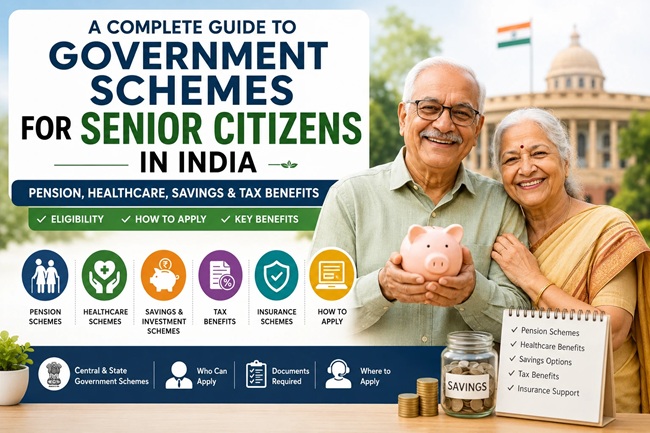
Government Schemes for Senior Citizens in India: Everything You Actually Need to Know

Last updated: July 2026
About This Guide: Written by the Financechecks.com Editorial Team, Personal Finance Researchers. This article has been researched using official notifications from the Ministry of Social Justice and Empowerment, the National Health Authority, India Post, and RBI circulars on small savings schemes, and is reviewed for accuracy as scheme rules and rates change.
My grandmother spent nearly a decade drawing a fixed deposit interest rate that never quite kept pace with her medical bills, simply because nobody in the family had sat down and gone through what she was actually entitled to as a senior citizen. It wasn’t that the schemes didn’t exist. It was that they were scattered across ten different government departments, each with its own website, its own form, its own jargon, and nobody had ever put them together in one place she could actually read and understand.
That is exactly the gap this guide is meant to close. India runs more than two dozen central schemes specifically for citizens above sixty, covering pensions, healthcare, savings, housing, and even something as simple as a discounted train ticket. Most families only ever discover two or three of them, usually by accident. Below is the fuller picture, organised the way it actually matters to a retired person or their family: money coming in every month, protection against a medical emergency, and a safe place to keep whatever savings already exist.
Government Schemes for Senior Citizens in India

Pension schemes that put money in your hands every month
The Indira Gandhi National Old Age Pension Scheme is the oldest and most widely used of these programmes, part of the broader National Social Assistance Programme. It is meant for citizens above sixty who fall below the poverty line, and the monthly pension amount actually increases once a person crosses eighty, recognising that needs tend to grow rather than shrink with age. Because it is a welfare scheme aimed at economically weaker households, eligibility is tied to state-level BPL classification, and the exact monthly amount varies from state to state, since many states top up the central contribution with their own funds.
For those who have some savings to invest rather than relying purely on welfare support, the Pradhan Mantri Vaya Vandana Yojana works differently. Run through the Life Insurance Corporation, it lets a senior citizen invest a lump sum and receive a guaranteed pension in return, paid monthly, quarterly, half yearly or yearly depending on what suits them. The maximum an individual can invest is capped, and the appeal here is really the certainty of it. The return is fixed for the entire ten year term regardless of what happens to interest rates elsewhere in the economy, and if the policyholder passes away during the term, the full purchase price is returned to the nominee, so the original capital is never actually lost.
Atal Pension Yojana works on a different principle again. Rather than being something you join after sixty, it is a scheme you contribute to during your working years, typically starting well before retirement, so that a guaranteed pension begins once you turn sixty. It was originally designed for workers in the unorganised sector who don’t have access to a formal employer pension, and the monthly amount you eventually receive depends on how much you contributed and at what age you started. The earlier someone starts, the smaller the monthly contribution needed to reach the same eventual pension.
If someone spent their working years in a job covered by the Employees’ Provident Fund Organisation, they may already be entitled to a monthly pension through the Employees’ Pension Scheme, provided they completed at least ten years of eligible service. This one is often overlooked simply because people assume their provident fund balance is the only thing waiting for them at retirement, without realising a separate pension entitlement exists on top of it.
Healthcare coverage, because medical costs are usually the biggest fear
If there is one scheme every family with an elderly member should know about right now, it is the expanded Ayushman Bharat coverage for citizens above seventy. Since September 2024, every Indian above the age of seventy is eligible for health cover under this scheme, and unlike most other government welfare programmes, this particular expansion has no income requirement attached to it. It does not matter whether the person is wealthy or economically disadvantaged. Simply crossing seventy makes a person eligible for coverage worth five lakh rupees a year for hospitalisation at empanelled hospitals across the country. Given how quietly this rule changed and how few people seem to actually know about it, this alone is worth checking for every senior citizen in your family, regardless of their financial situation.
Alongside this, the National Programme for Health Care of the Elderly runs a genuinely useful, if less talked about, layer of support through the regular public health system. It funds dedicated geriatric wards in district hospitals, outpatient services specifically for elderly patients at community health centres, and physiotherapy units aimed at age related mobility issues. In many rural areas, it also supports home based care for bedridden elderly patients, delivered through trained community health workers who visit the home directly rather than expecting a frail patient to travel to a hospital.
You May Also Like To Read:
- Government Schemes for Women Entrepreneurs in India: The Complete 2026 Guide to Loans, Subsidies and Support
- CGSS Explained: How the Government Is Backing ₹20 Crore Startup Loans Without a Single Rupee of Collateral
- NPS Explained: The Retirement Scheme That Could Save You ₹15,000 in Tax This Year
- What Is EPFO and UAN? The Complete Beginner’s Guide to Understanding Your PF Account
- Government of India Schemes for the Girl Child: A Complete Guide to Every Benefit Parents Should Know in 2026
- Government Schemes for Startups and Small Businesses in India: The Complete 2026 Guide to Funding, Tax Breaks and Ease of Doing Business
A safe place to keep whatever savings already exist
The Senior Citizen Savings Scheme remains, for many retirees, the single most trusted place to park a retirement corpus. It works much like a fixed deposit, opened initially for five years and extendable afterwards in blocks of three, and it currently pays close to the highest interest rate available on any government backed small savings instrument, reviewed and adjusted by the government every quarter. The interest is paid out every quarter rather than compounding silently in the background, which suits retirees who want a predictable income stream rather than a lump sum that only matures years later. It can be opened at any post office or authorised bank, and there is a maximum amount an individual is allowed to invest, which couples sometimes work around by opening separate accounts in each spouse’s name.
Beyond this specific scheme, most banks also offer a straightforward additional interest rate on regular fixed deposits simply for being a senior citizen, on top of whatever the standard rate happens to be. It is a small thing, easy to overlook, but worth specifically asking for at any bank, since it is not always applied automatically without a request and proof of age.
Tax relief that quietly adds up
Senior citizens benefit from a meaningfully higher basic income tax exemption limit compared to younger taxpayers, and this steps up again for those who cross eighty. On top of that, a specific deduction under Section 80TTB allows a much larger amount of interest income from savings accounts and fixed deposits to be claimed tax free compared to what younger taxpayers are permitted, which matters enormously for someone whose main source of income in retirement is interest from exactly these kinds of deposits. Health insurance premiums also attract a higher deduction limit for senior citizens under Section 80D, recognising that medical insurance tends to cost considerably more at this stage of life.
Everyday benefits that are easy to forget about
Indian Railways continues to offer senior citizens a meaningful discount on rail fares, and while this has changed in scope over the years, it remains worth checking at the time of booking, since the exact terms are occasionally revised. Under the Pradhan Mantri Awas Yojana, there is also a specific quota and set of relaxed conditions for senior citizen applicants seeking affordable housing support, something that rarely comes up in general conversation about the scheme but is genuinely there for those who qualify.
For anyone who simply needs guidance navigating any of this, or is dealing with elder abuse, neglect, or general distress, the government runs a dedicated toll free helpline called Elderline, reachable at 14567, offering support and guidance across the country in multiple languages.
How to actually go about applying
Most of these schemes are not automatically activated the day someone turns sixty. A pension scheme like IGNOAPS typically requires an application through the local village or ward office, along with age and income proof. Savings schemes like SCSS and PMVVY require visiting a post office, bank branch, or, in the case of PMVVY, going through LIC directly. The extended Ayushman Bharat coverage for those above seventy can be applied for online through the official beneficiary portal, or with help at the nearest Common Service Centre for anyone less comfortable navigating a website on their own.
The most practical piece of advice here is simple. Do not assume a family member is automatically covered by anything just because they are old enough to qualify. Nearly every one of these benefits requires someone to actively apply, submit age proof, and in some cases income proof, before the support actually begins. Given how many of these schemes exist and how differently each one is administered, sitting down once with a checklist and going through each one methodically tends to be far more effective than hoping to stumble upon them individually over time.
Frequently Asked Questions
What is the best government scheme for a senior citizen with no other source of income?
For someone with genuinely no income and no savings, the Indira Gandhi National Old Age Pension Scheme is typically the most directly relevant, since it is specifically designed for economically weaker senior citizens and provides a monthly pension based on state level criteria.
Is Ayushman Bharat really free for everyone above seventy?
Yes. Since September 2024, health coverage worth five lakh rupees a year under Ayushman Bharat has been extended to every Indian citizen above seventy, regardless of income, in addition to whatever coverage they may already hold through other health insurance policies.
What is the current interest rate on the Senior Citizen Savings Scheme?
The scheme currently offers an interest rate close to the highest among government backed small savings instruments, reviewed by the government every quarter, so it is worth checking the latest declared rate directly with a post office or bank before opening an account.
Can a senior citizen have both SCSS and PMVVY at the same time?
Yes, there is no restriction preventing someone from holding both. Many financial planners actually recommend splitting a retirement corpus across more than one guaranteed income scheme rather than concentrating everything in a single instrument.
Do these schemes require an income certificate to apply?
Some do and some don’t. Welfare focused pension schemes like IGNOAPS generally require proof of falling below the poverty line, while savings and insurance based schemes like SCSS and PMVVY are open to any senior citizen regardless of income, requiring only age proof.
What is the age at which someone becomes eligible for these senior citizen benefits?
Most schemes use sixty as the starting age for eligibility, though a number of them, including pension amounts and Ayushman Bharat’s universal coverage, provide enhanced benefits once someone crosses seventy or eighty specifically.
Is the additional bank interest rate for senior citizens automatic?
Not always automatically. While many banks apply it by default once age is verified in their records, it is worth specifically confirming with the bank and providing age proof if it does not appear to be reflected on a new or existing fixed deposit.
How can a family help an elderly relative who is not comfortable using the internet?
Nearly every scheme mentioned here can be accessed in person, either through a post office, bank branch, local government office, or a Common Service Centre, all of which can help with the application process for those who prefer not to navigate an online portal alone.
What should I do if a scheme application is rejected or delayed?
Most schemes have a local grievance redressal process through the same office where the application was submitted. The Elderline helpline at 14567 is also a useful starting point for guidance on where to escalate a stalled application.
Are these schemes only available to Indian citizens?
Yes, these central government schemes are specifically for Indian citizens. Requirements around age and, for certain schemes, income or state residency still apply on top of citizenship.
Final thoughts
The honest pattern across almost every one of these schemes is the same. The support genuinely exists, it is genuinely funded, and it is genuinely meant to reach exactly the people reading this article or their parents and grandparents. What is missing, most of the time, is simply the awareness that any of it is there to begin with. If there is one thing worth doing after reading this, it is going through the list once with whichever senior citizen in your life it applies to, checking what they are already receiving, and applying for whatever they are not.
Disclaimer: This article is for general informational and educational purposes only and should not be treated as financial, legal, or medical advice. Scheme names, interest rates, eligibility criteria, and benefit amounts mentioned above are based on publicly available government information current as of the stated date and are subject to change through future government notifications. Please verify current details directly with the relevant government department, bank, post office, or the official scheme portal before applying, and consult a qualified financial advisor for guidance specific to your situation.

Shuchi founded Finance Checks after spending 16+ years working in corporate, managing operations and distribution. She managed her own finances, learned and read regularly and helped people make sense of their savings, loans, insurance, and investments.
She started this site to offer the kind of clear, honest financial guidance she wished was more available when she was learning to manage her own money. Every article is researched personally, checked against official sources such as the Reserve Bank of India, SEBI, or the Income Tax Department, and revisited whenever regulations or figures change. She is upfront about how the site earns money through ads and select affiliate partnerships, and she does not let either influence what she actually recommends to readers.



[…] healthcare and child education rather than paying for both reactively out of a single shared pool. Government schemes for senior citizens, family floater health insurance, and starting even a modest retirement SIP early can meaningfully […]
[…] usually an additional 0.25 to 0.5 percent depending on the bank. Post office schemes, including the Senior Citizen Savings Scheme, also require age proof and this card can serve that purpose alongside […]