
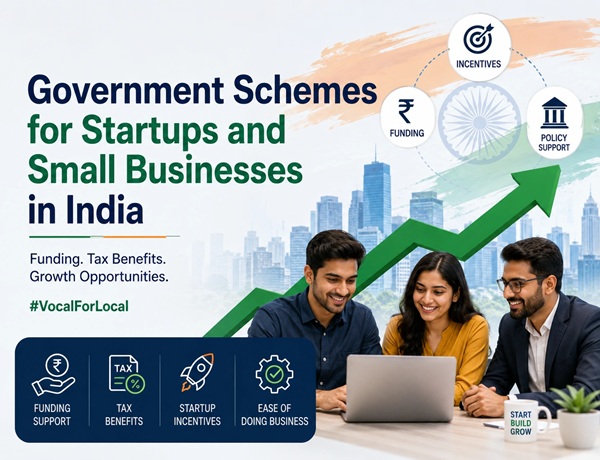
Government Schemes for Startups and Small Businesses in India: The Complete 2026 Guide to Funding, Tax Breaks and Ease of Doing Business

If you have ever sat with a notebook, sketched out a business idea, and then closed it again because you had no clue how you would pay for it, you are not alone. Most people who eventually build a successful business in India started exactly where you are right now: an idea, very little capital, and a long list of questions about registration, funding, loans, paperwork and which government office to even knock on first.
Here is the good news. Over the last decade, the Government of India has built one of the most layered support systems for entrepreneurs anywhere in the world. There is a scheme for the college graduate building a tech product, a scheme for the woman opening a boutique in a small town, a scheme for the carpenter who wants to upgrade his tools, and a scheme for the manufacturer trying to compete with Chinese imports. The problem is not that the support does not exist. The problem is that nobody hands you a map.
This guide is that map. We are going to walk through every major scheme that an Indian entrepreneur, in any sector, at any stage, can actually use right now in 2026: what it offers, who qualifies, how much money or benefit you can expect, where to apply, what papers you will need, and what mistakes trip people up. Whether you are dreaming of a software startup, a food processing unit, a manufacturing line, an agri-business, or a neighbourhood service business, there is something in here for you.
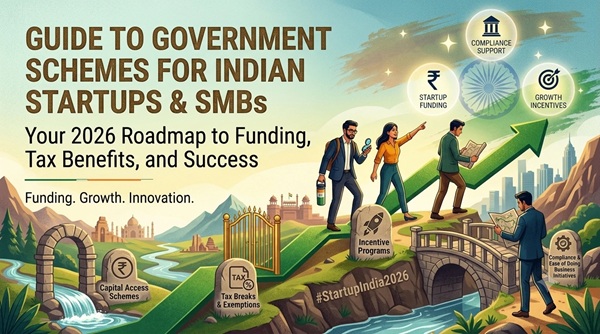
Why this matters more than ever right now
India now has over 1.7 lakh startups recognised by the Department for Promotion of Industry and Internal Trade, generating well over a million direct jobs. The Production Linked Incentive programme alone has pulled in more than ₹2.16 lakh crore of investment and created over 14 lakh jobs across fourteen manufacturing sectors. The angel tax that scared away early investors for twelve years has finally been scrapped from the financial year 2025-26 onward. MSME credit guarantee limits have been raised. The Mudra loan ceiling has been doubled. New funds worth thousands of crores have been announced for everything from women-led businesses to deep tech research.
None of this helps you, though, unless you know it exists and know how to use it. So let us get into the actual details, scheme by scheme, sector by sector.
Step one: figure out what kind of entrepreneur you are
Before diving into any specific scheme, it helps to place yourself in one of these broad buckets, because the schemes available to you depend heavily on which one you fall into:
A tech or innovation-led startup building a new product, process or scalable business model. This is the group that benefits most from Startup India, DPIIT recognition, the Seed Fund Scheme and the Fund of Funds.
A small manufacturer, trader or service provider running, or planning to run, a relatively traditional business. This is the MSME world: Udyam registration, Mudra loans, PMEGP, CGTMSE.
A woman entrepreneur or someone from a Scheduled Caste or Scheduled Tribe background starting a new enterprise. Stand-Up India was built specifically for you, and there is a fresh ₹2 crore scheme on the way targeted at first-time SC/ST women entrepreneurs.
An artisan or craftsperson working in a traditional trade with your hands and tools, such as a potter, weaver, blacksmith, tailor or cobbler. PM Vishwakarma exists for exactly this group.
A manufacturer in a strategic sector such as electronics, pharmaceuticals, textiles, food processing, auto components, solar, batteries or telecom equipment. The Production Linked Incentive scheme rewards you for scaling production, and it is not only for giant corporations; over 170 MSMEs are already benefiting from it.
Most founders actually belong to two or three of these buckets at once, which means you can often stack multiple schemes together. Let’s go through them one at a time.
Startup India and DPIIT recognition: the foundation everything else is built on
If you are building anything that counts as an innovative, scalable business, the very first thing you should do, before you even think about funding, is get your company recognised as a “startup” by the Department for Promotion of Industry and Internal Trade, commonly shortened to DPIIT. This is not the same as registering your company. Incorporating a Private Limited Company or LLP with the Ministry of Corporate Affairs is a separate legal step. DPIIT recognition is a free certificate you apply for afterward, and it is the key that unlocks almost every other benefit described in this article.
Who actually qualifies
Under the revised 2026 framework, your entity needs to be a Private Limited Company, a Limited Liability Partnership, a Registered Partnership Firm, or a Cooperative Society, including Multi-State Cooperatives. A plain sole proprietorship will not work; if you are currently operating as one, you will need to convert into one of these structures first. Your company cannot be older than ten years from its date of incorporation, and your turnover cannot have crossed ₹200 crore in any financial year since you began. There is now a special Deep Tech category for businesses built around fundamental scientific or engineering breakthroughs, such as semiconductors, biotech, quantum computing and space technology, where the age limit stretches to twenty years and the turnover ceiling rises to ₹300 crore, recognising that hard science takes longer to commercialise than a typical consumer app.
You also need to genuinely be working on innovation, whether that means developing a new product, improving a process, or running a business model with real potential to scale and create jobs. The notification specifically excludes businesses that were created simply by splitting up or rebranding an already existing company, so the innovation story you write matters; vague, generic descriptions are the single biggest reason applications get sent back for clarification.
How to apply and what it costs
The entire process happens online through the Startup India portal at startupindia.gov.in, and there is no government fee at any stage. You register an account, fill in your company details, write a clear description of the problem you are solving and the innovation behind your solution, and upload supporting documents. Most well-prepared applications with complete documentation are now cleared within a few days, though some require additional clarification and can take a couple of weeks. You will need your Certificate of Incorporation, PAN, details of directors or partners, a brief pitch deck or write-up explaining your innovation, and, if you have one, a letter of recommendation from an incubator or an investor, which is optional but strengthens your case.
What you actually get once recognised
This is where the real value sits, and it is worth listing out because most founders only know one or two of these:
A three-year income tax holiday under Section 80-IAC, where you can choose any three consecutive years out of your first ten years to claim a hundred percent exemption on profits. The smart move here is not to claim it in your early loss-making years; wait until you are genuinely profitable and then use the window, because that is when the saving actually means something.
Relief from the old angel tax headache. As of the financial year 2025-26, the angel tax provision under Section 56(2)(viib) has been abolished entirely for every category of investor, which means investors putting money into your company at a premium above book value will not trigger a tax dispute the way they used to for over a decade.
Self-certification under nine labour laws and three environmental laws for three years, which means no random inspections during your most fragile early period.
An eighty percent rebate on patent filing fees and a fifty percent rebate on trademark filing costs, with fast-tracked examination.
Easier access to government tenders through the Government e-Marketplace, where recognised startups are exempted from the usual prior turnover and prior experience requirements, and from the earnest money deposit that normally has to be paid upfront.
A simplified, fast-track winding-up process within roughly ninety days if your venture does not work out, instead of getting your capital stuck for years in a drawn-out insolvency process.
Eligibility for the Credit Guarantee Scheme for Startups, which allows collateral-free loans, and access to the Fund of Funds for Startups, both explained in the next section.
A listing on BHASKAR, the Bharat Startup Knowledge Access Registry, which acts as a searchable directory connecting recognised startups with investors, mentors and government bodies.
Getting funded without giving away your company: seed funding and the Fund of Funds
Once you are DPIIT recognised, two major funding routes open up, and they work very differently from each other.

The Startup India Seed Fund Scheme
This scheme was built for one very specific, very painful gap: the stretch between having a working idea and having enough traction to interest an angel investor or a bank. The scheme has a total outlay of ₹945 crore and is designed to help thousands of early-stage entrepreneurs across the country.
Here is the part people misunderstand most often: you do not apply to the government directly. The funds are routed through a network of more than three hundred approved incubators spread across the country. Each incubator runs its own Incubator Seed Management Committee, which reviews applications and, often, calls shortlisted founders in for a pitch presentation.
If selected, you can receive up to ₹20 lakh as a grant for proof of concept and prototype development, released in instalments as you hit agreed milestones, and this money does not have to be repaid. Beyond that, startups closer to market entry and commercialisation can access up to ₹50 lakh structured as convertible debentures or unsecured debt, with no requirement for the founder to put up a personal guarantee, an interest rate capped at the prevailing repo rate, a repayment period of up to five years, and a moratorium of up to twelve months before repayments begin.
To be eligible, your startup needs DPIIT recognition, should typically be within two years of incorporation, should not have already received more than ₹10 lakh in monetary support from any other government scheme, and needs at least fifty-one percent Indian promoter shareholding. You can apply to a maximum of three incubators in order of preference, and the choice of incubator matters quite a bit, since funding follows whichever incubator in your preference order actually selects you.
One honest note here: application cycles for this scheme open and close periodically as funds get allocated and incubators complete their selection rounds, so always check the live status on the official seed fund portal at seedfund.startupindia.gov.in before you plan around it. If a particular cycle has closed by the time you read this, similar non-dilutive options worth exploring include BIRAC’s BIG grant for biotech and life sciences founders, TIDE 2.0 for IT and electronics hardware founders, and the Nidhi Prayas grant run through the Department of Science and Technology for researchers and scientist-founders.
The Fund of Funds for Startups
This one works completely differently, and it is important to understand the mechanism because a lot of people assume the government writes them a cheque directly. It does not. Under the Fund of Funds, managed through the Small Industries Development Bank of India, the government invests a roughly ₹10,000 crore corpus into SEBI-registered venture capital funds, known as Alternative Investment Funds. Those funds, run by professional fund managers, then make their own investment decisions and put equity capital into individual startups, including yours, if your business fits their thesis.
In practice, this means the most useful thing you can do with the Fund of Funds is research which SEBI-registered AIFs have received an allocation from SIDBI and whose investment focus matches your sector and stage, then approach them the same way you would approach any private investor, with a strong pitch deck, clear unit economics, and a believable growth story.
You May Also Read About:
MSME schemes: loans, credit guarantees and registration for the rest of the business world
Not every business is a venture-backed startup, and frankly, most successful Indian businesses never will be. If you are opening a manufacturing unit, a small trading business, a service shop, or anything that fits the description of a Micro, Small or Medium Enterprise, this is the section that matters most to you.
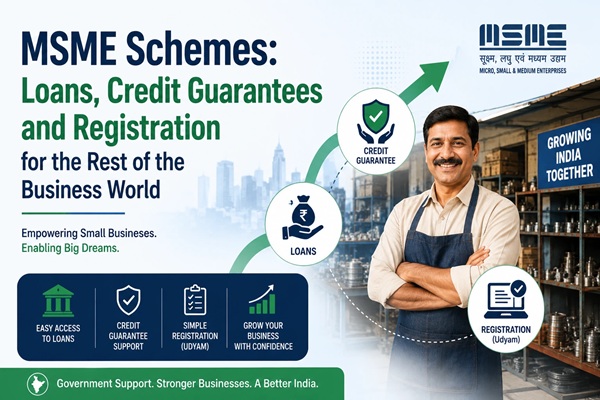
Udyam registration: your first move regardless of sector
Before you apply for any MSME-specific loan or benefit, register your business on the Udyam portal at udyamregistration.gov.in. It is completely free, fully online, requires no document uploads because it pulls your investment and turnover data directly from your PAN, GST and income tax records, and gives you a Udyam certificate that has lifetime validity with no renewal needed.
The classification thresholds were significantly widened from April 2025. A micro enterprise is now one with investment in plant, machinery or equipment up to ₹2.5 crore and annual turnover up to ₹10 crore. A small enterprise can have investment up to ₹25 crore and turnover up to ₹100 crore. A medium enterprise stretches all the way to ₹125 crore in investment and ₹500 crore in turnover. Both the investment and turnover criteria have to be satisfied, and if you cross the ceiling on either one, you move up a category; there is also a one-year grace period before you formally lose a category, so a sudden good year will not instantly strip away your benefits.
Once registered, Udyam unlocks priority sector lending status with banks, protection under Section 15 of the MSMED Act which forces any buyer to pay you within forty-five days or face interest penalties at three times the RBI bank rate, easier entry into the Government e-Marketplace for selling to government departments, and eligibility for every scheme described below.
Pradhan Mantri Mudra Yojana: small loans, fast disbursal
Mudra loans are aimed squarely at non-corporate, non-farm micro and small businesses, the kind of business a street vendor, artisan, small trader or first-generation entrepreneur runs. Loans are collateral-free and disbursed through commercial banks, regional rural banks, small finance banks, cooperative banks, microfinance institutions and NBFCs.
There are now four tiers. Shishu covers loans up to ₹50,000 for the very earliest stage. Kishor covers loans from ₹50,001 up to ₹5 lakh. Tarun covers loans above ₹5 lakh up to ₹10 lakh. And since the 2024 budget announcement, a new Tarun Plus category covers loans above ₹10 lakh up to ₹20 lakh, specifically for entrepreneurs who have already taken and successfully repaid a Tarun loan, effectively doubling the old ceiling for proven borrowers. The guarantee cover on these loans now extends right up to the ₹20 lakh mark under the Credit Guarantee Fund for Micro Units.
You can apply directly at a bank branch or online through the Jan Samarth portal at jansamarth.in, which routes you to your chosen bank’s specific application page. You will typically need your business plan, identity and address proof, business registration proof if applicable, and recent bank statements.
Prime Minister’s Employment Generation Programme
PMEGP is built to help people set up brand new manufacturing or service enterprises and is administered through the Khadi and Village Industries Commission via the kviconline.gov.in portal. Any individual above eighteen years of age can apply, though for project costs above ₹10 lakh in manufacturing or above ₹5 lakh in services, you need at least an eighth-standard pass educational qualification. The scheme is open to individuals, Self-Help Groups, registered societies, cooperative societies and charitable trusts, but it is strictly for new projects; an existing unit that has already taken a government subsidy elsewhere cannot apply again under PMEGP. The scheme includes a margin money subsidy from the government on top of bank financing, which effectively reduces your own cash contribution and your loan burden.
CGTMSE: collateral-free credit for micro and small enterprises
The Credit Guarantee Fund Trust for Micro and Small Enterprises solves the single biggest problem first-generation entrepreneurs face with banks: no property to pledge as collateral. Set up jointly by the Ministry of MSME and SIDBI, CGTMSE guarantees a large portion of your loan, currently covering facilities up to ₹10 crore, with the guarantee covering anywhere from seventy-five to eighty-five percent of the loan amount depending on the category. For DPIIT-recognised startups, a linked scheme called the Credit Guarantee Scheme for Startups extends similar collateral-free guarantee cover up to ₹20 crore.
Here is the key thing to understand: you do not apply to CGTMSE directly. You approach any scheduled bank or eligible NBFC, known as a Member Lending Institution, ask them to route your loan application under the CGTMSE guarantee, and they handle the rest. There is a modest annual guarantee fee, with concessions available for units in certain locations and for those holding ZED, or Zero Defect Zero Effect, certification.
Stand-Up India: backing women and SC/ST entrepreneurs into new businesses
Launched specifically to push at least one Scheduled Caste or Scheduled Tribe borrower and one woman borrower per bank branch into entrepreneurship, Stand-Up India offers a composite loan, combining a term loan and working capital, ranging from ₹10 lakh to ₹1 crore, covering up to eighty-five percent of your total project cost. This is strictly for setting up a new, or greenfield, enterprise in manufacturing, services, trading or agriculture-allied activities; it cannot be used to expand an existing business.
If your enterprise is not a sole proprietorship, at least fifty-one percent of the shareholding and controlling stake needs to be held by the eligible woman or SC/ST entrepreneur. Repayment stretches over seven years with a moratorium of up to eighteen months before you need to start paying down the principal, and the interest rate is capped at the bank’s base rate plus a small spread. You can apply through your nearest bank branch, through the Lead District Manager’s office, or online via the StandUpMitra portal at standupmitra.in, which also offers handholding support, training and help preparing your project report if you need it.
A significant expansion was announced in the Union Budget 2025-26: a dedicated new scheme aimed at five lakh first-time SC/ST and women entrepreneurs, offering term loans of up to ₹2 crore. If this applies to you, keep an eye on official Department of Financial Services announcements for the rollout details, since it represents a meaningful jump above the existing ₹1 crore Stand-Up India ceiling.
PM Vishwakarma: support built for traditional artisans and craftspeople
If your work involves your hands and traditional tools rather than a laptop, PM Vishwakarma deserves your attention. It covers eighteen recognised family-based trades, ranging from carpenters, blacksmiths and potters to tailors, cobblers, goldsmiths and weavers, and offers a genuinely complete package rather than just a loan. You get official recognition through a PM Vishwakarma certificate and ID card, a toolkit incentive of up to ₹15,000 delivered as an e-voucher to buy better equipment, free basic training of five to seven days and optional advanced training of fifteen days or more with a stipend of ₹500 per day during the training period, and a collateral-free Enterprise Development Loan of up to ₹3 lakh split into two tranches, the first up to ₹1 lakh repayable over eighteen months and the second up to ₹2 lakh repayable over thirty months once the first is cleared, all at a concessional five percent interest rate.
You need to be at least eighteen years old, actively working in one of the eighteen listed trades, and you should not have taken a similar government self-employment loan such as PMEGP, Mudra or PM SVANidhi in the past five years, though if you already fully repaid a Mudra or PM SVANidhi loan, you remain eligible. Apply at pmvishwakarma.gov.in or through your nearest Common Service Centre if you do not have easy internet access; registration goes through a three-stage local verification before benefits begin.
The Production Linked Incentive scheme: getting paid to manufacture in India
If you are thinking about manufacturing, this is the scheme that can genuinely change your unit economics, and it is far more accessible to small and mid-sized manufacturers than most people realise.
How it actually works
The Production Linked Incentive scheme does not hand you money upfront. Instead, the government pays you a percentage, generally somewhere between four and twenty percent depending on the sector, of your incremental sales above a fixed base year, once you have actually manufactured and sold the product. Think of it as the government sharing in your growth after you prove it, rather than betting on a plan before you have built anything. This makes it a poor fit if you are cash-strapped and need money before you produce, but an excellent fit once you are operational and want to meaningfully boost your margins.
The scheme spans fourteen strategic sectors: mobile manufacturing and electronic components, bulk drugs and active pharmaceutical ingredients, medical devices, pharmaceuticals more broadly, automobiles and auto components, specialty steel, telecom and networking equipment, electronic and technology products, white goods such as air conditioners and LED lighting, food products, textiles in the man-made fibre and technical textile segment, high-efficiency solar PV modules, advanced chemistry cell batteries, and drones and drone components. A newer, related scheme worth knowing about is the Electronics Component Manufacturing Scheme, with an allocation in the tens of thousands of crores, aimed at building India’s component supply chain for things like printed circuit boards, camera modules and lithium-ion cells, an area many smaller manufacturers are entering right now precisely because the larger assembly players above them need local suppliers.
By the most recent figures, the scheme has driven cumulative investment of more than ₹2.16 lakh crore, generated over ₹20 lakh crore in cumulative sales, pushed exports past ₹8.3 lakh crore, and created more than 14 lakh direct and indirect jobs. And contrary to the assumption that this is only for giant corporations like Tata or Samsung, well over 170 MSMEs are already approved beneficiaries, concentrated in bulk drugs, medical devices, pharma, telecom, white goods, food processing, textiles and drones.
Where the real opportunity sits for smaller players
A useful pattern to notice: most of the incentive payout so far has flowed to electronics and pharmaceuticals, while sectors like food processing, drones and advanced batteries remain comparatively under-tapped despite carrying decent margins. States like Telangana, Gujarat, Tamil Nadu and Maharashtra have absorbed most of the manufacturing activity under PLI, which means states with cheaper land, available labour and existing industrial corridors, such as Uttar Pradesh, Rajasthan, Odisha and Assam, are relatively wide open for a founder willing to set up a greenfield unit there.
To benefit, your company, LLP, partnership or proprietary firm needs to be registered in India, meet the sector-specific minimum investment threshold, which varies considerably by sector and is published in each sector’s individual guideline document, and then demonstrate the required year-on-year incremental sales growth above the FY 2019-20 base. Each sector is run by its own nodal ministry, so the exact application window, portal and documentation differ; the Ministry of Commerce and Industry and individual ministry websites such as the Department for Promotion of Industry and Internal Trade, the Ministry of Electronics and Information Technology, and the Ministry of Food Processing Industries are the right starting points depending on your sector.
Food processing and agri-business: PM FME and the broader ecosystem
If your business idea involves food, this deserves its own mention because the support here is unusually generous for a micro-scale enterprise. The Pradhan Mantri Formalisation of Micro Food Processing Enterprises scheme, run by the Ministry of Food Processing Industries with state governments sharing the cost, exists to help unorganised micro food businesses formalise and grow.
It offers a credit-linked capital subsidy of thirty-five percent on your project cost, up to ₹10 lakh, seed capital of ₹40,000 per member for Self-Help Groups to cover working capital and small tools, and a much larger subsidy of up to ₹3 crore for common infrastructure shared across multiple units, such as a shared processing facility or cold storage. The scheme is open to individual entrepreneurs, Farmer Producer Organisations, Self-Help Groups, cooperatives and producer companies, and it works alongside each state’s One District One Product strategy, which identifies a signature local food product per district and channels support toward building a value chain around it. Applications go through your state’s nodal department for food processing, with details and the detailed project report formats available at pmfme.mofpi.gov.in.
Cutting through the red tape: how the government has made starting up genuinely easier
Funding is only half the battle; the other half is approvals, licenses and paperwork, and this is an area where India has made real, measurable progress.
The National Single Window System, available at nsws.gov.in, is the single biggest improvement here. Instead of visiting dozens of separate departmental websites to figure out which licenses, registrations and clearances your specific business needs, you answer a guided questionnaire about your sector and activity, and the platform tells you exactly what approvals apply to you, lets you apply for many of them in one place, and lets you track every application from a single dashboard. It covers everything from Udyam and GST registration to sector-specific clearances for pharmaceuticals, agriculture inputs, electronics manufacturing and pollution control, and several states have now integrated their own approval systems with it, so you increasingly get a combined central-and-state view in one window.
The Government e-Marketplace, at gem.gov.in, is worth setting up early if any part of your business could realistically sell to a government department, public sector undertaking or local body. It is a fully online procurement portal, and DPIIT-recognised startups and Udyam-registered MSMEs get meaningful advantages here, including exemption from the usual prior turnover and experience requirements and exemption from the earnest money deposit that other bidders must pay.
On top of these platforms, the self-certification regime under labour and environmental laws for recognised startups, the fast-track company incorporation process that can now be completed within a couple of working days when your documents are in order, and the steady digitisation of patent and trademark filing have together meaningfully reduced the number of physical visits to government offices that used to eat up months of a founder’s time.
Tax matters every founder should actually understand
A few tax points deserve to be pulled out clearly because they affect almost every business covered in this article.
Section 80-IAC gives DPIIT-recognised startups a hundred percent tax exemption on profits for any three consecutive years out of their first ten, and the smart strategy is to time this window to your most profitable years rather than your earliest, often loss-making ones.
The angel tax under Section 56(2)(viib), which used to tax the premium an Indian company raised over its calculated fair market value as income, has been abolished for all categories of investors starting financial year 2025-26. This removes more than a decade of friction, valuation disputes and litigation risk that genuinely scared off early-stage investors, and it applies regardless of whether your company is DPIIT recognised, though recognised startups had already enjoyed a version of this relief earlier.
If you run a small business under the presumptive taxation scheme, Section 44AD currently allows businesses with turnover up to ₹3 crore to estimate their taxable profit as a fixed percentage of turnover rather than maintaining detailed books and going through a full audit, which is a meaningful compliance simplification for small traders and service providers.
And remember that GST registration operates entirely independently of DPIIT or Udyam recognition. If your turnover crosses the applicable GST threshold for your state and category of business, you need to register for GST regardless of any startup or MSME status you hold.
A practical, step-by-step path to actually getting started
Reading about ten different schemes can feel overwhelming, so here is a sensible order of operations that works for most founders, regardless of sector.
Start by deciding your legal structure. If you are building a scalable, innovation-led venture and plan to raise outside capital eventually, a Private Limited Company is usually the right choice. If you are running a smaller, more traditional business with one or two partners and do not anticipate external fundraising, an LLP or registered partnership can be simpler and cheaper to maintain.
Get your PAN and, if required for your structure, incorporate through the Ministry of Corporate Affairs portal. This typically takes a few working days now with the digital filing system.
Register on the Udyam portal immediately if your business fits an MSME profile; it costs nothing, takes minutes, and you will need it before applying for almost any MSME loan or benefit.
If your business is innovation-led and fits the startup criteria, apply for DPIIT recognition right after incorporation. Write your innovation description carefully and specifically; this single document is the most common reason for rejection.
Open a current account in your business’s name, since most schemes require funds to be disbursed into a dedicated business account rather than a personal one.
Map your funding need against the right scheme using the categories described above. A pre-revenue tech startup should look first at the Seed Fund Scheme and relevant sector-specific grants. A small manufacturer should look at Mudra, PMEGP or CGTMSE-backed bank loans. A woman or SC/ST entrepreneur starting fresh should explore Stand-Up India. A manufacturer scaling production in a PLI sector should evaluate that scheme once production has actually started.
Prepare your documentation in advance, because almost every scheme asks for some version of the same core papers: your PAN and Aadhaar, your incorporation or partnership documents, a clear business plan or detailed project report, financial projections, bank statements, photographs, and, depending on the scheme, caste certificates, educational qualification proof, or an existing Udyam or DPIIT certificate.
Apply through the official portal only, whether that is startupindia.gov.in, udyamregistration.gov.in, jansamarth.in, standupmitra.in, kviconline.gov.in, pmvishwakarma.gov.in, or your relevant ministry’s website, and never through an unofficial agent who asks for money to “guarantee” approval, since every one of these application processes is free at the government end.
Track your application through the relevant portal dashboard, respond promptly to any clarification requests, since most rejections happen because founders miss a query deadline rather than because the underlying business was weak.
Don’t overlook your state government
Everything described so far is a central government scheme, but nearly every Indian state runs its own parallel startup policy, often with its own seed funds, incubation support, capital subsidies for manufacturing units, stamp duty exemptions, and sector-specific incentives for industries the state wants to attract. Karnataka, Telangana, Tamil Nadu, Kerala, Gujarat, Maharashtra, Uttar Pradesh and several others have built genuinely strong state-level startup missions and industrial policies that stack on top of the central schemes rather than replacing them. It is worth a direct search for “[your state] startup policy” or a visit to your state’s Department of Industries website, because these state-level benefits are frequently underused simply because they get far less national media attention than the central schemes.
Mistakes that quietly sink good applications
A handful of avoidable errors come up again and again. Applying for DPIIT recognition as a sole proprietorship, which is simply not eligible, regardless of how good the business is. Writing a vague, buzzword-heavy innovation description instead of clearly naming the specific problem, the specific solution, and the evidence that it works. Assuming the government will invest equity directly into your company, when in reality the Fund of Funds invests through private venture funds and most direct support comes as grants, debt or guarantees rather than equity. Letting your Udyam details go stale and failing to update turnover figures, which can quietly misclassify your enterprise and cost you benefits you are otherwise entitled to. Missing a scheme’s specific application window, since several of these programmes, including the Seed Fund Scheme’s incubator-level cycles, open and close periodically rather than staying open all year round. And finally, ignoring state-level schemes entirely and assuming central government support is the only option on the table.
Bringing it all together
There genuinely is no single “best” scheme, because the right one depends entirely on what you are building. A founder coding a fintech product in a shared workspace needs DPIIT recognition, the Seed Fund Scheme and, later, the Fund of Funds network. A woman setting up a garment unit in a tier-two town needs Stand-Up India and a CGTMSE-backed bank loan. A young manufacturer assembling printed circuit boards needs Udyam registration and a serious look at the Electronics Component Manufacturing Scheme and the broader PLI framework. A weaver wanting to modernise her loom and reach a wider market needs PM Vishwakarma. Many founders will genuinely use three or four of these schemes across different stages of the same business’s life.
The system rewards founders who do their homework, register correctly the first time, keep their paperwork honest and current, and apply through the right official channel rather than a middleman. None of it is instant, and none of it is a substitute for a genuinely sound business idea executed well. But the financial and regulatory runway available to Indian entrepreneurs today is real, substantial, and, for most people starting out, far larger than they assume before they actually go looking for it.
Frequently Asked Questions
Do I need to register my company before applying for any government scheme? Yes, for almost everything described here you need a formally registered business entity first, whether that is a Private Limited Company, LLP, registered partnership, cooperative society, or in the case of Mudra and PMEGP, sometimes simply a clear business plan as an individual applicant. Udyam registration and DPIIT recognition both come after incorporation, not before it.
Is DPIIT recognition the same thing as registering an MSME on Udyam? No, and this trips up a lot of people. DPIIT recognition is specifically for innovation-led startups and unlocks tax holidays, IPR rebates and seed funding eligibility. Udyam registration is for the much broader universe of micro, small and medium enterprises and unlocks credit guarantees, priority lending and payment protection. Many growing businesses qualify for and benefit from both at the same time.
Can a sole proprietorship apply for DPIIT recognition? No. You will need to first convert into a Private Limited Company, LLP, registered partnership or cooperative society. Sole proprietorships and Hindu Undivided Families are excluded from DPIIT recognition, though they remain eligible for Mudra loans, PMEGP and several other MSME schemes.
Does the government directly invest money into my startup as equity? Generally no. Through the Fund of Funds for Startups, the government invests into SEBI-registered venture capital funds, and those funds make their own equity investment decisions into individual startups. Direct government support to your company usually takes the form of grants, debt, or credit guarantees rather than equity.
How much can I actually borrow without putting up collateral? It depends on the scheme. Mudra loans go up to ₹20 lakh under the new Tarun Plus category for repeat borrowers. CGTMSE-backed loans through a bank can run up to ₹10 crore for micro and small enterprises. DPIIT-recognised startups can access collateral-free guarantees up to ₹20 crore under the linked Credit Guarantee Scheme for Startups. Stand-Up India goes up to ₹1 crore for greenfield enterprises run by women or SC/ST entrepreneurs.
I have an idea but no prototype yet. Where should I start? Incorporate your entity, apply for DPIIT recognition while clearly articulating your innovation, and then approach an approved incubator under the Startup India Seed Fund Scheme, since that programme is specifically designed for the proof of concept and prototype stage before you have traction for an angel round.
Is the Production Linked Incentive scheme only for large companies? No. While the bulk of incentive payouts so far has gone to bigger players, more than 170 MSMEs are already approved PLI beneficiaries, mostly in bulk drugs, medical devices, food processing, textiles and drones. The catch is that PLI pays out after you have manufactured and sold, so it suits a business that already has some operating capital rather than one still raising its first round.
What documents should I keep ready no matter which scheme I apply to? At minimum: PAN and Aadhaar of the founders or proprietor, incorporation certificate or partnership deed, MOA and AOA for a company, a detailed project report or business plan, recent bank statements, address proof for the business premises, and passport-size photographs. Specific schemes will ask for additional documents such as caste certificates for Stand-Up India, educational proof for PMEGP above the relevant project cost threshold, or a DPIIT certificate number for seed funding.
Are these schemes available to NRIs or foreign nationals starting a business in India? Most schemes require majority Indian promoter shareholding, commonly fifty-one percent, and DPIIT recognition specifically requires the entity to be incorporated in India under Indian law. Foreign Direct Investment into an Indian MSME is permitted subject to sector-specific limits, but the benefits described in this guide are aimed at Indian-registered, Indian-promoted businesses.
How long does it usually take to get DPIIT recognition? Well-prepared applications with complete documentation are typically processed within a few days to about two weeks. Applications needing further clarification can take longer, and not responding to a portal query within the given deadline usually results in the application being treated as abandoned, so check your dashboard regularly after applying.
Can I apply for multiple schemes at the same time? Yes, and in fact most successful founders do. A startup can hold DPIIT recognition and Udyam registration simultaneously, apply for the Seed Fund Scheme while also exploring a CGTMSE-backed bank loan, and later qualify for PLI once it begins manufacturing at scale. The main restriction to watch is scheme-specific funding caps, such as the Seed Fund Scheme’s rule that you should not have already received more than ₹10 lakh from another government scheme.
Where can I check if a scheme’s application window is currently open? Always go to the official portal directly: startupindia.gov.in and seedfund.startupindia.gov.in for startup schemes, udyamregistration.gov.in for MSME registration, jansamarth.in for Mudra and several other government-backed loans, standupmitra.in for Stand-Up India, kviconline.gov.in for PMEGP, pmvishwakarma.gov.in for artisans, and nsws.gov.in for a consolidated view of approvals and many state and central schemes together. Application cycles, funding caps and eligibility thresholds genuinely do get revised at almost every Union Budget, so treat any third-party article, including this one, as a starting point for your research rather than the final word.
Disclaimer
This article has been written for general informational and educational purposes only and does not constitute legal, financial, tax or investment advice. While every effort has been made to verify the scheme details, eligibility criteria, funding amounts and application processes described here against publicly available government sources at the time of writing, government schemes, budget allocations, eligibility thresholds and application timelines are revised frequently, including at every Union Budget, and details may have changed since this article was published. Before making any business, financial or legal decision, please verify the current rules directly on the relevant official government portal and consult a qualified chartered accountant, company secretary, legal professional or financial advisor who can assess your specific situation. Neither the author nor the publisher accepts any responsibility or liability for losses or consequences arising from reliance on the information contained in this article.

Shuchi founded Finance Checks after spending 16+ years working in corporate, managing operations and distribution. She managed her own finances, learned and read regularly and helped people make sense of their savings, loans, insurance, and investments.
She started this site to offer the kind of clear, honest financial guidance she wished was more available when she was learning to manage her own money. Every article is researched personally, checked against official sources such as the Reserve Bank of India, SEBI, or the Income Tax Department, and revisited whenever regulations or figures change. She is upfront about how the site earns money through ads and select affiliate partnerships, and she does not let either influence what she actually recommends to readers.



[…] Government Schemes for Startups and Small Businesses in India […]
[…] Government Schemes for Startups and Small Businesses in India […]
[…] Government Schemes for Startups and Small Businesses in India […]
[…] Government Schemes for Startups and Small Businesses in India […]