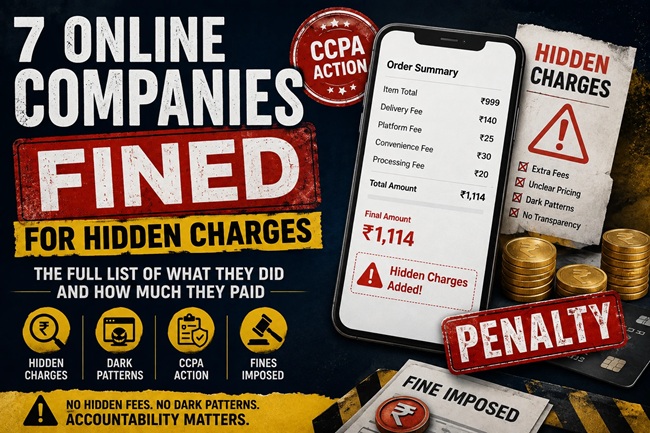
7 Online Companies Fined for Hidden Charges: The Full List of What They Did and How Much They Paid

Sunita ordered groceries on a quick commerce app last month, and the price on her cart looked fine right up until the payment screen, where a handling charge and a membership fee she never agreed to suddenly appeared. She paid it anyway, mostly out of habit, the same way most of us do when we’re three taps away from checkout and don’t want to start over. Turns out she wasn’t imagining it, and she wasn’t alone. The government just fined the platform for exactly this.
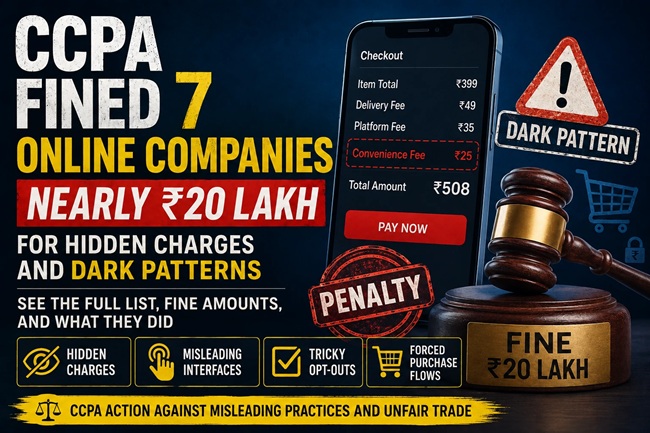
The Central Consumer Protection Authority has penalised nine digital platforms for using deceptive design tricks, officially called dark patterns, to nudge users into paying more or agreeing to things they never consciously chose. Seven of these companies had their fine amounts disclosed to Parliament, adding up to nearly Rs 20 lakh in total. Here’s exactly who was fined, how much, and what they were actually doing to your checkout screen.
What Are Dark Patterns, in Plain Terms
Before getting into the list, it helps to know what the government is actually penalising here. Under the Guidelines for Prevention and Regulation of Dark Patterns, 2023, the CCPA has identified 13 specific manipulative design practices that companies use online. These include things like drip pricing, where a low price is shown upfront and extra charges get added only at checkout, basket sneaking, where an item or membership gets added to your cart without clear consent, false urgency, like countdown timers that don’t actually mean anything, and confirm shaming, where a website guilt-trips you into an option using loaded language.
In June 2025, the Department of Consumer Affairs asked e-commerce and digital platforms to self-audit and remove these practices voluntarily. This latest round of penalties shows the government has moved past advisories and started actually fining companies that didn’t comply.
The 7 Companies Fined, With Amounts and What They Did
Zepto Marketplace, fined Rs 7 lakh. This was the highest fine in the batch. The CCPA found that Zepto initially displayed lower product prices, then added handling charges and a Zepto Pass membership fee at checkout, both without clear upfront disclosure. The regulator classified the handling charges as drip pricing and the automatically added membership as basket sneaking. The government confirmed Zepto has since removed both practices from its platform.
Physics Wallah, fined Rs 5 lakh. The edtech platform was penalised after the CCPA found a Rs 10 donation to the “PW Foundation” was pre-selected by default during payment, accompanied by emotionally persuasive messaging encouraging users to keep it selected rather than opt out. The regulator also objected to Physics Wallah requiring users to hand over personal information before accessing supposedly free courses. The company has paid the penalty and removed the flagged practices.
Anuj Jindal (coaching platform), fined Rs 3 lakh. This one involved a classic false urgency tactic, a misleading 24-hour countdown timer designed to pressure users into faster purchase decisions, even though the “deadline” didn’t reflect any real constraint.
FirstCry, fined Rs 2 lakh. The platform was penalised over how it displayed pricing relative to GST, showing prices that appeared tax-inclusive while actually charging GST separately at checkout, a mismatch between what users saw and what they were actually billed.
PharmEasy, fined Rs 1 lakh. The healthcare platform’s penalty centred on forced subscriptions and pre-ticked consent boxes for loyalty programmes and promotional communications, meaning users were opted in by default rather than asked to actively choose.
McAfee, fined Rs 1 lakh. The penalty here involved manipulative subscription renewal prompts, designs intended to make it harder for users to understand or exit an auto-renewing subscription.
SpiceJet, fined Rs 1 lakh. Similar to PharmEasy, the airline was flagged for pre-ticked consent boxes and forced membership-style add-ons during the booking process.
Two More Companies Named, Without Disclosed Fine Amounts
The broader CCPA crackdown covered nine platforms in total. Alongside the seven above, IndiGo and BookMyShow were also named as having been penalised for similar dark pattern practices. However, available government and news reporting hasn’t disclosed their specific fine amounts the way it has for the other seven, so it’s worth checking for updated figures before treating those two as confirmed at any particular number.
The Seven Fines at a Glance
| Company | Fine Amount | Dark Pattern Used |
|---|---|---|
| Zepto Marketplace | Rs 7 lakh | Drip pricing (handling charges) and basket sneaking (auto-added membership) |
| Physics Wallah | Rs 5 lakh | Pre-selected donation with persuasive messaging, forced data collection |
| Anuj Jindal | Rs 3 lakh | False urgency (misleading countdown timer) |
| FirstCry | Rs 2 lakh | Mismatched tax-inclusive pricing vs actual GST charged |
| PharmEasy | Rs 1 lakh | Forced subscriptions, pre-ticked consent boxes |
| McAfee | Rs 1 lakh | Manipulative subscription renewal prompts |
| SpiceJet | Rs 1 lakh | Pre-ticked consent boxes, forced add-ons |
You May Also Like To Read About:
Why This Matters Beyond These Seven Names
This isn’t just about a handful of companies getting caught. A report by Datum Intelligence, titled “Dark Patterns in India’s Online Marketplaces,” estimates that Indian online shoppers collectively lose somewhere between Rs 25,000 crore and Rs 28,000 crore every year because of these practices. The same report found that nearly 88 percent of the country’s roughly 304 million online shoppers lose an average of Rs 78 to Rs 87 every month to dark patterns, small enough per transaction that most people don’t notice, but significant when added up across an entire year and an entire country.
The government also told Parliament that the National Consumer Helpline received 308 complaints related to dark patterns between December 2023 and March 2026, which gives a sense of how often this issue is actually being flagged by consumers rather than just observed by regulators.
How to Spot Dark Patterns Before They Cost You
The clearest sign of drip pricing is a price that changes between the moment you open a product page and the moment you reach checkout, without you adding anything extra yourself. If your final bill is consistently higher than the number you first saw, it’s worth screenshotting the initial price and comparing it against the final one.
Basket sneaking usually shows up as an item, membership, or donation that’s already selected in your cart without you choosing it. Before completing any payment, it’s worth scrolling through your full order summary rather than just glancing at the total, specifically checking for anything you don’t remember adding.
Pre-ticked consent boxes are another common one, usually buried near the bottom of a checkout page in smaller text, asking you to opt out of things like promotional emails or loyalty programmes rather than opt in. Get in the habit of scanning for checkboxes before hitting submit on any purchase or signup.
About This Guide
This article is based on the Central Consumer Protection Authority’s enforcement action disclosed to the Rajya Sabha in August 2026, along with details reported by multiple national news outlets. Fine amounts and the specific practices attributed to each company reflect what has been publicly disclosed as of this writing. Given that details around IndiGo and BookMyShow’s specific penalties weren’t fully available in current reporting, it’s worth checking for updates before citing exact figures for those two companies.
Common Mistakes Consumers Make That Let Dark Patterns Work
The biggest one is rushing through checkout without reviewing the final order summary line by line. Dark patterns are specifically designed to work in that rushed moment, when you’re focused on completing a purchase rather than double-checking it.
Another common mistake is assuming a lower advertised price is the final price. As the Zepto case shows, platforms can legally advertise one number and add charges later, which is exactly why comparing the price you first saw against your final bill matters.
People also tend to ignore small, recurring charges because they feel too minor to bother disputing. A Rs 78 monthly loss might not feel worth the effort of complaining, but multiplied across millions of users and multiple platforms, it adds up to the tens of thousands of crores the Datum Intelligence report describes.
My Take
What strikes me most about this list isn’t the size of the fines, which are honestly small change for companies of this scale, it’s how ordinary these practices have become. A pre-ticked donation box, a countdown timer that means nothing, a membership fee that appears out of nowhere at checkout, these aren’t rare tricks from shady platforms. They’re common enough that seven well-known, mainstream companies got caught doing versions of the same thing. The real protection here isn’t waiting for the CCPA to catch every offender. It’s building the habit of actually reading your final bill before you pay it, every single time, even when you’re in a hurry.
Frequently Asked Questions
1. Which companies were fined for hidden charges by the CCPA? Seven companies had disclosed fine amounts: Zepto Marketplace, Physics Wallah, Anuj Jindal, FirstCry, PharmEasy, McAfee, and SpiceJet. IndiGo and BookMyShow were also named in the same broader crackdown of nine platforms, though their specific fine amounts weren’t publicly disclosed.
2. How much was Zepto fined and why? Zepto Marketplace was fined Rs 7 lakh, the highest amount in this batch, for displaying lower prices initially and adding handling charges and a membership fee at checkout without clear upfront disclosure.
3. What is drip pricing? Drip pricing is a dark pattern where a company shows a lower price initially and adds extra charges, like handling fees or service charges, only later in the checkout process, so the final price ends up higher than what was first advertised.
4. What is basket sneaking? Basket sneaking happens when an item, membership, or add-on is automatically included in your cart without your clear, active consent, so you end up paying for something you didn’t deliberately choose.
5. What law covers dark patterns in India? The Guidelines for Prevention and Regulation of Dark Patterns, 2023, issued under India’s consumer protection framework, identify 13 specific manipulative design practices that the CCPA can penalise companies for using.
6. How much money do Indian consumers lose to dark patterns each year? According to a Datum Intelligence report, Indian online shoppers lose an estimated Rs 25,000 crore to Rs 28,000 crore annually due to dark patterns across digital platforms.
7. What should I do if I notice a hidden charge while shopping online? You can report it to the National Consumer Helpline, which handles complaints related to dark patterns and hidden charges, in addition to reaching out to the platform’s customer support directly.
8. Did these companies stop using these practices after being fined? According to government statements, at least some companies, including Zepto and Physics Wallah, have discontinued the specific practices identified and paid their penalties.
9. Is Cash on Delivery surcharge considered a dark pattern? Extra charges specifically for choosing Cash on Delivery over prepaid options have separately drawn scrutiny from the Department of Consumer Affairs as a potentially deceptive practice, distinct from this particular batch of nine platforms.
10. How can I avoid falling for dark patterns while shopping online? Review your full order summary before paying, compare the price you first saw against your final bill, and check for pre-ticked checkboxes near the bottom of checkout pages before submitting any payment or signup.
Disclaimer
This article is based on publicly available news reporting and government statements made to Parliament regarding CCPA enforcement action as of August 2026. Fine amounts, company names, and specific practices are subject to updates as further details are disclosed. This article is for informational purposes only and does not constitute legal advice. If you believe you have been affected by a dark pattern or hidden charge, consider filing a complaint with the National Consumer Helpline or consulting a consumer rights professional.

Shuchi founded Finance Checks after spending 16+ years working in corporate, managing operations and distribution. She managed her own finances, learned and read regularly and helped people make sense of their savings, loans, insurance, and investments.
She started this site to offer the kind of clear, honest financial guidance she wished was more available when she was learning to manage her own money. Every article is researched personally, checked against official sources such as the Reserve Bank of India, SEBI, or the Income Tax Department, and revisited whenever regulations or figures change. She is upfront about how the site earns money through ads and select affiliate partnerships, and she does not let either influence what she actually recommends to readers.



[…] financial or non-financial, using your RuPay card at an ATM, point-of-sale terminal, or e-commerce platform within the 90 days before the accident. A card that’s never used, or hasn’t been used […]