
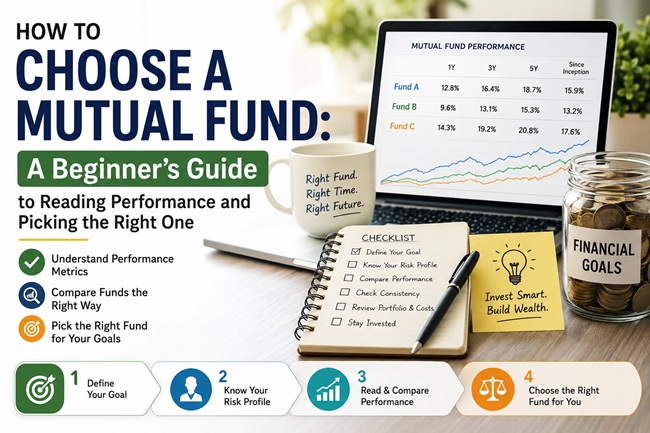
How to Choose a Mutual Fund: A Beginner’s Guide to Reading Performance and Picking the Right One

A cousin once asked me to just tell her “the best mutual fund” so she could start investing that weekend. When I asked what she was investing for and for how long, she paused. She didn’t actually know. She’d seen a fund mentioned in a YouTube video with a big return number in the thumbnail and figured that was enough information to go on.
Most first-time investors start exactly here, wanting a name rather than a process. The problem is that “best” doesn’t mean anything without context. The best fund for a 25-year-old investing for retirement looks nothing like the best fund for someone saving for a home loan down payment in three years. This guide walks through the actual process, from figuring out what you’re investing for to reading a fund’s numbers properly, so you can make this decision yourself instead of borrowing someone else’s answer.
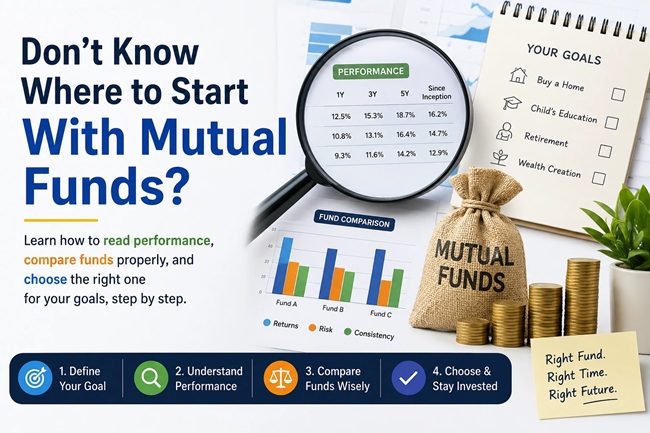
Steps to Choose A Mutual Fund
Step 1: Know What You’re Investing For Before You Look at Any Fund
This sounds obvious, but skipping it is the root cause of most bad mutual fund decisions. Your goal and timeline determine almost everything else, including which category of fund even makes sense for you.
If you need the money in one to three years, for something like a wedding or a planned large purchase, equity funds are usually the wrong tool entirely, regardless of how good their past returns look. Short time horizons don’t give equity markets enough time to recover from a downturn if one happens right before you need the money. Debt or liquid funds are more appropriate here.
If your goal is five years or more away, retirement, a child’s education, or long-term wealth building, equity funds become reasonable, since you have enough time to ride out volatility. The specific mix within equity, how much large cap versus mid cap versus small cap, still depends on your comfort with risk, but the broader category choice becomes much clearer once you’re honest about your timeline.
Step 2: Understand Your Own Risk Tolerance, Not Just the Fund’s
Every mutual fund in India is required to display a riskometer, a SEBI-mandated visual scale that rates the fund from Low to Very High risk based on six defined levels. This is a genuinely useful starting filter, but it only works if you’re honest about your own tolerance first.
Risk tolerance isn’t just about how much money you can technically afford to lose. It’s about how you’ll actually behave if your investment drops 20 percent in a few months. Plenty of investors who claim to have a “high risk appetite” panic and sell the moment their portfolio turns red, which defeats the entire purpose of taking on that risk in the first place. Being honest with yourself here matters more than picking whatever risk level sounds impressive.
Step 3: Learn Where to Actually Find Reliable Information
You don’t need paid tools to research mutual funds properly. A few free, credible sources cover almost everything a beginner needs.
AMFI’s website gives you official NAV data and access to each fund’s factsheet directly from the source. Value Research and Morningstar India both offer detailed fund analysis, including rolling returns, risk metrics, and fund manager history, often for free. Your AMC’s own website will also host the fund’s factsheet, updated monthly, which is where you’ll find the most granular portfolio breakdown.
For actually investing, platforms like Groww, Zerodha Coin, ET Money, and Paytm Money offer straightforward interfaces with built-in research tools, letting you compare funds side by side before committing. Direct investment through the AMC’s own website is also an option, and it typically carries a lower expense ratio since it cuts out the distributor commission, though it usually means researching and choosing funds entirely on your own.
Step 4: Read Performance the Right Way, Not the Way Most People Do
This is where most beginners go wrong. Looking at a single number, like “this fund gave 35 percent returns last year,” tells you almost nothing useful on its own.
Instead, look at rolling returns across multiple time periods, one year, three years, five years, and if available, ten years. A fund that’s consistently ranked well across all these windows tells you far more about reliability than a single standout year. The fund that topped the charts last year is frequently not the same fund that tops them the year after. Chasing last year’s winner is one of the most common and costly mistakes new investors make.
Just as important is comparing the fund’s returns against its benchmark index, not just against other funds in its category. A fund can look decent compared to its peers while still quietly underperforming the index it’s meant to beat, which is the entire point of paying for active management in the first place. If a fund has trailed its benchmark for an extended period, that’s a meaningful red flag worth taking seriously.
You May Also Like To Read:
- Large Cap vs Mid Cap vs Small Cap Funds: Which Risk Level Actually Fits You
- Mutual Fund Taxation Explained: LTCG, STCG, and the Rules Everyone Gets Wrong
- The Gold Investment Everyone Recommends That You Literally Cannot Buy in 2026
- Growth vs IDCW in Mutual Funds
- Direct vs Regular Mutual Funds
- Types of Mutual Funds in India (Equity, Debt, Hybrid & More Explained)
- How Mutual Funds Work Behind the Scenes: NAV, Units, and Fund Managers Explained
- What Is a Mutual Fund? A Complete Beginner’s Guide to How Your Money Actually Grows
Step 5: Check the Numbers That Actually Predict Future Reliability
Beyond returns, a handful of other metrics tell you a lot about whether a fund is likely to keep performing the way it has.
The expense ratio is the annual fee the fund charges, and it directly eats into your returns every single year, compounding over time. A difference of even half a percent between two similar funds can add up to a meaningful amount over a couple of decades, so this isn’t a detail to skip past.
Fund manager tenure and continuity matters more than most beginners realize. A fund’s strong five-year track record means far less if the manager responsible for that performance left last year and someone new has only been in charge for a few months. Check how long the current manager has actually been running the fund.
AUM, or assets under management, is worth glancing at too. Extremely rapid, sudden growth or sudden large outflows can sometimes signal instability, though a large, well-established AUM by itself isn’t necessarily a red flag for equity funds the way it can be for small cap funds, where too much money chasing too few good small companies can hurt future returns.
A Practical Checklist: What to Check and What It Tells You
| What to Check | Where to Find It | What It Tells You | Red Flag to Watch For |
|---|---|---|---|
| Rolling 3-5-10 year returns | Value Research, Morningstar, AMFI | Consistency over time, not a one-off good year | Strong 1-year return but weak 5-year and 10-year numbers |
| Performance vs benchmark | Fund factsheet, AMC website | Whether the fund is actually earning its fees | Trailing the benchmark for 18+ months consistently |
| Expense ratio | Fund factsheet | How much of your return gets eaten by fees annually | Noticeably higher than similar funds in the same category |
| Fund manager tenure | Factsheet, AMC website | Whether past performance reflects current management | Manager change with less than 1-2 years in the current role |
| Riskometer level | Fund factsheet, AMFI | Whether the fund’s risk matches your own tolerance | A mismatch between your comfort level and the fund’s rating |
| AUM trend | Factsheet, fund tracking platforms | Fund stability and size relative to its category | Sudden sharp inflows or outflows, especially in small cap funds |
| Portfolio overlap with other holdings | Portfolio overlap tools on research platforms | Whether you’re actually diversified or just holding duplicates | High overlap (over 50-60%) between funds you already own |
Step 6: Complete Your KYC and Pick a Platform
Before you can invest in any mutual fund, you need to complete KYC, Know Your Customer verification, which is mandatory under SEBI regulations. This is a one-time process, usually done online through Aadhaar and PAN verification, and once it’s done, you can invest across any AMC without repeating it each time.
From there, decide whether you want to invest through a platform like Groww, Zerodha Coin, ET Money, or Paytm Money, which bundle research tools with easy transactions, or go directly through the AMC’s own portal for a marginally lower expense ratio on direct plans. For a first-time investor, the convenience of a platform with built-in comparison tools is often worth more than the small cost difference, at least until you’re comfortable enough to research independently.
Step 7: Start With SIP and Review Without Overreacting
For most beginners, starting with a Systematic Investment Plan rather than a lump sum makes the process easier both financially and psychologically. SIPs let you invest a fixed amount regularly, average out your purchase cost over time, and avoid the pressure of trying to time when to invest a large sum all at once.
Once you’re invested, review your funds roughly every six months, not every week. Look at the same metrics covered above, rolling returns against the benchmark, fund manager continuity, and AUM stability, rather than reacting to short-term price movements. A reasonable rule many investors follow is to only consider exiting a fund if it has underperformed its benchmark for an extended period, generally well over a year, or if a manager change has clearly changed the fund’s approach for the worse. Market corrections, uncomfortable as they feel in the moment, are typically when continuing your SIP benefits you most through rupee cost averaging, not a signal to stop.
About This Guide
This article draws on SEBI’s mutual fund riskometer framework, AMFI’s official data and factsheet standards, and commonly used research tools like Value Research and Morningstar India, current as of 2026. Specific platform features, fund availability, and minimum investment amounts can change, so please verify current details directly on AMFI’s website or your chosen investment platform before acting. This guide is meant to build your own evaluation process rather than point you toward any specific fund.
Common Mistakes First-Time Investors Make
Chasing whichever fund had the best return last year is the single most common mistake, and it’s an easy trap because that’s exactly the information platforms and YouTube thumbnails tend to highlight. Consistency over several years matters far more than any single standout period.
Ignoring the expense ratio because the difference looks small on paper is another frequent one. A 1 percent annual difference compounded over 20 years can meaningfully shrink your final corpus, even though it feels negligible on any single statement.
Many beginners also stop their SIPs the moment the market drops, which undermines the entire rupee cost averaging benefit that makes SIP investing effective in the first place. Corrections are uncomfortable, but they’re also when your fixed monthly investment buys more units at a lower price.
Lastly, comparing a fund only against its category peers, without checking its performance against the actual benchmark index, can hide the fact that you’re paying active management fees for a fund that isn’t even beating a simple index over time.
My Take
If there’s one habit I’d want every beginner to walk away with, it’s checking a fund’s performance across multiple years and against its benchmark before checking anything else. Almost every other mistake on this list stems from skipping that one step and going straight to a headline return number instead. Investing doesn’t need to be complicated to be done well. It mostly needs to be done consistently, with a process you actually understand, rather than a name someone else handed you.
Frequently Asked Questions
1. How do I choose the best mutual fund as a beginner? Start by defining your financial goal and time horizon, then match that to an appropriate fund category, and finally compare specific funds within that category using rolling returns, expense ratio, and consistency against the benchmark, rather than a single year’s performance.
2. What is a good return to expect from a mutual fund? This varies significantly by category and market conditions, so there’s no single fixed number. Rather than chasing a specific return figure, focus on consistent performance relative to the fund’s own benchmark over multiple years.
3. What is the minimum amount needed to start investing in mutual funds? Most funds allow SIPs starting from as little as 500 rupees a month, making mutual funds accessible even for beginners with a limited starting budget.
4. How do I read a mutual fund factsheet? Focus on the fund’s category, expense ratio, rolling returns across multiple time periods, benchmark comparison, fund manager tenure, and the riskometer rating, all of which are typically listed on the monthly factsheet published by the AMC.
5. What is the difference between direct and regular mutual fund plans? Direct plans have a lower expense ratio since they exclude distributor commission, meaning slightly higher returns for the same fund, but require you to research and choose funds without advisor guidance.
6. How often should I review my mutual fund investments? Roughly every six months is a reasonable frequency for most long-term investors, focusing on rolling returns, benchmark comparison, and fund manager continuity rather than short-term price movements.
7. Should I stop my SIP if the market falls? Generally, no. Market corrections are typically when SIP investing benefits you most, since your fixed investment buys more units at lower prices, which can improve your average purchase cost over time.
8. What does the mutual fund riskometer mean? It’s a SEBI-mandated scale that rates a fund’s risk level from Low to Very High, based on six defined categories, helping investors match a fund’s risk profile to their own comfort level before investing.
9. Is a fund with a higher AUM always better? Not necessarily. A large, stable AUM can indicate investor trust, but extremely large AUM in small cap or mid cap funds can sometimes limit a fund manager’s flexibility to find good opportunities, potentially affecting future returns.
10. Where can I check a mutual fund’s official performance data for free? AMFI’s website provides official NAV and factsheet data, while platforms like Value Research and Morningstar India offer free, detailed performance analysis including rolling returns and risk metrics.
Disclaimer
This article is for informational and educational purposes only and does not constitute investment advice. Mutual fund investments are subject to market risk, and past performance does not guarantee future results. The tools, platforms, and metrics mentioned here are for illustrative purposes, and their availability or accuracy may change over time. Please read all scheme-related documents carefully and consult a qualified financial advisor before making investment decisions based on your individual financial situation.

Shuchi founded Finance Checks after spending 16+ years working in corporate, managing operations and distribution. She managed her own finances, learned and read regularly and helped people make sense of their savings, loans, insurance, and investments.
She started this site to offer the kind of clear, honest financial guidance she wished was more available when she was learning to manage her own money. Every article is researched personally, checked against official sources such as the Reserve Bank of India, SEBI, or the Income Tax Department, and revisited whenever regulations or figures change. She is upfront about how the site earns money through ads and select affiliate partnerships, and she does not let either influence what she actually recommends to readers.



[…] spouse, child, parent or another family member as a nominee in a bank account, insurance policy, mutual fund or investment, that person automatically becomes the legal owner of the money after their […]