

Arjun had been investing in stocks for almost a year, mostly on tips from a WhatsApp group and the occasional YouTube video. It worked out fine until one of his picks dropped 40% in three months, right after the company’s quarterly results came out. He went back and actually opened the balance sheet that had been sitting in the results PDF the whole time. He understood maybe two lines of it. Everything else looked like it was written for someone with a commerce degree and a decade of accounting experience.
That feeling stops a lot of retail investors from ever looking at the numbers behind a stock. They end up trusting a stock tip, a chart pattern, or a friend’s confidence instead of the company’s actual financial health. The irony is that a balance sheet isn’t actually that complicated once you know what the handful of important lines mean. You don’t need a finance degree. You need about twenty minutes and a checklist.
About This Guide
This guide breaks down a company’s balance sheet into the handful of numbers that actually matter for a retail investor, explains them in plain language, and shows you how to use them to sanity-check a stock before you buy it. It draws on how SEBI requires listed companies to disclose financials and on standard accounting definitions used across Indian annual reports, so you’re learning the same framework analysts use, just without the jargon.
What a Balance Sheet Actually Shows You
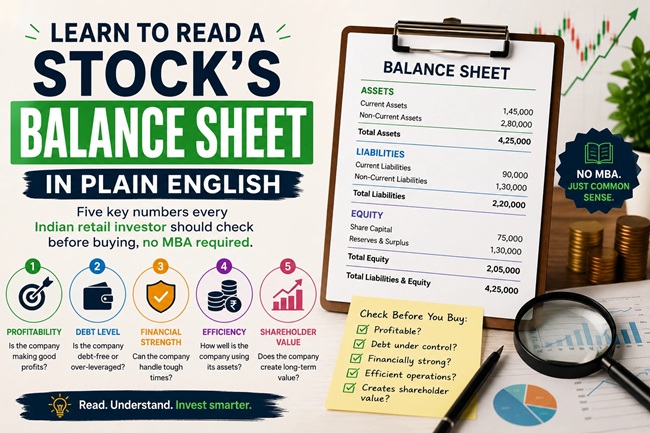
A balance sheet is a snapshot of what a company owns, what it owes, and what’s left over for shareholders, all measured on a specific date, usually the last day of a financial quarter or year. Unlike a profit and loss statement, which shows performance over a period, a balance sheet shows the company’s financial position at one single moment. Think of it like a photograph of the company’s bank locker on March 31st, not a video of the whole year.
Every balance sheet follows the same basic equation: Assets equal Liabilities plus Equity. In plain terms, everything the company owns was paid for either by money it borrowed (liabilities) or money that belongs to shareholders (equity). If that equation doesn’t balance, something in the accounting is wrong, which is exactly why it’s called a balance sheet.
Assets: What the Company Owns
Assets are split into two buckets. Current assets are things the company expects to convert into cash within a year, like inventory, receivables from customers, and cash itself. Non-current assets are longer-term holdings like factories, land, machinery, and investments the company plans to keep for years.
For a retail investor, the ratio between these two matters. A company sitting on a lot of cash and receivables generally has more flexibility than one whose money is tied up in factories and long-term investments, especially during a slowdown.
Liabilities: What the Company Owes
Liabilities work the same way. Current liabilities are debts due within a year, like supplier payments and short-term borrowings. Non-current liabilities are longer-term obligations, mainly long-term loans and bonds the company has issued.
The single most useful number here is total debt, and specifically how it compares to the company’s equity. A business with manageable debt can weather a bad year. A business drowning in debt can get wiped out by one.
Equity: What’s Left for Shareholders
Equity is what remains after you subtract liabilities from assets. It includes the money shareholders originally invested plus all the profits the company has kept and reinvested over the years, known as reserves and surplus. Rising equity year after year is usually a healthy sign. It means the company is either raising fresh capital sensibly or growing profits and holding onto them.
The Five Numbers That Actually Matter
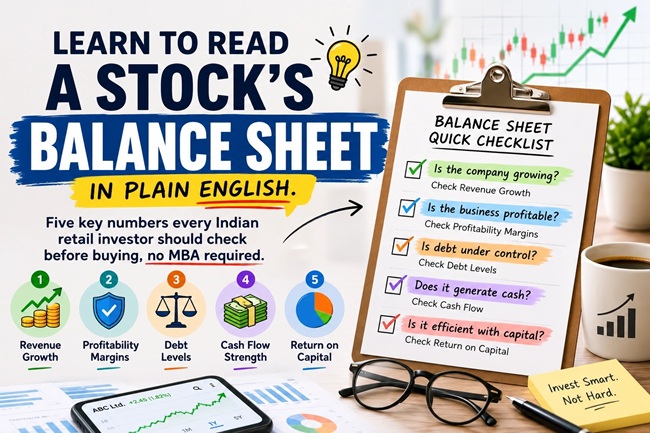
You don’t need to read every line of a balance sheet. These five tell you most of what you need to know.
Debt to Equity Ratio. This tells you how much of the company’s funding comes from borrowed money versus shareholder money. A ratio under 1 generally means the company owes less than what shareholders have put in, which is comfortable for most sectors. Capital-heavy industries like infrastructure and power tend to run higher ratios, so compare within the same sector rather than across sectors.
Current Ratio. This is current assets divided by current liabilities, and it tells you whether the company can pay its short-term bills without trouble. A ratio above 1 is generally reassuring. Well below 1, and the company may struggle to meet obligations due within the year.
Return on Equity (ROE). This measures how efficiently the company turns shareholder money into profit. A consistently high ROE, generally above 15%, suggests the business is good at generating returns on the capital it has, though it’s worth checking whether high ROE is coming from genuine profitability or simply high debt.
Reserves and Surplus Trend. Look at this figure across three to five years. Steadily rising reserves mean the company is consistently profitable and retaining earnings. A flat or shrinking number is a signal to dig into why.
Contingent Liabilities. This is usually tucked away in the notes to accounts, not the main balance sheet, and it’s the one most retail investors skip entirely. It lists potential future liabilities like pending lawsuits or disputed tax demands. A company with contingent liabilities larger than its net worth carries real hidden risk.
A Quick Comparison: Healthy vs Risky Balance Sheet Signals
| Metric | Healthy Signal | Warning Signal |
|---|---|---|
| Debt to Equity | Below 1, or in line with sector average | Rising sharply year over year |
| Current Ratio | Above 1 | Well below 1 for multiple quarters |
| Return on Equity | Consistently above 15% | High ROE driven mainly by heavy debt |
| Reserves and Surplus | Rising steadily each year | Flat, declining, or wiped out by losses |
| Contingent Liabilities | Small relative to net worth | Larger than net worth, or growing fast |
Where to Actually Find These Numbers
You don’t need paid software for any of this. Every listed company publishes its balance sheet in its quarterly and annual results, available on the BSE and NSE websites and on the company’s own investor relations page. Screener.in is a widely used free tool among Indian retail investors that pulls these numbers into a readable format and calculates most of the ratios above for you automatically, so you don’t have to do the math by hand every time.
Common Mistakes
Looking only at profit, never the balance sheet. A company can show rising profit while quietly piling up debt or letting receivables balloon. Profit tells you performance. The balance sheet tells you whether that performance is built on solid ground.
Comparing debt levels across different sectors. A debt to equity ratio that looks alarming for an IT company might be completely normal for a power or infrastructure company, since these businesses are capital-intensive by nature.
Ignoring the notes to accounts. Contingent liabilities, related party transactions, and accounting policy changes are often disclosed only in the notes, not the main statement, and they can change the picture entirely.
Checking the balance sheet only once. A single snapshot doesn’t tell you about direction. Always look at the trend across at least three to five years before drawing conclusions.
Treating every ratio as a strict pass or fail line. These are guidelines, not laws. A company with slightly higher debt might still be a sound investment if it has strong cash flows and a clear reason for that borrowing, like funding expansion in a growing market.
Frequently Asked Questions
1. Is a balance sheet the same as an annual report? No. The annual report is a much longer document that includes the balance sheet, profit and loss statement, cash flow statement, and management commentary, all together.
2. How often do companies publish their balance sheet? Listed companies in India publish financials quarterly, with a more detailed audited version in the annual report.
3. What’s a “good” debt to equity ratio? Generally under 1 is considered comfortable, but this varies significantly by sector, so always compare within the same industry.
4. Why do some strong companies still carry high debt? Debt isn’t inherently bad. Companies often borrow to fund expansion, and if that debt is generating higher returns than its cost, it can be a smart use of leverage.
5. What does “book value” mean? Book value is the company’s net worth (assets minus liabilities) divided by the number of shares outstanding. It’s one way to gauge whether a stock’s market price looks expensive relative to its underlying assets.
6. Should I avoid any company with contingent liabilities? Not necessarily. Almost every large company has some contingent liabilities. The concern is when they’re unusually large relative to the company’s net worth.
7. Where can I find a company’s balance sheet for free? BSE, NSE, the company’s investor relations page, and free tools like Screener.in all provide this information without cost.
8. Does a rising current ratio always mean a company is healthier? Usually, but an extremely high current ratio can also mean the company is sitting on too much idle cash or inventory instead of deploying it productively.
9. How is ROE different from ROI? ROE specifically measures return generated on shareholder equity. ROI is a broader term that can apply to any investment, not just a company’s equity base.
10. Do I need to read the balance sheet before every single stock purchase? For any stock you plan to hold for more than a few months, yes, it takes about twenty minutes and is one of the highest-value checks you can do before committing money.
Our Take
Reading a balance sheet isn’t about becoming an accountant. It’s about not being the last person to know when something’s wrong with a company you’ve put money into. Start with just the five numbers in this guide before every purchase. Once that becomes a habit, the rest of the balance sheet starts making a lot more sense on its own, and you’ll find yourself relying a lot less on tips and a lot more on what the numbers are actually telling you.
Disclaimer:
This article is for informational purposes only and does not constitute financial, investment, or tax advice. Please consult a certified financial advisor or chartered accountant before making financial decisions. FinanceChecks.com is not liable for any losses arising from the use of this information.

Shuchi founded Finance Checks after spending 16+ years working in corporate, managing operations and distribution. She managed her own finances, learned and read regularly and helped people make sense of their savings, loans, insurance, and investments.
She started this site to offer the kind of clear, honest financial guidance she wished was more available when she was learning to manage her own money. Every article is researched personally, checked against official sources such as the Reserve Bank of India, SEBI, or the Income Tax Department, and revisited whenever regulations or figures change. She is upfront about how the site earns money through ads and select affiliate partnerships, and she does not let either influence what she actually recommends to readers.