


Vikram had done his homework, or so he thought. He’d compared interest rates across two banks, picked the lower one, and signed the loan papers within a week of getting his offer letter accepted at a new job. Three months later, he was staring at a processing fee, a legal verification charge, a technical valuation fee, and GST on all of it, an amount that added up to nearly 80,000 rupees he hadn’t budgeted for. Then, six months in, his car loan EMI and his new home loan EMI together started eating close to 55 percent of his take-home salary, and he realized he’d never actually sat down and checked whether that was sustainable.
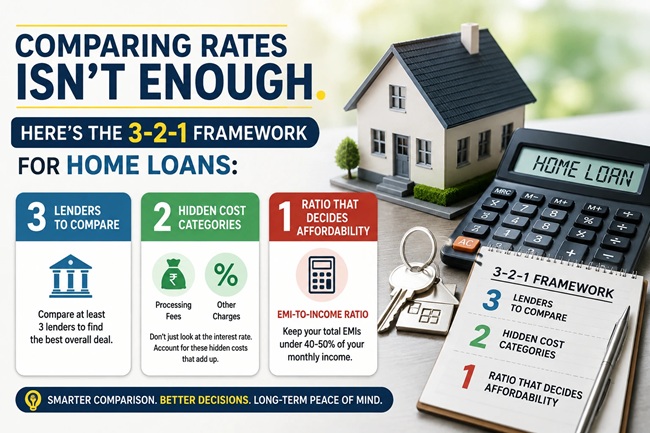
Vikram isn’t unusual. Most first-time home loan borrowers focus entirely on the interest rate and completely miss the three things that actually determine whether a home loan turns out to be manageable or miserable. We’ve distilled it into a simple framework we call the 3-2-1 rule, three lenders to compare, two hidden costs to budget for, and one number that decides whether you can actually afford the loan.
The “3”: Never Sign With the First Lender You Talk To
This is the part everyone technically knows but almost nobody actually does. Comparing at least three lenders before committing isn’t just about finding the lowest headline interest rate. It’s about comparing the full picture, because two lenders offering the “same” rate can end up costing you very differently once you look at processing fees, prepayment charges, and how flexible each one is if your situation changes.
When comparing lenders, look beyond the interest rate to the processing fee percentage, whether prepayment or foreclosure charges apply on your loan type, how quickly each lender processes disbursal, and whether the rate is linked to an external benchmark that moves transparently with RBI policy changes, versus an internal benchmark that a bank has more discretion over. A quarter percent difference in interest rate might matter less over your loan’s life than a lender that charges a hefty prepayment penalty right when you’re finally in a position to close the loan early.
It’s also worth checking your existing bank first, since many lenders offer preferential rates or reduced processing fees to customers with an existing salary account or long banking relationship, sometimes without advertising it. But even then, don’t skip the comparison entirely just because it’s convenient.
The “2”: The Two Cost Categories That Blindside First-Time Borrowers
The first hidden cost category is the bundle of charges that come with getting the loan itself, separate from the interest you’ll pay over time. This includes the processing fee, usually a percentage of the loan amount, along with GST on that fee, a legal verification charge for checking the property’s documents, and a technical valuation fee for assessing the property’s worth. Individually these look small. Added together, they can easily cross 1 to 1.5 percent of your loan amount, which on a reasonably sized home loan is a real number, not a rounding error.
The second cost category is everything that comes after disbursal that isn’t the EMI itself. This includes stamp duty and registration charges on the property, which vary significantly by state and can run into several lakhs on their own, along with ongoing costs like home insurance if your lender requires it, and any charges for services like an EMI payment mode change or a duplicate statement request down the line. None of these show up on the loan sanction letter’s headline numbers, but all of them show up in your bank account eventually.
The practical fix here is simple: before signing anything, ask your lender for a complete, itemised cost sheet, not just the interest rate and EMI amount, and separately budget for stamp duty and registration based on your state’s specific rates, since these alone can be 5 to 7 percent of the property value in several states.
The “1”: The One Ratio That Decides If You Can Actually Afford This
This is the number that matters more than almost anything else, and it’s the one Vikram skipped entirely. Lenders generally look at something called the Fixed Obligations to Income Ratio, or FOIR, which is the percentage of your take-home income that goes toward all your existing fixed monthly obligations combined, not just the new home loan EMI, but every other loan EMI and significant recurring commitment you already have.
Most lenders are comfortable approving loans where this ratio stays within roughly 40 to 50 percent of your net monthly income, though the exact threshold varies by lender and your income level. The problem is that lenders calculate this at the time of approval, based on your obligations then. They don’t recalculate it if you take on a new car loan a year later, or if your income growth doesn’t keep pace with your assumptions. It’s on you to keep tracking this ratio yourself, well after the loan is approved, not just once before signing.
A useful gut check: add up your home loan EMI, plus every other EMI you’re currently paying, plus any other fixed monthly commitment like a large recurring insurance premium. If that total crosses roughly half your take-home salary, you’re in a tighter spot than the sanction letter might suggest, even if the bank approved you for a larger loan than that.
The 3-2-1 Rule at a Glance
| The Rule | What It Means | Why It Gets Missed |
|---|---|---|
| 3 lenders | Compare at least three offers on rate, fees, and flexibility, not rate alone | People stop after finding a “good enough” rate |
| 2 hidden cost categories | Loan-origination charges (processing, legal, technical) and post-disbursal costs (stamp duty, registration, insurance) | These are quoted separately or not upfront, so they get missed until later |
| 1 affordability ratio | Your total fixed obligations, all EMIs combined, should generally stay within 40-50% of take-home income | Borrowers check affordability only against the new EMI, not their total existing debt |
About This Guide
The “3-2-1 rule” used in this article is a simplified framework created by FinanceChecks.com to make three genuinely important, but often scattered, pieces of home loan advice easier to remember together. It isn’t an official RBI or industry-designated term, unlike frameworks such as the widely used 20-30-40 rule for home buying. The underlying guidance, comparing multiple lenders, budgeting for both cost categories, and tracking your fixed obligations ratio, reflects standard, sound lending practices, but please verify specific charges, fee percentages, and FOIR thresholds with your chosen lender directly, since these vary by bank and change periodically.
Common Mistakes Home Loan Borrowers Make
Fixating on the interest rate alone is probably the single biggest one. A slightly lower rate from a lender with high processing fees, stiff prepayment penalties, and slower disbursal can end up costing more, in both money and stress, than a marginally higher rate from a more flexible lender.
Underestimating the total upfront cost is another frequent mistake. Many first-time borrowers budget precisely for their down payment and then get caught off guard by processing fees, legal charges, and especially stamp duty and registration, which can be a genuinely large number depending on the state and property value.
People also tend to calculate affordability based only on the new EMI, forgetting to factor in every other loan or major recurring commitment they’re already paying. A home loan that looks perfectly affordable in isolation can become genuinely stressful once it’s stacked on top of an existing car loan, education loan, or high insurance premium.
Finally, a lot of borrowers treat the sanction letter’s approved amount as a target to hit, rather than a ceiling to stay well under. Just because a bank is willing to lend you a certain amount doesn’t mean that amount fits comfortably into your actual monthly budget alongside everything else.
My Take
If I had to boil this whole framework down further, it’s this: the interest rate is the number banks want you focused on, because it’s the number that makes their offer look competitive. The two hidden cost categories and your own FOIR are the numbers that actually determine whether the loan feels manageable five years from now. Spend less time chasing the lowest possible rate across marginal differences, and more time getting a complete, itemised cost picture and being brutally honest with yourself about your total monthly obligations. That’s where the real risk in a home loan actually lives.
Frequently Asked Questions
1. What is the 3-2-1 rule for home loans? It’s a framework created by FinanceChecks.com to simplify home loan planning into three parts: comparing at least three lenders, budgeting for two categories of hidden costs, and keeping your total fixed obligations within a manageable ratio of your income. It isn’t an official regulatory term.
2. What hidden costs come with a home loan besides the EMI? Common hidden costs include the processing fee, GST on that fee, legal verification charges, technical valuation fees, stamp duty, registration charges, and home insurance if required by your lender.
3. What is FOIR in home loan approval? FOIR, or Fixed Obligations to Income Ratio, is the percentage of your take-home income that goes toward all your existing fixed monthly obligations, including all loan EMIs combined. Lenders typically prefer this to stay within roughly 40 to 50 percent of your net income.
4. How much does stamp duty add to a home loan cost in India? Stamp duty and registration charges vary by state and can range from roughly 5 to 7 percent of the property value in several states, making it one of the largest often-underestimated costs in a home purchase.
5. Should I always choose the lender with the lowest interest rate? Not necessarily. A lower rate can be offset by higher processing fees, stricter prepayment penalties, or slower service. It’s worth comparing the complete cost picture, not just the headline rate.
6. Does my existing car loan or personal loan affect my home loan eligibility? Yes. Lenders factor in all your existing fixed monthly obligations when calculating your FOIR, which can reduce the home loan amount you’re eligible for, even if your income alone would otherwise support a larger loan.
7. What is a good FOIR percentage for a home loan? Most lenders are comfortable with a FOIR of around 40 to 50 percent of take-home income, though this varies by lender and income bracket, and staying comfortably under this threshold generally leaves more financial cushion.
8. Can I negotiate the processing fee on a home loan? In many cases, yes, especially if you have an existing banking relationship with the lender or are comparing offers from multiple banks, which can sometimes be used as leverage during negotiation.
9. What is the difference between legal and technical charges on a home loan? Legal charges cover verification of the property’s ownership documents and title, while technical charges cover a valuation assessment of the property’s worth, both typically conducted by professionals engaged by the lender.
10. How can I check my own FOIR before applying for a home loan? Add up all your current fixed monthly obligations, including all EMIs and any large recurring commitments, then divide that by your monthly take-home income to get a rough percentage, which you can compare against the 40 to 50 percent range lenders typically use.
Disclaimer
This article is for informational and educational purposes only and does not constitute financial advice. The “3-2-1 rule” referenced here is an original framework created by FinanceChecks.com and is not an official term used by the RBI or the banking industry. Specific loan charges, fee structures, and eligibility criteria vary by lender and are subject to change. Please consult your bank or a qualified financial advisor and review your loan’s complete terms before making a borrowing decision.

Shuchi founded Finance Checks after spending 16+ years working in corporate, managing operations and distribution. She managed her own finances, learned and read regularly and helped people make sense of their savings, loans, insurance, and investments.
She started this site to offer the kind of clear, honest financial guidance she wished was more available when she was learning to manage her own money. Every article is researched personally, checked against official sources such as the Reserve Bank of India, SEBI, or the Income Tax Department, and revisited whenever regulations or figures change. She is upfront about how the site earns money through ads and select affiliate partnerships, and she does not let either influence what she actually recommends to readers.



[…] is one of the most common financial forks in the road for anyone with a home loan and some spare cash, and the honest answer depends on more than just comparing two interest rate […]
[…] you take a home loan or a loan against property, the bank keeps your original title documents — sale deed, mother […]