
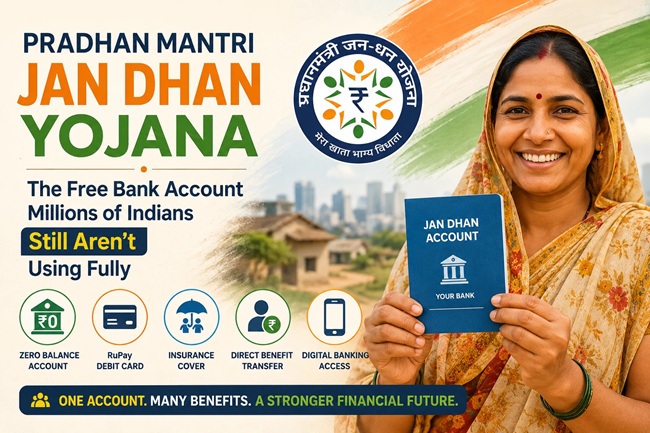
Pradhan Mantri Jan Dhan Yojana: The Free Bank Account Millions of Indians Still Aren’t Using Fully

Lakshmi’s mother had a Jan Dhan account for almost nine years before anyone in the family realized it came with built-in insurance. She’d opened it back in 2015 mainly because a local camp made it easy, used it occasionally to receive a small government subsidy, and never gave it much thought beyond that. She had no idea her RuPay debit card carried accidental insurance cover, or that six months of regular activity would have made her eligible for an emergency overdraft, features that had been sitting attached to her account the entire time, unused.
This is the story of Jan Dhan Yojana for a huge number of account holders. It’s the largest financial inclusion scheme in the world, over 55 crore accounts and counting, but a meaningful share of that reach hasn’t translated into people actually using everything the scheme offers. Here’s exactly what a Jan Dhan account gives you, what conditions quietly determine whether your benefits are actually active, and how to open one if you don’t have one yet.
What Pradhan Mantri Jan Dhan Yojana Actually Is
Launched on August 28, 2014, the Pradhan Mantri Jan Dhan Yojana set out to ensure every Indian household had access to at least one formal bank account, specifically targeting the large population that had never had one before. It’s built around a Basic Savings Bank Deposit Account that requires no minimum balance, a genuinely significant feature given how many traditional savings accounts penalize you for dipping below a minimum threshold.
The scale here is hard to overstate. More than 55 crore accounts have been opened under the scheme, including a substantial share from rural and semi-urban India, with combined deposits exceeding 2.3 lakh crore rupees. It’s widely regarded as the largest financial inclusion program of its kind anywhere in the world.
Pradhan Mantri Jan Dhan Yojana: The Core Features, and the Fine Print That Actually Matters
Zero balance banking. You don’t need to maintain any minimum balance in a PMJDY account, which removes the biggest practical barrier that’s historically kept low-income households away from formal banking.
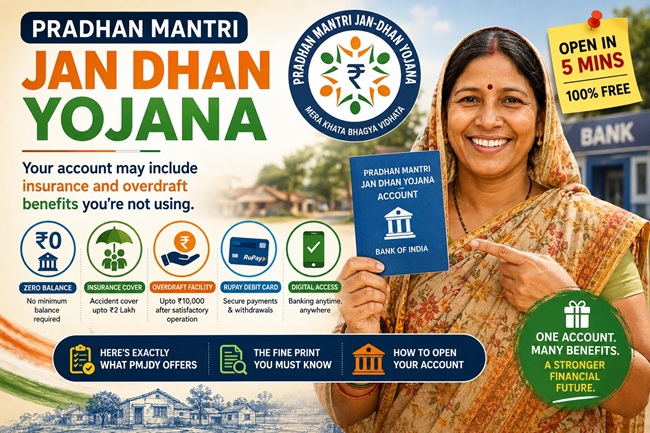
A free RuPay debit card with accidental insurance. Every PMJDY account comes with a RuPay debit card, and this card carries built-in accidental insurance. Here’s the detail that trips a lot of people up: the cover amount depends on when your card was issued. Cards issued before August 28, 2018 carry accidental insurance of 1 lakh rupees, while cards issued from that date onward carry 2 lakh rupees of cover. This single date is why you’ll see different insurance figures mentioned across different sources, and it’s worth checking which bracket your own card falls into.
There’s a second condition that matters even more, and it’s the one that most commonly leads to rejected claims. To keep this accidental insurance active, you need to have carried out at least one successful transaction, financial or non-financial, using your RuPay card at an ATM, point-of-sale terminal, or e-commerce platform within the 90 days before the accident. A card that’s never used, or hasn’t been used recently, can mean the insurance isn’t actually active when you need it, regardless of how long you’ve held the account.
Overdraft facility. After your account has been active for six months with regular usage and is Aadhaar-linked, you become eligible for an overdraft facility, short-term emergency credit you can draw against without a separate loan application. The original limit was 5,000 rupees, and this has since been expanded to up to 10,000 rupees under the scheme’s later phase, with priority typically given to women account holders within a household. Only one overdraft is generally sanctioned per household, so it’s worth checking with your specific bank on current eligibility and limits.
Life insurance for early accounts. If your account was opened specifically between August 15, 2014 and January 26, 2015, during the scheme’s initial launch window, you’re eligible for a 30,000 rupee life insurance cover. This is a narrow, time-limited benefit rather than a standard feature of every PMJDY account, so it applies to a fairly small, specific group of early adopters.
Direct Benefit Transfer integration. This might be the most consequential feature of all, even though it’s the least visible. PMJDY accounts are the backbone for Direct Benefit Transfer, the mechanism through which subsidies, scholarships, PM-KISAN payments, MGNREGA wages, and numerous other government scheme benefits get credited straight to beneficiaries, cutting out layers of intermediaries and reducing leakage. If you’re eligible for any DBT-linked scheme, having an active, correctly Aadhaar-linked PMJDY account is often the deciding factor in whether that money actually reaches you smoothly.
Pradhan Mantri Jan Dhan Yojana: Who Can Open an Account, and What You Need
Any Indian citizen aged 10 or above can open a PMJDY account. For a standard, full-featured account, you’ll need Aadhaar along with any other officially valid document, a Voter ID, PAN card, driving license, passport, NREGA job card, or a letter from a gazetted officer confirming your identity.
If you don’t have any of these documents at all, banks are required to offer a Small Account option, opened through self-declaration and a photograph. This comes with some restrictions, generally a cap on annual credits, a monthly withdrawal limit, and a validity period of 12 months, within which you’re expected to submit proper identification to upgrade to a full account. It’s a genuinely useful bridge option for someone who’s entirely outside the formal documentation system.
Opening an account itself is straightforward: walk into any public sector bank, private bank, or regional rural bank branch with your documents, and ask specifically for a Jan Dhan account, or a Basic Savings Bank Deposit Account if the branch staff use that terminology instead. There’s no fee to open one, and most banks can complete the process within about 30 minutes.
Pradhan Mantri Jan Dhan Yojana: What This Scheme Doesn’t Do
It’s worth being clear-eyed about the limitations too. PMJDY is fundamentally a basic banking and insurance access scheme, not a wealth-building tool. It doesn’t offer structured investment options, retirement planning, or meaningful interest growth beyond a standard savings account rate. If your financial goals extend beyond having a functioning, zero-balance bank account with basic insurance and overdraft access, you’ll need to look at other instruments, mutual funds, PPF, or the National Pension System, layered on top of this foundational account, not as a replacement for it.
There’s also a practical limitation worth knowing about: in many households, only one account, often the female head of the household’s, ends up as the “primary” Jan Dhan account for overdraft and certain benefits, which can occasionally limit direct access for other family members, particularly younger adults who might benefit from having their own account with these features.
A Quick Reference to PMJDY’s Core Benefits
| Feature | Detail |
|---|---|
| Minimum balance | None required |
| RuPay card accident insurance | ₹1 lakh (cards issued before Aug 28, 2018), ₹2 lakh (cards issued after) |
| Insurance activation condition | At least one RuPay card transaction within 90 days before the accident |
| Life insurance | ₹30,000, only for accounts opened Aug 15, 2014 – Jan 26, 2015 |
| Overdraft facility | Up to ₹10,000, after 6 months of regular account activity, Aadhaar-linked |
| DBT integration | Direct credit for subsidies, PM-KISAN, MGNREGA, scholarships, and more |
| Eligibility | Any Indian citizen aged 10 or above |
| Cost to open | Free |
About This Guide
This article reflects PMJDY’s features and figures as publicly reported in 2026, including the scheme’s phased expansion of overdraft limits and insurance cover since its 2014 launch. Specific benefit amounts, eligibility conditions, and account statistics are periodically updated by the Department of Financial Services, so please verify current details with your bank or on the official PMJDY portal before applying or claiming any benefit.
Common Mistakes Pradhan Mantri Jan Dhan Yojana Account Holders Make
Not using the RuPay card at all, or using it so rarely that the accidental insurance quietly lapses outside the required 90-day activity window, is probably the single most common and costly gap. A dormant card can mean a claim gets rejected exactly when a family needs the payout most.
Assuming the ₹2 lakh insurance figure applies to every account is another frequent misunderstanding. As covered above, this depends entirely on when your specific card was issued, and checking this detail in advance, rather than during a claim, avoids an unpleasant surprise.
Not linking Aadhaar properly is another quiet but consequential mistake, since Aadhaar linkage is a prerequisite for both the overdraft facility and smooth DBT credit. A mismatch or an unlinked account can cause a subsidy or benefit payment to silently fail without any clear notification to the account holder.
Finally, treating PMJDY as a complete financial plan on its own, rather than the foundational layer it’s designed to be, leaves many households without the additional insurance, savings, or retirement coverage that schemes like PMJJBY, PMSBY, and APY are specifically meant to add on top.
My Take on Pradhan Mantri Jan Dhan Yojana
The real achievement of PMJDY isn’t just the sheer number of accounts opened, it’s the infrastructure it quietly built underneath nearly every other government benefit that’s followed since. But infrastructure only helps the people who actually use it, and Lakshmi’s mother’s nine years of an underused account is a genuinely common story, not an unusual one. If you or someone in your family has a Jan Dhan account, it’s worth taking ten minutes to actually check three things: when the RuPay card was issued, whether it’s been used recently enough to keep the insurance active, and whether Aadhaar is properly linked. All three are usually free, quick fixes, and all three are the difference between a benefit that exists on paper and one that actually works when it’s needed.
Pradhan Mantri Jan Dhan Yojana: Frequently Asked Questions
1. Is Pradhan Mantri Jan Dhan Yojana still active in 2026? Yes, PMJDY remains an active, ongoing scheme, with the Department of Financial Services continuing to expand its features, including the current overdraft limit of up to ₹10,000 and updated insurance provisions.
2. How much accidental insurance does a Jan Dhan RuPay card provide? It depends on when the card was issued. Cards issued before August 28, 2018 carry ₹1 lakh of accidental insurance, while cards issued from that date onward carry ₹2 lakh.
3. Do I need to use my RuPay card regularly to keep the insurance active? Yes. To be eligible for the accidental insurance payout, you generally need to have made at least one successful transaction with the card within the 90 days before the accident occurred.
4. Can I open a Jan Dhan account without any identity documents? Yes, through a Small Account option, opened via self-declaration and a photograph, though this comes with transaction and balance limits and a 12-month validity period, within which you’re expected to provide proper ID to convert it to a full account.
5. How much overdraft can I get on a Jan Dhan account? Up to 10,000 rupees, available after your account has been active for six months with regular usage and is linked to Aadhaar. Only one overdraft is typically sanctioned per household.
6. Does every Jan Dhan account holder get life insurance? No, the 30,000 rupee life insurance benefit applies only to accounts opened during a specific window, between August 15, 2014 and January 26, 2015. Account holders outside this window can instead opt into PMJJBY separately for life cover.
7. Is there any charge for opening or maintaining a Jan Dhan account? No, opening a PMJDY account is free, and there’s no minimum balance requirement or standard maintenance charge.
8. How does a Jan Dhan account help with government subsidy payments? PMJDY accounts are central to Direct Benefit Transfer, meaning subsidies, scholarships, and scheme payments like PM-KISAN or MGNREGA wages are credited directly into the account, provided it’s properly Aadhaar-linked.
9. Can I upgrade a Small Account to a full Jan Dhan account later? Yes, by submitting valid identification documents within the account’s 12-month validity period, after which it converts to a full-featured account without the Small Account’s transaction and balance restrictions.
10. Who is eligible to open a Jan Dhan account? Any Indian citizen aged 10 or above is eligible, using Aadhaar along with another officially valid document, or through the Small Account route if no documents are available.
Disclaimer
This article is for informational and educational purposes only and does not constitute financial advice. Scheme features, benefit amounts, and eligibility criteria for PMJDY are subject to periodic revision by the Department of Financial Services and the Government of India. Please verify current details on the official PMJDY portal or with your bank before applying or making a claim.

Shuchi founded Finance Checks after spending 16+ years working in corporate, managing operations and distribution. She managed her own finances, learned and read regularly and helped people make sense of their savings, loans, insurance, and investments.
She started this site to offer the kind of clear, honest financial guidance she wished was more available when she was learning to manage her own money. Every article is researched personally, checked against official sources such as the Reserve Bank of India, SEBI, or the Income Tax Department, and revisited whenever regulations or figures change. She is upfront about how the site earns money through ads and select affiliate partnerships, and she does not let either influence what she actually recommends to readers.



[…] a minimum balance or pay routine account charges. If you’ve ever opened an account through a Jan Dhan Yojana enrollment or asked your bank for a “zero-balance account,” there’s a strong […]