
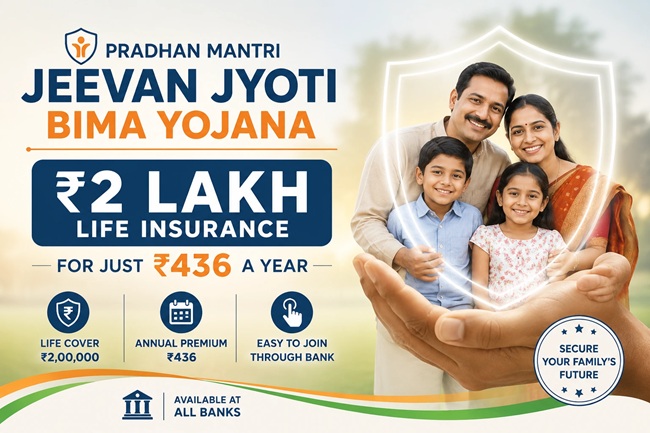
Pradhan Mantri Jeevan Jyoti Bima Yojana: ₹2 Lakh Life Insurance for 436 Rupees a Year

Suresh runs a small hardware shop and had never really thought about life insurance. It felt like something for people who could afford a “proper” policy with a relationship manager and a thick brochure explaining terms he’d never fully understand. When a bank employee mentioned he could get 2 lakh rupees of life cover for 436 rupees a year, just by linking it to his existing savings account, he assumed there had to be a catch. There wasn’t. He signed the consent form in about five minutes, and the premium now auto-debits from his account once a year without him having to think about it again.
PMJJBY is arguably the most underrated financial product available to the average Indian, precisely because it doesn’t look or feel like a “real” insurance policy. There’s no salesperson, no thick brochure, no medical exam. Here’s exactly what it covers, what it doesn’t, and the specific rules that determine whether a claim actually gets paid.
What Pradhan Mantri Jeevan Jyoti Bima Yojana Actually Is
Launched by the Ministry of Finance as part of the broader Jan Suraksha social security push, alongside its companion scheme PMSBY, the Pradhan Mantri Jeevan Jyoti Bima Yojana is a one-year term life insurance policy, renewable annually, offering 2 lakh rupees of life cover for a fixed annual premium. It covers death due to any cause, not just accidents, which is the key distinction from PMSBY, its lower-cost sibling scheme that covers accidental death and disability specifically.
The premium is currently 436 rupees a year, revised upward from the scheme’s original launch premium of 330 rupees when it began in 2015. The policy runs on a fixed annual cycle, from June 1 to May 31 the following year, and renews automatically each cycle through auto-debit from your linked bank account, provided you’ve given consent and maintain a sufficient balance on the debit date.
Pradhan Mantri Jeevan Jyoti Bima Yojana: Who Can Enroll, and Until What Age Coverage Lasts
You can join PMJJBY between the ages of 18 and 50, and you need an active savings bank account to enroll, since the premium is collected via auto-debit and any claim payout is credited directly to your nominee’s account. At enrollment, you’re required to provide a simple self-declaration of good health, there’s no medical examination or health checkup involved, which is a big part of what makes this scheme so accessible compared to a standard private term insurance policy.
Here’s a detail worth knowing clearly: if you enroll before turning 50, your coverage can continue all the way until you turn 55, as long as you keep renewing and paying the premium each year without a gap. This effectively gives you a meaningful multi-year window of coverage from a single enrollment decision made in your 30s or 40s, not just a single year of protection.
The 30-Day Waiting Period Most People Don’t Know About
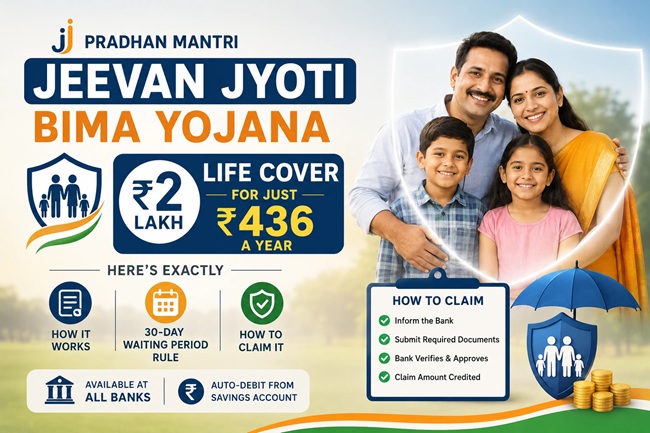
This is the single most important fine-print detail in the entire scheme, and it’s frequently missed. There’s a mandatory 30-day lien period from your date of enrollment. If the insured person dies of natural causes within these first 30 days, no claim is payable. However, this waiting period doesn’t apply to accidental death, which is covered from day one of enrollment, regardless of how recently you signed up.
This distinction matters practically. If you’re enrolling for the first time, it’s worth understanding that the “any cause” coverage the scheme is known for only fully kicks in after that first month, while accident-related coverage is immediate from day one.
Pradhan Mantri Jeevan Jyoti Bima Yojana: How to Actually Enroll
Enrollment is genuinely simple, most banks now offer it directly through net banking or a mobile banking app, in addition to visiting a branch in person. The process typically involves selecting PMJJBY from your bank’s insurance or government schemes section, confirming your bank account details, adding your nominee’s details, and giving written or digital consent for the annual auto-debit. Most banks complete this in a matter of minutes, and there’s no separate paperwork-heavy application process the way there would be with a private insurer.
It’s worth double-checking that your nominee details are entered correctly and kept up to date, since this is exactly what determines who receives the payout and how smoothly that process goes.
What Happens When a Claim Needs to Be Filed
If the insured person passes away, the nominee needs to approach the bank where the deceased held the savings account linked to the PMJJBY policy, carrying the death certificate and their own identification. The bank facilitates the claim process with the insurer administering the policy, typically LIC or another participating insurance company, depending on which insurer your specific bank has tied up with for the scheme.
Because the policy is directly linked to a specific bank account, keeping that account active and in good standing matters just as much as the policy itself. If the linked account is closed or the auto-debit fails due to insufficient balance and isn’t corrected, the coverage can lapse without a dramatic notification, quietly leaving a family without the protection they assumed was still active.
How Pradhan Mantri Jeevan Jyoti Bima Yojana Compares to a Private Term Insurance Policy
It’s worth being clear-eyed about what this scheme is, and isn’t. A 2 lakh rupee sum assured is a genuinely useful safety net, but it’s unlikely to be sufficient as someone’s only life insurance if they have significant financial dependents, a home loan, or children’s education to plan for. Private term insurance plans, while considerably more expensive, offer coverage that can run into a crore or more, medical underwriting that can sometimes secure better terms for healthy individuals, and considerably longer policy terms than PMJJBY’s renew-till-55 structure.
The realistic way to think about PMJJBY is as a low-cost, no-effort baseline, not a replacement for adequate life insurance if your family’s financial needs are substantial. For someone who currently has no life insurance at all, it’s an excellent, immediate starting point. For someone who’s already assessed they need significant coverage, it’s a sensible layer to keep alongside a larger private term policy, not a substitute for one.
Pradhan Mantri Jeevan Jyoti Bima Yojana at a Glance
| Feature | Detail |
|---|---|
| Life cover | ₹2 lakh, payable for death due to any cause |
| Annual premium | ₹436 |
| Eligibility age to join | 18 to 50 years |
| Coverage continues until | Age 55, if enrolled before 50 and renewed annually |
| Waiting period | 30 days for natural death; accidental death covered from day one |
| Health check required | No, only a self-declaration of good health |
| Policy cycle | June 1 to May 31, renewable annually |
| Premium collection | Auto-debit from linked bank account |
| Enrollment | Via bank branch, net banking, or mobile banking app |
About This Guide
This article reflects PMJJBY’s terms, premium, and eligibility criteria as they stand in 2026, including the scheme’s original 2015 launch premium of ₹330, later revised to the current ₹436. Specific administering insurers can vary by bank, and scheme terms are subject to periodic revision by the Ministry of Finance. Please verify current details with your bank or on the official PMJJBY documentation before enrolling or filing a claim.
Common Mistakes People Make With Pradhan Mantri Jeevan Jyoti Bima Yojana
Not checking whether the linked bank account has sufficient balance on the annual auto-debit date is a surprisingly common way coverage quietly lapses. Since renewal is meant to be automatic, it’s easy to assume the policy is continuously active without ever verifying the debit actually went through each year.
Assuming natural death is covered immediately upon enrollment is another frequent misunderstanding, given the 30-day waiting period that specifically applies to non-accidental death. Enrolling well in advance, rather than treating it as instant protection, matters here.
Treating PMJJBY as sufficient life insurance on its own, when your actual financial dependents and liabilities call for significantly more coverage, is a mistake worth avoiding too. It’s an excellent baseline, not necessarily an adequate ceiling.
Finally, not keeping nominee details updated after a major life change, marriage, the birth of a child, or a family restructuring, can create unnecessary complications for whoever is meant to receive the payout when it’s needed most.
My Take
What makes Pradhan Mantri Jeevan Jyoti Bima Yojana genuinely remarkable isn’t just the price, it’s how little friction stands between someone having zero life insurance and having a real, meaningful safety net in place. No medical exam, no lengthy paperwork, no salesperson pushing a policy you don’t fully understand, just a five-minute consent form linked to an account you probably already have. If you don’t currently have any life insurance at all, this is about as close to a no-excuse starting point as exists in Indian personal finance. The only real homework involved is remembering the 30-day waiting period, keeping your linked account funded each renewal date, and treating it as a floor to build on, not a ceiling to stop at.
Pradhan Mantri Jeevan Jyoti Bima Yojana : Frequently Asked Questions
1. What is the current premium for PMJJBY? The current annual premium is 436 rupees, revised upward from the scheme’s original launch premium of 330 rupees in 2015.
2. Does PMJJBY cover natural death or only accidents? It covers death due to any cause, including natural death and illness, not just accidents. This is the key difference from its companion scheme, PMSBY, which covers accidental death and disability specifically.
3. Is there a waiting period before PMJJBY coverage becomes active? Yes, there’s a mandatory 30-day waiting period from enrollment for natural death claims. Accidental death, however, is covered from day one of enrollment.
4. Who is eligible to join PMJJBY? Anyone between 18 and 50 years old with an active savings bank account can enroll, provided they submit a self-declaration of good health at the time of joining.
5. Until what age does PMJJBY coverage last? If you enroll before turning 50 and continue renewing annually without a gap, coverage can continue until you turn 55.
6. Do I need a medical checkup to enroll in PMJJBY? No, enrollment only requires a simple self-declaration of good health, with no medical examination required, unlike most private term insurance policies.
7. How is the PMJJBY premium paid? The premium is auto-debited annually from your linked savings bank account, based on your consent given at the time of enrollment.
8. How does a nominee claim the PMJJBY payout? The nominee needs to approach the bank where the deceased held the linked savings account, with the death certificate and their own identification, to initiate the claim process with the administering insurer.
9. Is PMJJBY enough life insurance on its own? For someone with significant financial dependents or liabilities, 2 lakh rupees may not be sufficient as standalone coverage. It works well as an affordable baseline, ideally supplemented with a larger private term insurance policy if your needs are greater.
10. What happens if I miss a premium payment? If the auto-debit fails due to insufficient balance and isn’t corrected, your PMJJBY coverage can lapse. You would generally need to re-enroll, subject to the eligibility age limit and a fresh waiting period, to restore coverage.
Disclaimer
This article is for informational and educational purposes only and does not constitute financial or insurance advice. PMJJBY’s premium, terms, and eligibility criteria are subject to periodic revision by the Ministry of Finance and participating insurers. Please verify current scheme details with your bank before enrolling, and consult a financial advisor to assess whether your overall life insurance coverage is adequate for your specific financial responsibilities.

Shuchi founded Finance Checks after spending 16+ years working in corporate, managing operations and distribution. She managed her own finances, learned and read regularly and helped people make sense of their savings, loans, insurance, and investments.
She started this site to offer the kind of clear, honest financial guidance she wished was more available when she was learning to manage her own money. Every article is researched personally, checked against official sources such as the Reserve Bank of India, SEBI, or the Income Tax Department, and revisited whenever regulations or figures change. She is upfront about how the site earns money through ads and select affiliate partnerships, and she does not let either influence what she actually recommends to readers.