
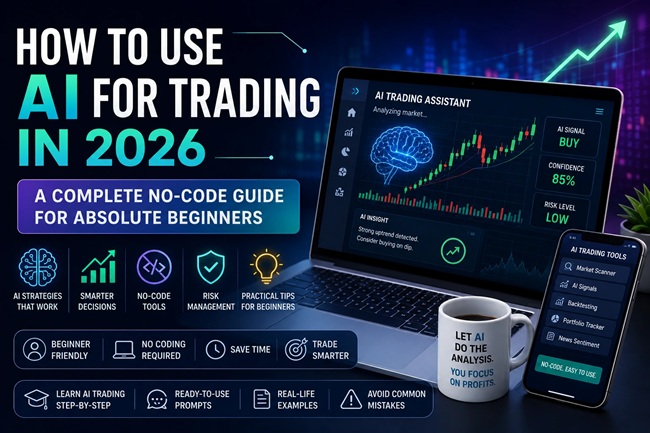
How to Use AI for Trading in 2026: A Complete No-Code AI Trading Guide for Absolute Beginners

If you have ever watched a candlestick chart move and thought “there is no way I can track all of this on my own,” you are not wrong. Markets today move on data volumes no human being can process in real time. That is exactly the gap artificial intelligence has stepped into, and the good news is you do not need to know a single line of code to use it.
This guide walks you through what AI for trading actually means, how it works in plain language, the tools people are using right now, and a step by step setup process you can follow even if the most technical thing you have ever done is set up a new phone.
What People Actually Mean When They Say “AI For Trading”
The phrase gets thrown around loosely, so let’s clear it up first. AI for trading generally falls into four buckets, and most tools you will come across do one or more of these:
- Market analysis and screening, where AI scans thousands of stocks or coins and flags ones matching certain patterns, so you are not manually scrolling through charts.
- Signal generation, where the AI tells you “this looks like a buy” or “this looks like a sell” based on technical indicators, price action, or news sentiment, but you still pull the trigger yourself.
- Strategy building without code, where you describe a trading idea in plain English or drag and drop conditions on a screen, and the platform converts that into a working strategy.
- Full automation, where once you set the rules, the system places trades on your behalf without you clicking anything, within limits you define.
None of these require you to understand machine learning, Python, or statistics. The platforms have already done that heavy lifting. Your job is to understand your goals, your risk tolerance, and how to read what the tool is telling you.
Do You Need to Know How to Code for AI for Trading? Honestly, No
This is probably the question weighing on you the most, so let’s address it directly. A few years ago, algorithmic trading genuinely required coding skills. You had to write scripts, connect to broker APIs, and debug your own logic. That barrier has largely disappeared.
Most modern platforms now offer what is called a no-code or low-code interface. You build strategies by picking conditions from dropdown menus, such as “buy when the 20 day moving average crosses above the 50 day moving average,” or you simply type your idea into a chat box and the platform translates it into a workable strategy. Some newer tools go a step further and let you describe a strategy in plain, everyday language, similar to how you would explain it to a friend, and the system builds the logic behind the scenes.
Coding knowledge becomes useful only if you want to build something highly customized later, connect to a broker’s raw API, or run your own predictive models. For everything a beginner needs in year one, it is not required.
What You Actually Need Before You Start AI for Trading
Before opening any app, get these basics in place. Skipping this step is where most beginners run into trouble later.
A trading or demat account with a regulated broker. In India this means a SEBI-registered broker such as Zerodha, Upstox, Angel One, or Groww. Outside India, use a regulated broker in your jurisdiction.
A clear idea of what you are trading. Stocks, options, futures, and crypto behave very differently, and AI tools are usually built with one asset class in mind. Decide this first.
A small amount of capital you are genuinely comfortable losing while you learn. Treat your first few months as tuition, not income.
A notebook or spreadsheet, digital or physical, to track what you tried and what happened. This matters more than people expect.
Patience for a testing phase. Every credible platform offers paper trading or backtesting, and skipping this step is the single most common beginner mistake.
Step by Step: Setting Up AI for Trading From Scratch
- Step 1: Open and verify your brokerage account
- Start with the broker, not the AI tool. Most AI for Trading platforms plug into your existing brokerage account rather than replacing it. Complete your KYC, link your bank account, and make sure your account is fully active before moving forward.
- Step 2: Decide what kind of help you actually want
- Be honest with yourself here. Do you want a tool that just tells you what to look at, so you still make the final call? Or do you want something that manages trades automatically once you set the rules? Beginners are generally better served starting with the first option, because it keeps you learning rather than just watching numbers move without understanding why.
- Step 3: Pick one platform and stick with it for a month
- Do not download five apps at once. Choose one tool that matches the asset class and comfort level from Step 2, and commit to learning it properly before adding anything else.
- Step 4: Run everything on paper trading first
- Every serious platform has a simulation or paper trading mode that uses real market data but fake money. Use it for at least two to four weeks. This is where you will find out whether a strategy actually behaves the way you expected, without risking a single rupee or dollar.
- Step 5: Backtest before you go live
- Backtesting shows you how a strategy would have performed on historical data. It is not a guarantee of future results, but it quickly tells you if an idea is fundamentally broken before you find out the expensive way.
- Step 6: Start live with the smallest possible size
- Once you move to real money, deploy the smallest position size the platform allows. The goal in month one of live trading is not profit, it is confirming that the system behaves in the real market the same way it did in testing.
- Step 7: Review weekly, not hourly
- Set a fixed time each week to review performance, not every few minutes. Constantly checking live trades leads to emotional decisions that undo the discipline the AI tool was supposed to provide in the first place.
Categories of AI for Trading Tools and Where Beginners Fit
- No-code strategy builders
- These let you build a trading strategy using indicators and conditions without writing code, and many now support backtesting on historical data before you deploy anything live. In India, this category is dominated by platforms tied to major brokers, letting you build and test strategies directly inside your existing trading account. Globally, similar platforms exist for stocks, ETFs, and crypto, letting you build logic based rules and connect them to supported brokerages.
- AI-assisted screeners and signal tools
- These scan the market for you and surface opportunities based on technical patterns, momentum, or unusual activity, along with probability based predictions rather than automated execution, leaving the final decision with you. This category is a gentle entry point because you stay in control of every trade while still getting the benefit of AI-driven pattern recognition.
- Options and derivatives specific AI tools
- For traders interested in options, some platforms use AI to recommend strategies based on your market view, calculate risk and reward automatically, and simplify what is otherwise a fairly complex area of the market. These are worth exploring only once you understand basic options concepts, since AI recommendations are only useful if you can evaluate whether they make sense.
- Fully automated crypto bots
- In the crypto space, bot platforms let you deploy strategies like grid trading or dollar cost averaging with no coding required. These operate around the clock, which is both the appeal and the risk, since a strategy left unattended can compound losses just as easily as gains if market conditions shift.
- Trade journaling and performance AI
- A category beginners often overlook is AI powered trade journals. These tools analyze your past trades, highlight recurring mistakes, and let you ask questions about your own trading history in plain language. For someone new to trading, understanding your own patterns is often more valuable in the first six months than any signal generating tool.
How to Actually Use These Tools Day to Day
Once you have picked a platform, a realistic daily or weekly routine looks something like this. Log in and check what the screener or signal tool flagged overnight or over the weekend. Cross check any flagged opportunity against your own basic understanding of the stock or asset, rather than accepting it blindly. If you are running an automated strategy, review whether it triggered any trades and whether those trades matched your risk rules. Update your trading journal with what worked and what did not. Adjust position sizing if you notice your losses are consistently larger than your wins, regardless of what the AI suggested.
The tool is there to remove grunt work and process large amounts of data quickly. It is not there to remove your judgment entirely, especially in the first year.
Common Mistakes Beginners Make With AI for Trading Tools
- Treating an AI signal as a guarantee rather than a probability. Every prediction comes with a confidence level or probability score for a reason, and ignoring that context is how accounts get wiped out quickly.
- Going fully automated before understanding the underlying strategy. If you cannot explain in one sentence why a strategy buys or sells, you are not ready to let it run unattended with real money.
- Skipping paper trading because it feels slow. This step exists specifically to catch problems before they cost you money, and skipping it defeats the purpose.
- Chasing every new tool that promises higher returns. Switching platforms every few weeks means you never actually learn any single system well enough to trust or improve it.
- Ignoring position sizing and risk limits. AI can pick a good entry point, but it cannot protect you from betting too much on a single trade unless you set that limit yourself.
A Realistic Way to Think About Results
AI for Trading tools are genuinely useful for cutting down research time, spotting patterns humans would miss, and removing some emotional decision making from the process. What they cannot do is guarantee profits, predict black swan events, or replace basic financial literacy. The traders who get real value from these tools are the ones who use them to support a plan they already understand, not as a replacement for having a plan at all.
Frequently Asked Questions About AI for Trading
Is AI for Trading legal in India and other countries?
Yes, in most jurisdictions, provided you trade through a regulated broker and comply with local exchange rules. In India, algorithmic and AI assisted trading is legal as long as it operates through SEBI registered brokers and follows exchange guidelines. Always confirm the regulatory status in your specific country before depositing funds anywhere.
Can I really start with zero coding knowledge?
Yes. No-code and natural language strategy builders exist specifically for this reason. You describe what you want, pick conditions from a menu, or select from pre-built templates, and the platform handles the technical execution.
How much money do I need to start?
This depends entirely on the asset class and broker, and many platforms let you begin exploring with very little capital or even in paper trading mode at no cost. The more important number is not how much you start with, but how much you are willing to lose while you are still learning, which should be an amount that does not affect your daily life if it goes to zero.
Will an AI trading tool guarantee profits?
No credible tool will honestly claim this, and you should treat any platform that promises guaranteed returns as a serious red flag. AI improves the quality and speed of your decision making, it does not eliminate market risk.
What is the difference between AI for Trading and algo trading?
Algo trading refers broadly to any trading executed through predefined rules or code, which may or may not involve AI. AI for Trading specifically uses machine learning or pattern recognition to generate insights, predictions, or adaptive strategies, and increasingly the two terms overlap since many algo platforms now use AI components.
Should a complete beginner start with automated trading or manual trading assisted by AI?
Start with AI assisted manual trading. Use screeners and signal tools to inform your decisions while you personally place each trade. This keeps you learning and in control while you build the experience needed to eventually trust a fully automated system, if that is a path you want to take at all.
How do I know if a strategy or platform is trustworthy?
Look for transparent backtesting data, a working paper trading mode, clear fee structures, and regulatory compliance with recognized brokers in your country. Be cautious of platforms that focus more on marketing and testimonials than on showing you how their system actually works.
Do I need different tools for stocks, options, and crypto?
Generally yes. Most platforms are built around one asset class because the data, regulations, and trading mechanics differ significantly. Pick the asset class you want to focus on first, then choose a tool built specifically for it.
Disclaimer
This article is for educational and informational purposes only and does not constitute financial, investment, or trading advice. Trading and investing in stocks, options, futures, and cryptocurrencies involves substantial risk of loss and is not suitable for every individual. Past performance of any strategy, tool, or backtest does not guarantee future results. Artificial intelligence tools can assist with analysis and execution but cannot eliminate market risk or guarantee profits. Before using any trading platform or AI tool, conduct your own research, verify the platform’s regulatory status in your jurisdiction, and consider consulting a licensed financial advisor who understands your personal financial situation. The mention of any specific platform or tool in this article does not constitute an endorsement, and the author and publisher accept no liability for any financial losses incurred as a result of decisions made based on this content.

Shuchi founded Finance Checks after spending 16+ years working in corporate, managing operations and distribution. She managed her own finances, learned and read regularly and helped people make sense of their savings, loans, insurance, and investments.
She started this site to offer the kind of clear, honest financial guidance she wished was more available when she was learning to manage her own money. Every article is researched personally, checked against official sources such as the Reserve Bank of India, SEBI, or the Income Tax Department, and revisited whenever regulations or figures change. She is upfront about how the site earns money through ads and select affiliate partnerships, and she does not let either influence what she actually recommends to readers.



This is one of those posts I’ll keep coming back to.