
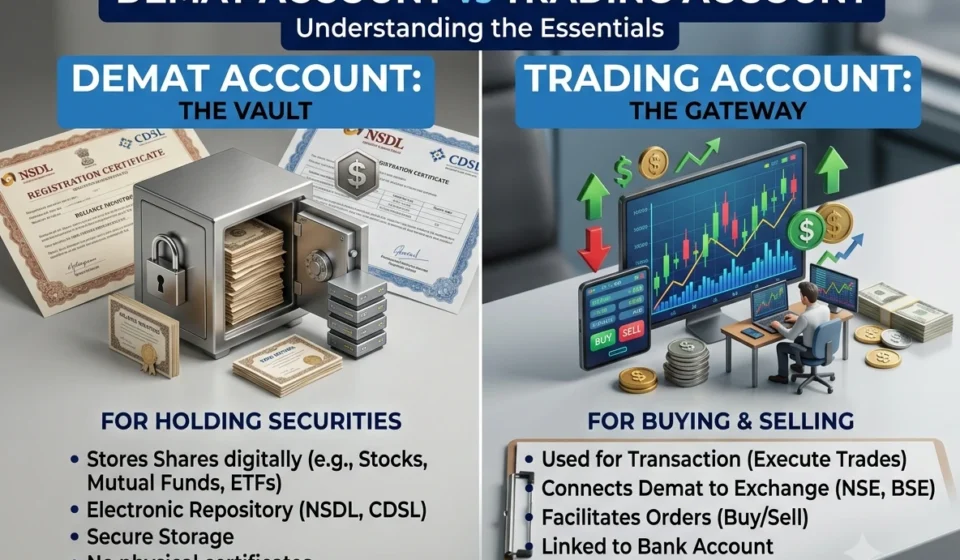
Demat Account vs Trading Account: What’s the Difference and Why You Need Both

A question I hear constantly, usually right after someone has decided to start investing, is whether a Demat account and a trading account are the same thing. The honest answer is no, though the confusion is understandable, since most brokers open both together and the whole process feels like one seamless step. But they serve two completely different purposes, and understanding that difference actually makes the rest of your investing journey much easier to follow.
In our last post, we walked through the process of opening these accounts. This time, we are slowing down on just this one distinction, because it comes up again and again once you start actually trading, checking statements, or troubleshooting why a transaction looks the way it does.
What a Demat Account Actually Does
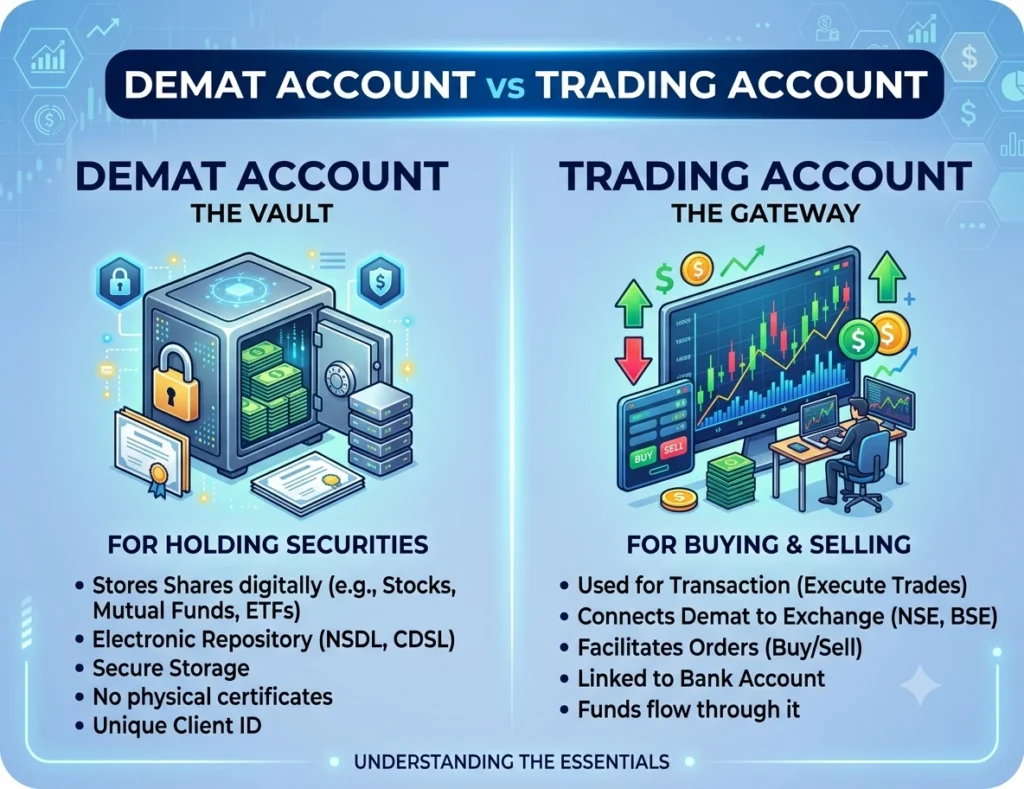
Demat is short for dematerialised, and the account exists purely to hold your investments in electronic form. Before the late 1990s, owning shares in India meant holding physical paper certificates, and transferring ownership meant physically signing over that certificate, which was slow and prone to fraud, loss, and forgery. The Demat system replaced all of that with digital records.
Your Demat account is maintained by a Depository Participant, which is usually the same broker you opened your account with, but the actual custody sits with one of two depositories in India, NSDL or CDSL. Think of your broker as the bank branch and the depository as the central vault. Everything you own, whether it is equity shares, mutual fund units held in electronic form, bonds, or ETFs, sits inside this account as a line item, the same way your salary sits as a number in your bank account rather than as physical cash.
A Demat account does not let you buy or sell anything on its own. It simply holds what you already own and reflects any changes after a transaction is completed elsewhere.
What a Trading Account Actually Does
The trading account is the account through which the actual buying and selling happens. When you log into your broker’s app and place an order to buy shares of a company, that order routes through your trading account to the stock exchange, either NSE or BSE. The exchange matches your buy order with someone else’s sell order, and the trade executes.
Once the trade settles, which in India typically happens within one working day under the T+1 settlement cycle, two things happen simultaneously. The shares get credited into your Demat account, and the money gets debited from your linked bank account through the trading account. Sell a share instead, and the reverse happens: shares leave your Demat account, and money lands in your bank account.
So the trading account is essentially the engine of activity, while the Demat account is the record of what you currently hold as a result of that activity.
The Simplest Way to Picture the Difference between Demat Account vs Trading Account
I find this analogy helps most people instantly. Imagine you are shopping online. The trading account is like the checkout page and payment gateway, where the actual transaction happens. The Demat account is like the delivery address and the box that shows up at your door, holding whatever you purchased. You cannot complete a purchase without the checkout process, and you cannot receive or store what you bought without somewhere for it to arrive.
Or think of a bank locker system. Your trading account behaves like your savings account, where money moves in and out based on transactions. Your Demat account behaves like a safety locker, where the actual valuables sit once the transaction is done.
Side by Side Comparison of Demat Account vs Trading Account
| Aspect | Demat Account | Trading Account |
|---|---|---|
| Primary function | Holds shares and securities electronically | Facilitates buying and selling of securities |
| Regulated by | Depositories, NSDL and CDSL | Stock exchanges, NSE and BSE |
| Managed through | Depository Participant, usually your broker | Stockbroker registered with SEBI |
| What it contains | Your existing holdings, shares, bonds, ETFs | Order history, buy and sell transactions |
| Linked to | Your bank account for holding value | Your bank account for fund transfers |
| Can you trade using only this account | No, holding shares requires this account but not placing orders | No, this alone cannot store the shares you buy |
You May Also Like To Read:
- How to Read a Stock Quote and Stock Chart: A Complete Beginner’s Guide
- How to Open a Demat and Trading Account in India: A Complete Step-by-Step Guide
- The Stock Market Glossary Every Beginner Actually Needs
- Why Should You Even Invest in Stock Market?
- What Is the Stock Market, and How Does It Actually Work?
Why You Cannot Use Just One of the Two
Some beginners assume they can skip one account and just use the other, so it is worth explaining directly why that does not work.
If you only had a trading account without a Demat account, you could technically place a buy order, but there would be nowhere for the shares to be credited once the trade executes. The transaction simply could not complete.
If you only had a Demat account without a trading account, you would have a place to hold securities, but no mechanism to actually purchase them in the first place, since all buying and selling happens through the exchange via a trading account.
This is exactly why brokers bundle both into a single onboarding flow today. The two accounts are functionally inseparable for anyone who wants to participate in the stock market, which is why the earlier era of separate, standalone applications for each has mostly disappeared.
A Common Misconception Worth Clearing Up
A lot of people assume the money sitting in their trading account balance is somehow separate or held by the broker in a way that puts it at risk if the broker runs into financial trouble. This is not accurate. Regulations require brokers to keep client funds in a separate account, distinct from the broker’s own operating funds, and SEBI has tightened these rules further over the years to protect investor money.
Similarly, people sometimes worry that if their broker shuts down or faces regulatory action, their shares disappear. This is also incorrect. Your shares are held with the depository, NSDL or CDSL, not with the broker itself. The broker is simply the intermediary managing your access to that depository record. Even if you had to shift to a new broker, your shares in the Demat account remain safe and are simply transferred, they do not vanish.
Charges Attached to Each Account
It helps to know that these two accounts often carry different types of charges, so your statement does not confuse you later.
The Demat account usually attracts an annual maintenance charge, billed once a year regardless of how frequently you trade, since it is essentially a storage fee. Some brokers waive this in the first year as a promotional offer.
The trading account typically does not have its own separate annual fee, but every transaction you place through it may attract brokerage, either a flat fee per trade or a percentage of the trade value depending on your broker’s structure, along with smaller regulatory charges like transaction charges, GST, stamp duty, and SEBI turnover fees.
Reading your contract note after every trade is a good habit to build early, since it breaks down exactly which of these charges applied to that specific transaction.
Why Understanding This Distinction Matters Practically
Beyond satisfying curiosity, this distinction actually helps in a few real situations. If you ever switch brokers, you will realise you are not starting from scratch, since your shares in the Demat account can be transferred to a new Depository Participant while your trading history stays associated with the old trading account. If you ever see a discrepancy between your holdings and your recent transactions, knowing which account handles which function makes it much easier to figure out where to look. And if you ever consult a tax professional about capital gains, they will often ask for your Demat account statement specifically, since that is the authoritative record of what you held and for how long, which directly affects whether a gain is classified as short-term or long-term.
Frequently Asked Questions on Demat Account vs Trading Account
Can I open a Demat account without a trading account? Technically yes, some banks and depositories allow a standalone Demat account, but you would not be able to buy new shares through it without a linked trading account.
Can I have a trading account without a Demat account? No, since any share you buy needs somewhere to be credited, and that is exclusively the Demat account.
Do I pay charges on both accounts every year? The Demat account typically has an annual maintenance charge. The trading account usually does not have a fixed yearly fee but attracts brokerage and regulatory charges per transaction.
If I switch my broker, do I lose my existing shares? No, your shares remain safe in your Demat account and can be transferred to a new Depository Participant when you switch brokers.
Is my money in the trading account safe if the broker shuts down? Client funds are required to be kept separate from the broker’s own funds under SEBI regulations, which is designed to protect investor money in such situations.
Can I hold mutual funds in my Demat account too? Yes, if you choose to hold mutual fund units in electronic form rather than through the fund house directly, they can sit in your Demat account alongside your shares.
What is the difference between NSDL and CDSL? Both are depositories that maintain electronic records of securities in India. Your broker will be affiliated with one or both, and the choice generally does not affect you as an investor.
How do I check my Demat account holdings? You can view this directly through your broker’s app or website, and NSDL and CDSL also offer consolidated account statements that show holdings across all your linked Demat accounts.
Does closing my trading account also close my Demat account? Not automatically. These are technically separate accounts, so you may need to close each one individually depending on your broker’s process, and any existing holdings would need to be transferred out first.
Disclaimer
This article is intended for general educational and informational purposes only and does not constitute investment advice, a recommendation, or a solicitation to buy or sell any security. Stock market investments are subject to market risks, and past performance is not indicative of future results. Charges, fee structures, and regulatory processes mentioned here are illustrative and subject to change over time; readers should verify current details directly with their broker, depository, or the relevant regulator. Please consult a SEBI-registered investment advisor or financial planner before making any investment decisions based on your personal financial situation.

Shuchi founded Finance Checks after spending 16+ years working in corporate, managing operations and distribution. She managed her own finances, learned and read regularly and helped people make sense of their savings, loans, insurance, and investments.
She started this site to offer the kind of clear, honest financial guidance she wished was more available when she was learning to manage her own money. Every article is researched personally, checked against official sources such as the Reserve Bank of India, SEBI, or the Income Tax Department, and revisited whenever regulations or figures change. She is upfront about how the site earns money through ads and select affiliate partnerships, and she does not let either influence what she actually recommends to readers.



[…] Demat Account vs Trading Account: What’s the Difference and Why You Need Both […]
[…] trading or demat account with a regulated broker. In India this means a SEBI-registered broker such as Zerodha, Upstox, […]