
What Happens to Your Money If Your Bank Shuts Down? The DICGC Insurance Guide Every Indian Should Read

Kavita had ₹9 lakh sitting in a fixed deposit with a small cooperative bank near her home, the same bank her parents had used for thirty years, the same bank where the manager knew her by name and always kept a plate of biscuits on the counter. She never once thought to ask what would happen to that money if the bank ran into trouble, because the question felt almost disrespectful, like doubting an old family friend. Then one Monday morning, she read that the RBI had placed a nearby cooperative bank under restrictions, freezing withdrawals for its depositors. Her stomach dropped. She pulled out her FD receipt, stared at the ₹9 lakh figure, and for the first time in three decades of banking with that branch, genuinely wondered: is my money actually safe here, and how much of it would I get back if the worst happened?
Kavita’s question is one almost nobody asks until it is too late to matter, and that is exactly the gap this article is meant to close.
Quick Answer
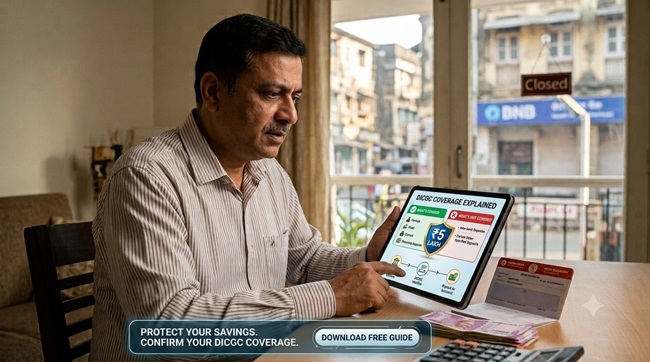
If a bank in India fails, is liquidated, or is placed under RBI restrictions, your deposits are protected by the Deposit Insurance and Credit Guarantee Corporation, or DICGC, a wholly owned subsidiary of the RBI. As of 2026, DICGC insures each depositor up to ₹5 lakh per bank, covering the combined principal and interest across all your savings, current, fixed, and recurring deposit accounts held in the same capacity at that bank. This ₹5 lakh limit currently protects close to 98 percent of all deposit accounts in India in full, though it may not cover the entire balance for depositors holding larger sums. The government has proposed raising this limit to somewhere between ₹7.5 lakh and ₹12 lakh, but as of this writing that increase has not yet been formally approved or notified, so ₹5 lakh remains the operative limit. If your bank is placed under RBI directions, DICGC is required to pay out the insured amount within 90 days.
About This Guide
This guide is based on DICGC’s official published rules, RBI data on insured banks, and recent government statements on the proposed increase to the deposit insurance limit, current as of August 2026. FinanceChecks.com is not a bank, an insurer, or a financial advisory service, and this article does not constitute financial advice. Deposit insurance rules can change following government approval, so always verify the current limit through DICGC’s official website before making financial decisions based on it.
What DICGC Actually Is
DICGC stands for Deposit Insurance and Credit Guarantee Corporation. It is a wholly owned subsidiary of the Reserve Bank of India, originally established in 1961 after the failure of two banks, Laxmi Bank and Palai Central Bank, exposed how vulnerable ordinary depositors were when a bank collapsed with no safety net in place. Its entire purpose is straightforward: to guarantee that depositors get at least a portion of their money back, automatically and without having to fight for it, if their bank fails.
Every bank licensed by the RBI is required to be registered with DICGC, and depositors do not pay any premium for this protection themselves, the cost is borne entirely by the banks, who pay a small premium to DICGC based on their deposit base. As of March 2026, there were 1,950 registered insured banks in India, made up of 124 commercial banks and 1,826 cooperative banks of various types, and the DICGC deposit insurance fund itself stood at ₹2,61,823 crore, having grown 14.4 percent over the previous year.
How Much Is Actually Covered
The current limit is ₹5 lakh per depositor, per bank, covering both principal and any accrued interest combined. This limit was last revised upward from ₹1 lakh to ₹5 lakh in February 2020, in the aftermath of the Punjab and Maharashtra Cooperative Bank crisis, and it has not changed since.
It is worth being precise about what “per depositor, per bank” actually means, because this is the detail most people get wrong. The ₹5 lakh cover applies to the combined total of everything you hold in a single bank in the same capacity, not to each individual account separately. If you have ₹3 lakh in a savings account and ₹4 lakh in a fixed deposit at the same bank, both under your own name, your total exposure at that bank is ₹7 lakh, but DICGC will only pay out ₹5 lakh, since it aggregates everything held in the same right and capacity. However, if you hold ₹5 lakh in State Bank of India and another ₹5 lakh in HDFC Bank, both amounts are fully covered independently, since the limit resets separately for each bank you use.
This also means that if you hold significant savings, splitting deposits across multiple banks, rather than concentrating everything in one institution, genuinely increases how much of your money is protected under this scheme. Holding accounts in different capacities within the same bank, such as an individual account, a joint account with a spouse, and an account where you act as guardian for a minor child, can also expand your effective coverage at that single bank, since DICGC treats deposits held in different legal capacities separately.
What Counts As Covered, and What Doesn’t
DICGC covers savings accounts, current accounts, fixed deposits, and recurring deposits held at any DICGC-registered bank, which includes commercial banks, small finance banks, payment banks, regional rural banks, and cooperative banks.
It does not cover deposits with non-banking financial companies, chit funds, or other finance companies that are not RBI-licensed banks, so if your money is parked with an NBFC offering an attractive fixed deposit rate, that money sits outside DICGC’s protection entirely. It also does not cover post office deposits, which have their own separate government backing rather than DICGC coverage, and it does not cover mutual fund investments, stocks, or insurance products, none of which are bank deposits in the first place.
What Actually Happens, Step by Step, When a Bank Fails
The process rarely starts with a sudden collapse. Typically, the RBI first identifies that a bank’s financial position looks shaky and places it under what is called Prompt Corrective Action, which restricts the bank from taking on risky new lending and forces it to work on improving its financial health under closer supervision. If the situation does not improve and the RBI concludes the bank cannot be saved in its current form, the RBI may cancel the bank’s license or place it under an All Inclusive Direction, which typically involves freezing or restricting depositor withdrawals while a resolution, whether liquidation, merger, or reconstruction, is worked out.
Once a bank reaches this point, DICGC’s obligation is triggered. The bank submits a list of its depositors and their balances to DICGC, and DICGC is required to settle and pay out the insured amount, up to the ₹5 lakh limit per depositor, within 90 days of receiving that final claim list. In FY26 alone, DICGC settled ₹1,988 crore in claims, and all of it related to urban cooperative banks that had been either liquidated or placed under directions, which tells you where the actual risk in India’s banking system tends to concentrate, smaller cooperative banks rather than large scheduled commercial banks.
Are Big Banks Like SBI, HDFC, or ICICI at Risk of Failing
This is worth addressing directly, because it is the fear that usually drives this question in the first place. SBI, HDFC Bank, and ICICI Bank are currently classified by the RBI as Domestic Systemically Important Banks, sometimes informally called “too big to fail,” meaning regulators actively monitor and manage these institutions with extra scrutiny precisely because their failure could destabilise the broader financial system, and the RBI has strong tools and strong incentive to intervene long before any of these institutions would reach a genuine failure scenario. Historically, essentially all DICGC payouts in India have related to smaller urban cooperative banks, not large scheduled commercial banks, which is a useful, calming data point if your deposits sit primarily with a major national bank.
One Thing DICGC Does Not Protect You From
A common misconception is that if your bank fails, any loan you owe that bank simply disappears along with it. That is not true. Your loan is an asset on the bank’s books, not a liability, and that obligation does not vanish if the bank is liquidated or merged; it typically transfers to whichever entity takes over the bank’s operations, whether that is an acquiring bank or a court-appointed liquidator managing the wind-down. You would still be expected to continue repaying it.
What You Should Actually Do With This Information
If you have more than ₹5 lakh sitting in deposits at a single bank, particularly a smaller cooperative bank rather than a large scheduled commercial bank, it is worth genuinely considering whether splitting that money across two or more banks makes sense for you, purely from a deposit insurance standpoint, separate from any interest rate considerations. This is especially relevant for retirees and anyone holding a large lump sum, like retirement corpus or property sale proceeds, in a single account for a temporary period.
It is also worth periodically checking whether your bank is on DICGC’s list of registered insured banks, particularly if you are dealing with a smaller cooperative or regional bank you are less familiar with, since this list is publicly available on DICGC’s official website.
My Take
What struck me researching this piece is how little most people think about deposit insurance until the exact week it becomes urgently relevant to them, the way Kavita only asked the question after her neighbourhood bank ran into trouble. That is not really a criticism of anyone’s financial awareness; it is just human nature to trust the systems that have quietly worked for decades without incident. But the ₹5 lakh limit has not moved since 2020, even as inflation, salaries, and typical household savings have all grown meaningfully in that time, which means the real, inflation-adjusted protection this scheme offers has been quietly shrinking even though the number on paper looks the same. If the proposed increase to ₹7.5 lakh or higher does eventually get approved, it will genuinely matter for a large number of Indian households, and it is worth watching for that formal notification rather than assuming it has already happened, since as of now it has not.
Frequently Asked Questions
1. What is the current DICGC deposit insurance limit in India? As of 2026, the DICGC insures deposits up to ₹5 lakh per depositor, per bank, covering both principal and accrued interest combined. This limit has been in effect since February 2020.
2. Is the ₹5 lakh limit about to increase? The government has proposed raising the limit, with figures ranging from ₹7.5 lakh to ₹12 lakh discussed at different points, and the finance ministry has sent a proposal for approval. However, as of this writing, no increase has been formally approved or notified, so ₹5 lakh remains the current, operative limit.
3. If I have multiple accounts at the same bank, is each one covered separately up to ₹5 lakh? No. DICGC aggregates all your deposits held in the same capacity at a single bank, savings, current, fixed, and recurring deposits combined, and covers the total only up to ₹5 lakh, not ₹5 lakh per individual account.
4. Are my deposits at different banks covered separately? Yes. The ₹5 lakh limit applies separately to each bank. If you hold ₹5 lakh at one bank and ₹5 lakh at another, both amounts are fully covered independently of each other.
5. Are large banks like SBI, HDFC Bank, or ICICI Bank at risk of failing? These banks are classified by the RBI as Domestic Systemically Important Banks and receive heightened regulatory scrutiny specifically because of their size and importance to the financial system. Historically, DICGC payouts in India have almost entirely involved smaller urban cooperative banks rather than large scheduled commercial banks.
6. Does DICGC cover fixed deposits with NBFCs or chit funds? No. DICGC coverage applies only to RBI-licensed banks. Deposits with non-banking financial companies, chit funds, or other finance companies are not covered under this scheme.
7. Does DICGC cover post office deposits? No. Post office deposit schemes have their own separate government-backed protection and are not covered under DICGC, which applies specifically to bank deposits.
8. How long does it take to get my money back if my bank fails? DICGC is required to settle and pay the insured amount within 90 days of receiving the final list of depositor claims from the bank or its liquidator.
9. If my bank fails, do I still have to repay my loan from that bank? Yes. Your loan obligation does not disappear if your bank fails. It typically transfers to the acquiring institution or the liquidator managing the bank’s wind-down, and you remain responsible for repaying it.
10. How can I increase my effective deposit insurance coverage? You can spread deposits across multiple DICGC-registered banks, since the ₹5 lakh limit applies separately per bank, and you can also hold accounts in different legal capacities, such as individual, joint, and guardian accounts, within the same bank, since DICGC treats deposits held in different capacities separately.
Disclaimer
This article is intended for general informational and educational purposes only and does not constitute financial or legal advice. FinanceChecks.com is not a bank, insurer, or financial advisory service. The information here reflects DICGC rules and government proposals as publicly reported as of August 2026, and deposit insurance limits are subject to change upon formal government approval and notification. Please verify the current limit and your bank’s DICGC registration status through DICGC’s official website, and consult a qualified financial advisor for guidance specific to your situation.

Shuchi founded Finance Checks after spending 16+ years working in corporate, managing operations and distribution. She managed her own finances, learned and read regularly and helped people make sense of their savings, loans, insurance, and investments.
She started this site to offer the kind of clear, honest financial guidance she wished was more available when she was learning to manage her own money. Every article is researched personally, checked against official sources such as the Reserve Bank of India, SEBI, or the Income Tax Department, and revisited whenever regulations or figures change. She is upfront about how the site earns money through ads and select affiliate partnerships, and she does not let either influence what she actually recommends to readers.