
Digital Arrest Scam Explained: How It Works, Why It Targets Elderly People, and What To Do

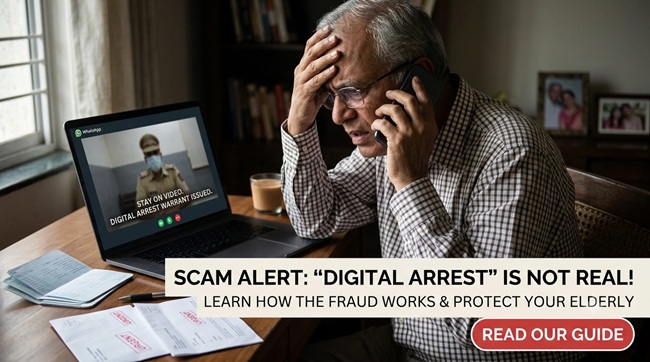
Ramesh Uncle, a retired bank employee in his seventies, was home alone one afternoon when his phone rang. The caller introduced himself as an officer from the Cyber Crime Cell and said a courier parcel booked in Ramesh Uncle’s name had been intercepted at the Mumbai airport, containing five passports, a bank card, and 200 grams of a banned substance. Before he could fully process what he had heard, the call switched to video. A man in what looked like a police uniform sat in front of an Ashoka emblem, a case file open on the desk, and told him he was now under “digital arrest” and could not disconnect the call, leave his house, or speak to anyone until the matter was “verified.” For the next six hours, Ramesh Uncle sat frozen in his chair, phone propped against a flower vase, while the “officer” instructed him to transfer his fixed deposit savings to a “RBI verification account” to prove his money was clean. It was only when his daughter, unable to reach him for hours, rushed over and saw the video call still running that the spell broke.
Ramesh Uncle’s story is not unusual. It is, with small variations in script and amount, the same story that has now happened to tens of thousands of people across India, and increasingly, that person is someone’s parent or grandparent.
Quick Answer
A digital arrest scam is a form of cyber fraud where criminals impersonate police officers, CBI, ED, RBI, TRAI, or customs officials over a phone or video call, falsely claim the victim is linked to a serious crime such as money laundering, drug trafficking, or a fake parcel containing illegal items, and then keep the victim under constant video surveillance while pressuring them to transfer money to “verify” their innocence or avoid arrest. There is no such legal concept as a digital arrest anywhere in Indian law. No court, police officer, or investigating agency can arrest, detain, or hold you under surveillance through a phone or video call. If this happens to you, the single most important action is to disconnect the call immediately and call the national cybercrime helpline at 1930, ideally within the first 24 hours, since that window offers the best chance of the bank freezing or reversing the transferred money.
About This Guide
This guide draws on reported cybercrime data from the Indian Cyber Crime Coordination Centre (I4C), recent Supreme Court directions on digital arrest fraud dated August 2026, and multiple verified news reports of digital arrest cases across India through 2025 and 2026. FinanceChecks.com is not a law enforcement agency, a legal advisory service, or affiliated with the police or cybercrime authorities. This article is meant purely to help you and your family recognise and respond to this specific fraud pattern. If you or someone you know is currently experiencing this scam, do not wait to finish reading this article, call 1930 right now.
How the Digital Arrest Scam Actually Works
The scam almost always follows a recognisable sequence, even though the specific accusation changes from case to case.
It usually begins with a phone call or a WhatsApp video call from a number that may look Indian or may show a foreign country code. The caller claims to represent an authority, commonly the Central Bureau of Investigation, the Enforcement Directorate, the Reserve Bank of India, the Telecom Regulatory Authority of India, Customs, or local police cyber cells. The opening accusation is designed to be alarming and specific enough to sound real: a parcel addressed to you has been seized containing drugs, fake passports, or weapons, or your Aadhaar or PAN has been used in a money laundering case, or your mobile number is linked to an FIR in a city you have never visited.
Once the fear response kicks in, the caller escalates to a video call. This is a deliberate psychological tactic, since a face on screen in a uniform, sitting in what looks like a police station with official emblems and case files visible, is far more convincing than a voice on the phone. Fraudsters use props, real-looking but fake ID cards, forged court orders, and even backgrounds resembling CBI or ED offices, to complete the illusion.
The victim is then told they are under “digital arrest” and must remain on the call continuously, sometimes for hours, sometimes for days. They are explicitly instructed not to hang up, not to contact family members or lawyers, and not to leave the frame of the camera. This isolation instruction is the core mechanism of the entire scam, because it prevents the one thing that would break it instantly: another person, calm and outside the fear spiral, looking at the situation and immediately recognising it as fraud.
While under this pressure, the victim is asked to transfer money, often described as a “verification deposit,” “RBI clearance fee,” “bail amount,” or funds moved to a “secret supervision account” that will supposedly be returned once the investigation clears them. In reality, the moment the money lands in the fraudster’s account, it is rapidly split and moved across dozens or even hundreds of other accounts, through RTGS transfers, cash withdrawals, and payment gateways, making it very difficult to trace or recover once time has passed.
Recent Cases That Show the Scale of This Problem
These are not rare, isolated incidents. Some of the more significant cases reported in Indian media through 2025 and 2026 illustrate just how much money is involved and how the tactic has evolved.
In April 2026, an elderly man in Mangaluru lost INR 2.07 crore after scammers posing as government investigators convinced him he was under investigation. In August 2026, a woman in Goa lost more than Rs 2.6 crore in a digital arrest scam after fraudsters kept her on a video call for nearly two weeks and convinced her to transfer money to so-called “Secret Supervision Accounts”, a case that later led investigators to a much larger money laundering network. A retired professor in Indore lost Rs 33 lakh, but because police acted quickly on his complaint, they managed to block and recover Rs 26.45 lakh of it, a rare example of how speed genuinely determines the outcome. In Delhi, a 92-year-old man lost Rs 2 crore to fraudsters impersonating TRAI and Maharashtra Police officials before the Delhi Police’s IFSO unit recovered and restored the full amount to him. In Himachal Pradesh’s Shimla, a father transferred Rs 93 lakh after being told his son had been implicated in a rape case, while another man in the same city lost Rs 38 lakh to a fake income tax raid threat.
The financial scale nationally is staggering. Cybercrime complaints on the National Cybercrime Reporting Portal rose sharply, and India’s Supreme Court has separately flagged losses of close to ₹30 billion, about $360 million, to cybercriminals posing as government or law enforcement officials in these scams. Between 2022 and 2025 alone, official figures point to over two lakh reported digital arrest and related scam cases nationally.
Why Elderly People Are Targeted So Frequently
If you have noticed that most of the reported victims are senior citizens, that is not a coincidence, it is a deliberate targeting strategy, and understanding why matters for protecting the older members of your own family.
Fraudsters specifically look for a combination of factors that make elderly people easier to manipulate. Older individuals, particularly those who worked in government service, banking, or other formal institutions for most of their lives, tend to carry a deep, ingrained respect for authority figures like police officers, judges, and government departments. That same respect, which served them well throughout their working lives, becomes the exact lever fraudsters pull to induce panic and compliance without question.
Many senior citizens also live alone or with a spouse while their children live in another city or abroad, which means there is often no one physically present to interrupt a scam call in progress or notice something is wrong for hours at a stretch. This social isolation is precisely what the “do not contact anyone” instruction is designed to exploit and preserve.
There is also a generational technology gap. Someone who has spent decades trusting that a phone call from an “official number” or a uniformed person on a video screen is exactly who they claim to be may not be as quick to recognise caller ID spoofing, doctored video backgrounds, or forged digital documents as someone who grew up navigating online scams from a younger age.
Finally, and perhaps most practically, elderly Indians are frequently sitting on the largest lump sums of accessible money in a household, retirement corpuses, fixed deposits, and pension savings accumulated over an entire career, which makes them a financially attractive target compared to someone with money still tied up in long-term investments or a salary that arrives in smaller monthly instalments.
What You Should Be Aware Of
There are a handful of facts that, once you know them, make this scam very difficult to fall for.
No Indian law allows any agency, police, CBI, ED, RBI, customs, or income tax, to arrest, detain, or place you under surveillance through a phone call or video call. Arrests in India require a physical process, documentation, and due legal procedure. A “digital arrest” as a legal concept simply does not exist.
No genuine government official will ever ask you to transfer money to a personal or “verification” bank account to prove your innocence, avoid arrest, or clear your name. Government fines and legal dues are never collected this way.
Genuine investigating officers do not conduct interrogations over WhatsApp video calls, nor do they instruct you to stay isolated from your own family during an “investigation.” Real legal processes involve written notices, documented summons, and the right to legal representation, not a demand for secrecy.
Caller ID and phone numbers can be spoofed to appear as if they are coming from a real police station or government department, so a number that looks legitimate is not proof that the call is genuine.
You May Also Like To Read About:
What To Do If You Receive Such a Call
Disconnect the call immediately. You are not obligated to stay on a call with anyone claiming police or investigative authority, and doing so is never how real legal processes work.
Do not transfer any money, no matter how convincing the documents, uniforms, or threats appear on screen.
Call the national cybercrime helpline at 1930 as soon as possible. If a transfer has already happened, speed matters enormously, since banks and cybercrime cells have the best chance of freezing the money if a complaint is filed within the first 24 hours.
File a complaint at cybercrime.gov.in, which is the official portal for reporting cyber fraud, and preserve any screenshots, call recordings, or messages as evidence.
Talk to a family member or someone you trust immediately, rather than staying isolated, since a second, calmer perspective is often what breaks the fear response the scam depends on.
If you have elderly parents or grandparents, consider having an open conversation with them about this specific scam pattern before it ever happens to them, since recognition in advance is far more effective than trying to reason with someone already mid-scam.
What Not To Do
Do not engage with the caller’s demands to “prove your innocence” through any financial transaction, however the request is framed, verification fee, bail amount, RBI clearance, or legal settlement.
Do not download any remote access or screen-sharing app the caller asks you to install, since this can hand over control of your device and banking apps directly to the fraudster.
Do not share your Aadhaar number, PAN, OTPs, or banking credentials over the call, regardless of how official the request sounds.
Do not stay silent about it out of embarrassment. Many victims delay reporting because they feel foolish for having believed the scam, but that delay is exactly what allows the stolen money to move beyond recovery. Every hour matters.
What the System Is Doing About This
This is not a problem the government has ignored. In August 2026, the Supreme Court, hearing a case on digital arrest fraud, passed interim directions instructing the RBI to formally adopt a standard operating procedure requiring banks to place temporary debit holds on accounts linked to money-mule activity and cyber-enabled fraud, and to implement a delayed transaction safeguard mechanism. States and law enforcement agencies were directed to operationalise a Grievance Redressal Module and a Money Restoration Module, and as of that order, a Money Restoration Mechanism Portal covering 57 participating banks and all States and Union Territories had already completed restoration in over 36,000 cases for an aggregate amount of more than Rs 18 crore. This tells you two things: recovery is genuinely possible when reported quickly, and the system is actively being strengthened, even though it still lags behind the pace at which the scam itself is evolving.
My Take
What strikes me most about digital arrest scams is how little technical sophistication they actually require compared to how much psychological sophistication they use. There is no hacking, no malware, no breach of your bank’s security in most of these cases. The entire scam works because it manufactures fear faster than a person’s rational mind can process it, and then it deliberately cuts off the one thing that would restore that rational thinking, another human being to talk to.
That is also exactly why I think the most effective protection is not a technical fix but a family conversation. If your parents or grandparents know, in advance and without any pressure in the moment, that no real police officer will ever arrest them over video call or ask them to transfer money to “prove innocence,” that single fact sitting quietly in their memory is worth more than any app or helpline number, because it gives them permission to hang up without guilt the moment a call like this begins.
Frequently Asked Questions
1. Is digital arrest a real legal process in India? No. There is no provision under Indian law that allows any police officer, court, or government agency to arrest, detain, or place someone under surveillance through a phone or video call. Any call claiming to do this is fraud.
2. What is the first thing I should do if I get such a call? Disconnect the call immediately. You are under no legal obligation to remain on a call with anyone claiming to be a police or investigating officer, and no genuine legal process works this way.
3. What number should I call to report a digital arrest scam? Call the national cybercrime helpline at 1930 as soon as possible, and file a complaint at cybercrime.gov.in. If money has already been transferred, acting within the first 24 hours significantly improves the chance of recovery.
4. Can the bank really get my money back if I’ve already transferred it? Sometimes, yes, but only if reported quickly. Cases like the Indore retired professor, who recovered Rs 26.45 lakh out of Rs 33 lakh lost, and the 92-year-old Delhi victim, who recovered his full Rs 2 crore, show that fast reporting through 1930 and local cyber cells can lead to accounts being frozen before the money is fully laundered away.
5. Why do fraudsters specifically target elderly people? Older individuals often carry a strong, ingrained respect for authority figures, may live alone or far from family, may be less familiar with digital fraud tactics like caller ID spoofing, and typically hold larger lump-sum savings like fixed deposits and pension funds, making them both easier to pressure and more financially rewarding to target.
6. What accusations do scammers typically use to create panic? Common scripts include a parcel addressed to you containing drugs or fake passports being intercepted, your Aadhaar or PAN being linked to a money laundering case, your phone number appearing in an FIR, or a family member being implicated in a serious crime like rape or financial fraud.
7. Should I install any app the caller asks me to download? No. Never install any remote access, screen-sharing, or “verification” app a caller instructs you to download, since this can give the fraudster direct control over your phone and banking apps.
8. Is it safe to share my Aadhaar or PAN number if the caller says it’s needed for verification? No. Never share Aadhaar, PAN, OTPs, or banking credentials over a call, regardless of how official or urgent the request sounds. Genuine government verification does not happen this way.
9. How can I protect my elderly parents from this scam? Have a calm, advance conversation with them about exactly how this scam works, emphasising the one fact that undoes it entirely: no real police officer will ever arrest them by video call or ask for money to prove innocence. Encourage them to call you immediately if they receive any such call, rather than staying isolated as instructed by the fraudster.
10. What is being done at the government level to address this? The Supreme Court issued interim directions in August 2026 requiring the RBI to implement standard procedures for freezing accounts linked to fraud and a delayed transaction safeguard, alongside a Money Restoration Mechanism Portal that has already restored funds in tens of thousands of cases across participating banks and states.
Disclaimer
This article is intended for general awareness and educational purposes only and is based on publicly reported cybercrime cases, government data, and court directions available as of August 2026. FinanceChecks.com is not a law enforcement agency, cybercrime authority, or legal service provider, and this article should not be treated as legal advice. If you or someone you know is currently experiencing a digital arrest scam or any other cyber fraud, contact the national cybercrime helpline at 1930 or visit cybercrime.gov.in immediately rather than relying solely on this guide.

Shuchi founded Finance Checks after spending 16+ years working in corporate, managing operations and distribution. She managed her own finances, learned and read regularly and helped people make sense of their savings, loans, insurance, and investments.
She started this site to offer the kind of clear, honest financial guidance she wished was more available when she was learning to manage her own money. Every article is researched personally, checked against official sources such as the Reserve Bank of India, SEBI, or the Income Tax Department, and revisited whenever regulations or figures change. She is upfront about how the site earns money through ads and select affiliate partnerships, and she does not let either influence what she actually recommends to readers.



[…] to mind are usually a scary phone call, a suspicious SMS with a link, or the now widely-discussed “digital arrest” video call scam. What gets far less attention, and arguably deserves just as much caution, is a fraud that […]