

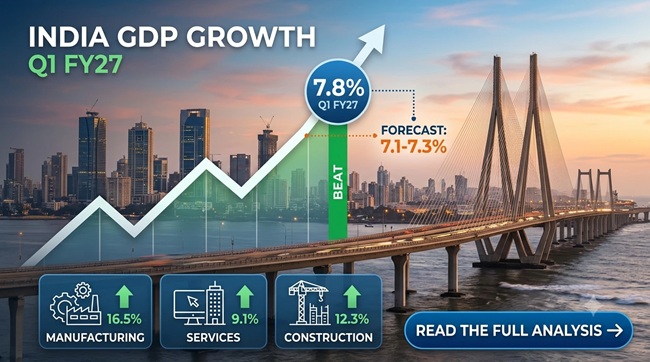
Quick answer: India’s real GDP expanded 7.8% year-on-year in the April–June quarter of fiscal year 2026-27 (Q1 FY27), according to data released by the Ministry of Statistics and Programme Implementation (MoSPI) on August 31, 2026. That figure beat the consensus economist estimate of 7.1–7.3% and the Reserve Bank of India’s own projection of 7%, reaffirming India’s position as the world’s fastest-growing major economy.
The Headline Numbers at a Glance
| Metric | Q1 FY27 (Apr–Jun 2026) | Q1 FY26 (Year Ago) | Change |
|---|---|---|---|
| Real GDP | ₹81.36 lakh crore | ₹75.46 lakh crore | +7.8% |
| Nominal GDP | ₹88.27 lakh crore | — | +10.3% |
| Gross Value Added (GVA) | ₹73.82 lakh crore | — | +8.2% |
| Govt. capex utilized | 27.8% of FY budget estimate | 24.5% | Up 3.3 pts |
These aren’t rounding-error beats. A 7.8% print against a 7.1–7.3% consensus is one of the widest positive surprises India’s GDP data has delivered in recent years, and it puts India comfortably ahead of every other G20 economy on growth for the quarter.
Why the Economy Outperformed Forecasts
Three forces did most of the work this quarter:
- 1. Manufacturing and construction did the heavy lifting. Both sectors posted growth well above the headline rate, pulling overall Gross Value Added up 8.2% to ₹73.82 lakh crore. Utility services also contributed meaningfully.
- 2. Government capital expenditure front-loaded hard. New Delhi deployed 27.8% of its entire annual capex budget in just the first quarter — up from 24.5% a year earlier. That’s a deliberate acceleration, and it shows up directly in construction and infrastructure-linked output.
- 3. High-frequency indicators confirmed the trend before the official print landed. Passenger vehicle sales jumped 24% in June alone, and electricity demand climbed sharply — both classic real-time proxies for consumption and industrial activity that had already signaled a stronger-than-expected quarter.
How Economists Got It Wrong
Before the release, a survey of 58 economists had pegged growth at a median of roughly 7.1%. Forecasters weren’t unanimous, though:
- SBI Research was the outlier bull, projecting growth near 8% on the back of consumption trends and industrial momentum — and it came closest to the actual number.
- ICRA and Bank of Baroda were more conservative, clustering around 7%, largely because of concerns about agricultural headwinds from an uneven monsoon.
- The RBI itself had projected just 7% for the quarter.
The gap between the RBI’s 7% call and the actual 7.8% print is the kind of surprise that tends to move bond yields, currency markets, and rate-cut expectations — worth watching in the RBI’s next Monetary Policy Committee commentary.
The One Weak Spot: Agriculture
Not every sector shared in the boom. Monsoon-related disruptions weighed on farm output this quarter, dragging on agriculture’s contribution to overall growth. That matters disproportionately in India because roughly 42% of the country’s workforce still depends on agriculture for its livelihood — so a soft farm sector affects rural incomes and consumption even when the headline GDP number looks strong.
Where This Fits in the Bigger Trend
This isn’t a one-off spike. Q1 FY27’s 7.8% matches the growth rate India posted in Q4 of the previous fiscal year, suggesting the momentum is durable rather than a statistical blip. For context:
- Full-year FY2025-26: the Indian economy expanded 7.7%.
- FY2026-27 outlook: projections currently sit around a similar 7.7%, though some economists expect the pace to moderate toward the mid-to-high 6% range later in the year as the extraordinary early-year momentum normalizes and softer private investment, a weaker rupee, and elevated crude oil prices weigh on the second half.
In other words, Q1 FY27 may represent a high point for the year rather than the new baseline — but even a “slowdown” to 7% territory would still make India the fastest-growing large economy on the planet.
What It Means for Investors and Businesses
- Equity markets: Strong GDP prints typically support risk-on sentiment in Indian equities, particularly in capital-goods, cement, and infrastructure stocks tied directly to government capex.
- Currency and rates: A growth beat this large reduces near-term pressure on the RBI to cut rates, since above-trend growth gives the central bank more room to prioritize inflation control.
- Corporate planning: Companies exposed to consumer durables and autos should note the 24% June surge in passenger vehicle sales as a genuine demand signal, not just a base-effect artifact.
- Global positioning: With most major economies growing at 1–3%, India’s 7.8% print reinforces its case as a primary destination for manufacturing diversification and foreign direct investment away from China-plus-one supply chain strategies.
Get The Latest Financial Updates on Financechecks.com
Frequently Asked Questions
What was India’s GDP growth rate in Q1 FY27? India’s real GDP grew 7.8% year-on-year in the April–June 2026 quarter (Q1 of fiscal year 2026-27), according to MoSPI data released on August 31, 2026.
Did India’s GDP growth beat expectations? Yes. The 7.8% figure beat the consensus economist forecast of 7.1–7.3% and exceeded the RBI’s own projection of 7% for the quarter.
What drove India’s GDP growth this quarter? Manufacturing, construction, and utility services were the primary drivers, supported by a sharp acceleration in government capital expenditure — 27.8% of the full-year capex budget was spent in Q1 alone.
Is India still the world’s fastest-growing major economy? Yes. At 7.8%, India’s growth rate remains well ahead of other major economies, most of which are growing in the 1–3% range.
What is dragging on India’s growth? Agriculture is the soft spot, with monsoon-related disruptions weighing on farm output. This is significant because about 42% of India’s workforce is employed in agriculture.
What is India’s full-year GDP growth forecast for FY2026-27? Current projections sit around 7.7% for the full fiscal year, though some economists expect growth to moderate toward the high-6% range in the second half as early-year momentum normalizes.
Sources: Ministry of Statistics and Programme Implementation (MoSPI), Reserve Bank of India (RBI). Data as of the August 31, 2026 release. This article is for informational purposes only and does not constitute financial or investment advice.

Shuchi founded Finance Checks after spending 16+ years working in corporate, managing operations and distribution. She managed her own finances, learned and read regularly and helped people make sense of their savings, loans, insurance, and investments.
She started this site to offer the kind of clear, honest financial guidance she wished was more available when she was learning to manage her own money. Every article is researched personally, checked against official sources such as the Reserve Bank of India, SEBI, or the Income Tax Department, and revisited whenever regulations or figures change. She is upfront about how the site earns money through ads and select affiliate partnerships, and she does not let either influence what she actually recommends to readers.