
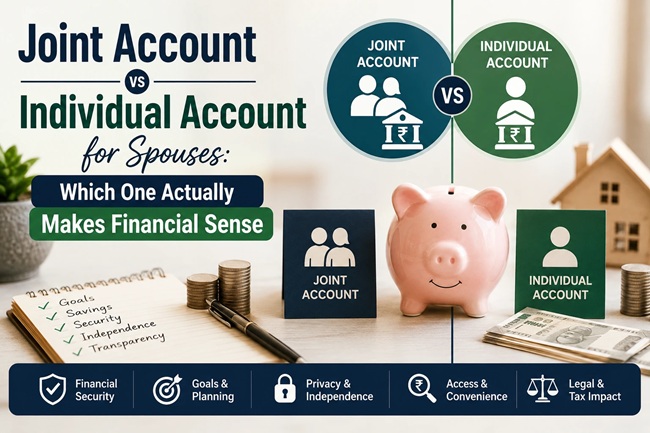
Joint Account vs Individual Account for Spouses: Which One Actually Makes Financial Sense

Neha and Vikram had been married for four months when the question came up almost by accident, while they were filling out a form for their new apartment’s maintenance deposit. “Should we just open one account together?” Vikram asked, half joking. Neha wasn’t sure. Her mother had always kept a separate account “just in case,” a phrase that had never made complete sense to her growing up but somehow felt important now that she was the one getting married. Vikram’s parents, on the other hand, had run one shared account their entire married life and swore by how much simpler it made everything. Four months in, Neha and Vikram still hadn’t decided, and every time the topic came up, it turned into a slightly tense half-conversation that never quite reached a conclusion.
If this sounds familiar, you’re not overthinking it. This is a genuinely practical decision with real financial, tax, and even emotional trade-offs on both sides, and most couples make it based on family habit rather than actually working through what fits their specific situation.
Quick Answer
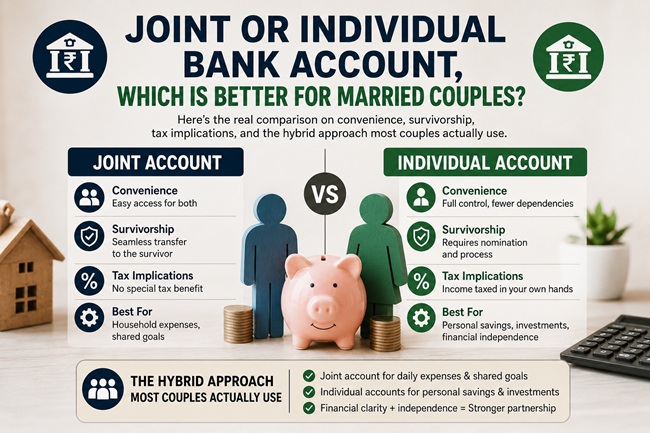
There is no universally correct answer between a joint account and individual accounts for a married couple; the right choice depends on how you want to manage shared expenses, how much financial independence each of you wants to retain, and your respective tax situations. A joint account simplifies shared household expenses, offers survivorship benefits that make it easier for the surviving spouse to access funds if one partner passes away, and can offer a modest tax advantage if structured with the lower-earning spouse as the primary holder. Individual accounts preserve financial independence, keep credit history and financial identity separate, and avoid the tax complication known as clubbing of income that can apply when money is moved between spouses. Many financially well-organised couples in India don’t actually choose one over the other; they run a joint account for shared expenses alongside individual accounts for personal spending and independent savings, which captures most of the benefits of both approaches.
About This Guide
This guide is based on RBI’s general banking guidelines on joint accounts, Income Tax Act provisions on clubbing of income under Sections 60 to 64, and current tax treatment of joint account interest as reported by tax advisory sources current to 2026. FinanceChecks.com is not a bank, tax consultancy, or financial advisory service, and this article does not constitute legal, tax, or financial advice specific to your situation. Tax outcomes depend on individual facts and can benefit from a qualified CA’s review, particularly around clubbing provisions.
What a Joint Account Actually Offers
- Simpler management of shared expenses. Rent, groceries, EMIs, utility bills, and other recurring household costs are far easier to track and pay from a single pool of money than by constantly splitting bills or transferring money back and forth between two individual accounts. For couples with genuinely merged finances and shared financial goals, this convenience is not a small thing; it removes a recurring source of friction from the relationship.
- Survivorship benefits that matter more than people expect. Most Indian joint accounts are opened under an “Either or Survivor” or “Anyone or Survivor” mandate, which means if one account holder passes away, the surviving holder can continue operating the account and accessing the funds without waiting for a lengthy succession or probate process. With an individual account, if the account holder passes away, the funds typically get frozen until legal heirs complete a formal succession process, which can take weeks or months even in straightforward cases, and considerably longer if there’s any family dispute involved. This single feature is often the most underrated reason financial planners recommend at least one joint account for a married couple, since it directly protects the surviving spouse’s immediate access to household funds during an already difficult time.
- A modest tax advantage, if structured correctly. Interest earned on a joint account is taxable, but the bank generally reports it under the primary account holder’s PAN for TDS purposes. Because of this, some tax advisors suggest making the spouse with the lower income, and therefore the lower tax slab, the primary holder on a joint savings or fixed deposit account, since a larger share of the practical tax reporting burden then falls on the lower tax bracket. This is a genuine, commonly used technique, though it’s worth doing carefully and ideally with a CA’s input, since the underlying legal position is that tax liability follows actual beneficial ownership and contribution, not simply whose name appears first on the account.
- Combined banking relationship benefits. A joint account with a healthy average balance can sometimes help a couple collectively qualify for premium banking relationships, lower loan processing fees, or better terms on products like locker rentals, that either partner individually might not qualify for alone.
What an Individual Account Actually Offers
- Genuine financial independence. An individual account is entirely yours to manage, without needing to discuss, justify, or coordinate every transaction with your spouse. For many people, particularly those who’ve built their own career and financial habits before marriage, this isn’t about secrecy; it’s about retaining a basic sense of financial autonomy within the relationship, which several relationship counsellors and financial planners specifically recommend preserving even within an otherwise financially merged marriage.
- A clean, separate credit and financial history. Your individual account activity, and more importantly your individual credit card and loan repayment history, builds a credit profile that belongs entirely to you. This matters concretely if you ever need to apply for a loan independently, if your spouse has a credit issue you’d rather not be automatically entangled with, or simply if you want your own financial track record to remain clearly attributable to your own decisions.
- Avoiding the clubbing of income complication. This is a genuinely underappreciated point. Under Sections 60 to 64 of the Income Tax Act, if one spouse transfers money or an income-generating asset to the other without adequate consideration, meaning as a gift rather than a loan or fair exchange, any income earned on that transferred amount gets clubbed back into the transferring spouse’s taxable income, not taxed in the recipient’s hands. This is specifically designed to prevent a higher-earning spouse from parking money with a non-working or lower-earning spouse purely to reduce the household’s overall tax burden. Keeping finances genuinely separate, or structuring any transfers between spouses as a documented loan with fair interest and traceable repayment through banking channels rather than as an informal gift, avoids this complication entirely.
- Simplicity in case of separation or disputes. While not a pleasant thing to plan for, individual accounts avoid the genuinely messy process of untangling a shared account if a marriage runs into serious difficulty, since joint account funds and the question of each partner’s actual contribution can become a real point of dispute.
The Tax Detail Almost Nobody Checks: Whose PAN Actually Gets the Notice
Here’s a specific, practical issue that has been causing real problems for Indian couples, and particularly for elderly joint account holders. Even though interest on a joint account is legally taxable in the hands of both holders based on actual contribution and beneficial ownership, banks typically report the full interest income against the primary holder’s PAN for TDS purposes. Tax authorities have increasingly been sending scrutiny notices based on this PAN-linked reporting, and chartered accountants have flagged that this is disproportionately catching non-contributing second holders, very often an elderly spouse who is listed as a joint holder on an account they didn’t actually fund, since the automated matching system doesn’t easily distinguish between “named on the account” and “actual economic owner of the money.” If you do maintain a joint account, it’s worth keeping a basic paper trail, whose salary or funds actually go into the account, and how income is genuinely being split, so that you have something concrete to show if either of you ever receives a mismatched notice.
A Practical Middle Path Many Couples Use
Rather than treating this as a binary choice, a genuinely common and workable approach is to run both. A joint account handles shared, recurring household expenses, rent or EMI, groceries, utilities, and joint savings goals like a vacation fund or a child’s education corpus, funded by both partners according to whatever split feels fair to them. Alongside that, each partner keeps their own individual account for salary credit, personal spending, and independent savings or investments they don’t need to discuss transaction by transaction. This structure captures the survivorship and convenience benefits of a joint account for the money that’s genuinely shared, while preserving individual financial independence and avoiding unnecessary clubbing complications for money that isn’t.
Questions Worth Discussing Before You Decide
How do you want to split contributions to shared expenses, equally, proportionate to income, or some other arrangement you both find fair? What operating mandate do you want on a joint account if you open one, “Either or Survivor” gives both partners full independent access, which is the most common and generally most practical choice for a spouse relationship? And are there specific financial goals, an emergency fund, a large purchase, a joint investment, that you’d specifically want to fund and track together rather than leaving informally split across both your individual accounts?
My Take
I don’t think this decision is really about which account structure is objectively better, because both genuinely work well for different couples depending on how they want to run their shared life. What I’d actually push back on is deciding this purely based on what your parents did, the way both Neha and Vikram were unconsciously doing, since a couple’s actual financial situation, income gap, individual career trajectories, and comfort with shared versus separate money, rarely maps cleanly onto what worked for the previous generation. The hybrid approach, a joint account for the shared load and individual accounts for personal independence, tends to be the quiet, practical choice that most financially thoughtful couples eventually land on, not because it’s trendy, but because it genuinely captures the real upside of both without forcing an all-or-nothing trade-off.
Frequently Asked Questions
1. Is a joint account or an individual account better for a married couple? Neither is universally better. A joint account offers convenience and survivorship benefits for shared expenses, while individual accounts preserve financial independence and avoid certain tax complications. Many couples use both, a joint account for shared costs and individual accounts for personal finances.
2. What happens to a joint account if one spouse passes away? Under the common “Either or Survivor” mandate, the surviving spouse can continue operating the account and accessing funds without waiting for a formal succession or probate process, which is one of the most practically valuable benefits of a joint account.
3. Is interest earned on a joint account taxable, and who pays the tax? Yes, it’s taxable, and legally the tax liability follows actual contribution and beneficial ownership, not just whose name is on the account. In practice, banks typically report the full interest under the primary holder’s PAN for TDS purposes, which is why some couples strategically choose the lower-earning spouse as the primary holder.
4. What is “clubbing of income” and how does it affect spouses? Under Sections 60 to 64 of the Income Tax Act, if one spouse transfers money as a gift to the other without adequate consideration, any income earned on that money is taxed in the transferring spouse’s hands, not the recipient’s, specifically to prevent income-shifting for tax reduction. Structuring transfers as a documented loan with traceable repayment avoids this.
5. Can elderly parents or a non-working spouse get an unexpected tax notice from a joint account? Yes, this has become a genuine, reported issue. Since banks report joint account interest against the primary holder’s PAN, non-contributing second holders, often an elderly spouse, have received scrutiny notices for interest income they didn’t actually earn, due to how the automated PAN-matching system works.
6. How many people can be added to a joint account in India? The RBI does not prescribe a fixed maximum, but individual banks generally allow between two and four joint holders on a single account.
7. What operating mandate should a married couple choose for a joint account? “Either or Survivor” is the most commonly used and generally most practical mandate for a spouse relationship, since it allows either partner to operate the account independently while ensuring the surviving spouse retains full access if the other passes away.
8. Does keeping separate individual accounts hurt a marriage financially? Not inherently. Many financial planners and relationship counsellors specifically recommend preserving some individual financial independence within a marriage, and a hybrid approach, joint plus individual accounts, is a common and workable way to balance shared responsibility with personal autonomy.
9. Should a non-working spouse be added as a joint holder purely for tax savings? This should be approached carefully. While making a lower-earning spouse the primary holder on a joint account can shift some practical tax reporting benefit, simply parking a working spouse’s money with a non-working spouse to reduce tax exposure can trigger clubbing of income provisions, so it’s worth structuring any such arrangement with a CA’s guidance.
10. What’s a practical way to manage money for a couple who can’t decide between joint and individual accounts? Consider running both: a joint account funded by both partners for shared expenses like rent, EMIs, and household costs, alongside individual accounts each partner uses for personal spending and independent savings, which covers most of the benefits of each approach without an all-or-nothing choice.
Disclaimer
This article is intended for general informational and educational purposes only and does not constitute legal, tax, or financial advice specific to your situation. FinanceChecks.com is not a bank or a tax advisory service, and tax outcomes described here, including clubbing of income provisions and TDS reporting practices, depend on individual facts and circumstances. Please consult a qualified chartered accountant or financial advisor before making decisions regarding joint accounts, fund transfers between spouses, or tax planning.

Shuchi founded Finance Checks after spending 16+ years working in corporate, managing operations and distribution. She managed her own finances, learned and read regularly and helped people make sense of their savings, loans, insurance, and investments.
She started this site to offer the kind of clear, honest financial guidance she wished was more available when she was learning to manage her own money. Every article is researched personally, checked against official sources such as the Reserve Bank of India, SEBI, or the Income Tax Department, and revisited whenever regulations or figures change. She is upfront about how the site earns money through ads and select affiliate partnerships, and she does not let either influence what she actually recommends to readers.