

Lost Your Job With EMIs Still Due? Here Is Exactly What Happens Next and What You Can Legally Do

A friend of mine was let go in a mid-year restructuring two years ago, and the first thing he did that week was not update his resume. It was open his loan app and check how many EMIs he had running at once, because the panic of a sudden income stop hits the bank account before it hits anywhere else. If you are reading this because the same thing has happened to you or someone close to you, the most useful thing I can tell you upfront is this: missing an EMI is a financial event with a defined legal process behind it, not an overnight catastrophe, and there is a meaningful gap between “I missed a payment” and “the bank can take my house or my car.” That gap is where almost all of your options live, and this article walks through it in the order you will actually need it.
The first 48 hours matter more than people think
Before anything else, resist the instinct to go silent. Borrowers who stop answering calls or emails from their bank almost always end up in a worse position than borrowers who proactively call the lender and say, in plain words, “I have lost my job, here is my situation, I want to work something out.” Every recovery framework the RBI has put in place, from restructuring to settlement, works better and faster when you initiate the conversation rather than waiting for the bank to chase you.
Two practical things to do immediately: check whether you hold any loan protection insurance or credit shield policy tied to the loan, since many home loans, car loans, and some personal loans come bundled with an insurance rider that specifically covers EMIs during involuntary job loss for a limited period, and second, get a clear written list of every active EMI, its due date, and whether it is secured against an asset like a house or vehicle or unsecured like a personal loan or credit card, because the legal process and your options are genuinely different for each category.
What actually happens, step by step, when an EMI is missed
Understanding the real timeline removes a lot of unnecessary panic, because most of what borrowers fear happens much later than they expect.
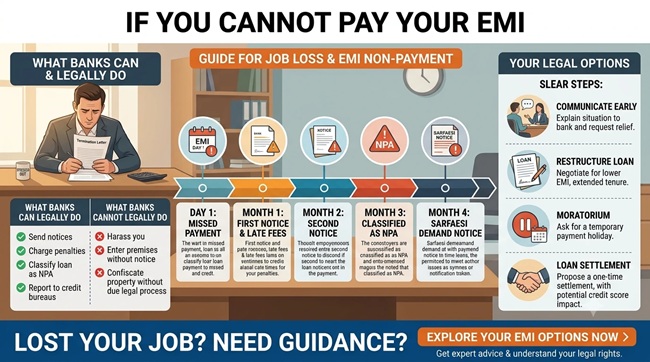
A single missed EMI typically triggers a grace period of about ten to fifteen days along with a late payment fee, and lenders usually attempt phone or SMS reminders during this window rather than any formal action. If EMIs continue to be missed, the account is tracked internally as overdue, but for it to become what banks call a Non-Performing Asset, or NPA, the principal or interest must remain unpaid for ninety consecutive days. This ninety-day threshold is set under RBI’s income recognition and asset classification norms and is consistent across banks and NBFCs. Nothing drastic in terms of asset seizure happens before this point.
Once an account crosses ninety days of default, its consequences diverge depending on whether the loan is secured or unsecured.
For secured loans, meaning home loans, car loans, loans against property, or gold loans, the lender can invoke the SARFAESI Act once the account is classified as NPA, but even then the very first legally required step is a written demand notice under Section 13(2), giving you sixty full days to either repay the outstanding amount or file a formal written objection. In practice, most banks take several additional weeks after NPA classification before this notice is even issued, so the realistic timeline from your very first missed payment to any possession action is typically somewhere between five and eight months, not days or weeks as many people assume. If you respond to the notice with objections, the bank is legally required to reply to your representation in writing within fifteen days under Section 13(3A), and a vague or boilerplate reply from the bank can itself be challenged. If the bank proceeds to take possession under Section 13(4) after the sixty-day window, you still have the right to appeal to the Debt Recovery Tribunal within forty-five days of that possession action under Section 17 of the Act.
For unsecured loans, meaning personal loans, most credit cards, and consumer durable loans, there is no asset for the bank to seize at all. Unsecured recovery legally requires the lender to either pursue you through a civil recovery suit or, if a post-dated cheque you issued has bounced, file a criminal complaint specifically under Section 138 of the Negotiable Instruments Act for cheque dishonour, which is a separate and narrower legal route triggered by the cheque bouncing, not by the underlying loan default itself.
What your credit score does during all of this
Your CIBIL or credit bureau score reacts far earlier than any legal process does. A single missed EMI can pull your score down by roughly fifty to a hundred points depending on your existing credit history, and a sustained default can cost a hundred and fifty points or more as the account moves from overdue to NPA to, eventually, written-off status if it is never resolved. This happens automatically through monthly reporting to credit bureaus and is not something you can negotiate away except by resolving the underlying default, whether through repayment, restructuring, or settlement.
Your real options, roughly in the order you should consider them
Talk to your lender about restructuring before you miss anything, if you can see it coming. If you know a job loss is imminent, such as during a notice period, contact your relationship manager or the bank’s collections or customer service line before the first EMI bounces. RBI guidelines encourage lenders to work out a genuine repayment plan with borrowers facing real hardship, and restructuring at this stage, before default, is treated far more favourably by the bank internally and does not carry the same credit score damage as a post-default settlement.
Ask about tenure extension or a temporary EMI reduction. Most lenders can restructure a loan by extending the repayment tenure, which lowers your monthly EMI in exchange for paying more total interest over a longer period. This is usually the least damaging option to your credit profile if approved formally, since it shows as a modified loan rather than a default.
Understand that a formal moratorium is not an automatic right outside specific circumstances. During the pandemic, RBI mandated a blanket moratorium for all borrowers, but that was an extraordinary, one-time measure. Outside disaster-declared regions, where RBI has more recently introduced rules requiring banks to proactively offer relief such as EMI deferment once an area is officially notified as disaster-hit, a general job-loss moratorium is something you negotiate directly with your specific lender rather than something guaranteed by regulation. Some banks do offer a discretionary two to three month deferment for genuine hardship cases, but interest typically continues to accrue during this period, so ask for the exact numbers in writing before agreeing.
Check your loan protection or credit shield insurance immediately if you have one. These policies, when purchased at the time of taking a home loan, car loan, or sometimes a personal loan, are specifically designed to cover a defined number of EMIs, usually somewhere between three and twelve months, in the event of involuntary job loss, disability, or death. If you were sold one of these at loan disbursal, this is often the fastest and least damaging option, since the insurer pays the EMI directly and your credit record stays clean. Dig out your loan file and check for this before assuming you have no cushion.
Consider a one-time settlement, but treat it as a genuine last resort. Under RBI’s Master Direction on Compromise Settlements from June 2023, banks and NBFCs are required to have a board-approved policy for settling loans with borrowers in genuine financial distress, and settlement is meant to be considered only after restructuring and other options have been properly examined, not offered as a first response. In a settlement, the lender agrees to accept less than the full outstanding amount as full and final payment. This resolves the debt, but it has real costs: your CIBIL report will show the account as “Settled” for approximately seven years, which makes future unsecured borrowing harder during that window, you typically cannot take a fresh loan from the same bank for twelve months afterward under RBI’s cooling-off rule, and if the amount waived exceeds fifty thousand rupees, it may be treated as taxable income under Section 56(2) of the Income Tax Act, so it is worth a short conversation with a chartered accountant before finalising. If you do settle, insist on three documents before you pay a rupee: a signed settlement letter that explicitly states “full and final settlement,” a No Dues Certificate after payment, and confirmation that the bank will update your credit bureau status to “Settled” rather than leaving it as “Default.” The updated status should reflect within thirty to forty-five days; if it does not, you have the right to raise a dispute directly with the credit bureau.
For secured loans, negotiate before the sixty-day SARFAESI notice period ends, not after. If you have received a Section 13(2) demand notice, this window is actually your strongest negotiating position, because the bank still faces the cost and delay of a formal auction process and often prefers a settlement or restructuring at this stage over pursuing possession. Voluntarily selling the asset yourself, with the bank’s cooperation, will almost always fetch a better price than a distress auction and is worth proposing directly.
Voluntary surrender is different from repossession and protects you better. If you genuinely cannot continue paying for a financed vehicle, proactively offering to hand over the vehicle to the lender, in writing, with an agreed valuation, is legally and financially cleaner than waiting for a forced repossession, since it demonstrates cooperation and can be negotiated to close out the loan with less damage than a distress sale conducted entirely on the bank’s terms.
Look at whether refinancing or a balance transfer to a lower-cost lender makes sense, but only if you already have some new income visibility, since taking on a fresh loan while genuinely income-less will usually make things worse, not better.
Individual insolvency under the Insolvency and Bankruptcy Code exists but is rarely the right tool for typical EMI stress. The IBC does contain provisions for personal insolvency and a fresh start process for individuals below certain asset and income thresholds, but this route is slow, involves formal tribunal proceedings, and is generally reserved for genuinely unmanageable, large-scale debt situations rather than a temporary job-loss cash crunch. For most salaried borrowers, restructuring or settlement resolves the problem faster and with less long-term complexity.
As a non-legal but very real option, prioritise which EMI to protect first if you truly cannot service all of them. Secured loans on assets you cannot afford to lose, such as your home, generally deserve priority over unsecured personal loans or credit cards, since the consequences of default are structurally more severe and harder to reverse for secured debt.
What your bank and its recovery agents are legally allowed to do
Banks and NBFCs have real, legitimate recovery powers, and it helps to know exactly where those powers end.
They can send you reminders by call, SMS, email, or letter, and can apply a late payment fee or penal charge for missed payments, though since RBI’s August 2023 circular on Fair Lending Practices, this must be levied as a separate, reasonable “penal charge” rather than an inflated “penal interest” added on top of your loan’s interest rate, and it cannot be capitalised into your principal to generate further compounding interest on the penalty itself. They can and will report your missed payments to credit bureaus like CIBIL, which affects your score immediately and independent of any legal action. For secured loans, once the account is a confirmed NPA, they can issue a formal SARFAESI demand notice and, after the sixty-day window lapses without resolution, take lawful possession of the secured asset and sell it through a proper auction process, applying the proceeds against your outstanding dues and returning any surplus to you. If a cheque you issued for repayment bounces, they can file a criminal complaint under Section 138 of the Negotiable Instruments Act. They can assign your account to a third-party recovery agency, but that agency remains entirely the bank’s responsibility for any misconduct.
What your bank and its recovery agents cannot legally do
This is the part most borrowers genuinely do not know, and it matters because violations here are common and enforceable.
They cannot contact you before 8 AM or after 7 PM, through any channel, including phone calls, SMS, WhatsApp, or automated messages; this is a hard rule under RBI’s Fair Practices Code and has resulted in real financial penalties against major banks when violated. They cannot discuss your loan, your default, or your outstanding amount with your family members, employer, neighbours, or colleagues to pressure or embarrass you into paying; recovery contact must be directed only at the borrower or a guarantor on the loan. They cannot use threatening, abusive, or humiliating language, and cannot threaten arrest or criminal prosecution for a straightforward payment default, since defaulting on a loan by itself is a civil matter, not a crime; the only common exception is a genuinely bounced cheque, which triggers a specific and separate criminal provision under the Negotiable Instruments Act. They cannot forcibly repossess a vehicle or any secured asset using intimidation, muscle power, or by intercepting it on a public road; multiple High Court and Supreme Court rulings have explicitly held this practice illegal, holding that a borrower’s constitutional right to live with dignity under Article 21 prevails over a lender’s contractual recovery rights when the two conflict, and that banks remain vicariously liable for the unlawful conduct of the recovery agents they hire. For unsecured loans specifically, they cannot seize any asset at all without first obtaining a court decree, since there is no security interest to enforce in the first place. Recovery agents visiting your home or workplace must identify themselves by name, state the lender’s name, and cannot use public shaming, physical contact, or coercion as a tactic.
If a guarantor is involved
If your loan has a guarantor, whether a parent, sibling, or friend, understand that under most loan agreements the guarantor’s liability is triggered once the primary borrower defaults, and lenders are legally entitled to pursue the guarantor for the outstanding amount, sometimes in parallel with pursuing you. This is worth discussing openly and early with your guarantor rather than letting them find out through a recovery notice, since it affects their credit profile too if the account turns delinquent.
If you believe you are being harassed
Keep a simple record from the very first instance: the date, time, phone number, and what exactly was said or done, including screenshots of any messages. Escalate first in writing to your bank’s Grievance Redressal Officer, whose contact details are mandatorily listed on the bank’s website and on your loan statement. If the bank does not resolve it within thirty days, or you are unsatisfied with the response, you can file a free complaint with the Reserve Bank – Integrated Ombudsman Scheme through the RBI’s online portal, without needing a lawyer. As of July 2026, this scheme covers complaints against banks, most NBFCs, and credit information companies under a single unified framework, and the Ombudsman has the authority to award compensation for both direct financial loss and for the harassment or inconvenience caused. In cases involving genuine criminal intimidation, threats, or physical harassment, you can also file a police complaint separately, since that conduct falls outside banking regulation entirely and into ordinary criminal law.
A short, practical checklist for the first two weeks after job loss
Contact your lender directly and explain the situation rather than avoiding calls. Check every loan document for a bundled loan protection or credit shield insurance policy. List every EMI by amount, due date, and whether it is secured or unsecured, and prioritise accordingly if you cannot service everything. Ask your bank specifically what restructuring, deferment, or settlement options they offer for job-loss hardship, in writing, before agreeing to anything. Keep every communication with the bank or its recovery agents documented from day one. Avoid taking a new loan or credit card to cover an existing EMI unless you have clear visibility into new income, since this frequently compounds the original problem.
Frequently asked questions
How many days after missing an EMI can a bank take legal action? A single missed EMI does not trigger legal action. An account must remain unpaid for ninety consecutive days to be classified as a Non-Performing Asset, and for secured loans, the bank must then issue a formal sixty-day notice before it can move toward taking possession of any secured asset. Realistically, the gap between a first missed payment and any possession action is usually several months.
Can a bank take my house or car immediately if I miss one EMI? No. This can only happen for secured loans after the account becomes an NPA at ninety days of default, followed by a mandatory sixty-day demand notice under the SARFAESI Act, followed by the borrower failing to repay or resolve the matter within that window. Forcible or immediate seizure without this process is illegal.
Can a recovery agent call my employer or family to pressure me? No. RBI’s Fair Practices Code specifically prohibits recovery agents from contacting anyone other than the borrower or a guarantor on the loan to discuss the default. Doing so is a reportable violation.
Is defaulting on a personal loan a criminal offence? No, loan default by itself is a civil matter. The only common criminal exposure arises if a post-dated cheque you issued bounces, which can trigger a case under Section 138 of the Negotiable Instruments Act specifically for the cheque dishonour, separate from the loan default itself.
What is the difference between loan restructuring and loan settlement? Restructuring changes the terms of your existing loan, such as extending the tenure or temporarily reducing the EMI, while you still intend to repay the full amount eventually. Settlement means the bank agrees to accept less than the full outstanding amount as final payment, closing the loan but leaving a “Settled” mark on your credit report for around seven years.
Will a one-time settlement destroy my credit score permanently? Not permanently, but it does have a real and lasting effect. The “Settled” status typically stays on your credit report for about seven years and can make future unsecured borrowing harder in that window, though disciplined use of secured credit products afterward can help rebuild your score over two to three years.
Can banks charge unlimited penalty interest if I miss payments? No. Since RBI’s August 2023 circular, penalties for missed payments must be levied as a separate, reasonable “penal charge” rather than added on top of your interest rate as compounding “penal interest,” and this charge cannot itself generate further interest.
What can I do if a recovery agent calls me at midnight or uses threatening language? Document the date, time, and content of the call, then file a written complaint with your bank’s Grievance Redressal Officer. If unresolved within thirty days, escalate to the Reserve Bank – Integrated Ombudsman Scheme through RBI’s online complaint portal, which is free and does not require legal representation.
Does a job loss automatically qualify me for an EMI moratorium? Not automatically as a matter of regulation, except in RBI-notified disaster-hit regions where lenders are required to proactively offer relief. For an individual job loss, any deferment or moratorium is a discretionary arrangement you would need to negotiate directly with your specific lender.
What happens to my guarantor if I stop paying? The guarantor becomes liable for the outstanding amount once you default, and the lender can legally pursue them for repayment. It is worth informing your guarantor directly and early rather than letting them discover this through a recovery notice.
Can I sell my financed car or property myself instead of letting the bank auction it? Yes, and this is often financially better for you. Proactively proposing a voluntary sale to the bank, especially during the sixty-day SARFAESI notice window, typically results in a fairer valuation than a forced distress auction, since it avoids the additional costs and delays of the formal repossession process.
Is there a fixed amount below which a bank cannot use the SARFAESI Act against me? Yes. The SARFAESI Act applies only to secured loans with an outstanding amount above one lakh rupees, and loan accounts where the amount due is below twenty percent of the original principal and interest are excluded from action under the Act.
A closing thought
Losing a job is stressful enough without also feeling like your bank can show up and take everything the next morning. It cannot, and the law is actually built with more borrower protection at every stage than most people assume, provided you engage with the process instead of going quiet. The single most effective thing you can do this week, more than reading any guide including this one, is to call your lender directly and put your situation on record. Every option described here, from restructuring to settlement to simply buying time, works better when you are the one who started the conversation.
Disclaimer: This article is for general informational and educational purposes only and does not constitute legal, financial, or tax advice. Loan recovery rules, RBI circulars, timelines, and thresholds referenced here reflect information available and in force at the time of writing and are subject to change by the Reserve Bank of India, individual lenders’ board-approved policies, and applicable courts from time to time. Every loan agreement carries its own specific terms, and outcomes in an actual recovery or settlement situation depend on the facts of that case. This article does not review or verify the specific loan documents, notices, or communications of any individual reader. If you are facing loan default, a SARFAESI notice, recovery agent harassment, or possible legal action, please consult a qualified lawyer or a certified financial counsellor, and verify current rules directly through the Reserve Bank of India’s official website at rbi.org.in, the RBI Integrated Ombudsman portal at cms.rbi.org.in, or your bank’s official grievance redressal channel before taking any action based on this article. Neither the author nor this publication accepts responsibility for outcomes arising from decisions made solely on the basis of this content.

Shuchi founded Finance Checks after spending 16+ years working in corporate, managing operations and distribution. She managed her own finances, learned and read regularly and helped people make sense of their savings, loans, insurance, and investments.
She started this site to offer the kind of clear, honest financial guidance she wished was more available when she was learning to manage her own money. Every article is researched personally, checked against official sources such as the Reserve Bank of India, SEBI, or the Income Tax Department, and revisited whenever regulations or figures change. She is upfront about how the site earns money through ads and select affiliate partnerships, and she does not let either influence what she actually recommends to readers.



[…] Lost Your Job With EMIs Still Due? Here Is Exactly What Happens Next and What You Can Legally Do […]