
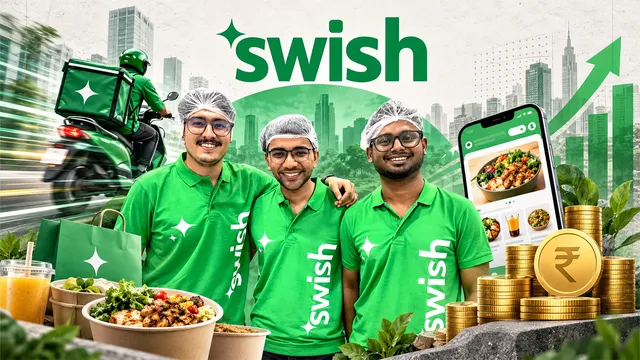
Swish Raises $24 Million to Expand Its 10 Minute Food Delivery Network Across Bengaluru and NCR

Six months ago Swish closed a $38 million round and told everyone it was going to chase multi city expansion. Now it’s back at the fundraising table again, this time pulling in ₹224.54 crore, roughly $24 million, in an extended Series B led by Bertelsmann India Investments. Two rounds in one calendar year isn’t something you see often in Indian food tech, and it says something about how this company is being read by investors right now, even in a segment where bigger names have already backed off.
Quick answer
Swish, the Bengaluru based quick food delivery startup, is raising $24 million as an extension of its existing Series B round, led by Bertelsmann India Investments with continued participation from Bain Capital Ventures, Accel and Hara Global. Bertelsmann is putting in the largest chunk at roughly $15 million, taking an expected 8.67 percent stake once the deal closes. The round pushes Swish’s post money valuation up by more than 30 percent to around ₹1,653 crore, close to $175 million, from ₹1,268 crore after its March round. This is Swish’s second raise in 2026 and takes its total funding since 2024 past $50 million. The money is earmarked for deepening its kitchen network in Bengaluru and building out a fresh cluster in the National Capital Region, along with supply chain and automation work. What makes this one worth watching isn’t just the number, it’s that Swish is doubling down on a category, ten minute food delivery, that Swiggy, Zepto and Zomato have all quietly pulled back from over the past year.
About this piece
This article draws on funding details reported by YourStory, Viestories and other business publications covering Swish’s extended Series B round, current as of early September 2026. FinanceChecks.com has no relationship with Swish, Bertelsmann India, or any of the investors named here. This is informational coverage, not investment advice, and none of the figures in this piece should be treated as audited or independently verified financial statements, since that’s simply not how private funding disclosures work.
What’s actually happening with this round
Swish isn’t raising a brand new round here, it’s extending the Series B it closed back in March. That distinction matters. Rather than going out and pricing a fresh Series C at a new valuation from scratch, the company brought in a new lead investor, Bertelsmann India, to top up the same round structure. Bertelsmann is contributing about ₹143 crore of the total, with the rest split between existing backers: Bain Capital Ventures adding roughly ₹62 crore, Accel around ₹14 crore, and Hara Global a smaller ₹4.8 crore top up.
Once this closes, the cap table looks like this: Accel stays the largest shareholder at 23.48 percent, Hara Global follows at 17.93 percent, Bain Capital Ventures holds just under 10 percent, and Bertelsmann steps in with 8.67 percent. The valuation bump takes Swish from $139 million post money in March to somewhere around $175 million now, a jump of more than 30 percent in under six months.
Who’s actually behind Swish and what it does
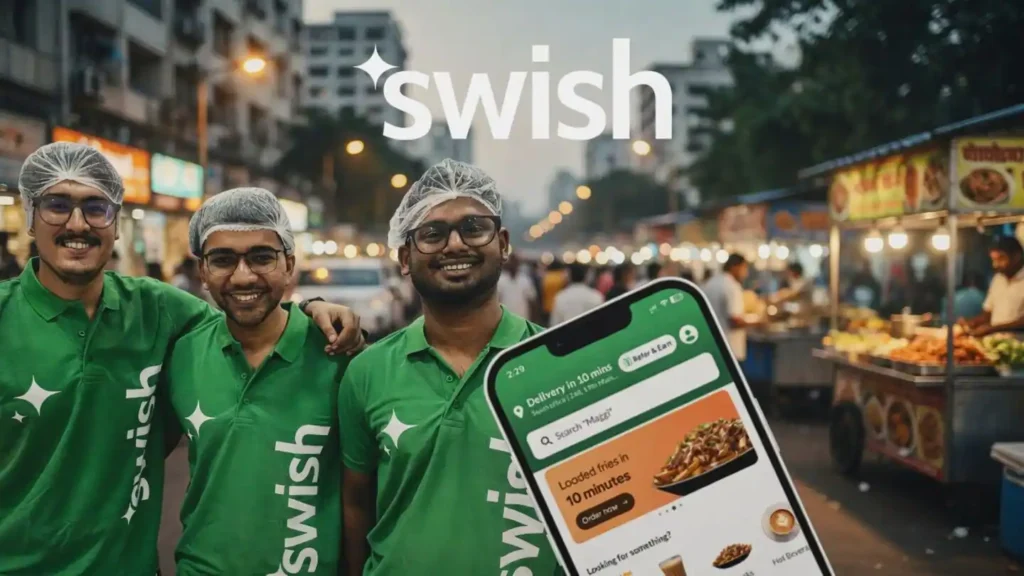
Swish was started in 2024 by Aniket Shah, Ujjwal Sukheja and Saran S. The pitch is simple to describe and genuinely hard to execute: fresh food, delivered inside ten minutes, from small neighbourhood kitchens placed close enough to customers that the delivery radius stays under a kilometre. Rather than leaning on a marketplace of third party restaurants the way Swiggy or Zomato do, Swish owns the whole chain itself, the kitchens, the delivery riders, the app. Cutting out the middlemen and their commissions is the whole point, the idea being that the margin saved gets reinvested into better food and faster delivery instead of getting eaten up by platform fees.
It started small, coffee and snacks out of a single Bengaluru kitchen, and has since grown into full meals across more locations in the city. At the time of its March raise the company said it was doing over 20,000 orders a day.
You May Also Like To Read About:
- QNu Labs Raises ₹200 Cr to Scale Quantum Cybersecurity R&D
- Circolife Raises $4.5 Mn to Scale Subscription-Based Air Conditioning Across India
- D2C Pet Food Startup Lickicious Raises ₹19 Crore to Expand Manufacturing and Distribution
- Pixxel Raises $100 Million: India’s Biggest-Ever Spacetech Funding Round, Explained
- Nua Raises $50 Million in Series C: What This Funding Round Actually Signals About India’s Women’s Wellness Market
The numbers that matter beyond the headline
Here’s the part that doesn’t usually make it into the celebratory funding announcement. Swish reported roughly ₹4 crore in revenue against ₹19 crore in losses for an eight month stretch of FY25. That’s a loss nearly five times the revenue, which isn’t unusual for a company at this stage chasing growth over profitability, but it’s worth sitting with for a second before getting swept up in the funding headline. The company hasn’t put out its FY26 numbers yet, so there’s no way to say from public information whether that gap has narrowed.
This is also a genuinely brutal category to be operating in. Instant food delivery has chewed through capital and confidence across the Indian startup scene. Zomato, Swiggy and Zepto have all scaled back or shut down their own rapid delivery food experiments in the past year, citing exactly the kind of cost pressure and operational headache that comes with promising ten minute delivery on something as fragile and perishable as hot food. Zing, another player chasing the same idea, walked away from its plans entirely. Swish raising twice in one year, while its bigger rivals retreat from the same category, is either a sign that its tighter, vertically owned model is genuinely working where others failed, or a sign that it simply hasn’t hit the same wall yet. Both are plausible right now, and it’s too early to say which one this turns out to be.
Where the new money is going
The expansion plan has two clear fronts. In Bengaluru, the focus is on going deeper rather than wider, adding more kitchens in neighbourhoods where repeat orders are already strong, rather than spreading thin across the whole city map. In the National Capital Region, this marks Swish’s first real push outside its home market, building kitchen clusters around dense residential pockets and office corridors instead of scattering locations across the region.
Alongside the geographic expansion, the company says it’s putting money into supply chain work, standardising how kitchens operate, and building out automation for order forecasting, food prep and dispatch. None of that is glamorous, but for a business built on ten minute delivery promises, this is genuinely where the operational battle gets won or lost.
What this means for the wider quick commerce race
Swish now competes directly with the rapid food arms of the country’s biggest platforms, Blinkit Bistro, Zepto Cafe and Swiggy Bolt, alongside established cloud kitchen operators like Rebel Foods and Curefoods. That’s a crowded field with deep pocketed rivals on one side and operationally seasoned kitchen businesses on the other.
What Swish has going for it right now is focus. It isn’t trying to be everything to everyone, it’s trying to nail one narrow promise, fast and fresh, in a small number of dense pincodes, before worrying about scale everywhere at once. Whether that discipline holds up once NCR expansion adds real operational complexity is the thing worth watching over the next couple of quarters, not the funding number itself.
My take
The most interesting thing about this raise isn’t the dollar figure, it’s the timing. Swish went back to investors just months after its last close, in a category where the biggest names in Indian food tech have been quietly retreating. That’s either genuine conviction from investors who think Swish has cracked something its larger rivals haven’t, or it’s a company burning through cash faster than expected and needing a bridge before the next real test. The ₹19 crore loss against ₹4 crore revenue from its last disclosed numbers doesn’t settle that question either way. What would actually tell us something is the FY26 numbers, whenever they surface, and whether the NCR expansion holds up the same repeat order behaviour Swish is banking its whole model on in Bengaluru.
Frequently asked questions
How much did Swish raise in this round? Swish raised ₹224.54 crore, around $24 million, in an extended Series B round led by Bertelsmann India Investments, with existing investors Bain Capital Ventures, Accel and Hara Global also participating.
Is this a new funding round or an extension of an old one? It’s an extension of the Series B round Swish closed in March 2026, not a fresh, separately priced round.
What is Swish’s valuation after this round? The round is expected to push Swish’s post money valuation up more than 30 percent to around ₹1,653 crore, close to $175 million, from ₹1,268 crore after the March 2026 round.
Who founded Swish and when? Swish was founded in 2024 by Aniket Shah, Ujjwal Sukheja and Saran S, and began operations in July of that year.
How much total funding has Swish raised so far? Including this round, Swish has raised over $50 million across three rounds since 2024, including $14 million in March 2025 and $38 million in March 2026.
Is Swish profitable? No. The company reported roughly ₹4 crore in revenue against ₹19 crore in losses for an eight month period of FY25, and has not yet disclosed its FY26 financial results.
What will Swish use the new funding for? The company plans to deepen its kitchen network in Bengaluru, build a new cluster of kitchens across the National Capital Region, and invest in supply chain infrastructure and kitchen automation.
Who are Swish’s main competitors? Swish competes with Blinkit Bistro, Zepto Cafe and Swiggy Bolt from the quick commerce side, and with cloud kitchen operators like Rebel Foods and Curefoods.
Why has instant food delivery been a difficult category in India? Larger platforms including Swiggy, Zepto and Zomato have scaled back or shut down their own rapid food delivery experiments over the past year, citing high operational costs and the difficulty of managing perishable food at ten minute delivery speeds. Another startup, Zing, abandoned its plans in this space entirely.
Who holds the largest stake in Swish after this round? Accel remains the largest shareholder at 23.48 percent, followed by Hara Global at 17.93 percent, Bain Capital Ventures at just under 10 percent, and Bertelsmann India expected to hold around 8.67 percent.
Disclaimer
This article is for general information only and does not amount to investment advice regarding Swish or any company named here. FinanceChecks.com has no affiliation with Swish, Bertelsmann India Investments, or any of the investors mentioned in this piece. All figures are drawn from publicly reported coverage of the funding round as of early September 2026 and reflect private company disclosures, which are not independently audited in the way public company financials are. Readers should treat funding announcements, valuations and revenue figures for private companies as reported information rather than verified fact, and should do their own research before drawing conclusions about any company’s financial health.

Shuchi founded Finance Checks after spending 16+ years working in corporate, managing operations and distribution. She managed her own finances, learned and read regularly and helped people make sense of their savings, loans, insurance, and investments.
She started this site to offer the kind of clear, honest financial guidance she wished was more available when she was learning to manage her own money. Every article is researched personally, checked against official sources such as the Reserve Bank of India, SEBI, or the Income Tax Department, and revisited whenever regulations or figures change. She is upfront about how the site earns money through ads and select affiliate partnerships, and she does not let either influence what she actually recommends to readers.



[…] Swish Raises $24 Million to Expand Its 10 Minute Food Delivery Network Across Bengaluru and NCR […]