
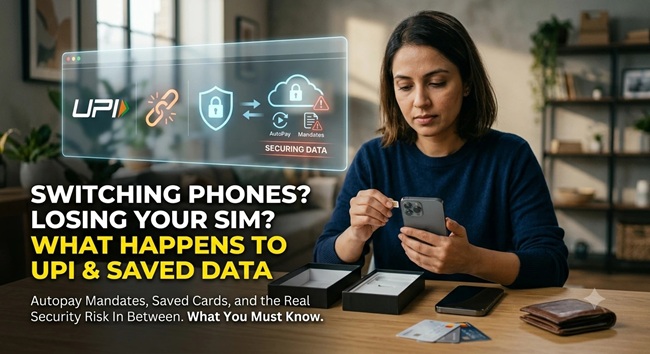
What Happens to Your UPI Apps and Saved Payment Data If You Switch Phones or Lose Your SIM

A man in Delhi lost his phone on a Saturday. Four days later, once he’d finally gotten his SIM replaced, his bank started sending him alerts for transactions he never made. Delhi Police eventually arrested two men over what they called a UPI hijack racket, and the whole thing worked on one simple idea: the four days between losing his phone and getting his number back were the four days nobody was watching that number but them.
Most people, when they lose a phone, think about the hardware. The screen, the camera, the ₹40,000 they spent on it. What actually matters a lot more is the tiny piece of plastic inside it, the SIM, because that’s the thing your entire UPI life is built on top of.
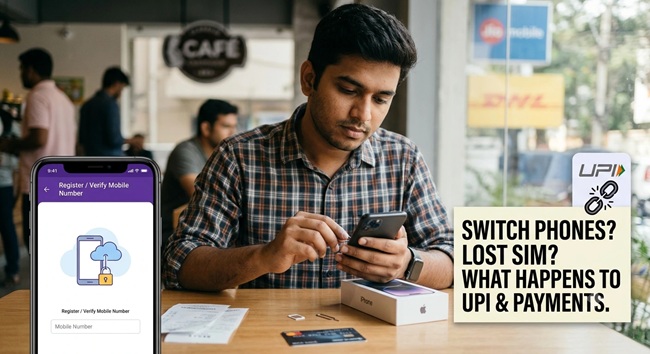
Quick answer
Your UPI setup runs on your mobile number, not your phone. So if you get a new phone but keep the same SIM, you just reinstall the app, punch in your number, verify with an OTP, pick your bank, set a new PIN, and you’re back in business. Nothing happens to your money in the meantime. Losing your SIM is the one that actually matters, because until you get it blocked and replaced, whoever’s holding it can potentially see every OTP and bank message meant for you. Saved cards usually don’t carry over automatically to a new phone, since they’re tied to that specific device through tokenization, so you’ll need to add them again. Autopay mandates for things like SIPs or subscriptions are generally linked to your bank account rather than the app itself, so those usually keep running fine, though it’s worth double checking. If your phone or SIM goes missing, speed is everything, block the SIM and call your bank before anyone else gets a chance to use that gap.
About this guide
This is based on how UPI registration and security actually work as documented by NPCI and Indian banks, plus real reported cases of fraud tied to lost phones and SIMs, current as of September 2026. FinanceChecks.com has no tie up with NPCI or any bank. Exact steps can differ slightly between apps and telecom operators, so check with your own bank and provider if anything here doesn’t quite match what you see on your screen.
New phone, same SIM, this part’s easy
If you’re just upgrading your phone and keeping the same number, there’s genuinely nothing to worry about. Your UPI app doesn’t magically appear pre-loaded on the new device with your account already set up, you have to download it fresh and go through registration again, number, OTP, bank selection, new PIN. That’s not a glitch, that’s the system doing its job, confirming that whoever’s setting this up on the new phone actually has the SIM in hand.
Your bank account doesn’t know or care which phone you’re using. It only cares about the number and the PIN. So once you’ve re-registered, everything works exactly like before.
Losing your SIM is where things get real
This is the part worth actually paying attention to. Your phone number is basically the master key here, it’s what receives every OTP, every “your account was debited” message, every verification code your bank sends. If your SIM goes missing, stops working, or gets stolen along with your phone, whoever’s got it now has access to that same stream of messages, right up until you get it blocked.
That’s exactly what happened in the Delhi case. The gap wasn’t a hack in the traditional sense. Nobody broke into a server. Someone just had physical access to a working SIM during the window before the real owner managed to shut it down.
So the fix isn’t complicated, it’s just fast. The second you realize your phone or SIM is gone, you need two things happening almost at once: call your telecom provider and block the SIM, and call your bank and tell them to freeze UPI on that number. Do only one and you’ve still got a hole. Block the SIM but skip the bank call, and your UPI access might technically still be live. Call the bank but leave the SIM active, and whoever’s got it is still reading your messages.
Getting back up and running
Once the SIM’s blocked, you go get a replacement with the same number, which means a trip to your operator’s store with Aadhaar or similar ID, and a wait that’s usually somewhere between a few hours and a couple of days depending on who you’re with. Until that new SIM is live, you can’t get OTPs on that number, full stop, no matter which phone you’re holding.
Once it’s active, restoring UPI is the same drill as any phone switch, reinstall the app, register with your number, verify through the OTP that lands on your new SIM, set a fresh PIN. Your account and your balance were never actually at risk through any of this, the phone and SIM were only ever the key, not the vault.
What about your saved cards
Cards you’d saved on your old phone generally don’t just show up on the new one. Most apps use tokenisation for this, basically swapping your real card number for an encrypted stand in that’s tied to that specific device. New device, no token, so you’ll need to add the card again and let it generate a fresh one. Mildly annoying, sure, but it’s also a decent security feature in disguise, since your actual card number was never something the new phone could just inherit.
What about Autopay
Good news here. Recurring UPI mandates, the kind funding your SIP or your OTT subscription, are tied to your bank account and VPA, not to the specific phone the app happens to be installed on. So these usually survive a phone or SIM change without you lifting a finger. Still, open the app after any switch and glance at your active mandates list, just to be sure nothing quietly dropped off.
Before and after you switch
If you’re switching phones on your own terms, not because of an emergency, check whether your app wants you to log out of the old device first. Some apps get suspicious if a new registration shows up without the old one properly signing off, and that can slow things down.
If you’re porting your number to a new SIM for any reason, tell your bank proactively. A mismatch between what your bank thinks your number is and what SIM is actually live in your phone is a surprisingly common reason people get locked out, unable to even receive the OTP that would fix it.
And after any switch, give it five minutes, check your cards got re-added, check your mandates are still active, and if you use UPI Lite, check whatever balance was sitting there didn’t just get left behind on the old device.
My take
What actually stands out to me about the Delhi case isn’t that UPI has some flaw in how it verifies people. Tying everything to your mobile number is a reasonable way to confirm it’s really you. What stands out is how much that whole system leans on you moving fast at the exact moment you’re least prepared to, right after losing your phone, probably a bit panicked, maybe without another device handy to even make the calls that matter. The real takeaway isn’t about UPI mechanics at all. It’s keeping your telecom provider’s blocking number and your bank’s fraud line saved somewhere that isn’t the phone you might lose, your partner’s phone, a notebook, anywhere that doesn’t depend on the one device that’s now missing.
Frequently asked questions
Do I need to do anything special to use UPI on a new phone if I keep the same SIM? Yes, you’ll reinstall the app and register again, number, OTP, bank, new PIN. Your account itself is untouched.
What’s the first thing I should do if I lose my phone with the SIM in it? Block the SIM with your telecom operator and call your bank to freeze UPI, both, right away. One without the other leaves a gap.
Can someone drain my account just by having my lost phone? Not directly through your balance, but they can potentially intercept OTPs sent to your SIM, which is exactly the mechanism behind reported UPI hijack cases.
Do my saved cards move over to a new phone automatically? Usually not. Cards are typically tied to the device through tokenisation, so you’ll need to re-add them and let the app generate a new token.
Will my Autopay for subscriptions or SIPs stop if I switch phones? Generally no, since mandates are linked to your account, not the app installation. Worth a quick check afterward anyway.
How long does getting a replacement SIM actually take? Anywhere from a few hours to a couple of days, depending on your operator, and you’ll need ID proof like Aadhaar.
Is my UPI Lite balance safe if I lose my phone? Worth checking directly with your provider, since this balance typically sits on the device itself.
Should I tell my bank if I’m just porting my number, no lost phone involved? Yes. A number your bank has on file that doesn’t match your live SIM is a common way people get accidentally locked out.
What actually happened in the Delhi case? Police say two men exploited the gap between a victim losing his phone and getting a new SIM issued, using that window to bypass security and pull money from his account.
Can I still use UPI if my SIM is blocked but I’ve still got the phone? No. Verification needs an active SIM to receive SMS, so a blocked SIM stops that cold, phone or no phone.
Disclaimer
This article is for general information only. FinanceChecks.com isn’t affiliated with NPCI, any bank, or any telecom provider. Exact steps and timelines vary by bank, app, and operator, and what’s here reflects general guidance as of September 2026. If you actually lose a phone or SIM, call your operator and your bank directly rather than relying only on this article.

Shuchi founded Finance Checks after spending 16+ years working in corporate, managing operations and distribution. She managed her own finances, learned and read regularly and helped people make sense of their savings, loans, insurance, and investments.
She started this site to offer the kind of clear, honest financial guidance she wished was more available when she was learning to manage her own money. Every article is researched personally, checked against official sources such as the Reserve Bank of India, SEBI, or the Income Tax Department, and revisited whenever regulations or figures change. She is upfront about how the site earns money through ads and select affiliate partnerships, and she does not let either influence what she actually recommends to readers.