
Sensex Falls Again Amid West Asia Tensions: This Is the Third Time in Two Weeks, Here’s What’s Different Today

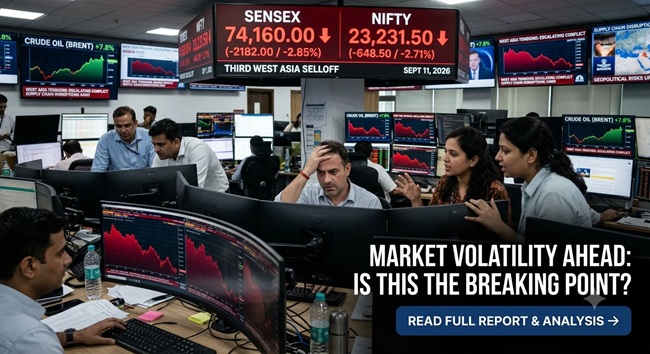
If today’s market fall felt familiar, that’s because it is. This is the third distinct sell off tied to West Asia tensions that Indian markets have gone through in under two weeks, following a 377 point fall on August 31 and an 809 point intraday drop on September 2. Today, Friday September 11, the Sensex opened lower and slid to an intraday low of 74,160, down 742 points or about 1 percent, while the Nifty 50 touched 23,231, down 246 points, also around 1 percent. For anyone who’s been watching this play out repeatedly, the question isn’t really why did the market fall today, it’s why does this keep happening, and does it change anything about what you should actually do.
Quick answer
Indian benchmark indices fell sharply again on September 11, 2026, driven by three factors working together: continued escalation in West Asia keeping crude oil prices elevated, rising global bond yields fuelling fresh concern about a possible US Federal Reserve rate hike next week, and persistent foreign institutional investor selling, with FIIs offloading Rs 438.24 crore worth of Indian equities the previous session even as domestic institutional investors kept buying. Weak global cues added to the pressure, with Asian markets including Japan’s Nikkei falling sharply and US markets extending losses for a fourth straight session. This is now the third West Asia related selloff in Indian markets in under two weeks, and the pattern across all three, sharp fall on fresh escalation, followed by at least partial stabilisation within days, remains a more useful guide for long term investors than reacting to any single day’s headline number.
About this piece
This article is based on live market reporting from Business Standard, India TV News and other financial outlets on the September 11, 2026 trading session, current as of the time of writing. FinanceChecks.com is not a SEBI registered investment advisor, and this article does not constitute investment advice. Since markets were still trading as this was written, figures reflect intraday data and may not match the day’s final closing numbers, which readers should verify separately before drawing conclusions.
What actually happened today
The Sensex opened at 74,309, already down 593 points from Thursday’s close of 74,902, and extended losses through the morning to an intraday low of 74,160, a fall of 742 points or 1 percent. The Nifty 50 followed the same pattern, opening around 23,270 and sliding to a low of 23,231, down 246 points or just over 1 percent. Selling was broad, with fifteen of sixteen major sectoral indices trading lower, and both midcap and smallcap indices down roughly 1.1 percent.
Three things converged to drive this. Crude oil kept climbing, with Brent reported trading close to $110 a barrel in Asian trade as investors weighed growing risks to key maritime and energy corridors amid the ongoing West Asia conflict. Global bond yields rose at the same time, and that combination specifically revived worry about the Fed raising rates at its meeting next week rather than the rate cuts markets had been hoping for earlier in the year, a genuinely different and more negative signal than what drove some of the market’s earlier wobbles this year. And FIIs kept selling, Rs 438.24 crore worth on September 10 alone, even as domestic institutional investors bought Rs 1,025.85 crore worth of shares the same day, a divergence that’s been a recurring feature through this entire stretch of volatility.
Asian and US markets set a weak tone well before Indian markets even opened. Japan’s Nikkei was down as much as 2.79 percent, Hong Kong’s Hang Seng fell nearly 1 percent, South Korea’s Kospi dropped 2.52 percent, and Wall Street extended its own decline into a fourth consecutive session.
Why this is the third time this has happened
Anyone tracking Indian markets closely over the past two weeks has now seen this specific pattern play out three separate times. On August 31, the Sensex fell 377 points on fading hopes of a diplomatic breakthrough in West Asia. On September 2, fresh strikes pushed the Sensex down as much as 809 points intraday. Today, September 11, a combination of the same underlying conflict plus a new worry, a possible Fed rate hike, pushed the index down a further 742 points intraday.
What’s actually new today isn’t the West Asia angle, it’s the Fed piece. Earlier bouts of market anxiety this year were tied more to uncertainty about when rate cuts might arrive. A rising probability of a rate hike instead is a meaningfully different, more directly negative signal for equity markets globally, since higher rates make bonds more attractive relative to stocks and increase borrowing costs across the economy. That’s worth separating clearly from the geopolitical angle, since the two are compounding each other today rather than being the same story repeated.
What this means if you’re invested
The core guidance from the previous two episodes still holds, and if anything, having three data points now rather than two makes it a slightly stronger case rather than a weaker one. If you invest through a SIP, continuing it without interruption remains the mathematically sound choice, since a falling market is precisely when a fixed monthly contribution buys more units, not a reason to pause. If you’re sitting on a lump sum waiting for a calmer entry point, it’s worth being honest that three separate dips in two weeks haven’t actually produced a period that felt calm enough, which is itself useful information about how long that kind of waiting can realistically drag on.
Where today’s news does warrant slightly more attention than the previous two episodes is the Fed angle specifically. A rate hike, if it materialises next week, would be a genuinely new input rather than a continuation of the same West Asia story, and it’s worth watching that specific outcome rather than assuming today’s fall resolves the same way the August 31 and September 2 dips eventually did.
My take
Three sell offs in two weeks tied to overlapping but distinct triggers is a genuinely unusual stretch, and I think the temptation is to either become numb to it, markets fall on Iran news again, nothing to see here, or to treat each one as a fresh crisis deserving a fresh reaction. Neither is quite right. The West Asia angle has, so far, produced sharp but recoverable dips each time it’s flared up this year. The Fed rate hike risk sitting alongside it today is a separate thread worth actually watching over the coming week, since it doesn’t have the same track record within this specific stretch to draw on. My honest read is that today’s fall deserves slightly more attention than pure repetition of the last two, not because the West Asia story has changed, but because a genuine Fed rate hike would be a new kind of headwind layered on top of an already jumpy market.
Frequently asked questions
Why did the Sensex and Nifty fall on September 11, 2026? The fall was driven by continued West Asia tensions keeping crude oil prices elevated, rising global bond yields fuelling concern about a possible US Fed rate hike next week, and continued FII selling, compounded by weak global cues from falling Asian and US markets.
How much did the market fall today? The Sensex hit an intraday low of 74,160, down 742 points or about 1 percent, while the Nifty 50 touched an intraday low of 23,231, down 246 points or just over 1 percent. These are intraday figures and may not reflect the day’s final close.
Is this related to the earlier market falls in late August and early September? Yes, this is the third distinct West Asia related selloff in under two weeks, following a 377 point fall on August 31 and an 809 point intraday fall on September 2.
What’s different about today’s fall compared to the previous two? Today’s fall includes a new factor, rising concern about a possible Fed rate hike next week, rather than just the ongoing West Asia conflict that drove the two earlier episodes.
Should I stop my SIP because of this market fall? Generally no. A SIP is designed to buy more units when prices fall, so continuing it through a dip like this is consistent with how the strategy is meant to work, rather than a reason to pause.
Were foreign investors buying or selling during this period? FIIs were net sellers, offloading Rs 438.24 crore worth of Indian equities on September 10, while domestic institutional investors were net buyers of Rs 1,025.85 crore the same day.
How high did crude oil prices go during this selloff? Brent crude was reported trading close to $110 a barrel in Asian trade as the West Asia conflict raised concerns about disruption to key maritime and energy routes.
Why does a possible Fed rate hike affect Indian stock markets? A US rate hike makes bonds more attractive relative to equities and raises borrowing costs globally, which tends to pull investment away from equity markets, including in India, and can add pressure on the rupee.
Did global markets fall alongside India today? Yes. Japan’s Nikkei fell nearly 2.8 percent, Hong Kong’s Hang Seng and South Korea’s Kospi also declined, and US markets extended losses into a fourth straight session.
What should long term investors actually do during a stretch like this? Continuing existing SIPs, avoiding reactive lump sum decisions, and paying attention to genuinely new developments like the Fed’s upcoming decision, rather than reacting to every single day’s headline number, remains the more consistent approach across all three episodes so far.
Disclaimer
This article is intended for general informational purposes only and does not constitute investment advice. FinanceChecks.com is not a SEBI registered investment advisor. This article discusses a live, developing market and geopolitical situation as of September 11, 2026, and figures cited reflect intraday data available at the time of writing, which may differ from the day’s final closing numbers. Past market patterns discussed here are historical observations, not guarantees of future performance. Equity investments carry market risk, including potential loss of principal. Please verify current market data independently and consult a qualified financial advisor before making investment decisions.

Shuchi founded Finance Checks after spending 16+ years working in corporate, managing operations and distribution. She managed her own finances, learned and read regularly and helped people make sense of their savings, loans, insurance, and investments.
She started this site to offer the kind of clear, honest financial guidance she wished was more available when she was learning to manage her own money. Every article is researched personally, checked against official sources such as the Reserve Bank of India, SEBI, or the Income Tax Department, and revisited whenever regulations or figures change. She is upfront about how the site earns money through ads and select affiliate partnerships, and she does not let either influence what she actually recommends to readers.