
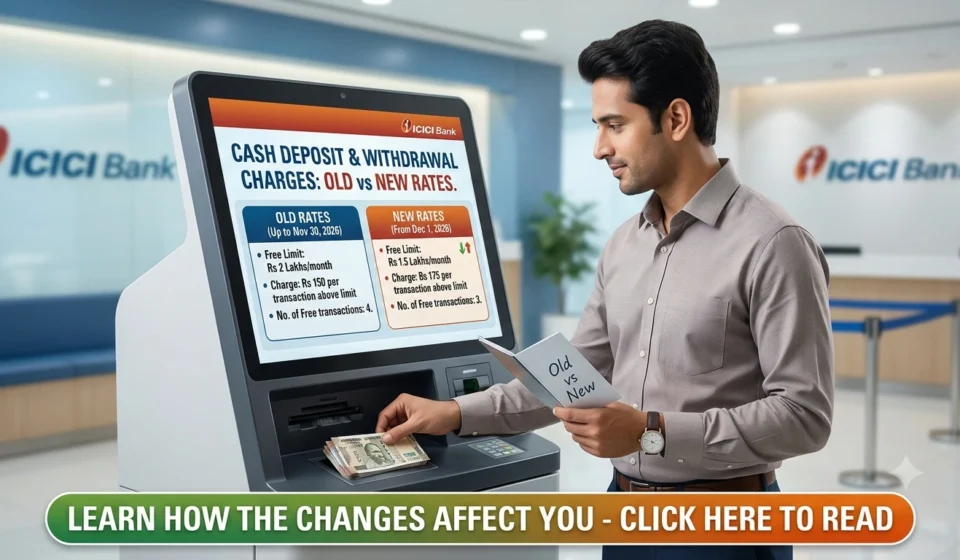
ICICI Bank Cash Deposit and Withdrawal Charges From 1 December 2026: Old vs New Rates, Free Limits and Other Changes

ICICI Bank is revising select banking service charges from 1 December 2026. The changes affect certain cash deposits and withdrawals, demand drafts, and electronic clearing service (ECS) debit returns. While the bank’s reported free monthly cash transaction limits remain unchanged, customers who exceed the applicable limits may pay higher charges.
According to reports published by The Economic Times on 22 October 2026 and Mint on 23 October 2026, the value-based charge for eligible cash transactions exceeding the complimentary monthly limit will rise from ₹3.50 to ₹4 per ₹1,000, subject to a minimum charge of ₹150.
This guide explains the reported changes, compares the old and new charges, includes practical calculations, and outlines what ICICI Bank customers should check before the revised schedule takes effect.
Effective date: 1 December 2026
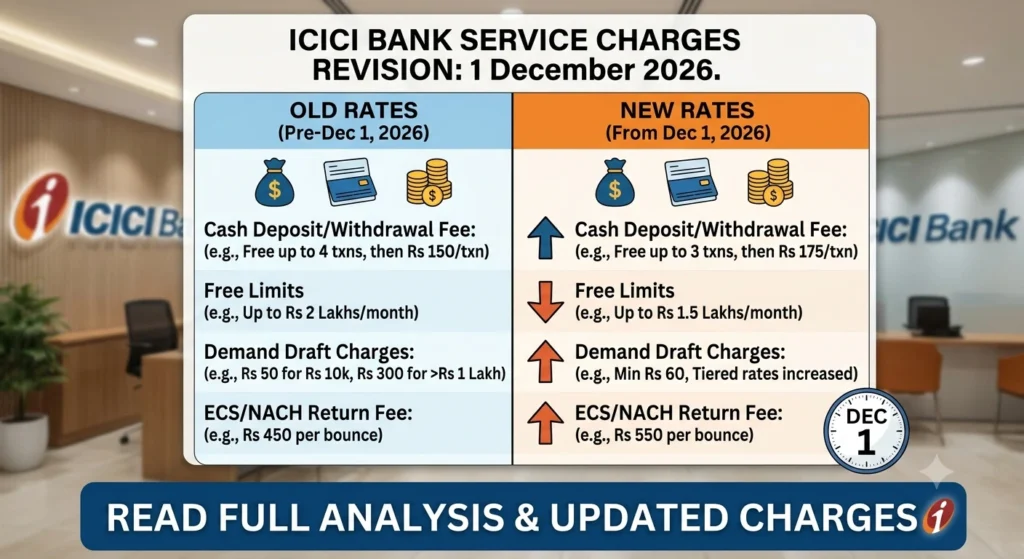
ICICI Bank Charges From December 2026: What’s Changing?
The revision does not mean every cash deposit or withdrawal will attract a fee. Customers will continue to receive three free cash deposits and three free cash withdrawals per month under the reported schedule, with a separate monthly complimentary value limit of ₹1 lakh for deposits and ₹1 lakh for withdrawals.
The main change is the rate used to calculate charges when the applicable monthly value limit is exceeded.
Here is a quick overview.
| Banking service | Earlier charges | From 1 December 2026 |
|---|---|---|
| Free cash deposits | 3 per month | 3 per month |
| Free cash withdrawals | 3 per month | 3 per month |
| Complimentary monthly deposit value | ₹1 lakh | ₹1 lakh |
| Complimentary monthly withdrawal value | ₹1 lakh | ₹1 lakh |
| Value-based charge beyond the applicable limit | ₹3.50 per ₹1,000 | ₹4 per ₹1,000 |
| Minimum value-based charge | ₹150 | ₹150 |
| Charge for cash deposits beyond the free transaction count | ₹150 per transaction | ₹150 per transaction |
| Charge for cash withdrawals beyond the free transaction count | ₹150 per transaction | ₹150 per transaction |
Source: The Economic Times and Mint, reporting on ICICI Bank’s customer communication. These figures relate to the reported schedule for applicable savings accounts; account-specific terms may differ. GST is additional where applicable.
You May Also Like To Read About:
- Never Google a Bank’s Customer Care Number: SBI’s Warning and How to Stay Safe
- Government Plans to Cut Stakes in 4 PSU Banks to 75%: Is Privatisation Next After IDBI Bank?
- SBI Data Leak: 3,897 Customer Records Found on the Dark Web. What Happened and What You Should Do Now
- IDBI Bank Sale to Fairfax: Latest News and What It Means for Account Holders, Borrowers and Shareholders
- Your Bank Account Is Frozen: 9 Reasons You Could Lose Access to Your Own Money
1. ICICI Bank Cash Deposit Charges: Old vs New
Customers depositing cash into their savings accounts need to track two things: how many cash deposits they make during the month and the total value of those deposits.
Under the reported schedule, the monthly complimentary limit remains three cash deposit transactions, with a value limit of ₹1 lakh.
If the applicable value limit is exceeded, the value-based rate will rise from ₹3.50 to ₹4 per ₹1,000, subject to a minimum charge of ₹150.
For example, suppose the chargeable excess over the monthly complimentary value limit is ₹38,000.
The revised calculation is:
₹38,000 ÷ ₹1,000 × ₹4 = ₹152.
The resulting value-based charge would be ₹152 before applicable GST.
The calculation is based on the chargeable excess, not automatically on the entire amount deposited during the month. Customers should check the bank’s applicable tariff to understand how the transaction count and value limits interact.
What if you make more than three cash deposits?
The reported transaction-based charge remains ₹150 for each cash deposit beyond the free transaction count.
This means a customer may exceed the free transaction count even if the total deposited remains below ₹1 lakh.
For example, someone making four cash deposits totalling ₹80,000 would exceed the reported free transaction count, despite remaining below the monthly complimentary value threshold. The applicable transaction-based charge may therefore apply.
2. ICICI Bank Cash Withdrawal Charges From 1 December 2026
The reported revision also covers eligible cash withdrawals at ICICI Bank branches.
Customers will continue to receive three free cash withdrawals per month, subject to their account’s terms. The complimentary monthly withdrawal value remains ₹1 lakh under the reported schedule.
When the monthly value limit is exceeded, the applicable rate will increase from ₹3.50 to ₹4 per ₹1,000, or ₹150, whichever is higher.
Consider a customer whose chargeable withdrawal excess is ₹50,000.
At the revised rate:
₹50,000 ÷ ₹1,000 × ₹4 = ₹200.
The value-based charge would be ₹200 before GST.
However, if the customer makes more than three cash withdrawals during the month, the separate transaction-count rule may also become relevant. Where both limits are breached, the reported schedule says the higher applicable charge will apply.
Important: These changes should not be confused with ATM withdrawal charges. ATM transactions have their own applicable fee rules, and the reported December revision should not be interpreted as a blanket increase in every ATM fee.
3. How Is the New ₹4-per-₹1,000 Charge Calculated?
The revised charge can be understood through three examples.
| Chargeable excess over the applicable monthly value limit | Calculation at ₹4 per ₹1,000 | Value-based charge |
|---|---|---|
| ₹1,000 | ₹1,000 ÷ ₹1,000 × ₹4 = ₹4 | ₹150 minimum |
| ₹38,000 | ₹38 × ₹4 = ₹152 | ₹152 |
| ₹50,000 | ₹50 × ₹4 = ₹200 | ₹200 |
The minimum charge of ₹150 applies when the calculated value-based fee is lower than ₹150.
For comparison, under the earlier ₹3.50 rate, a chargeable excess of ₹50,000 would produce a value-based charge of ₹175, rather than ₹250.
The calculation is mathematical; the amount that the bank treats as chargeable excess depends on the applicable account tariff and monthly transaction rules.
4. Who Will Be Affected by the Revised Charges?
The changes are most relevant to customers who regularly transact in cash.
Small business owners: People depositing daily business collections may exceed the monthly transaction count or value threshold.
Customers who prefer cash: Frequent branch withdrawals can result in charges when the free transaction limit is crossed.
Families making large cash transactions: Customers handling substantial cash deposits or withdrawals should review the applicable monthly limits before transacting.
Customers using automatic payments: The separate ECS debit return revision may affect customers whose scheduled electronic payments fail because of insufficient funds or other financial reasons.
Customers who remain within the applicable complimentary limits should not assume that they will automatically incur the revised cash transaction charges.
5. ICICI Bank Demand Draft Charges From December 2026
The reported revision also covers demand drafts.
| Demand draft amount | Reported charge from 1 December 2026 |
|---|---|
| Below ₹1 lakh | No charge |
| ₹1 lakh and above | ₹2 per ₹1,000, capped at ₹15,000 |
There is an important detail to verify: the published report lists the free and chargeable categories in a way that leaves the treatment of a demand draft worth exactly ₹1 lakh unclear.
Customers planning to obtain a draft for precisely ₹1 lakh should confirm the applicable fee with ICICI Bank before requesting it.
6. ECS Debit Return Charges: What Changes?
Electronic clearing service (ECS) debit returns can occur when a scheduled debit, such as a loan EMI or another automatic payment, cannot be completed.
The reported revised schedule lists the following charges for returns due to financial reasons.
| ECS debit return | Reported charge |
|---|---|
| First return | ₹500 |
| Second return | ₹550 |
| Third return | ₹550 |
| Maximum charged instances | 3 per month per mandate |
The reported cap remains three charged instances per month for the same mandate.
These charges are particularly relevant to customers with recurring EMIs and automatic bill payments. Maintaining sufficient funds before scheduled debit dates can help reduce the risk of avoidable return fees.
The charges listed here relate to the reported revision. Customers should verify the bank’s account-specific terms and the conditions under which a return fee applies.
7. Will GST Apply to the Revised ICICI Bank Charges?
Yes, GST is reported to apply in addition to the service charges discussed in the customer communication.
This means the final amount deducted from an account may be higher than the headline fee.
For example, if a charge is ₹200 before GST, the final amount will depend on the applicable tax treatment at the time the charge is levied.
Customers should therefore distinguish between the published service fee and the total amount, including applicable taxes.
8. How Can ICICI Bank Customers Avoid Unnecessary Charges?
Customers can take a few practical steps before the new schedule comes into effect.
- Track monthly cash deposits and withdrawals. Keep count of the transactions instead of assuming each branch visit is free.
- Monitor the total value. A customer may remain within the free transaction count but still exceed the complimentary monthly value limit.
- Check the correct account category. Savings, salary, senior citizen, basic savings and other accounts may have different terms and fee schedules.
- Plan cash transactions carefully. Where practical, consolidate routine cash deposits instead of making numerous small transactions, provided this suits your banking needs.
- Maintain sufficient funds for automatic payments. Check your balance before scheduled EMIs and other debits to reduce the risk of ECS return fees.
- Confirm charges before large transactions. Contact the bank if you are uncertain about the applicable fee for a substantial cash deposit, withdrawal or demand draft.
Digital payment methods may also reduce the need for physical cash. However, customers should consider the costs, limits and suitability of each payment method before choosing one.
9. Where to Check ICICI Bank’s Official Service Charges
ICICI Bank publishes separate service-charge schedules for different account categories.
Customers can visit the official page below to identify the applicable schedule:
Official source: ICICI Bank Service Charges and Fees
It is important to select the correct account category instead of relying solely on a general news report. The official schedule is the appropriate place to verify the charges that apply to an individual account.
The reported December changes should also not be confused with older fee revisions or with unrelated charges for ATM transactions, cards, money transfers and other banking services.
Frequently Asked Questions (FAQs)
1. When will ICICI Bank’s revised cash deposit and withdrawal charges take effect?
The reported revised charges will take effect from 1 December 2026. Customers should check the applicable official schedule for their account type.
2. How many free cash deposits will ICICI Bank allow per month?
The reported schedule retains three free cash deposits per month, subject to the applicable account terms.
3. How many free cash withdrawals will ICICI Bank allow per month?
Customers will continue to receive three free cash withdrawals per month under the reported schedule, subject to their account’s terms.
4. What is ICICI Bank’s monthly complimentary cash transaction limit?
The reported monthly complimentary value limit is ₹1 lakh for cash deposits and ₹1 lakh separately for cash withdrawals.
5. What is the new ICICI Bank cash transaction charge per ₹1,000?
For eligible transactions exceeding the monthly complimentary value limit, the reported rate increases from ₹3.50 to ₹4 per ₹1,000, subject to a minimum charge of ₹150.
6. Will ICICI Bank charge ₹150 for every cash deposit?
No. The reported ₹150 transaction-based charge applies when the applicable free transaction count is exceeded. The value-based charge is calculated separately under the applicable tariff.
7. Can I be charged if my cash deposits total less than ₹1 lakh?
Yes, a transaction-based fee may apply if you exceed the free number of monthly deposits, even if your total deposits remain below ₹1 lakh.
8. Are ATM withdrawals included in the December 2026 revision?
The reported revision concerns specified cash transactions, including branch cash deposits and withdrawals. It should not be interpreted as a blanket change to ATM withdrawal charges.
9. Do the revised charges apply to every ICICI Bank account?
Not necessarily. ICICI Bank publishes different schedules for savings, salary, basic savings, senior citizen, NRI and other account categories. Customers should consult the relevant schedule.
10. Is GST charged on ICICI Bank service fees?
GST is reported to apply in addition to the revised service charges. The final amount may therefore be higher than the listed fee.
11. What is the new ICICI Bank demand draft charge?
The reported schedule lists no charge for demand drafts below ₹1 lakh. Drafts of ₹1 lakh and above are listed at ₹2 per ₹1,000, capped at ₹15,000. The fee for a draft of exactly ₹1 lakh should be confirmed with the bank.
12. How much will ICICI Bank charge for an ECS debit return?
The reported schedule lists ₹500 for the first eligible return and ₹550 each for the second and third returns for financial reasons, capped at three instances per month per mandate.
Final Takeaway
ICICI Bank’s reported revision from 1 December 2026 is important for customers who regularly deposit or withdraw cash, obtain demand drafts or use automatic debit payments.
The three free monthly cash deposits, three free monthly cash withdrawals and ₹1 lakh monthly complimentary value limits remain unchanged under the reported schedule. The main cash transaction change is an increase in the value-based rate from ₹3.50 to ₹4 per ₹1,000, subject to a minimum charge of ₹150.
Customers should review their transaction patterns and verify the applicable account-specific tariff before the new schedule takes effect. Checking the official terms in advance is the best way to understand potential fees and avoid unexpected deductions.
Sources
- ICICI Bank – Official Service Charges and Fees
- The Economic Times – ICICI Bank cash transaction charge revision
- Mint – Revised charges from 1 December 2026
Disclaimer: This article is for informational and educational purposes only. The revised figures are based on media reports about ICICI Bank’s customer communication. Charges and conditions may vary by account category and may be updated by the bank. Confirm the applicable schedule with ICICI Bank before making financial decisions.

Shuchi founded Finance Checks after spending 16+ years working in corporate, managing operations and distribution. She managed her own finances, learned and read regularly and helped people make sense of their savings, loans, insurance, and investments.
She started this site to offer the kind of clear, honest financial guidance she wished was more available when she was learning to manage her own money. Every article is researched personally, checked against official sources such as the Reserve Bank of India, SEBI, or the Income Tax Department, and revisited whenever regulations or figures change. She is upfront about how the site earns money through ads and select affiliate partnerships, and she does not let either influence what she actually recommends to readers.



[…] ICICI Bank Cash Deposit and Withdrawal Charges From 1 December 2026: Old vs New Rates, Free Limits a… […]