
Blocked Your Debit Card? Your Subscriptions Could Still Be Charging You—Here’s Why

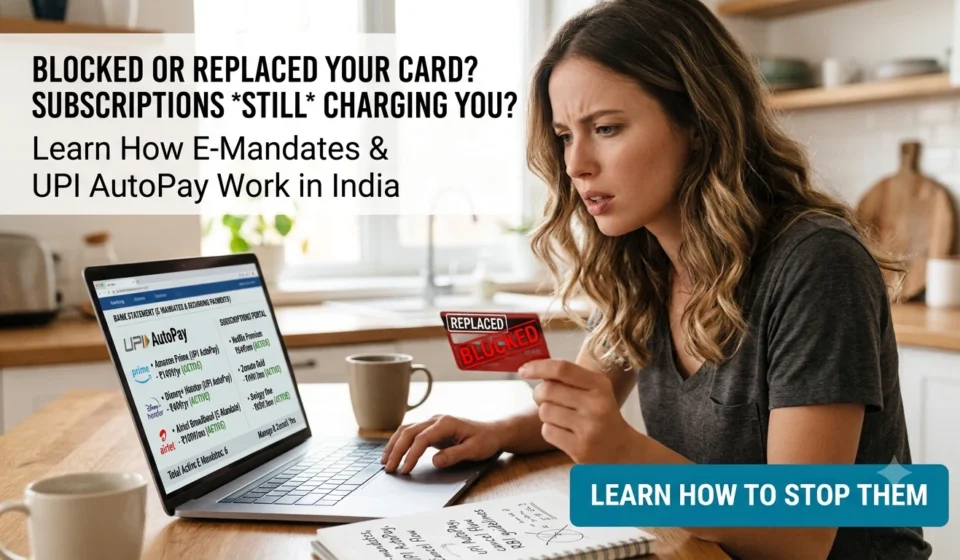
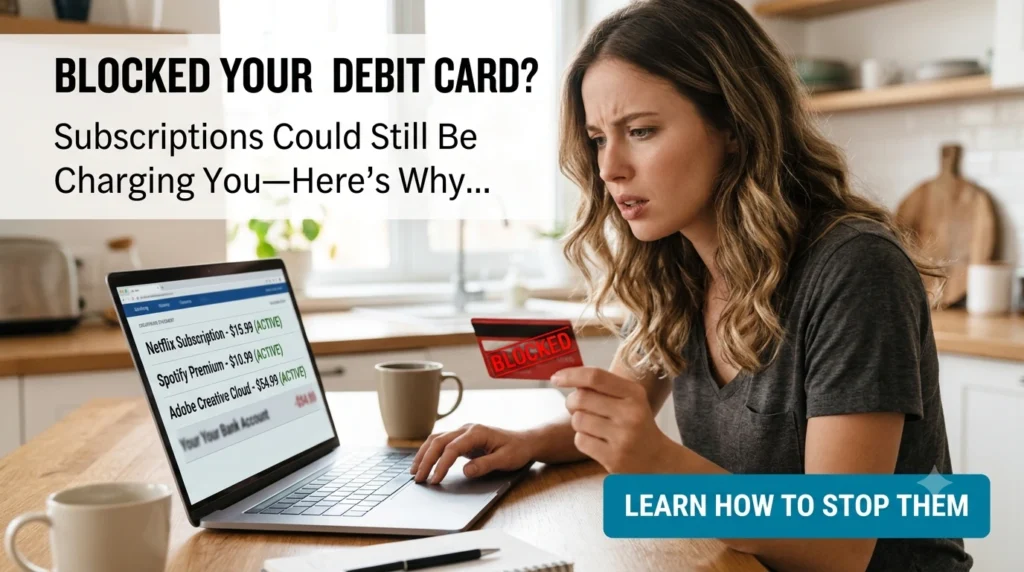
Blocking a debit card may stop you from using it for everyday purchases, but it does not always cancel your active subscriptions. If you have recurring payments set up for OTT platforms, music streaming apps, cloud storage, insurance premiums or other online services, some payments may continue even after your card is blocked or replaced.
The reason is simple: blocking a debit card and cancelling a recurring payment mandate are two different things.
In India, recurring payments can be processed through card e-mandates or UPI AutoPay, depending on how you authorised the transaction. Whether a payment continues after a card replacement depends on the payment method, the bank’s systems, the merchant’s arrangements and the status of the mandate.
Here is how recurring payment mandates work, why unwanted debits can occur after a card is blocked, and what you can do to stop future charges.
You Can Also Like To Read About:
- What Happens to Your SIP, Mutual Fund Units and Autopay Mandate If the Investor Dies, and How the Nominee Claims Them
- What Happens to Your SIP Autopay If Your Bank Defaults, Merges or Is Restricted by RBI, and How to Manage Your Autopays
- What Happens to Loan EMIs and Autopay Mandates If You Die Before Anyone Tells the Bank
What Is a Recurring Payment Mandate?
A recurring payment mandate is an authorisation that allows a merchant or payment service provider to collect payments automatically, subject to the agreed terms and applicable banking rules.
For example, you might authorise Netflix, Spotify or another subscription service to charge you every month. Instead of entering your payment details each time, the merchant initiates the recurring payment under the authorisation you previously provided.
In India, recurring payments commonly operate through two systems:
- Card e-mandates: Recurring payments authorised using a debit or credit card.
- UPI AutoPay: Recurring payments authorised through a UPI app and linked bank account.
These arrangements are governed by applicable RBI requirements, including rules on customer consent, authentication, notifications and transaction limits.
Importantly, a mandate is not the same as the physical debit card. Cancelling or blocking a card does not necessarily cancel every authorisation associated with it.
Does Blocking a Debit Card Stop Recurring Payments?
Not necessarily. The outcome depends on the payment arrangement and whether the recurring mandate remains active.
Consider these scenarios:
| Situation | What may happen |
|---|---|
| You block a lost debit card | New card transactions may be declined, but you should separately check active mandates. |
| Your bank issues a replacement card | Some subscription arrangements may continue if updated card credentials are made available through supported payment systems. |
| You cancel a subscription but leave the mandate active | Further payment attempts may depend on the merchant’s cancellation process and the mandate’s status. |
| You cancel a card mandate | Future payments under that mandate should stop once cancellation takes effect, subject to processing status and any already initiated transactions. |
| You use UPI AutoPay | Blocking a debit card generally does not cancel a mandate authorised separately through UPI. |
These are general scenarios, not guarantees for every bank or merchant. A replacement card does not automatically mean every old subscription will continue, just as blocking a card does not guarantee that every recurring arrangement has been cancelled.
Why Can Subscription Payments Continue After Card Replacement?
There are several reasons why a subscription may remain active after you receive a new debit card.
1. The recurring mandate is still active
When you authorise a recurring payment, the authorisation may be recorded separately from the card you physically hold.
If the underlying mandate remains active, you should not assume that replacing the card has cancelled it. Check the mandate status through your bank and the subscription provider.
2. Updated card credentials may be supported
Certain payment networks and merchants support account or card credential updates. These services can help participating merchants maintain recurring payment arrangements when a card is replaced.
However, this does not mean every replacement card automatically inherits every subscription. The outcome depends on the participating bank, payment network, merchant and transaction setup.
3. You may have authorised payment through UPI AutoPay
If you subscribed using UPI AutoPay, the recurring instruction is associated with the UPI mandate and linked bank account rather than being solely dependent on your debit card.
Blocking the card may therefore have no effect on that separate instruction.
4. The subscription may use another payment method
You might have forgotten that a subscription is linked to a second card, another bank account or a different payment service.
If an unexpected debit appears after a card replacement, check the transaction description and the payment method associated with the merchant before assuming the old card was used.
Card E-Mandates vs UPI AutoPay: What Is the Difference?
Although both systems support automatic payments, their cancellation processes differ.
| Feature | Card e-mandate | UPI AutoPay |
|---|---|---|
| Payment authorisation | Debit or credit card | UPI app and linked bank account |
| Common uses | Online subscriptions, memberships and recurring bills | OTT subscriptions, app payments, bills and other recurring services |
| Where to check | Bank’s card controls or mandate section, where available | UPI app’s AutoPay or mandate section |
| Does blocking a debit card automatically cancel it? | Not guaranteed | Generally no, because the mandate is separate from the card |
| How to stop future payments | Cancel the mandate through an available bank or merchant channel | Revoke or cancel the AutoPay mandate through the relevant UPI app or supported bank channel |
Remember: Cancelling a payment mandate and cancelling the underlying subscription are related but separate actions. You may need to do both.
How to Stop Recurring Payments After Blocking or Replacing Your Debit Card
If you want to prevent unwanted subscription charges, follow these steps.
Step 1: Check your active subscriptions
Make a list of services that may charge you automatically, including:
- OTT platforms and music streaming apps
- Cloud storage and productivity software
- Gaming memberships and mobile apps
- Gym memberships and other recurring services
- Insurance premiums and recurring bill payments
Review your bank statement and payment history to identify merchants you may have overlooked.
Step 2: Check active card mandates with your bank
Log in to your bank’s mobile banking app or internet banking portal and look for sections labelled e-Mandates, Standing Instructions, Recurring Payments, Subscriptions or similar.
The exact menu and available controls vary between banks.
Identify the merchant and payment frequency, then cancel any mandate you no longer want. If the option is unavailable, contact your bank through its official customer-care channel and ask how to revoke the specific recurring authorisation.
Keep the complaint or service-request reference number.
Step 3: Review UPI AutoPay mandates separately
Open the UPI app you used when setting up the subscription. Check its AutoPay or mandate section for active instructions.
Select the relevant mandate and follow the app’s cancellation or revocation process. If you cannot find the mandate, contact the app’s support team or your bank for guidance.
Do not assume that cancelling a card mandate also cancels a UPI AutoPay instruction.
Step 4: Cancel the subscription with the merchant
Log in to the subscription provider’s official website or app and cancel the service if you no longer want it.
Save the cancellation confirmation, email or screenshot. This helps establish when you requested cancellation if another payment is attempted later.
If you want to retain the subscription but change the payment method, update the payment details instead of cancelling the service.
Step 5: Check the next billing date and monitor your account
After cancellation, check the mandate status and the next scheduled billing date, if available.
A cancellation request may take time to be reflected across systems. A transaction already initiated or processed may not be reversed automatically simply because you subsequently cancelled the mandate.
Review your bank statements for the next billing cycle and contact the bank promptly if a debit occurs that you believe was unauthorised.
RBI Rules on Recurring Payments in India: What Customers Should Know
The Reserve Bank of India has established a framework for recurring transactions processed through cards and certain other payment instruments. The framework includes requirements relating to customer consent, authentication, pre-debit notifications and additional authentication for applicable transactions.
Under the RBI’s e-mandate framework, customers are generally entitled to receive a pre-debit notification at least 24 hours before an applicable recurring transaction, subject to the rules and exceptions relevant to the payment arrangement.
Additional authentication requirements and transaction thresholds depend on the applicable RBI directions and the type of payment. Customers should check current rules with their bank rather than assume that every recurring payment follows identical requirements.
A few important points:
- Consent matters: A merchant should not treat a card replacement as fresh consent to a new mandate without the required authorisation.
- Notifications matter: Check SMS messages, emails and banking-app alerts for upcoming recurring debits.
- Cancellation matters: Use the available mandate-revocation process instead of relying only on card blocking.
- Disputes matter: If a debit appears unauthorised, report it to your bank promptly and retain the transaction details.
For official information, refer to the Reserve Bank of India’s website at https://www.rbi.org.in/ and search for its Framework for Processing of e-mandates for Recurring Transactions and subsequent updates.
What Should You Do If Money Is Debited After You Cancel a Mandate?
If you notice a subscription debit after requesting cancellation, take action as soon as possible.
1. Identify the transaction. Note the amount, date, merchant name and transaction reference.
2. Check the cancellation status. Confirm whether the mandate was successfully revoked and whether the debit was initiated before cancellation took effect.
3. Contact the merchant. Ask why the payment was collected and request a refund if the charge was not due under the agreed terms.
4. Raise a complaint with your bank. Explain that you had cancelled the mandate or did not authorise the transaction. Provide supporting evidence and request investigation.
5. Escalate if necessary. If your bank does not resolve the complaint satisfactorily, you can use its grievance-redressal process. Where the complaint meets the applicable conditions, you may also approach the RBI’s Complaint Management System under the RBI Integrated Ombudsman Scheme.
For a suspected unauthorised electronic banking transaction, notify your bank immediately. Customer liability can depend on the circumstances, including whether the transaction resulted from a bank deficiency, a third-party breach or customer negligence. Reporting time can be important.
If you suspect fraud, you can also report it through India’s official cybercrime portal at https://cybercrime.gov.in/ or call the national cybercrime helpline at 1930 where applicable.
Frequently Asked Questions
Will blocking my debit card stop Netflix or other OTT subscriptions?
Not always. A card-based subscription may stop, but the result depends on the payment arrangement and whether the mandate remains active or supported card credentials are updated. Check the subscription’s payment method and your bank’s mandate records.
Will replacing my debit card cancel all existing subscriptions?
No. Replacing a debit card is not the same as cancelling subscriptions or revoking recurring payment mandates. Review active card mandates and any separate UPI AutoPay instructions.
Can UPI AutoPay continue after I block my debit card?
Yes, it may continue if the UPI AutoPay mandate remains active and the linked bank account can fund the payment. Card blocking alone generally does not revoke a separate UPI mandate.
How can I check active e-mandates on my bank account?
Check your bank’s mobile app or internet banking for recurring payments, standing instructions or e-mandates. If you cannot find the option, contact the bank using its official support channels.
Can I stop recurring payments without closing my bank account?
Yes. In most cases, you can revoke a specific mandate or cancel the relevant subscription without closing the bank account. Use the appropriate cancellation channel for the payment method.
Will cancelling a mandate automatically refund money already deducted?
No. Cancellation generally concerns future payments. A refund for an earlier debit depends on the circumstances, the merchant’s terms and the outcome of any bank investigation or dispute.
What if my bank does not cancel the mandate?
Submit a formal complaint and request a reference number. If the bank does not resolve the issue satisfactorily, escalate through its grievance-redressal mechanism and consider the RBI’s complaint process where eligible.
The Bottom Line
Blocking or replacing your debit card is an important security step, but it should not be treated as a universal way to cancel recurring payments.
If you want to stop unwanted subscription debits, check your active card e-mandates, review UPI AutoPay separately, cancel subscriptions you no longer need and retain confirmation of every cancellation request.
The safest approach is to cancel the specific mandate and the subscription where appropriate, then verify that the changes have taken effect.

Shuchi founded Finance Checks after spending 16+ years working in corporate, managing operations and distribution. She managed her own finances, learned and read regularly and helped people make sense of their savings, loans, insurance, and investments.
She started this site to offer the kind of clear, honest financial guidance she wished was more available when she was learning to manage her own money. Every article is researched personally, checked against official sources such as the Reserve Bank of India, SEBI, or the Income Tax Department, and revisited whenever regulations or figures change. She is upfront about how the site earns money through ads and select affiliate partnerships, and she does not let either influence what she actually recommends to readers.



[…] Blocked Your Debit Card? Your Subscriptions Could Still Be Charging You—Here’s Why […]