
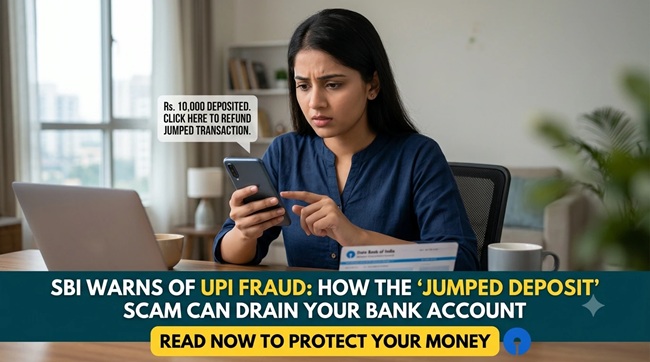
SBI Warns of UPI Fraud: How the ‘Jumped Deposit Scam’ Can Drain Your Bank Account

An unexpected credit in your bank account may look like a harmless mistake. But if an unknown person calls you claiming to have transferred money accidentally and asks you to return it urgently, stop and verify the transaction before doing anything.
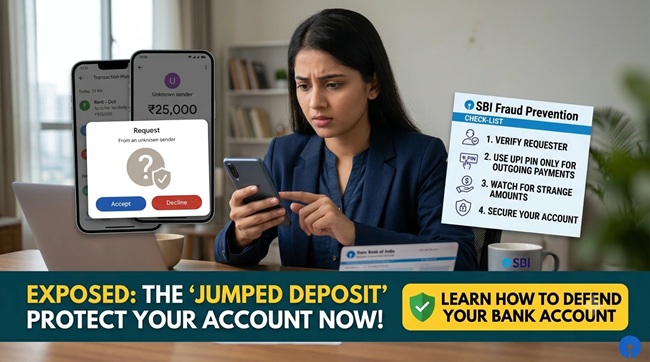
The State Bank of India (SBI) warned customers about the jumped deposit scam on October 10, 2026, urging people to remain cautious about unexpected bank credits and suspicious UPI payment requests. The warning highlighted how fraudsters may use a seemingly innocent deposit to gain a victim’s trust before pressuring them into authorising a much larger payment.
With UPI payments widely used across India, understanding this type of digital payment fraud can help you protect your bank account, avoid unauthorised transfers and respond safely to suspicious transactions.
In this guide, we explain what the jumped deposit scam is, how it works, the warning signs to watch for, what SBI and NPCI say about UPI safety, and what to do if you receive an unexpected bank deposit.
What Is the Jumped Deposit Scam?
The jumped deposit scam is a reported form of UPI-related social engineering fraud in which a fraudster uses an unexpected credit or a claim of mistaken payment to persuade someone to authorise a payment to an unknown recipient.
The caller may claim that they accidentally transferred a small amount to your bank account. They might ask you to return it immediately, use emotional pressure or create a sense of urgency.
The danger arises when the victim follows the caller’s instructions without independently verifying the transaction. The scammer may then try to persuade the victim to approve a separate, higher-value UPI payment request.
However, an important technical distinction matters: an unexpected deposit does not, by itself, give another person access to your bank account. A UPI payment generally requires the account holder to take an action to authorise it, such as selecting a payment request and entering their UPI PIN.
The safest response is to verify the credit with your bank and avoid approving unfamiliar payment requests.
How Does the Jumped Deposit Scam Work?
The scam may unfold in several stages.
1. An unexpected amount appears in your account
You notice a credit from an unfamiliar person or receive a message claiming that money has been transferred to you by mistake.
The amount may be relatively small, making the situation appear genuine and harmless.
2. The alleged sender contacts you
A caller or message claims that the transfer was accidental. They may ask you to send the money back immediately, sometimes insisting that they urgently need it.
The caller may sound convincing, polite or distressed. Their aim is to make you act before checking the facts.
3. The fraudster creates urgency
The person may repeatedly call you, send messages or use emotional pressure to prevent you from contacting your bank.
They may also give instructions about opening a UPI app, checking a request or completing a transaction.
4. You may be persuaded to approve a separate payment
This is the critical risk. A fraudster may attempt to trick you into selecting a payment request and authorising a transaction for an amount much higher than the original credit.
For example, you might see an unexpected credit of ₹500 and then face pressure to approve a UPI payment of ₹5,000 or another amount.
The figures are illustrative, not a report of a specific transaction.
5. Money leaves your account
If you authorise the payment, the funds may be transferred to the recipient. Recovering money from an authorised but fraudulent transaction can be difficult, so prevention and prompt reporting are essential.
Remember: A caller cannot legitimately make you approve a payment simply by depositing money into your account. Never authorise a transaction unless you understand exactly what it does and independently trust the recipient.
SBI’s Warning About the Jumped Deposit Scam
SBI issued its warning as part of its National Cyber Security Month Special Campaign 6.0. The bank cautioned customers about unexpected credits, claims of accidental transfers and pressure to approve emergency UPI requests.
The advisory encouraged customers to avoid emotional manipulation, block suspicious numbers and report concerns to their bank promptly.
The warning reinforces a broader principle of digital banking safety: do not let an unfamiliar caller dictate how you use your banking app.
For the latest guidance, customers should consult SBI’s official Cyber Security page.
Can Someone Steal Money From Your Account Just by Depositing Money?
No. An unexpected deposit alone does not automatically give the sender access to your bank account or authorise a withdrawal.
The National Payments Corporation of India (NPCI) issued a clarification on the jumped deposit scam on January 13, 2025, addressing technical misconceptions surrounding the reported fraud.
NPCI explained that simply opening a UPI or banking app does not automatically approve a transaction. A user must take the relevant action to authorise a payment, including explicitly selecting the payment option and entering the UPI PIN when required.
NPCI also clarified that a payment request does not allow an outside party to directly withdraw money without the user’s authorisation.
This distinction is important because exaggerated claims about UPI vulnerabilities can create unnecessary panic. The practical risk is social engineering: a fraudster tricks a person into approving a transaction they did not intend to make.
Read the NPCI clarification on the jumped deposit scam.
7 Warning Signs of a Jumped Deposit Scam
Watch for these red flags when dealing with an unexpected bank credit.
1. An unfamiliar credit appears in your account
A deposit from an unknown person should prompt verification, particularly if someone contacts you immediately afterwards.
2. Someone demands an immediate refund
Fraudsters often use urgency to discourage you from checking transaction details or speaking to your bank.
3. The caller asks you to approve a UPI request
Never approve an unfamiliar payment request simply because someone claims to have sent you money.
4. The amount on the screen does not match the original deposit
Check the amount, recipient name and transaction type carefully. A refund request and a new payment are not necessarily the same transaction.
5. Someone asks for your UPI PIN or OTP
Never disclose your UPI PIN, one-time password, banking password or card security details to another person.
6. The caller discourages you from contacting your bank
A genuine banking concern can be checked through official channels. Be suspicious of anyone who insists that you must act without verification.
7. You are asked to scan a QR code or install an app
Do not scan unfamiliar payment QR codes, click suspicious links or install remote-access applications at the request of an unknown caller.
You May Also Like To Read About:
- Your Rights If You Are a Victim of UPI or Online Banking Fraud: RBI Zero Liability Rules and Reporting Timelines Explained
- Fraud Isn’t Just Calls and SMS Anymore: How Fake Websites Are Stealing From Indians Right Now
- SMS Fraud Alert: How to Tell a Genuine Bank Message From a Scam
- Deepfake KYC Fraud Is Here: How Scammers Are Using AI to Open Accounts in Your Name
- UPI Fraud: The 7 Scams Costing Indians the Most Money Right Now
- Fake Income Tax Notice on WhatsApp: Could One Click Put Your Bank Account at Risk?
- Your Bank Account Is Frozen: 9 Reasons You Could Lose Access to Your Own Money
What Should You Do If You Receive an Unexpected UPI Deposit?
If money appears in your account from an unknown sender, follow these precautions.
Step 1: Do not panic or spend the money.
Keep the amount untouched while you establish why it was credited. Do not assume the transfer was intended for you.
Step 2: Check your actual bank statement.
Open your bank’s official app or internet banking service independently. Verify whether the credit is reflected in the transaction history rather than relying only on an SMS, screenshot or message from the caller.
Step 3: Do not approve any unfamiliar payment request.
You do not need to enter your UPI PIN to receive money. Entering the PIN in a payment flow authorises an action that must be understood before proceeding.
Step 4: Contact your bank through official channels.
Explain that you have received an unexpected credit and ask how the matter should be handled. Use the contact details on your bank’s official website, app or statement.
Step 5: Do not return the money to an unverified account.
If the sender claims that a transfer was accidental, ask your bank to guide you through the appropriate process. Avoid making a separate payment to an account supplied by an unknown caller without verification.
Step 6: Preserve the evidence.
Keep the transaction reference, bank statement entry, phone number, messages and screenshots. These details may help your bank or the authorities investigate the incident.
Step 7: Report suspicious activity promptly.
If you suspect fraud, contact your bank immediately and report the incident through India’s official cybercrime channels.
What to Do If You Have Already Approved a Fraudulent UPI Payment
If you have entered your UPI PIN and authorised a payment under pressure, or notice a transaction you did not intend to make, act quickly.
- Contact your bank immediately. Report the transaction, provide the transaction ID and ask the bank to register a complaint and advise on available measures.
- Call India’s cybercrime helpline at 1930. Report suspected financial cyber fraud as soon as possible.
- Submit a complaint online. Use the official National Cyber Crime Reporting Portal.
- Secure your payment access. Follow your bank’s instructions to block or disable UPI services if necessary. Change compromised banking credentials and review other recent transactions.
- Preserve all evidence. Keep SMS alerts, UPI transaction details, call logs, messages and complaint acknowledgement numbers.
A prompt report may help the authorities and participating banks take action, but recovery is not guaranteed. Do not pay anyone who promises to recover your lost money in exchange for an upfront fee.
SBI lists its official cyber-security guidance and reporting information on its Cyber Security page. Its contact centre also provides banking assistance through official helpline numbers published on the SBI Contact Centre page.
Is UPI Safe to Use After the Jumped Deposit Scam Warning?
UPI remains a widely used digital payment system, and the reported scam is not evidence that simply receiving a deposit automatically compromises a UPI account.
NPCI’s clarification emphasises that users must authorise payments. This makes it important to understand the difference between receiving money, checking a balance and approving a payment request.
You can reduce the risk of UPI fraud by following these rules:
- Never share your UPI PIN, OTP, password or card security details.
- Remember that you do not need to enter your UPI PIN to receive money.
- Read the recipient’s name and transaction amount before approving a payment.
- Decline payment requests you do not recognise.
- Never act under pressure from an unknown caller.
- Use only official banking apps and trusted customer-support channels.
- Monitor your account regularly and enable transaction alerts.
- Report suspected fraud to your bank and the cybercrime helpline promptly.
Digital payment safety depends on both secure payment systems and informed user decisions. Verification is more reliable than acting on a stranger’s instructions.
Frequently Asked Questions (FAQs)
1. What is the jumped deposit scam?
The jumped deposit scam is a reported UPI-related fraud tactic in which a person receives an unexpected credit or is told that money was sent accidentally. A fraudster then uses urgency or emotional pressure to try to persuade the recipient to approve a payment to an unknown account.
2. Can someone withdraw money from my account by depositing ₹500?
No. Depositing ₹500 does not automatically give the sender access to your bank account. The risk arises if you are tricked into authorising a payment, disclosing credentials or taking another unsafe action.
3. Do I need to enter my UPI PIN to receive money?
No. You do not need to enter your UPI PIN to receive money. If an unexpected payment request appears, examine the transaction carefully and do not authorise it unless you deliberately intend to make that payment.
4. What should I do if an unknown person sends money to my bank account?
Check the credit in your official bank statement, keep the money untouched, contact your bank and follow its instructions. Do not make a separate refund to an unverified account simply because a caller demands it.
5. What did SBI say about the jumped deposit scam?
SBI warned customers about unexpected bank credits and fraudsters who may use claims of accidental transfers to pressure people into authorising high-value UPI payments. The bank advised customers to remain vigilant and report suspicious activity.
6. What did NPCI clarify about the jumped deposit scam?
NPCI’s January 13, 2025 clarification stated that merely opening a UPI or banking app does not automatically approve a transaction. The user must take the required action to authorise the payment. The clarification addressed technical misconceptions about how UPI transactions are approved.
7. Where can I report UPI fraud in India?
Contact your bank immediately, call the national cybercrime helpline at 1930, and file a complaint at cybercrime.gov.in. Keep your transaction reference and supporting evidence ready.
8. Can I get my money back after a fraudulent UPI payment?
Recovery depends on the circumstances, the transaction and the action taken by the bank and authorities. Report the transaction immediately, provide all available evidence and follow the complaint process. Recovery cannot be guaranteed.
9. Is the jumped deposit scam a flaw in the UPI system?
The reported tactic primarily involves manipulating users into authorising payments. NPCI clarified that opening a UPI app alone does not authorise a transaction. Users should follow official security guidance rather than assume that an unexpected credit automatically exposes their accounts.
10. Should I block someone who claims to have transferred money by mistake?
If the caller is suspicious, pressuring you or asking you to approve an unfamiliar payment, stop engaging and contact your bank independently. You can block and report suspicious numbers, but do not ignore the unexpected credit itself; ask your bank how to handle it.
Final Takeaway: Verify First, Pay Only When You Intend To
The SBI jumped deposit scam warning is a reminder that fraudsters may exploit trust, urgency and confusion rather than directly bypassing payment security.
If an unfamiliar amount appears in your bank account, do not panic, spend it or rush to return it. Verify the credit through your bank, avoid unknown UPI payment requests and report suspicious activity promptly.
One simple rule can help protect your money: receiving money is not the same as authorising a payment. Never enter your UPI PIN or approve a transaction just because a stranger tells you to.
Disclaimer
This article is intended for general financial education and public awareness. It is based on publicly available information and official guidance from SBI and NPCI available at the time of writing. It is not legal, financial or banking advice, and it does not guarantee that following these precautions will prevent every form of fraud or ensure recovery of lost funds. Banking procedures and complaint-handling processes may vary. Readers should contact their bank and consult official government cybercrime resources for assistance with specific incidents.

Shuchi founded Finance Checks after spending 16+ years working in corporate, managing operations and distribution. She managed her own finances, learned and read regularly and helped people make sense of their savings, loans, insurance, and investments.
She started this site to offer the kind of clear, honest financial guidance she wished was more available when she was learning to manage her own money. Every article is researched personally, checked against official sources such as the Reserve Bank of India, SEBI, or the Income Tax Department, and revisited whenever regulations or figures change. She is upfront about how the site earns money through ads and select affiliate partnerships, and she does not let either influence what she actually recommends to readers.