

Health Insurance Claim Rejected? Here’s What to Do Next

Anjali’s father was hospitalized for four days, she paid the bills, submitted every document the third-party administrator asked for, and then waited. Forty days later, an email arrived with a single line: claim repudiated. No detailed explanation, no next steps, just a rejection sitting in her inbox next to bills she’d already paid out of pocket. Her first reaction was to assume that was the end of it, the insurer had decided, and there was nothing left to do.
That assumption is wrong, and it’s worth knowing that before you’re the one staring at a rejection email. Health insurance in India is a tightly regulated product, and IRDAI has built a specific, free, structured process precisely for situations like this. A rejected claim isn’t a final verdict. It’s the start of a process designed to work in the policyholder’s favour at almost every stage, provided you actually use it.
Health Insurance Claim Rejected, Steps To Claim It Again
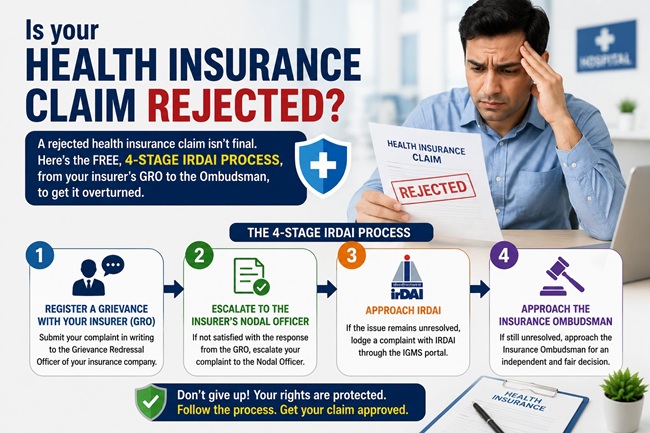
Step 1: Get the Rejection in Writing, With a Reason
Before anything else, make sure you have a written rejection with a specific reason attached, not just a verbal “not approved” from a TPA desk or a vague one-line email. Insurers are required to provide this, and the exact reason cited shapes everything that follows. A rejection for an incomplete discharge summary requires a completely different response than one citing a policy exclusion or a pre-existing disease clause.
While you’re at it, gather everything else too: your policy document, all hospital bills and receipts, discharge summary, any correspondence with the insurer or TPA, and a clear timeline of events, when the policy was purchased, when the claim event happened, when you filed, and when the rejection arrived. This becomes your evidence file for every stage that follows.
Step 2: File a Formal Complaint With the Insurer’s Grievance Redressal Officer
Every insurer is legally required to have a Grievance Redressal Officer, or GRO, and this is your first formal escalation step, not a repeat of your original claim submission. Email or write to the GRO directly, referencing your policy number, claim number, and the specific rejection reason you’re disputing, along with your supporting documents.
The insurer’s GRO is required to respond within 15 working days. It’s genuinely common for rejections to get quietly reversed at exactly this stage, particularly when the original issue was a documentation gap, a misapplied policy clause, or a waiting period that had actually already elapsed by the time treatment happened. Insurers know a formal GRO complaint is the first step of a regulatory process, and many resolve issues here rather than let them escalate further.
Step 3: Escalate to IRDAI’s Bima Bharosa Portal
If the GRO doesn’t resolve things within that 15-day window, or you’re unsatisfied with their response, the next step is IRDAI’s official grievance portal, Bima Bharosa, at bimabharosa.irdai.gov.in. This replaced the older Integrated Grievance Management System in 2023 and serves as the central, regulator-monitored complaint channel for every type of insurance, health, life, motor, and general.
To file here, visit the portal, register your complaint with your policy details, insurer name, and the nature of your dispute, then upload your supporting documents, claim forms, correspondence, and the rejection letter. You’ll receive a complaint reference or token number to track progress. Once filed, IRDAI forwards your grievance directly to the insurer and monitors their response, which adds a layer of regulatory pressure that a purely internal complaint doesn’t carry. You can also reach IRDAI through its toll-free helpline, 155255, or by email at complaints@irdai.gov.in, if you’d rather not use the portal directly.
Step 4: Approach the Insurance Ombudsman
If Bima Bharosa still doesn’t resolve your dispute, the next step is the Insurance Ombudsman, a quasi-judicial authority set up under the Insurance Ombudsman Rules, 2017, amended in 2021, operating across 17 regional zones in India. This is where the process gets genuinely powerful for policyholders. The Ombudsman can award compensation of up to 50 lakh rupees, a limit raised from the earlier 30 lakh rupee cap under the 2021 amendment, and the entire process is completely free, with no requirement to hire a lawyer.
To be eligible, you generally need to have already filed a grievance with the insurer and waited the required 15 days, and you must apply within one year of the insurer’s final rejection, so this isn’t a step to delay indefinitely. You can file online through the Bima Bharosa portal or by post to your regional Ombudsman’s office, and a hearing, in-person or online, will typically be scheduled where you can present your case directly, referencing specific policy clauses and your documentation. The Ombudsman’s award is binding on the insurer, who must comply within 30 days, though if you’re personally unhappy with the outcome, you retain the right to pursue the matter further.
Step 5: Consumer Court, If You’re Still Not Satisfied
If the Ombudsman’s decision doesn’t resolve things to your satisfaction, you can take the matter to a Consumer Court, District, State, or National Consumer Commission depending on the claim amount involved. This is a more formal legal route than the previous three steps, and while it can take longer, it remains an option if you believe the earlier stages haven’t delivered a fair outcome.
How Long the Whole Process Actually Takes
Realistically, expect the complete journey from initial GRO complaint through to an Ombudsman award to take somewhere in the range of 2 to 6 months, depending on the complexity of your case and your specific region’s Ombudsman workload. The GRO stage typically resolves within its mandated 15 working days, Bima Bharosa complaints are generally acknowledged and routed within a similar 15-working-day window, and Ombudsman hearings and awards tend to take the longest stretch of the process, often several weeks to a few months depending on scheduling and case complexity.
Know This Rule: The 5-Year Moratorium
One protection worth knowing about specifically, if you’ve held continuous health insurance coverage for 5 years, insurers generally cannot reject your claim on the grounds of a pre-existing disease or non-disclosure at that point, except in cases involving proven fraud. This moratorium provision exists precisely to prevent long-standing policyholders from being denied claims over old medical history technicalities once they’ve paid premiums faithfully for years. If your rejection cites a pre-existing condition and you’ve held the policy continuously for 5 years or more, this is worth raising specifically in your GRO complaint.
You May Also Like To Read:
- Term Insurance vs Whole Life Insurance: Which Actually Protects Your Family
- Term Insurance for Smokers: Why Your Premium Is So Much Higher, and What You Can Actually Do About It
- Term Insurance Explained: Why It Matters, How Much You Actually Need, and Exactly How It Pays Out
- Turning 35? Here Is Why Life Insurance Just Became Non Negotiable For You
Common Reasons Claims Get Rejected, and What They Mean for Your Response
| Rejection Reason | What It Usually Means | Your Best Response |
|---|---|---|
| Incomplete or illegible documents | Often a fixable, procedural issue rather than a genuine denial | Resubmit clear, complete documents through the GRO |
| Pre-existing disease non-disclosure | Insurer claims a prior condition wasn’t declared at purchase | Check if the 5-year moratorium applies, or dispute the non-disclosure claim with medical records |
| Waiting period not completed | Claim filed before a specific condition’s waiting period elapsed | Verify the actual waiting period against your policy date and claim date |
| Policy exclusion cited | Insurer says the treatment falls under an excluded category | Review your policy wording carefully, exclusions are sometimes misapplied |
| Non-network hospital for cashless claim | Cashless facility denied because the hospital isn’t empanelled | File as a reimbursement claim instead, using original bills and documents |
The 4-Stage Escalation Path at a Glance
| Stage | Where to Go | Typical Timeline | Cost |
|---|---|---|---|
| 1. Insurer GRO | Insurer’s Grievance Redressal Officer | 15 working days to respond | Free |
| 2. Bima Bharosa | bimabharosa.irdai.gov.in | ~15 working days to acknowledge and route | Free |
| 3. Insurance Ombudsman | 17 regional zones, via Bima Bharosa or post | Several weeks to a few months | Free |
| 4. Consumer Court | District/State/National Consumer Commission | Varies, generally the longest stage | Court fees may apply |
About This Guide
This article reflects IRDAI’s grievance redressal framework as it stands in 2026, including the Bima Bharosa portal (which replaced the earlier IGMS system in 2023) and the Insurance Ombudsman Rules, 2017, as amended in 2021. Specific timelines, documentation requirements, and eligibility conditions can vary based on your insurer, policy terms, and the nature of your dispute, so please verify current procedures directly on the Bima Bharosa portal or with the Council for Insurance Ombudsmen before filing.
Common Mistakes People Make After a Claim Rejection
Accepting a verbal or vague rejection without insisting on a specific written reason is probably the most common mistake. The exact reason cited determines your entire strategy going forward, and insurers are obligated to provide this in writing if you ask.
Skipping the GRO stage and jumping straight to Bima Bharosa or the Ombudsman is another frequent misstep. Most escalation paths require proof that you’ve already attempted resolution with the insurer directly, and skipping this step can send your complaint back to square one.
People also frequently wait too long to escalate, particularly missing the one-year window to approach the Ombudsman after a final rejection. Treating the Ombudsman as a last resort you’ll “get to eventually” rather than a time-bound right can genuinely close off this option if too much time passes.
Finally, many policyholders give up entirely after the first rejection, assuming a denial is final. As the process above shows, a significant number of rejections get overturned specifically at the GRO or Ombudsman stage, particularly ones involving documentation issues or misapplied policy clauses rather than genuinely excluded claims.
My Take
The thing that stands out most about this process is how deliberately it’s structured to favour the policyholder, free at every single stage, no lawyer required, and a real, binding authority in the Ombudsman that most people have simply never heard of. Insurers understand this system far better than most policyholders do, which is exactly why so many rejections get quietly reversed the moment a formal GRO complaint lands, before a case ever needs to reach the Ombudsman at all. If your claim gets rejected, treat that email as the first move in a process, not the final word, and don’t let a one-line rejection go unanswered.
Frequently Asked Questions
1. What should I do first if my health insurance claim is rejected? Request a written rejection with a specific reason if you haven’t received one, then gather your policy documents, bills, and correspondence before filing a formal complaint with your insurer’s Grievance Redressal Officer.
2. What is Bima Bharosa? Bima Bharosa is IRDAI’s official online grievance redressal portal for all types of insurance complaints, including health insurance claim disputes, accessible at bimabharosa.irdai.gov.in. It replaced the earlier Integrated Grievance Management System in 2023.
3. How much compensation can the Insurance Ombudsman award? The Insurance Ombudsman can award compensation of up to 50 lakh rupees, a limit raised from 30 lakh rupees under the 2021 amendment to the Insurance Ombudsman Rules.
4. Is there a fee to file a complaint with IRDAI or the Ombudsman? No, both the Bima Bharosa portal and the Insurance Ombudsman process are completely free, and you don’t need to hire a lawyer to file or pursue a complaint.
5. How long do I have to approach the Insurance Ombudsman after a claim rejection? You generally need to file with the Ombudsman within one year of the insurer’s final rejection, so it’s important not to delay escalation indefinitely.
6. Can my claim be rejected for a pre-existing disease if I’ve had the policy for years? Generally, no. After 5 years of continuous coverage, insurers typically cannot reject a claim on grounds of pre-existing disease or non-disclosure, except in cases involving proven fraud, under IRDAI’s moratorium provision.
7. What if my cashless claim is denied at the hospital? If cashless approval is denied, often because the hospital isn’t empanelled with your insurer, you can still pay upfront and file the claim as a reimbursement instead, using your original bills and documents.
8. Do I need a lawyer to file a complaint with the Insurance Ombudsman? No, the process is specifically designed to be accessible without legal representation. You can present your case directly using your documentation and policy details.
9. What happens if I’m not satisfied with the Ombudsman’s decision? You retain the right to escalate further to a Consumer Court, District, State, or National Consumer Commission depending on the claim amount, if you remain dissatisfied with the Ombudsman’s award.
10. Why do most health insurance claims actually get rejected? Common reasons include incomplete or illegible documentation, pre-existing disease non-disclosure disputes, claims filed before a waiting period elapsed, policy exclusions, and cashless claims at non-network hospitals, several of which are resolvable through the escalation process rather than being final.
Disclaimer
This article is for informational and educational purposes only and does not constitute legal or insurance advice. Grievance redressal timelines, eligibility conditions, and procedures are subject to change by IRDAI and the Council for Insurance Ombudsmen. Please refer to the official Bima Bharosa portal and your specific policy documents for guidance accurate to your situation, and consult a qualified professional for complex disputes.

Shuchi founded Finance Checks after spending 16+ years working in corporate, managing operations and distribution. She managed her own finances, learned and read regularly and helped people make sense of their savings, loans, insurance, and investments.
She started this site to offer the kind of clear, honest financial guidance she wished was more available when she was learning to manage her own money. Every article is researched personally, checked against official sources such as the Reserve Bank of India, SEBI, or the Income Tax Department, and revisited whenever regulations or figures change. She is upfront about how the site earns money through ads and select affiliate partnerships, and she does not let either influence what she actually recommends to readers.



[…] India are non-disclosure of pre-existing conditions, which drives an estimated 15 to 40% of serious insurance rejections depending on the data source, followed by waiting period violations, room rent cap mismatches that […]