
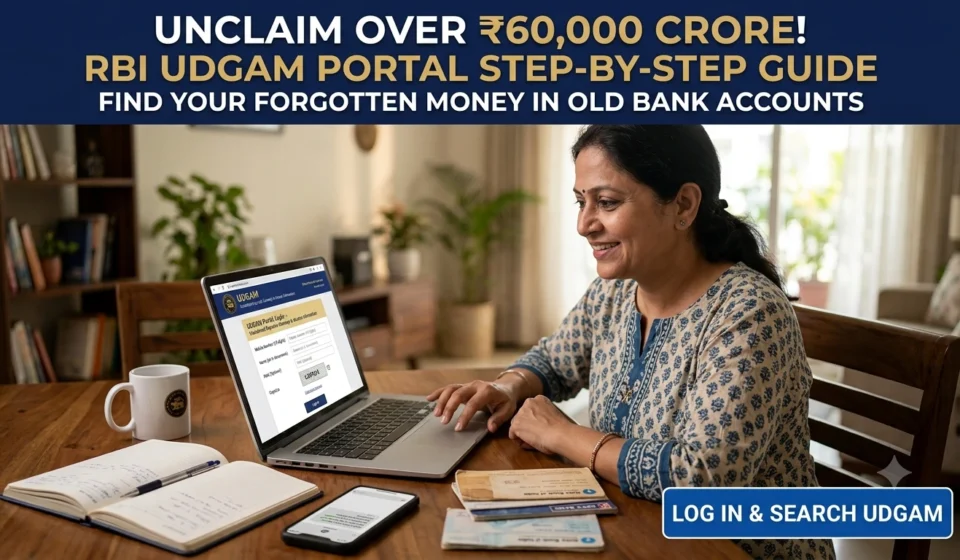
RBI’s UDGAM Portal: How to Check If You Have Forgotten Money Sitting in an Old Bank Account

Anand had switched jobs four times in his career, and with every switch, a new salary account had opened somewhere, sometimes because his new employer had a tie-up with a specific bank, sometimes just out of convenience. He was cleaning out an old cupboard when he found a passbook from a bank he hadn’t stepped inside in over a decade, a savings account from his very first job that he’d simply stopped using once his salary started going elsewhere. He assumed whatever small balance was in there had probably been absorbed by the bank somehow, or lost to inactivity fees, or was simply too small to bother chasing. On a whim, he searched his name on a portal a colleague had mentioned once, called UDGAM. Within two minutes, it showed an unclaimed fixed deposit under that same old bank, matured years ago, sitting untouched, still legally his.
Anand’s story isn’t unusual. Indian banks are currently sitting on more than ₹60,000 crore in deposits that technically belong to someone, money nobody has claimed simply because they forgot it existed, moved cities, changed their phone number, or, in some cases, passed away without their family knowing the account existed at all.
Quick Answer
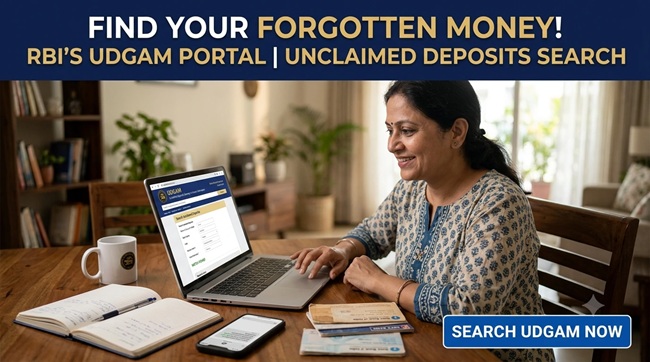
UDGAM, which stands for Unclaimed Deposits – Gateway to Access inforMation, is a free, official RBI portal that lets you search for unclaimed bank deposits across multiple banks in a single place, without needing to visit each bank individually. You can access it at udgam.rbi.org.in. To use it, register with your name and mobile number, verify with an OTP, then search using the account holder’s name along with one identifying document like a PAN, voter ID, driving licence, passport, or date of birth. If a match is found, the portal shows you which bank holds the unclaimed deposit and points you to that bank’s claim process; UDGAM itself does not pay out any money, it only helps you locate it. As of April 2026, the portal covers 30 banks that together account for around 90 percent of all unclaimed deposit value held in RBI’s Depositor Education and Awareness Fund, and over 20 lakh users had registered to search it.
About This Guide
This guide is based on RBI’s official UDGAM portal documentation and FAQ, along with public data on unclaimed deposits reported through government responses and RBI press releases, current as of August 2026. FinanceChecks.com is not affiliated with RBI or any bank, and this article is intended purely to help readers understand and use this free official tool. Always access the portal only through its official URL, udgam.rbi.org.in, and never share your OTP, password, or banking credentials with anyone claiming to retrieve unclaimed funds on your behalf for a fee.
What Counts as an “Unclaimed Deposit”
Under RBI’s rules, a bank account is classified as inoperative, and eventually its balance as an unclaimed deposit, when there have been no customer-induced transactions in the account for ten consecutive years, or when a fixed deposit matures and remains unclaimed by the depositor for ten years from the date of maturity. This can happen for entirely ordinary reasons: an old salary account left behind after a job change, a fixed deposit opened by a parent or grandparent for a child that nobody remembered to close after maturity, or an account belonging to someone who has since passed away, with the family unaware the account ever existed.
Once an account crosses that ten-year inactivity threshold, banks are required to transfer the outstanding balance to the Depositor Education and Awareness Fund, a fund maintained and controlled by the RBI itself, rather than by the individual bank. It’s worth being clear about one important point here, since this is a common source of anxiety: the money does not disappear, and the bank cannot use it for its own purposes. It legally remains yours, or your legal heir’s, indefinitely, and can be claimed at any point, even decades later, once you know where to look.
Why This Portal Exists
Before UDGAM launched in August 2023, finding an old, forgotten account meant writing individually to every bank you could remember ever having an account with, and waiting, often for weeks, for a response that might or might not confirm anything. RBI built UDGAM specifically to remove that friction, giving the public a single, centralised place to search across dozens of major banks at once, rather than approaching each one separately. The portal expanded quickly after launch: coverage grew from an initial seven banks to thirty banks by September 2023, together representing roughly 90 percent of the total value sitting in the DEA Fund. By April 2026, more than 20 lakh users had registered on the portal, and over 44 lakh individual searches had been conducted, figures that give you a sense of just how widespread the problem of forgotten deposits genuinely is across Indian households.
How to Search UDGAM Step by Step
- Register on the portal. Visit udgam.rbi.org.in and click on the registration option. Enter your name and mobile number, set a password, complete the captcha, and accept the disclaimer shown on screen.
- Verify with OTP. You’ll receive an OTP on your registered mobile number to complete and confirm your registration.
- Log in. Return to the portal, enter your mobile number, password, and captcha, and verify again with an OTP to access your account.
- Search using the account holder’s details. Enter the account holder’s name and select the specific bank you want to search, or search across all covered banks if you’re not certain which one holds the account. You’ll also need to provide at least one identifying document number, this can be a PAN, voter ID, driving licence number, passport number, or the account holder’s date of birth, depending on what the search form requests.
- Review the results. If the portal finds a matching unclaimed deposit, it will display the relevant bank’s details and outline that bank’s specific process for filing a claim. If nothing appears, that generally means either there’s no unclaimed deposit under those details at any of the covered banks, or the account in question is with a bank not yet part of UDGAM’s coverage.
What Happens After You Find a Match
This is the part worth understanding clearly: UDGAM only finds unclaimed deposits, it does not settle or pay out any money itself. Once you’ve identified which bank holds your unclaimed deposit, you’ll need to take the next steps directly with that bank, not through the UDGAM portal.
Gather your identity proof, address proof, and any old documentation you still have, passbooks, fixed deposit receipts, or account statements, even partial or outdated ones can help. Visit the bank branch in question, or use their online claim process if one is available. Depending on the bank and how long the account has been inactive, you may need to complete a fresh KYC update or formally request account reactivation before the claim can be processed. If the specific branch you originally opened the account at has since closed or the bank has undergone a merger, it’s worth mentioning the old branch name or any old account details you remember, since this can help staff trace records that may have moved during consolidation. After you submit a claim, the bank is expected to acknowledge your request within a few weeks, though the exact timeline can vary depending on how much verification is required.
If the account holder has passed away and a family member is claiming on their behalf, the process additionally requires proof of the legal heir’s relationship and entitlement, typically a death certificate along with succession documentation, which varies somewhat by bank and by whether a nominee was registered on the account.
What UDGAM Does Not Cover
It’s worth being precise about the limits of this specific portal, since several other categories of unclaimed money exist entirely outside UDGAM’s scope. Unclaimed provident fund balances sit with EPFO’s own separate portal. Unclaimed insurance payouts are handled through IRDAI’s Bima Bharosa platform. Unclaimed shares and dividends fall under the Investor Education and Protection Fund. Post office deposits also sit outside UDGAM entirely, since they fall under a different government department altogether.
To address exactly this fragmentation, a newer, broader government platform launched on May 29, 2026, called the Common Landing Portal for Unclaimed Financial Assets, accessible at unclaimedassetsportal.in. Built by the Department of Financial Services together with the Public Sector Bank Alliance, this newer portal is designed to give citizens a single entry point across bank deposits, insurance payouts, shares, dividends, and mutual fund balances together, rather than needing to check several separate systems individually. If you’re doing a genuinely thorough search for any forgotten money across your family’s financial history, it’s worth checking both UDGAM specifically for bank deposits and this newer combined portal for a broader sweep across other asset types.
A Word of Caution
UDGAM is completely free to use, and RBI has been explicit that it does not permit any agent or third party to retrieve unclaimed deposits on a paying customer’s behalf. If anyone contacts you claiming they can recover unclaimed deposits for a fee, or asks for your OTP, password, or banking credentials to “help” you access funds through UDGAM, this is a scam, and you should disengage immediately. The only legitimate way to search is by visiting udgam.rbi.org.in directly yourself, and the only legitimate way to actually claim funds once found is by approaching the relevant bank branch in person or through its own official online channel.
Why It’s Worth Doing This Search Even If You’re Fairly Sure You Have No Old Accounts
The value of a UDGAM search isn’t limited to your own accounts. It’s genuinely worth checking on behalf of elderly parents or grandparents, who are statistically far more likely to have old fixed deposits or dormant savings accounts from decades ago that they’ve either forgotten about or never told the rest of the family about. It’s also worth checking after the passing of a family member, since forgotten accounts belonging to a deceased relative are one of the more common ways families discover, sometimes years later, that money they were entitled to had simply been sitting unclaimed the entire time. The search itself takes only a couple of minutes and costs nothing, which makes it one of the very few financial checks with essentially no downside to doing, even on the small chance it turns up nothing.
My Take
What strikes me most about UDGAM’s numbers, more than ₹60,000 crore sitting unclaimed, over 20 lakh people who’ve registered to search, is how much of this money likely represents not carelessness but simply the ordinary friction of modern life: job changes, city moves, phone number changes, and family members who never got around to telling each other about every account they’d opened over a lifetime. This isn’t really a story about lost money so much as about how easy it’s become, across a career with multiple employers and multiple cities, to lose track of small financial threads that were never actually gone, just waiting on the other end of a search you hadn’t thought to run. Given that the entire process takes less time than reading this article, it’s genuinely one of the easiest, highest-value financial checks available to any Indian household right now, and it’s worth doing not just for yourself but as a quiet favour to your parents the next time you’re home.
Frequently Asked Questions
1. What is the RBI UDGAM portal and what does it do? UDGAM (Unclaimed Deposits – Gateway to Access inforMation) is a free, official RBI portal at udgam.rbi.org.in that lets you search for unclaimed bank deposits across multiple participating banks in one place. It only helps locate unclaimed deposits; the actual claim must still be filed directly with the relevant bank.
2. When does a bank account or deposit become “unclaimed”? Under RBI rules, a savings or current account with no customer-induced transactions for ten consecutive years, or a fixed deposit that has matured and remains unclaimed for ten years after maturity, is classified as an unclaimed deposit and transferred to RBI’s Depositor Education and Awareness Fund.
3. Does the bank keep the money if it’s unclaimed for ten years? No. RBI explicitly prohibits banks from using unclaimed deposit money for their own purposes. The funds legally continue to belong to the account holder, or their legal heirs, and can be claimed at any point, regardless of how long the account has been inactive.
4. What information do I need to search on UDGAM? You need to register with your name and mobile number, verify with an OTP, then search using the account holder’s name, the specific bank (if known), and one identifying document such as a PAN, voter ID, driving licence, passport number, or date of birth.
5. How many banks does UDGAM currently cover? As of the portal’s coverage expansion, UDGAM includes 30 banks, together accounting for approximately 90 percent of the total value of unclaimed deposits held in RBI’s DEA Fund.
6. Is UDGAM free to use? Yes, entirely. RBI explicitly does not permit agents or third parties to charge a fee for retrieving unclaimed deposits, and any such offer should be treated as a scam.
7. If UDGAM finds my unclaimed deposit, how do I actually get the money? You need to approach the relevant bank branch directly, or use its official online claim process, with identity proof, address proof, and any available old documentation like passbooks or FD receipts. The bank may require a KYC update or account reactivation before releasing the funds.
8. Does UDGAM cover unclaimed provident fund, insurance, or share dividends too? No. UDGAM covers only bank deposits. Provident fund balances are handled through EPFO’s own portal, unclaimed insurance through IRDAI’s Bima Bharosa, and unclaimed shares or dividends through the Investor Education and Protection Fund. A newer, broader government portal launched in May 2026, the Common Landing Portal for Unclaimed Financial Assets, aims to combine several of these categories in one place.
9. Can I claim an unclaimed deposit belonging to a deceased family member? Yes, but this typically requires additional documentation beyond a standard claim, generally a death certificate along with proof of legal heirship or succession, and the exact requirements can vary by bank depending on whether a nominee was registered on the account.
10. Is it worth checking UDGAM even if I don’t think I have any old accounts? Yes, it’s genuinely worth it, both for yourself and especially on behalf of elderly parents or grandparents, who are statistically more likely to have older, forgotten fixed deposits or dormant accounts. The search takes only a couple of minutes and costs nothing.
Disclaimer
This article is intended for general informational and educational purposes only. FinanceChecks.com is not affiliated with the Reserve Bank of India or any bank, and this article does not constitute financial or legal advice. Portal features, coverage, and claim processes described here reflect publicly available information as of August 2026 and may change; always refer to RBI’s official UDGAM website for the most current information. Never share your OTP, password, or banking credentials with anyone claiming to assist with unclaimed deposit recovery for a fee.

Shuchi founded Finance Checks after spending 16+ years working in corporate, managing operations and distribution. She managed her own finances, learned and read regularly and helped people make sense of their savings, loans, insurance, and investments.
She started this site to offer the kind of clear, honest financial guidance she wished was more available when she was learning to manage her own money. Every article is researched personally, checked against official sources such as the Reserve Bank of India, SEBI, or the Income Tax Department, and revisited whenever regulations or figures change. She is upfront about how the site earns money through ads and select affiliate partnerships, and she does not let either influence what she actually recommends to readers.