
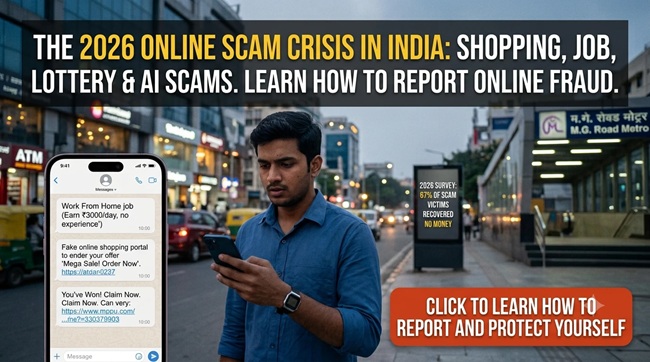

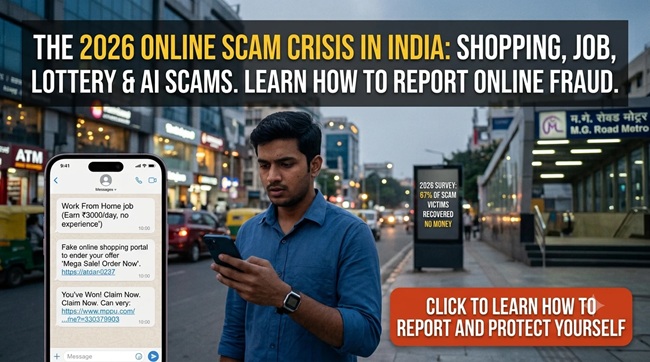
Losing money to an online scam is bad enough. Getting none of it back is even worse. A 2026 survey by the GSMA found that 67% of Indian scam victims who lost money recovered nothing, while 33% of reported cases remained unresolved. From fake shopping deals and work-from-home job offers to lottery fraud and AI-powered impersonation, scammers are finding new ways to trick unsuspecting consumers. Here’s what the survey reveals, the warning signs you should never ignore, and the steps you can take to report online fraud in India.
India’s digital economy has made shopping, banking, payments and job hunting easier than ever. But the same convenience has created more opportunities for fraudsters to reach consumers through messaging apps, social media, email and fake websites.
The latest India Consumer Scam Report 2026, published by the GSMA, highlights an important problem: reporting a scam does not always mean a victim will recover the money lost.
The report found that 12% of Indian consumers surveyed had experienced a scam in the previous 12 months. Another 39% said they had not personally been scammed but knew someone close to them who had.
Among victims who lost money, 67% recovered nothing. Meanwhile, 33% of reported cases remained unresolved, underlining the gap between reporting digital fraud and obtaining a satisfactory outcome.
For consumers, the findings offer a timely reminder to recognise warning signs, verify digital transactions and act quickly when fraud occurs.
India Scam Survey 2026: Key Findings at a Glance
| Survey finding | Percentage |
|---|---|
| Consumers surveyed who experienced a scam in the previous 12 months | 12% |
| Consumers who had not been scammed but knew someone close who had | 39% |
| Scam victims who recovered no money after losing money | 67% |
| Reported cases that remained unresolved | 33% |
| Scam victims who approached an organisation for help | 86% |
| Consumers who had seen AI being used in scams | 89% |
Source: GSMA, India Consumer Scam Report 2026. The figures refer to different survey questions and respondent groups; they should not be treated as percentages of the same population.
Which Scams Are Most Common in India in 2026?
Online shopping scams were the most frequently reported category among Indian scam victims surveyed, followed by prize and lottery fraud and job-related scams.
The report identified the following leading scam categories:
| Type of scam | Share of reported scam types |
|---|---|
| Online shopping scams | 33% |
| Prize, lottery and inheritance scams | 31% |
| Job or income scams | 30% |
| QR-code or payment-link scams | 27% |
These percentages may overlap because respondents could report more than one type of scam. They are not shares of all Indian cybercrime cases officially registered with the police.
1. Online shopping scams: Fake deals and fraudulent sellers
Online shopping fraud often targets consumers looking for discounts, limited-period offers or products advertised at prices substantially below normal retail rates.
A fraudster may create a fake shopping website, impersonate a legitimate brand on social media or advertise a product through a messaging group. The customer pays through UPI, a bank transfer or another payment method, but the product never arrives.
Some scams involve fake tracking information, counterfeit goods or requests for additional payments to release an order.
Warning signs to watch for:
- Prices that seem unrealistically low compared with established retailers.
- Websites with suspicious URLs, copied product images or incomplete contact details.
- Sellers insisting on payment through a personal UPI ID or bank account.
- Requests for additional fees after an order has supposedly been placed.
- Social media stores with limited history, suspicious comments or no verifiable business information.
How to stay safe: Check the seller’s identity, read independent reviews and examine the website address carefully. Prefer payment methods that offer appropriate dispute or buyer-protection mechanisms. Avoid transferring money simply because a seller claims an offer will expire within minutes.
2. Job and part-time income scams: The promise of easy money
Job scams exploit the need for employment, additional income or flexible work. They can target students, fresh graduates, experienced professionals and people seeking part-time opportunities.
A typical scam begins with an unsolicited WhatsApp or Telegram message offering attractive earnings for simple tasks, such as liking videos, reviewing products or completing online assignments.
Initially, the fraudster may provide a small payment to build trust. The victim is then asked to deposit money to unlock higher-paying tasks, complete a prepaid assignment or withdraw supposed earnings.
Once the victim transfers a larger amount, the fraudster may demand additional deposits or stop responding.
Warning signs to watch for:
- Guaranteed high earnings for very little work.
- Registration, training or security deposits demanded by an unverified recruiter.
- Requests to transfer money to unlock salary, commissions or existing earnings.
- Recruitment conversations conducted entirely through unofficial accounts.
- Pressure to make an immediate payment before receiving a written offer.
How to stay safe: Verify vacancies on the employer’s official careers website and confirm the recruiter’s identity using independently obtained contact details. Do not pay an unverified recruiter to obtain a job or release your earnings.
A genuine-looking company name, logo or offer letter does not establish that a job opportunity is legitimate.
3. Lottery and prize scams: Pay first to receive a reward
Lottery scams typically tell victims that they have won a cash prize, lottery, lucky draw or inheritance they never knowingly entered.
The fraudster may impersonate a well-known company, government department, bank or lottery organiser. The victim is then asked to pay a processing fee, tax, registration charge or verification fee before receiving the supposed prize.
After the first payment, additional demands may follow.
Warning signs to watch for:
- Notifications about prizes or inheritances you never entered or were not expecting.
- Requests for advance payments to release winnings.
- Messages asking for OTPs, banking passwords, card details or UPI PINs.
- Unofficial email addresses, suspicious phone numbers or links to unfamiliar websites.
- Claims that a prize will be cancelled unless you pay immediately.
How to stay safe: Verify any claimed prize directly with the organisation through its official website or published contact details. Never pay an unverified person to release unexpected winnings, and never share banking credentials or OTPs.
4. QR-code and payment-link scams
QR-code fraud can exploit the confusion between making a payment and receiving money.
A fraudster may send a QR code or payment link while claiming to issue a refund, purchase an item from you or transfer a prize. The victim is directed to a payment screen and may unknowingly authorise a transfer.
Remember: Receiving money through UPI generally does not require you to enter your UPI PIN. Entering your PIN authorises a payment, so check the transaction details before approving it.
Never approve a collect request or payment notification unless you understand who is requesting the money and why.
How AI Is Making Online Scams More Convincing
Artificial intelligence is giving fraudsters additional ways to make their messages, advertisements and impersonations appear authentic.
The GSMA survey found that 89% of Indian consumers surveyed had seen AI being used in scams. AI-written messages and fake AI-generated images were each identified by 48% of respondents, while 42% said they had seen deepfake videos of real people.
These findings measure consumers’ reported exposure and awareness, rather than the percentage of all scams proven to have used AI.
AI-enabled fraud can take several forms:
- Voice cloning: A fraudster imitates a relative, colleague or senior executive and requests an urgent transfer.
- Deepfake videos: Fake videos make it appear that a public figure or trusted person is promoting an investment or product.
- AI-generated advertisements: Fraudulent promotions use realistic images, convincing text and fabricated endorsements.
- Personalised phishing: Messages are tailored to a victim’s interests, employment, recent purchases or publicly available information.
The main risk is that familiar voices, professional-looking messages and realistic videos can create a false sense of trust.
How to protect yourself: Verify urgent financial requests through a separate, trusted communication channel. Call the person using a number you already know, rather than the number provided in the suspicious message. Use a family verification phrase for unusual emergency requests if appropriate, and never make a financial decision based solely on a voice note or video.
Why Do So Many Scam Victims Fail to Recover Their Money?
The survey highlights a significant difference between reporting fraud and obtaining a financial recovery.
Among victims who lost money, only 33% recovered some or all of it, while 67% recovered nothing. Separately, 33% of reported cases remained unresolved.
Several practical challenges can affect the recovery process.
1. Money can move quickly between accounts. Fraudsters may transfer stolen funds through multiple accounts or payment channels before a victim reports the transaction.
2. Victims may report the incident late. Some people spend hours trying to contact the seller, recruiter or supposed customer-care representative before realising they have been scammed.
3. Responsibility may involve several organisations. A complaint could require coordination between a bank, payment provider, digital platform, telecom operator and law-enforcement agency.
4. Reporting does not guarantee reimbursement. An acknowledgement number confirms that a complaint has been recorded; it does not automatically mean the money will be returned.
The report also found that 86% of Indian scam victims approached at least one organisation for help. This suggests that the challenge is not simply encouraging people to report fraud, but also improving investigation, coordination and resolution.
What Should You Do If You Lose Money in an Online Scam?
If you suspect that money has been stolen through UPI, internet banking, a fake shopping website or a job scam, act immediately. Do not wait for the fraudster to respond or promise a refund.
Step 1: Call India’s cyber financial fraud helpline at 1930
Call 1930 as soon as possible to report suspected financial cyber fraud. Provide the transaction details and any information requested by the helpline.
Prompt reporting can help authorities and participating financial institutions take steps to identify or hold suspicious funds where possible. However, recovery is not guaranteed.
Step 2: Submit a complaint on the official cybercrime portal
Visit cybercrime.gov.in and follow the instructions for reporting financial cyber fraud.
Keep the acknowledgement number and other complaint details for follow-up.
Step 3: Inform your bank or payment provider
Contact your bank or payment provider through its official app, website or verified customer-care number. Report the unauthorised or fraudulent transaction and request that the institution take appropriate action.
Ask for a complaint or service-request number and retain all correspondence.
Step 4: Preserve evidence
Save the following wherever available:
- UPI transaction IDs, bank statements and payment receipts.
- Screenshots of messages, advertisements, profiles and websites.
- Phone numbers, email addresses, QR codes and payment links.
- Order details, job offers or supposed prize notifications.
- Complaint acknowledgement numbers and communications with the bank.
Do not delete the conversation or reset your phone before preserving relevant evidence.
Step 5: Secure your accounts
If you shared credentials or installed an app at a fraudster’s request, contact your bank, change affected passwords, revoke suspicious access and review account activity.
Never share your OTP, UPI PIN, card PIN or internet-banking password with someone claiming to help recover your money.
Step 6: Beware of recovery scams
Victims who have already lost money may be targeted again by people claiming to be recovery agents, lawyers, police officers or cybersecurity experts.
Be cautious of anyone demanding an advance fee or promising a guaranteed refund. Verify any legal or professional service independently before paying.
The Government of India’s official National Cyber Crime Reporting Portal provides reporting facilities and information for complainants.
Are Indian Consumers Changing Their Online Behaviour?
The survey suggests that scams are influencing how people approach digital transactions and trust online services.
Consumers are not necessarily abandoning digital payments or shopping. Instead, many are becoming more cautious about the people and platforms they trust.
The report found that 87% of Indian respondents were comfortable with their bank or financial provider holding and using their data to detect fraud. The corresponding figures were 82% for government, 81% for mobile operators and 73% for digital platforms.
These findings indicate that many consumers are willing to accept some use of personal data for fraud prevention. However, trust differed according to the outcome of a reported scam, particularly in relation to government and digital platforms.
For businesses, this creates an important responsibility: fraud prevention must be accompanied by clear reporting channels, transparent communication and meaningful support when customers face problems.
For consumers, awareness alone is not enough. Safe online behaviour also requires verifying payment requests, protecting account credentials and knowing where to report fraud.
What Do These Findings Mean for Consumers in India?
The 2026 survey points to three important lessons.
First, online scams are not limited to one demographic or digital platform. Shopping, employment, payments and social communication can all become entry points for fraud.
Second, convincing messages and familiar branding should never replace independent verification. AI tools can make fraudulent communications more realistic, increasing the importance of checking the underlying request.
Third, a fast response matters. Reporting suspicious financial transactions immediately, contacting the bank and preserving evidence may improve the opportunity for intervention, although no particular recovery outcome can be promised.
The figures also highlight the importance of stronger coordination between financial institutions, digital platforms, telecom operators and law-enforcement agencies.
For consumers, the most useful approach is to combine caution before making a payment with a clear action plan in case something goes wrong.
Frequently Asked Questions (FAQs)
1. What percentage of Indian scam victims recovered no money in 2026?
According to the GSMA’s India Consumer Scam Report 2026, 67% of victims who lost money recovered nothing. The figure reflects the survey findings and should not be interpreted as an official count of all cybercrime victims in India.
2. Which online scams are most common in India in 2026?
The survey identified online shopping scams (33%), prize, lottery and inheritance scams (31%), and job or income scams (30%) as leading categories reported by Indian scam victims. QR-code and payment-link scams accounted for another 27% of reported scam types.
3. What should I do if I have been scammed online in India?
Call the national cyber financial fraud helpline at 1930 as soon as possible. Also report the incident through cybercrime.gov.in, notify your bank or payment provider, preserve evidence and secure affected accounts.
4. Can I get my money back after a UPI or online shopping scam?
Recovery may be possible, depending on the circumstances, available evidence and whether funds can be traced or held. Report the incident promptly and contact your bank. Filing a complaint does not guarantee reimbursement.
5. How can I identify a fake online job offer?
Be wary of guaranteed high earnings, unsolicited job offers, requests for deposits and demands to pay money to unlock commissions. Verify the vacancy and recruiter through the employer’s official channels before sharing personal information or making any payment.
6. How do lottery and prize scams work?
Fraudsters claim that a person has won a prize or inheritance and demand an advance fee to release it. Verify unexpected claims directly with the purported organisation, and do not pay unverified fees or share banking credentials.
7. How are AI tools used in online scams?
AI can be used to generate convincing messages, fake advertisements, realistic images, impersonation profiles and deepfake videos or voices. Verify unusual requests independently, especially when money or sensitive information is involved.
8. Is the 1930 cybercrime helpline available for financial fraud?
Yes. The Government of India provides the 1930 helpline for reporting financial cyber fraud. Victims should call promptly and follow the instructions for submitting a complaint through the official cybercrime portal.
9. Where can I report an online scam in India?
You can report cybercrime through the official National Cyber Crime Reporting Portal. For suspected financial cyber fraud, call 1930 as soon as possible as well.
10. Does reporting a scam guarantee that the money will be returned?
No. Reporting creates a record and may help authorities and financial institutions take action, but recovery depends on the facts and circumstances of the case. Avoid anyone promising a guaranteed refund in exchange for an advance payment.
Disclaimer
This article is intended for general consumer awareness and informational purposes only. Survey figures are attributed to the GSMA’s India Consumer Scam Report 2026 and reflect the respondents and methods described in that report; they should not be treated as a complete count of all fraud incidents in India. Reporting a suspected scam does not guarantee the recovery of funds. Readers should contact their bank, payment provider and the relevant authorities for guidance specific to their circumstances. This article does not constitute legal, financial or cybersecurity advice.

Shuchi founded Finance Checks after spending 16+ years working in corporate, managing operations and distribution. She managed her own finances, learned and read regularly and helped people make sense of their savings, loans, insurance, and investments.
She started this site to offer the kind of clear, honest financial guidance she wished was more available when she was learning to manage her own money. Every article is researched personally, checked against official sources such as the Reserve Bank of India, SEBI, or the Income Tax Department, and revisited whenever regulations or figures change. She is upfront about how the site earns money through ads and select affiliate partnerships, and she does not let either influence what she actually recommends to readers.



[…] Online Scams in India 2026: 67% Get No Money Back—Shopping, Job and Lottery Fraud Warning […]
[…] Online Scams in India 2026: 67% Get No Money Back—Shopping, Job and Lottery Fraud Warning […]