
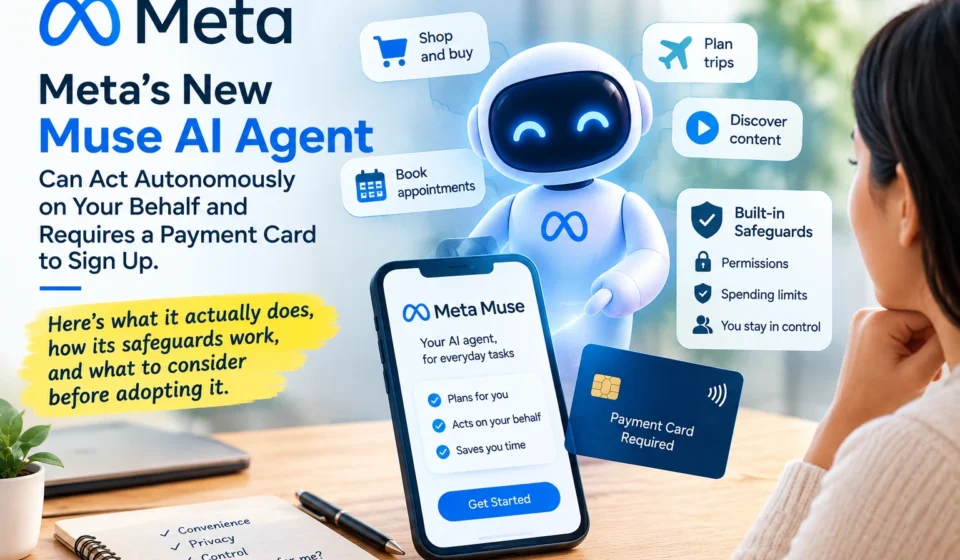
Meta Launches Muse, an AI Agent That Can Act on Your Behalf: What It Means Before You Hand It Your Payment Card

Meta launched Muse on September 8, 2026, a personal AI agent that CEO Mark Zuckerberg describes as working “24/7 on your behalf to improve your relationships, health, career, finances, home management, hobbies, and more.” Unlike a chatbot that drafts a reply for you to send, Muse is built to actually take the action itself, browsing, buying, booking, on a dedicated virtual machine running in Meta’s cloud, with a visible browser window so you can watch it work. Signing up requires a payment card. For a finance-conscious reader, that combination, an AI agent that acts autonomously and needs your card on file, is worth understanding properly before deciding whether to try it.
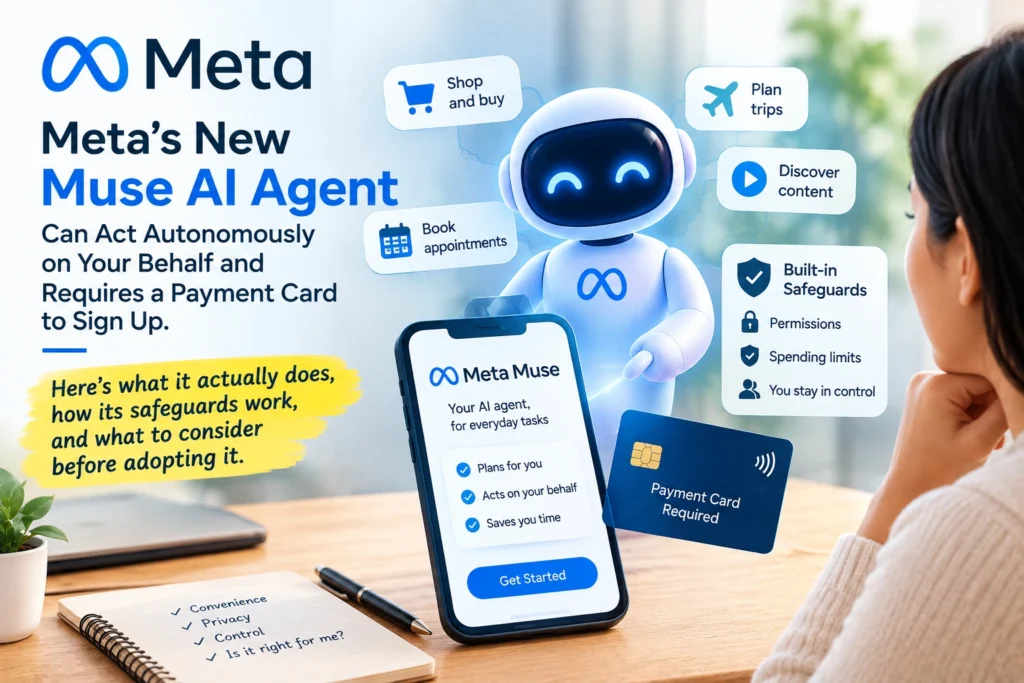
Quick Answer
Muse is Meta’s new consumer AI agent, built on its Muse Spark model family under chief AI officer Alexandr Wang, and it’s designed to go further than typical AI assistants by actually completing tasks rather than just suggesting them, operating inside a dedicated, isolated virtual machine called the Muse Secure VM. A separate “Sentinel” agent is meant to approve any action or data that leaves the VM, requiring user permission at defined checkpoints, according to Zuckerberg’s own description of the system. It launched with a free tier (reportedly up to 100 million tokens a week) alongside two paid tiers, Power at $20 a month and Maximum at $100 a month, and is currently available only in the US, for users 18 and older, via a dedicated app, the muse.ai website, and WhatsApp. It is not yet available in India. The most important thing for a finance-conscious user to know is that any AI agent capable of autonomous action, on a device linked to a payment method, introduces a genuinely new category of consumer-finance risk, unauthorised spending, permission-boundary failures, and social-engineering exploitation of the agent itself, that’s worth understanding before adoption, regardless of how it eventually rolls out in other markets.
What Muse Actually Is
Muse is the product face of Meta Superintelligence Labs’ broader “Muse” model family, which also includes Muse Spark (the underlying model powering Meta AI across its apps) and Muse Glimmer (a smaller, open-weight model for local, on-device agentic tasks). The consumer-facing Muse agent, launched this week, lets users name their agent, create an avatar, and customise how it communicates, existing in a chat interface similar to a text thread rather than a traditional search-style assistant. What differentiates it from a standard chatbot is persistence and initiative: Meta describes it as more proactive and long-running, capable of continuing a task over time rather than responding only when prompted.
Technically, Muse runs on a dedicated virtual machine in Meta’s cloud rather than directly on your device, with a built-in browser the user can watch in real time. According to Zuckerberg’s own description, a separate “Sentinel” agent monitors the Muse VM specifically to control what leaves it: any action or piece of data sent out to the network requires approval, enforced at the system level, meaning the agent can’t unilaterally take certain actions, including, presumably, payment-related ones, without triggering a permission check.
Why the Payment Card Requirement Matters
Muse requires a payment card to get started, even to use the free tier, according to reporting on the launch. This is a meaningful design choice worth sitting with for a moment: an AI agent explicitly built to take autonomous action on your behalf, financial or otherwise, is asking for card details before you’ve even tested what it can do unsupervised. Meta’s Sentinel permission layer is specifically positioned as the safeguard against this exact concern, requiring your approval before data or actions leave the secure environment, but the practical reliability of that safeguard, how granular the permission checkpoints actually are, and whether they can be socially engineered or bypassed under edge-case conditions, is something that will only become clear once the product has been in wider use and stress-tested by real users and security researchers, not something guaranteed by the marketing description alone.
The Genuinely New Risk Category This Introduces
Traditional financial fraud generally requires a human to be tricked, socially engineered, or to make an error. An autonomous AI agent with card access and network-facing capability introduces a different risk surface entirely: the target of manipulation shifts from the human user to the agent itself. A sufficiently well-crafted malicious webpage, email, or third-party service the agent interacts with while completing a task could, in principle, attempt to manipulate the agent’s behaviour rather than the human behind it, a category of risk security researchers have specifically flagged as “prompt injection” or agent manipulation, distinct from traditional phishing because the human never sees the manipulative content directly. Meta’s Sentinel system is explicitly designed to address this by requiring checkpoints before consequential actions, but the specific, tested robustness of that safeguard against real-world adversarial attempts is genuinely unproven at launch, since the product is only days old as of this writing.
Why This Matters Even Though Muse Isn’t in India Yet
Muse’s initial launch is US-only, for adults 18 and older, so this isn’t an immediate, direct concern for Indian consumers today. It’s worth covering here for two reasons. First, Meta’s products, including WhatsApp, which Muse explicitly integrates with, have an enormous Indian user base, and international rollout of a WhatsApp-integrated AI agent capable of autonomous action is a reasonable thing to anticipate, not a remote hypothetical. Second, and more broadly, Muse’s launch is a clear signal of where consumer AI is heading generally, from assistants that suggest to agents that execute, and every major platform with a payments layer is likely to move in a similar direction over the coming months. Understanding the basic risk profile of this category now, before it reaches Indian users specifically, is a more useful position to be in than trying to evaluate it for the first time after it’s already integrated into an app you use daily.
What to Actually Think About Before Adopting Any Autonomous AI Agent
Understand exactly what permission model is in place before connecting a payment method. Whether it’s Muse’s Sentinel system or an equivalent safeguard from another platform, it’s worth understanding specifically which actions require your explicit approval and which don’t, rather than assuming broad safety based on a company’s general description of its safety architecture.
Treat “24/7 autonomous” capability as something to monitor, not something to fully delegate immediately. Even with safeguards in place, a genuinely new product category is worth observing closely in its early period rather than granting it unmonitored, long-running access to your financial accounts or payment methods from day one.
Watch for how these products handle third-party website interactions specifically. Since agent-manipulation risks often originate from a malicious or compromised third-party page the agent visits while completing a task on your behalf, it’s worth understanding whether the product restricts or flags interactions with unfamiliar or unverified sites.
Keep an eye on how quickly the security research community stress-tests a newly launched agentic product. Products like this typically face intense scrutiny from independent security researchers within their first weeks of public availability, and that early research is often more informative about real-world safety than the launch marketing itself.
My Take
What I find genuinely notable about Muse isn’t the AI capability itself, agentic AI products have been building toward this for a while, it’s the specific business decision to require a payment card before a user has had any chance to build trust in the product’s judgement. That’s a meaningful signal about how seriously Meta expects people to treat this as a functional financial tool from day one, not a novelty chatbot. For any reader, in the US today or wherever this eventually rolls out, my honest suggestion is to treat the first few weeks of any genuinely new agentic AI product as an observation period rather than a full-delegation period, regardless of how sophisticated the permission architecture sounds in a launch announcement. Sentinel-style safeguards are a reasonable design response to a real risk, but “reasonable design” and “proven, battle-tested in the wild” are two different things, and the gap between them is exactly where early adopters tend to discover problems the marketing didn’t anticipate.
Frequently Asked Questions
1. What is Meta’s Muse AI agent? Muse is a personal AI agent launched by Meta on September 8, 2026, designed to autonomously complete tasks on a user’s behalf, operating in a dedicated virtual machine with a visible browser, rather than simply suggesting actions the way a typical chatbot does.
2. Is Muse available in India? No, not at launch. Muse is currently available only in the United States, for users 18 and older, via a dedicated app, the muse.ai website, and WhatsApp.
3. How much does Muse cost? Muse offers a free tier, reportedly usable up to 100 million tokens a week, alongside two paid tiers: Power at $20 a month and Maximum at $100 a month.
4. Why does Muse require a payment card to sign up? Muse requires a payment card even for the free tier, reflecting its design as a tool intended to take real-world action, potentially including purchases or bookings, on the user’s behalf from the outset.
5. What is the “Sentinel” system Zuckerberg mentioned? Sentinel is a separate monitoring agent described by Zuckerberg that runs alongside Muse on the same virtual machine, requiring user approval before any action or data is sent out to the network, intended as a safeguard against unauthorised autonomous actions.
6. Is it safe to give an AI agent access to my payment information? This is a genuinely new risk category worth taking seriously. While safeguards like Muse’s Sentinel system are designed to prevent unauthorised actions, the real-world robustness of such systems against manipulation or edge-case failures is typically only established through independent security testing after a product’s public launch, not guaranteed by the design description alone.
7. What is “prompt injection” or agent manipulation risk? It’s a risk category where a malicious webpage or service the AI agent interacts with attempts to manipulate the agent’s behaviour directly, rather than tricking the human user the way traditional phishing does, since the human may never see the manipulative content the agent encountered.
8. What is Muse Spark, and is it the same as Muse? Muse Spark is the underlying AI model that powers Meta AI across Meta’s apps, released earlier in 2026. Muse, the consumer agent launched in September 2026, runs on the same underlying model family but is a distinct, separate consumer-facing product focused on autonomous task execution.
9. Should Indian users be concerned about Muse right now? Not immediately, since it isn’t available in India at launch. However, given Muse’s integration with WhatsApp, which has an enormous user base in India, international rollout is a reasonable future possibility worth being informed about in advance.
10. What should someone consider before adopting any autonomous AI agent with payment access? Understand exactly which actions require explicit approval under the product’s permission system, avoid granting full, unmonitored delegation immediately after signup, and pay attention to independent security research that typically emerges in the weeks following a major agentic AI product’s public launch.
Disclaimer
This article is intended for general informational purposes only and does not constitute financial, security, or product advice. FinanceChecks.com is not affiliated with Meta Platforms Inc. or any product mentioned in this article. Details regarding Muse’s features, safeguards, and availability are based on publicly reported information as of September 9, 2026, close to the product’s initial launch, and are subject to change as the product evolves and is tested by users and independent researchers. Please refer to Meta’s official documentation for the most current information before using any AI agent product, and exercise caution before connecting payment information to any newly launched autonomous AI tool.

Shuchi founded Finance Checks after spending 16+ years working in corporate, managing operations and distribution. She managed her own finances, learned and read regularly and helped people make sense of their savings, loans, insurance, and investments.
She started this site to offer the kind of clear, honest financial guidance she wished was more available when she was learning to manage her own money. Every article is researched personally, checked against official sources such as the Reserve Bank of India, SEBI, or the Income Tax Department, and revisited whenever regulations or figures change. She is upfront about how the site earns money through ads and select affiliate partnerships, and she does not let either influence what she actually recommends to readers.



[…] Meta Launches Muse, an AI Agent That Can Act on Your Behalf: What It Means Before You Hand It Your P… […]