

Deepinder Goyal’s Temple Brain Wearable: ₹85,000 Price, Pre-Order Date, Features and How It Works

Deepinder Goyal’s Temple wearable is attracting attention for its unusual approach to health tracking. Reportedly priced at ₹85,000 for its first batch, the device is designed to monitor changes in cerebral blood flow and generate an “Entropy” score linked to physiological strain. Pre-orders are scheduled to open on November 1, 2026. Here is everything you need to know about its reported price, features, technology and potential uses.
A smartwatch can tell you how fast your heart is beating, how many steps you have taken and, in some cases, how well you have slept. But what if a wearable could also help you understand how your body responds to physical exertion, stress and recovery through signals associated with blood flow to the brain?
That is the idea behind Temple, the brain-monitoring wearable developed by Zomato co-founder Deepinder Goyal.
Unlike conventional fitness trackers and smart rings, Temple focuses on changes in cerebral blood flow rather than relying primarily on familiar measurements such as heart rate and step count. The device is expected to launch initially in limited quantities, with early-access invitations reportedly listing a price of ₹85,000.
However, there is an important distinction between reported details and officially confirmed specifications. The price has appeared in early-access invitations shared by selected users, while the company’s public pricing and final purchase terms remain to be confirmed.
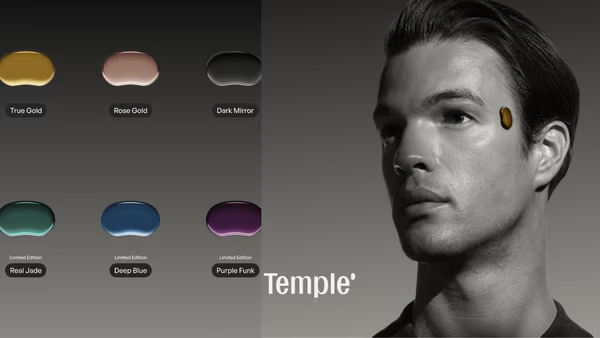
Temple Wearable: Price, Launch Date and Key Details
Here is a quick overview of what is currently known about Deepinder Goyal’s Temple wearable.
| Feature | Details |
|---|---|
| Product name | Temple |
| Founder associated with the venture | Deepinder Goyal |
| Product category | Brain-monitoring and health wearable |
| Reported price in India | ₹85,000 |
| Subscription | Lifetime subscription reportedly included with Batch 01 |
| Pre-order date | November 1, 2026 |
| Initial launch | Limited first batch, called Batch 01 |
| Manufacturing | Hand-made to order |
| Expected delivery | Within three months of purchase, according to Goyal |
| Primary measurement | Changes in cerebral blood flow |
| Technology | BrainFlow |
| Additional metric | Entropy score indicating physiological strain |
| Colour options | True Gold, Rose Gold, Black Mirror, Real Jade, Deep Blue and Purple Funk |
Important: The ₹85,000 price and lifetime subscription details are based on reported early-access information. Buyers should check the final terms on Temple’s official ordering platform before making a purchase.
What Is Deepinder Goyal’s Temple Wearable?
Temple is a compact wearable designed to sit against the side of the head, around the temple area between the forehead and ear.
The idea is to measure changes in blood flow associated with the brain and use those signals to help users understand how their bodies respond to different situations.
Traditional fitness wearables generally focus on measurements such as heart rate, movement, sleep patterns and, depending on the device, blood oxygen levels. Temple takes a different approach by exploring cerebral blood flow as another source of physiological information.
The device is associated with a technology called BrainFlow, which is designed to monitor changes in cerebral blood flow.
The concept could be relevant to people interested in exercise performance, recovery, stress and the relationship between physiological signals and daily activities. However, its practical value will depend on the reliability of its measurements, how clearly the app explains the results and whether the data proves useful in real-world situations.
How Does Temple Work?
Temple uses optical sensing technology to monitor changes in cerebral blood flow. In simple terms, it is designed to track variations in the movement of blood through the brain rather than merely counting steps or measuring activity at the wrist.
The device then presents information through its accompanying digital platform, including a metric called Entropy.
The approach is different from conventional wrist-based fitness tracking because it focuses on signals associated with blood flow near the head.
However, monitoring changes in cerebral blood flow is not the same as directly measuring every aspect of brain function. A wearable reading should not automatically be interpreted as a definitive measure of intelligence, mental clarity, stress levels or overall brain health.
The usefulness of the device will depend on how its measurements are validated and interpreted.
What Is Temple’s Entropy Score?
One of Temple’s most talked-about features is its Entropy score, a metric intended to indicate physiological strain.
According to reports about the device, the score ranges from 1 to 250. It is designed to help users understand how their physiological state changes in response to factors such as sleep, exercise, stress and caffeine.
For example, someone might compare their readings across different training sessions or examine how their measurements change after a demanding day.
The aim is to help users identify patterns over time instead of relying only on how energetic or tired they feel.
However, users should understand three important points:
- It is a device-specific metric: An Entropy score should not automatically be treated as a universal scientific measure of stress or brain health.
- A score is not a diagnosis: A particular reading does not establish that someone has a neurological condition or another medical problem.
- Context matters: Activity, sleep, posture and other physiological factors may influence measurements, so interpreting an isolated number can be misleading.
The key question is whether Temple can translate its readings into meaningful, repeatable insights that users can apply in everyday life.
What Are the Main Features of Temple?
1. Cerebral blood flow monitoring
Temple’s central feature is its focus on changes in cerebral blood flow. This distinguishes it from many mainstream fitness wearables that primarily track movement, heart rate and sleep.
2. Entropy score
The device generates an Entropy score intended to represent physiological strain. The metric could help users explore patterns associated with exercise, rest and other daily activities.
3. Compact, screenless design
Temple follows a different design philosophy from a conventional smartwatch. Instead of displaying notifications on a wrist-mounted screen, it is designed to collect physiological data and work with a companion app.
4. Adhesive-based attachment
The wearable attaches to the skin using specially designed adhesive strips called Grips. This allows it to sit around the temple area without requiring a conventional watch strap.
The recurring need for adhesives, their replacement schedule and their availability are worth checking before buying the device.
5. Designed for activity
Reports indicate that Temple is intended to be used during physical activities, including running and jumping. Its suitability for different sports, environmental conditions and long-duration wear should be assessed using verified product guidance and real-world user experience.
6. Six colour options
The launch edition is expected to offer six colours:
- True Gold
- Rose Gold
- Black Mirror
- Real Jade
- Deep Blue
- Purple Funk
Real Jade, Deep Blue and Purple Funk have been described in reports as limited-edition options.
Get the regular finance and business updates, follow us on Instagram and Youtube.
Temple Price in India: Why Is It Reportedly ₹85,000?
The reported ₹85,000 price puts Temple in the premium segment of the wearable market.
Unlike a typical fitness band, the product is built around a specialised sensing approach and a different type of physiological data. The reported Batch 01 package also includes a lifetime subscription, which may be attractive to people who want to avoid recurring platform charges.
Nevertheless, the price alone does not establish whether the device offers good value.
Potential buyers should consider:
- How accurate and repeatable are the measurements?
- Is the Entropy score supported by sufficient scientific validation?
- What insights does the app provide beyond displaying numbers?
- Does the lifetime subscription cover all relevant software features?
- Are adhesives and other consumables included, and for how long?
- What warranty, repair and replacement policies apply?
- Can the information be exported or integrated with other health platforms?
A lifetime subscription may reduce future software expenses, but it does not necessarily mean that every accessory, repair or replacement will be free for life.
Until the complete commercial terms are published, it is sensible to treat the reported price as provisional.
When Do Temple Pre-Orders Open?
Temple Batch 01 is scheduled to open for pre-orders on November 1, 2026.
Deepinder Goyal has indicated that each unit will be hand-made to order and delivered within three months of purchase. This means that buyers should not necessarily expect immediate delivery after placing an order.
The initial batch is expected to be limited, with orders handled on a first-come, first-served basis.
Interested customers should use Temple’s official website or app to verify ordering instructions, availability, final pricing and delivery terms. Early-access invitations may have separate instructions for selected users.
Because production is expected to be made to order, buyers should review the cancellation, refund and delivery policies before paying.
Who Could Benefit From Temple?
Temple may be particularly interesting to people who want to explore physiological data beyond conventional fitness tracking.
Athletes and runners
Runners and other athletes may be interested in understanding how their physiological measurements change during training and recovery. The device could be useful for experimentation, provided its readings are interpreted cautiously and alongside established training indicators.
Fitness enthusiasts
People who already track their workouts, sleep and recovery may be curious to see whether cerebral blood flow measurements add useful information to their existing routines.
Researchers and technology enthusiasts
Temple’s approach may attract people interested in wearable sensors, physiological monitoring and emerging health technology.
Professionals interested in performance
People working in demanding environments may be interested in learning more about physiological strain. However, claims about improved workplace performance or cognitive ability would need appropriate evidence rather than assumptions based on a wearable score.
For most users, the decision should come down to whether the device offers practical insights that justify its premium price.
Temple vs Smartwatches and Smart Rings
Temple should not be viewed as a direct replacement for every smartwatch or smart ring. Its main focus is different.
| Category | Temple | Traditional smartwatches and smart rings |
|---|---|---|
| Primary focus | Changes in cerebral blood flow and physiological strain | Activity, heart rate, sleep and other supported metrics |
| Form factor | Compact wearable attached near the temple | Wrist-worn watch or finger-worn ring |
| Display | Screenless design | Depends on the device |
| Data access | Companion platform | Device-specific app and platform |
| Typical use | Exploring physiological patterns | Everyday health, activity and fitness tracking |
| Price positioning | Reportedly ₹85,000 for Batch 01 | Varies widely by model |
This comparison describes the products’ general focus rather than a definitive comparison of accuracy. The devices measure different things, and their readings should not be treated as interchangeable.
For someone who primarily wants step counts, workout tracking and sleep summaries, a conventional wearable may be sufficient. Temple’s higher price would be easier to justify if its specialised measurements provide reliable and useful information beyond what existing devices offer.
Is Temple a Medical Device?
Temple is being presented in reports as a wellness and research-oriented wearable, not as a device for diagnosing medical conditions.
This distinction matters because physiological monitoring does not automatically translate into clinically validated diagnosis or treatment.
Users should not rely on Temple’s readings to diagnose neurological conditions, change medication or decide whether to seek medical care. Anyone experiencing persistent symptoms or concerning changes in health should consult a qualified medical professional.
Before purchasing, users should also review the company’s published information on scientific validation, data privacy, security and the intended use of its measurements.
Is Temple Worth Buying at ₹85,000?
The answer depends on what you expect from a wearable.
It may interest early adopters who are comfortable experimenting with new technology, understand its limitations and want to explore physiological measurements that mainstream wearables do not primarily focus on.
It may be difficult to justify for everyday fitness users who mainly want step tracking, heart-rate monitoring, workout statistics and sleep summaries. Less expensive devices already cover many of these needs.
At ₹85,000, prospective buyers should look beyond the novelty of brain monitoring. They should consider the quality of the evidence behind the measurements, the usefulness of the app, ongoing accessory costs, privacy protections and the company’s after-sales support.
The reported lifetime subscription is a potential advantage, but it does not by itself prove that the device will deliver value over several years.
Frequently Asked Questions (FAQs)
1. What is the price of Deepinder Goyal’s Temple wearable in India?
Temple’s first batch has reportedly been listed at ₹85,000 in early-access invitations. The final public retail price and complete purchase terms should be confirmed by the company.
2. When will Temple pre-orders open?
Pre-orders for Temple Batch 01 are scheduled to open on November 1, 2026.
3. Does Temple include a lifetime subscription?
Early-access reports indicate that the ₹85,000 package includes a lifetime subscription. Buyers should verify the final terms and the precise scope of lifetime access before ordering.
4. What does Temple measure?
Temple is designed to monitor changes in cerebral blood flow using its BrainFlow technology and generate an Entropy score intended to indicate physiological strain.
5. What is the Entropy score?
The Entropy score is a device-specific metric reportedly ranging from 1 to 250. It is intended to help users understand changes in physiological strain, but it should not be interpreted as a medical diagnosis.
6. Which colours will Temple be available in?
The six reported colours are True Gold, Rose Gold, Black Mirror, Real Jade, Deep Blue and Purple Funk.
7. When will customers receive Temple after ordering?
Deepinder Goyal has indicated that each unit will be hand-made to order and delivered within three months of purchase. Actual delivery may depend on the order date and production schedule.
8. Can Temple diagnose brain diseases?
There is no basis to assume that the wearable can diagnose brain diseases. Its reported focus is wellness and research, and users should consult qualified medical professionals for diagnosis or treatment.
9. Is Temple better than an Apple Watch or a smart ring?
Not necessarily. Temple focuses on a different set of physiological signals, while conventional wearables offer established features such as activity and heart-rate tracking. The best choice depends on the user’s needs, budget and the reliability of the measurements.
10. Is Temple worth ₹85,000?
It may appeal to technology enthusiasts and people interested in specialised physiological monitoring. For everyday fitness tracking, a less expensive smartwatch or smart ring may offer better value. Independent validation and real-world reviews will be important in assessing Temple’s benefits.
Final Verdict
Deepinder Goyal’s Temple wearable is an unusual addition to India’s growing health-tech market. By focusing on cerebral blood flow and an Entropy score associated with physiological strain, it aims to explore an area that conventional consumer wearables do not primarily address.
The reported ₹85,000 price, lifetime subscription and November 1, 2026 pre-order date have generated interest ahead of the first batch.
However, the biggest question is not whether Temple can produce another health metric. It is whether those measurements can deliver reliable, understandable and actionable insights for everyday users.
For now, interested buyers should verify the final price, subscription terms, scientific evidence, privacy policy and delivery conditions before committing to the purchase.
Disclaimer: This article is for informational purposes only and does not constitute medical or purchasing advice. Product pricing, availability and specifications may change. Verify the latest information through official Temple channels before ordering.

Shuchi founded Finance Checks after spending 16+ years working in corporate, managing operations and distribution. She managed her own finances, learned and read regularly and helped people make sense of their savings, loans, insurance, and investments.
She started this site to offer the kind of clear, honest financial guidance she wished was more available when she was learning to manage her own money. Every article is researched personally, checked against official sources such as the Reserve Bank of India, SEBI, or the Income Tax Department, and revisited whenever regulations or figures change. She is upfront about how the site earns money through ads and select affiliate partnerships, and she does not let either influence what she actually recommends to readers.