
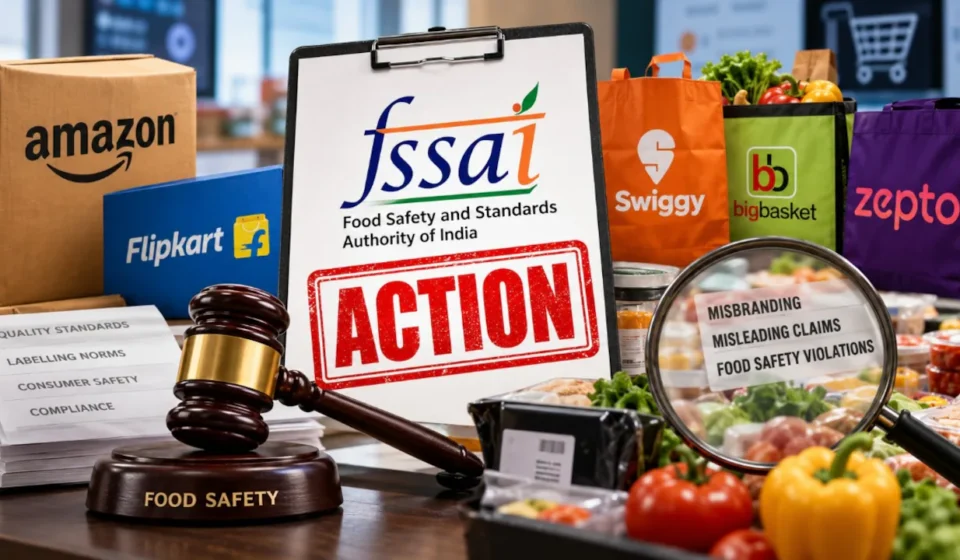
FSSAI Penalises Amazon, Flipkart and Instamart: What Every Online Shopper in India Needs to Know

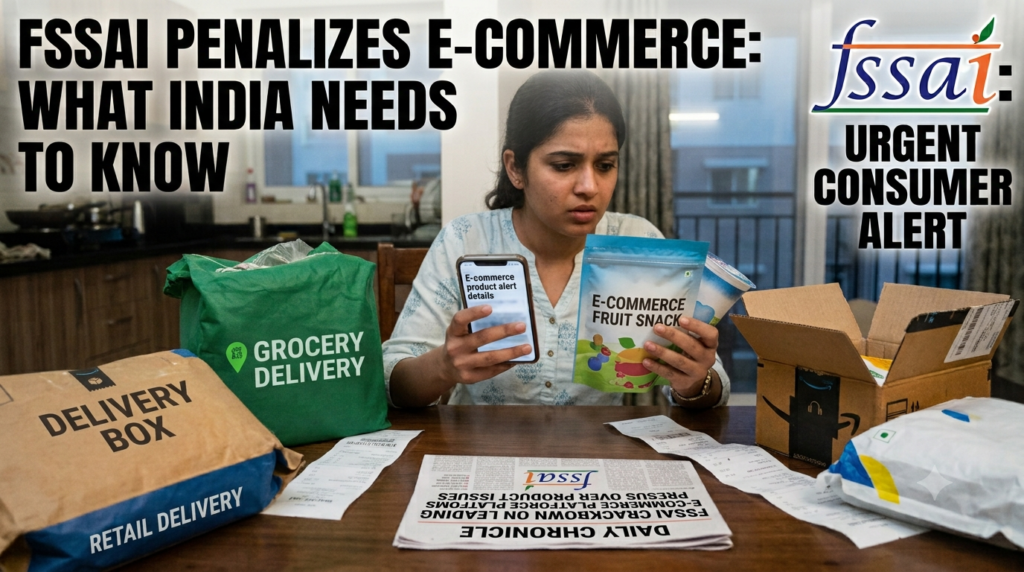
Priya had just finished her Sunday grocery run, except she never left her sofa. Two taps on Swiggy Instamart, a Greek yoghurt tub and a bag of premium date bites in her cart, and dinner was sorted in eleven minutes flat. That is the quiet magic of quick commerce in India today, and it is exactly why a headline that dropped this week made her put her spoon down mid-bite.
The Food Safety and Standards Authority of India had just penalised the very platforms she uses every week, including Amazon, Flipkart, Swiggy Instamart, BigBasket and Zepto, over food safety violations ranging from misleading labels to the listing of a banned, poisonous plant. Priya was not angry about the money she had spent. She was unsettled by a simpler question: if a national food regulator had to step in to catch this, what else was slipping past her own notice every time she added something to cart without a second look?
If that question is nagging at you too, this guide walks through exactly what FSSAI found, why it matters for your household budget and safety, and the checks you can build into thirty seconds of your next online order.
Quick Answer
FSSAI initiated penal action on September 23, 2026 against five major e-commerce and quick-commerce platforms, Amazon, Flipkart, Swiggy Instamart, BigBasket and Zepto, for violations under the Food Safety and Standards Act, 2006. The core issues were misleading product claims on items like a popular date-bites snack and certain Milky Mist dairy products, along with the sale and display of Datura (Dhatura), a toxic fruit and seed, on some of these platforms. No platform has been shut down or delisted nationally as a result of this specific action, but it signals tighter scrutiny of dark stores and marketplace sellers, and it is a useful prompt for shoppers to double-check labels and claims before hitting buy, especially on food items bought through quick-commerce apps.
About This Guide
This guide was compiled by the FinanceChecks.com editorial team by cross-referencing official regulatory statements from FSSAI with reporting from established business and consumer publications to ensure accuracy. We focus on the practical money and safety angle for Indian households rather than just repeating the news, because a regulatory action like this only matters if it changes how you shop. Our aim is always to translate developments like this into decisions you can actually act on, whether that is scanning a label more carefully or knowing which platforms have faced repeat issues. We update our consumer-protection coverage whenever regulators issue fresh action, and we do not accept payment from any platform named in this article to influence how it is covered.
What Actually Happened
FSSAI’s action was not a single sweeping ban. It was a set of specific, product-level findings across five platforms, and the details matter because they show this was targeted enforcement rather than a blanket crackdown.
Amazon, Flipkart, Swiggy Instamart, BigBasket and Zepto were all flagged for the same product, a date-bites snack sold under a popular packaged foods brand, over claims on its label that FSSAI considered misleading. Separately, Swiggy Instamart and BigBasket faced additional scrutiny over labelling and product information on a few dairy items, including a low-fat cream, a curd and a Greek yoghurt from a well-known dairy brand. The most serious finding involved Amazon Seller Services, Swiggy Instamart and BigBasket, where the regulator flagged the sale, display or offer for sale of Datura, a plant whose seeds and fruit are toxic and are sometimes mistaken for or misused alongside food or ritual items. Listing or selling it through a food and grocery platform runs directly against the Food Safety and Standards Act, 2006.
FSSAI framed this as part of a wider, sustained push. Over the past six months, the regulator has stepped up enforcement against food business operators and e-commerce platforms generally, and it has increasingly used its own social media channels to publicise these actions directly to consumers rather than waiting for news coverage to catch up.
Why This Matters for Your Wallet, Not Just Your Health
It is easy to file this away as a food safety story and move on, but there is a real financial angle here that Indian households often miss.
When a product carries a misleading claim, whether that is an exaggerated health benefit, an inflated quantity, or vague sourcing information, you are not just risking your health, you are also overpaying for a product that is not what it claims to be. Premium pricing on packaged snacks and dairy is often justified by exactly these kinds of claims: low fat, farm fresh, zero preservatives, protein-rich. If the claim does not hold up, you have paid a premium for marketing rather than for the product itself.
There is also a repeat-purchase cost. Quick commerce apps thrive on convenience and habit. Most shoppers do not re-verify a product every time they reorder it, they simply tap “buy again.” That habit is efficient, but it also means a single misleading listing can quietly drain money from a household’s grocery budget over months of repeat orders before anyone notices.
Platform-by-Platform Snapshot
Here is a simple comparison of what FSSAI flagged, so you know where to be a little more careful the next time you shop on each app.
| Platform | Products Flagged | Nature of Violation |
|---|---|---|
| Amazon (Seller Services) | Date bites snack, Datura fruits/seeds | Misleading claims; sale of a prohibited, poisonous item |
| Flipkart | Date bites snack | Misleading or non-compliant claims |
| Swiggy Instamart | Date bites snack, Milky Mist dairy range, Datura | Misleading claims, non-compliant product information, sale of a prohibited item |
| BigBasket | Date bites snack, Milky Mist dairy range, Datura | Misleading claims, non-compliant product information, sale of a prohibited item |
| Zepto | Date bites snack | Misleading or non-compliant claims |
A second, quicker reference for what to actually check before you buy:
| What to Check | Why It Matters | Where to Look |
|---|---|---|
| FSSAI license number | Confirms the seller is a registered food business | Product detail page or package image |
| Ingredient and claim match | Flags exaggerated “low fat,” “farm fresh,” or “pure” claims | Nutrition label vs product description |
| Seller name, not just platform | Marketplace sellers vary in reliability even on the same app | Seller info section on the listing |
| Recent reviews mentioning packaging or freshness | Early warning sign before a regulator ever gets involved | Sort reviews by “most recent” |
Common Mistakes Shoppers Make
Most Indian households are not being careless, they are just trusting the platform’s own quality signals a little too much. A few patterns show up again and again.
Shoppers often assume that if a big, familiar platform is selling something, it has already been vetted, when in reality most marketplaces host thousands of third-party sellers with uneven quality control. Another common slip is judging a product purely by its star rating without reading what the actual complaints in the reviews say, since a 4.2 rating can still hide a cluster of recent notes about mislabeling or spoilage. People also tend to stop checking labels once a product becomes a regular reorder, treating “I have bought this before” as proof of safety rather than checking the current batch. Finally, very few shoppers ever look up whether a seller or product has had a prior regulatory flag, even though this information is now being published openly by FSSAI on its own social channels.
My Take
What stands out to me about this particular action is not the violation itself, it is where it happened. Quick commerce is built on speed, and speed is precisely what erodes the small, careful checks that used to be part of grocery shopping. When you are physically at a kirana store, you can pick up a pack, read the label, and put it back if something feels off. On a ten-minute delivery app, that instinct rarely survives the interface.
I do not think this means Indian shoppers should distrust these platforms wholesale. Millions of orders go through them safely every day, and enforcement action like this is actually a sign that the system is working, not that it has failed. But I would treat this as a nudge rather than noise. The next time you are about to hit “buy again” on a packaged food item, especially anything positioned as a premium or health product, it is worth the fifteen seconds it takes to glance at the label one more time. That habit costs you nothing, and it is the single most effective, no-cost financial and safety check available to any household right now.
Frequently Asked Questions
1. Has FSSAI banned Amazon, Flipkart or Instamart in India? No. This is penal action against specific product listings and non-compliances, not a ban or shutdown of any platform.
2. Which exact products were flagged by FSSAI? A date bites snack across most platforms, certain Milky Mist dairy products on Swiggy Instamart and BigBasket, and Datura (Dhatura) fruits and seeds on Amazon Seller Services, Swiggy Instamart and BigBasket.
3. What is Datura and why is it dangerous? Datura, also called Dhatura, is a plant whose seeds and fruit are toxic if ingested. It is sometimes used in religious offerings but should never be sold or consumed as food.
4. Should I stop using quick commerce apps because of this news? Not necessarily. The action shows regulatory oversight is active, which is reassuring. It is more useful as a reminder to check labels than as a reason to avoid these platforms entirely.
5. How can I check if a product listing has had past issues? FSSAI has been publicising enforcement actions directly on its official social media accounts, which is a quicker source than waiting for news coverage.
6. Does this affect the price I pay for groceries on these apps? Not directly, but products with misleading claims often carry a price premium that is not justified once the claim is found to be false, so you may be indirectly overpaying.
7. Are dark stores inspected differently from regular warehouses? Dark stores used by quick commerce platforms have come under increased scrutiny recently, alongside standard warehouse and marketplace seller checks.
8. Can I get a refund if I bought one of the flagged products? Refund policies depend on the individual platform’s customer service process. Reach out to the platform directly with your order details if you are concerned about a specific purchase.
9. Is this the first time these platforms have faced regulatory action? No. Several of these platforms have separately faced action from other regulators, including compliance checks by the Bureau of Indian Standards on non-food items in the past.
10. What is the single most useful habit to pick up from this news? Read the label and the FSSAI license number on any packaged food item before buying, even on a platform you trust and reorder from often.
Disclaimer
This article is for general informational purposes only and does not constitute legal, medical or financial advice. Details are based on publicly available regulatory statements and news reporting available at the time of writing and may be updated as the situation develops. Readers should verify current product status directly with the relevant platform or with FSSAI before making purchasing decisions. FinanceChecks.com is not affiliated with FSSAI, Amazon, Flipkart, Swiggy Instamart, BigBasket or Zepto.

Shuchi founded Finance Checks after spending 16+ years working in corporate, managing operations and distribution. She managed her own finances, learned and read regularly and helped people make sense of their savings, loans, insurance, and investments.
She started this site to offer the kind of clear, honest financial guidance she wished was more available when she was learning to manage her own money. Every article is researched personally, checked against official sources such as the Reserve Bank of India, SEBI, or the Income Tax Department, and revisited whenever regulations or figures change. She is upfront about how the site earns money through ads and select affiliate partnerships, and she does not let either influence what she actually recommends to readers.



[…] FSSAI Penalises Amazon, Flipkart and Instamart: What Every Online Shopper in India Needs to Know […]