
The Food Safety and Standards Authority of India (FSSAI) has moved to tighten the legal definition of paneer, proposing a formal ban on the use of the word “paneer” for any product made from non-milk constituents. The draft notification, dated September 22, 2026 and published in the Gazette of India on September 23, follows months of state-level crackdowns on “analogue paneer” and comes as FSSAI chief Rajit Punhani has publicly floated a nationwide restriction pending consensus from the states. For a country where paneer is a daily protein staple in millions of households and a fixture on nearly every restaurant menu, this update settles a question that has quietly confused shoppers and restaurant-goers for years: what actually counts as paneer, and what does not.
This guide lays out the existing legal standard for paneer, what the new draft regulation changes, how to tell real paneer from an analogue at the shop or on a menu, and why this matters well beyond the kitchen.
Quick Answer
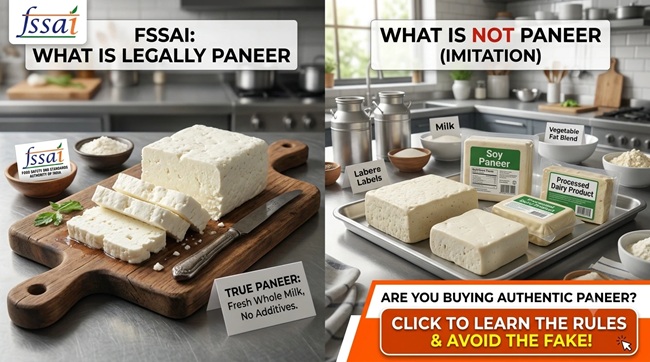
Under India’s food law, paneer must be made only from cow or buffalo milk (or a combination), precipitated using a permitted acid, with milk fat as an essential component. A product is only allowed to be called paneer if it meets this milk-based compositional standard set out in Regulation 2.1.16 of the Food Safety and Standards (Food Products Standards and Food Additives) Regulations, 2011. Any product that replaces milk fat or milk solids, wholly or partly, with vegetable oil, vegetable fat, starches or emulsifiers is legally an “analogue in dairy context” and cannot be sold, named, marketed or served as “paneer.” FSSAI’s new draft amendment, notified on September 22, 2026, formalizes a nationwide ban on using the word “paneer” for such analogue products, following similar bans already imposed by at least eight Indian states.
About This Guide
This guide was compiled by the FinanceChecks.com editorial team using FSSAI’s official gazette notifications, its Food Products Standards and Food Additives Regulations, 2011, and coverage from established legal and business publications, to give readers an accurate, plain-language picture of a technical regulatory change. We focus on translating dense regulatory language into checks a household or a restaurant customer can actually use, because a standard buried in a gazette notification only helps people once it is explained clearly. This article will be updated if FSSAI finalises the draft amendment after its sixty-day comment period, or if the state consultation on a nationwide ban produces a formal notification.
The Legal Definition of Paneer: What the Law Actually Says
Paneer is what regulators call a “standardised food,” meaning it cannot be made however a manufacturer likes. It has a fixed compositional definition under Regulation 2.1.16 of the Food Safety and Standards (Food Products Standards and Food Additives) Regulations, 2011.
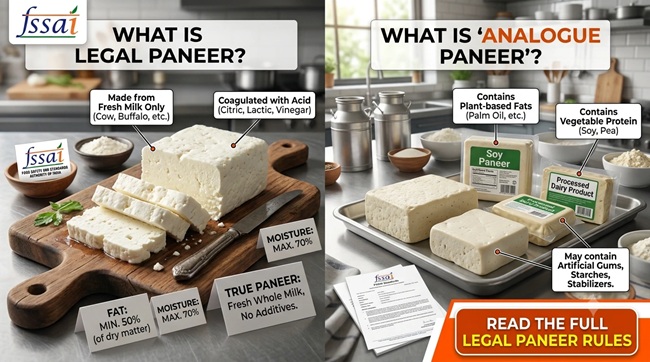
According to this standard, paneer is the product obtained from cow or buffalo milk, or a combination of the two, by precipitating it with a permitted acidulant, which includes lactic acid, citric acid, malic acid, vinegar, glucono delta lactone or sour whey, followed by heating. Milk solids may be added, but milk fat is treated as an essential constituent, not an optional one. The regulation is explicit that vegetable oil, vegetable fat or any other non-milk fat cannot be substituted in and still have the resulting product called paneer.
The standard also sets compositional limits based on moisture and fat content, and it recognises three categories of paneer depending on how much fat it contains.
| Category | Maximum Moisture | Milk Fat Requirement (Dry Matter Basis) |
|---|---|---|
| Paneer (full fat) | 60% | Minimum 50% |
| Medium Fat Paneer | 60% | More than 20% and less than 50% |
| Low Fat Paneer | 60–70% | Maximum 20% |
A product can only carry the name “Low Fat Paneer” or “Medium Fat Paneer” if it is sold in a sealed package with the correct label declaration. A product cannot simply call itself “paneer” while quietly sitting outside these fat and moisture limits.
What “Analogue Paneer” Actually Is
Analogue paneer is a paneer-like product in which some or all of the milk-based ingredients are replaced with non-dairy substitutes, most commonly vegetable oil, starches and emulsifiers. It is manufactured to visually and texturally resemble real paneer, which is precisely why regulators consider it a labelling risk rather than simply a diet alternative.
FSSAI’s own gazette language is direct on this point. A product resembling paneer in which milk fat or milk solids are replaced wholly or partly by non-milk constituents is, in law, an “analogue in dairy context,” governed by separate regulations under the Prohibition and Restrictions on Sales Regulations, 2011. Such a product is not paneer, cannot be named, sold or served as paneer, and is required to carry a clear declaration near the product name, such as “Contains Vegetable Fat” and “Contains No Milk Fat.” Any analogue product sold or served as paneer without this declaration is considered misbranded, and if it uses non-food-grade ingredients or otherwise fails to conform to standards, it can be treated as unsafe under the Food Safety and Standards Act, 2006.
Analogue dairy products are legal and sold in many countries, and FSSAI has not proposed banning them outright. The regulatory objection is specifically about naming, not about the existence of the product. Several Indian states, including Maharashtra, Chhattisgarh, Madhya Pradesh, Gujarat and Karnataka, have already banned the sale of analogue paneer within their jurisdictions rather than waiting for a national rule, and FSSAI’s Western Region issued a public notice in April 2026 specifically flagging cheese analogues being sold as paneer as a violation, directing food-service establishments to disclose the use of cheese analogues on menus and display boards.
Real Paneer vs Analogue Paneer: A Side-by-Side Comparison
| Feature | Real Paneer | Analogue Paneer |
|---|---|---|
| Base ingredient | Cow or buffalo milk | Vegetable oil, starch, emulsifiers, sometimes with limited milk solids |
| Legal to call “paneer”? | Yes, if it meets Regulation 2.1.16 standards | No; must be labelled as an analogue with a clear declaration |
| Milk fat content | Minimum 50% (dry matter basis) for full fat paneer | Typically low or none; fat is largely vegetable-based |
| Protein quality | High-quality complete milk protein | Lower or altered protein profile depending on formulation |
| Typical price point | Often higher due to milk cost | Often cheaper, since vegetable fat costs less than milk fat |
| Where it commonly appears unlabelled | Rare in organised retail, but occurs in unpackaged/loose sales | Common in low-cost restaurant dishes, catering, and some processed snacks |
| Required label declaration | Standard nutrition label | Must state “Contains Vegetable Fat” / “Contains No Milk Fat” near the product name |
Why This Matters for Your Household Budget and Health
For a country where paneer is often the primary source of protein in vegetarian diets, mislabeling has a direct nutritional cost. A household buying what it believes is a protein-dense milk product may actually be consuming a starch-and-vegetable-oil substitute with a very different nutritional profile, while paying a price that assumes real paneer.
There is also a straightforward financial angle. Milk fat costs meaningfully more to produce than vegetable oil and starch, which is exactly why unlabelled analogue paneer is attractive to cost-conscious restaurants, caterers and low-margin retailers. When it is sold under the paneer name without disclosure, the price difference between the ingredient cost and what the consumer pays effectively becomes an undisclosed markup on a cheaper product, on top of the nutritional shortfall.
Restaurant menus are a particular blind spot. Diners rarely ask a server whether the paneer tikka or paneer butter masala on the menu is made with real paneer or an analogue, and prior to the April 2026 directive, disclosure on menus was inconsistent at best.
You May Also Like To Read About:
Common Mistakes People Make
Many shoppers assume that if a product is labelled “paneer” at all, whether in a supermarket, a local dairy shop or a restaurant menu, it must meet the dairy standard, when in reality enforcement has historically been inconsistent and mislabeling has been widespread enough to trigger state-level bans. Another common mistake is judging paneer purely by texture and appearance, since well-made analogue paneer can look and even feel similar to the real product without a lab test. People also tend to assume that low price alone signals poor quality without realising that price is actually one of the more reliable indicators, since genuine milk-based paneer is rarely available far below the prevailing market rate for milk. Finally, very few consumers check for the “Contains Vegetable Fat” declaration that analogue products are legally required to carry, largely because they do not know to look for it in the first place.
How to Check Before You Buy
A few checks make it meaningfully easier to tell the two apart before you buy or order.
On packaged paneer, look for the product name itself. If it says “Paneer,” “Low Fat Paneer” or “Medium Fat Paneer,” it is required to meet the milk-based compositional standard. If it says anything involving “analogue,” “vegetable fat,” or carries a declaration such as “Contains No Milk Fat,” it is legally not paneer regardless of how it is marketed on the front of the pack. Check the ingredient list for vegetable oil, palm oil, starch or emulsifiers appearing before or alongside milk solids, since real paneer’s ingredient list should essentially read as milk and an acidulant. On restaurant menus, the April 2026 FSSAI directive requires disclosure of cheese or dairy analogues where used, so it is reasonable to ask directly whether a dish is made with real paneer, particularly at lower-cost eateries, catering services and buffet-style outlets where analogue paneer has been most commonly reported. Price is also a genuine signal. A block of paneer priced well below the cost of the milk required to make it is worth a second look at the label.
My Take
The most useful thing about this update is not the ban itself, it is the clarity. Indian food law has quietly had a precise definition of paneer for years, but that definition was doing very little for ordinary shoppers because there was no consistent labelling or menu disclosure requirement forcing sellers to be upfront about analogues. What has changed recently is enforcement, first through a wave of state-level bans, then through FSSAI’s own regional directives, and now through this draft national amendment.
I would not expect analogue paneer to disappear from the market even if this draft is finalised as written, since analogue dairy products remain legal to manufacture and sell under their own name. What should change, if enforcement keeps pace with the regulation, is that consumers stop being the last people to find out what they are actually eating. Until enforcement is consistent everywhere, the checks in this guide, reading the label, checking the ingredient list, and simply asking at restaurants, remain the most reliable protection available to any household.
Frequently Asked Questions
1. What is the legal definition of paneer in India? Paneer is defined under Regulation 2.1.16 of the Food Safety and Standards (Food Products Standards and Food Additives) Regulations, 2011, as a product made from cow or buffalo milk, precipitated using a permitted acid, with milk fat as an essential component.
2. What is analogue paneer? Analogue paneer is a paneer-like product in which milk fat or milk solids are partly or wholly replaced with non-dairy ingredients such as vegetable oil, starches and emulsifiers.
3. Is analogue paneer illegal in India? Analogue dairy products themselves are not banned nationally, but as of the September 2026 draft regulation, they cannot legally be sold, marketed or named as “paneer.” Several states have gone further and banned their sale outright.
4. Which states have already banned analogue paneer? At least eight states have introduced bans, including Maharashtra, Chhattisgarh, Madhya Pradesh, Gujarat and Karnataka, with Karnataka’s ban running for a year.
5. How can I tell if paneer is real or analogue just by looking at it? Visual inspection alone is unreliable, since well-made analogue paneer can closely resemble real paneer. Checking the label, ingredient list and price is far more reliable than appearance.
6. What must analogue paneer products say on their label? They must carry a declaration near the product name, such as “Contains Vegetable Fat” and “Contains No Milk Fat,” under Regulation 2.1.1(5)(b) of the Prohibition and Restrictions on Sales Regulations, 2011.
7. What is the minimum milk fat content required for real paneer? Full-fat paneer must contain a minimum of 50% milk fat on a dry matter basis. Medium fat paneer falls between 20% and 50%, and low fat paneer must not exceed 20%.
8. Are restaurants required to disclose if they use analogue paneer? Following FSSAI’s Western Region notice in April 2026, food-service establishments are directed to disclose the use of cheese or dairy analogues on menus or display boards.
9. When will the new draft regulation on paneer come into force? The draft was notified on September 22, 2026, with a sixty-day period for public objections and suggestions before it can be finalised.
10. Why does FSSAI care about the difference between paneer and analogue paneer? The core concern is consumer protection: preventing shoppers and diners from unknowingly paying for and consuming a different product than what the name promises, both in terms of nutrition and price.
Disclaimer
This article is for general informational purposes only and does not constitute legal, medical or financial advice. It reflects the regulatory position and draft proposals available as of the time of writing, which may change once FSSAI finalises its amendment following the public comment period. Readers should verify current regulations directly on the official FSSAI website or with a qualified professional before making decisions based on this content. FinanceChecks.com is not affiliated with FSSAI or any dairy brand mentioned in this article.

Shuchi founded Finance Checks after spending 16+ years working in corporate, managing operations and distribution. She managed her own finances, learned and read regularly and helped people make sense of their savings, loans, insurance, and investments.
She started this site to offer the kind of clear, honest financial guidance she wished was more available when she was learning to manage her own money. Every article is researched personally, checked against official sources such as the Reserve Bank of India, SEBI, or the Income Tax Department, and revisited whenever regulations or figures change. She is upfront about how the site earns money through ads and select affiliate partnerships, and she does not let either influence what she actually recommends to readers.