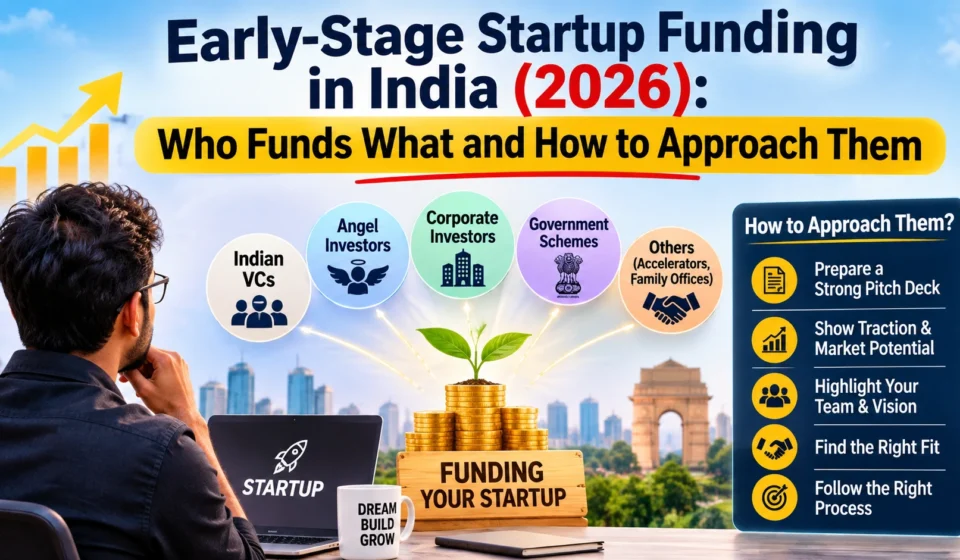
Early-Stage Startup Funding in India (2026): Who Funds What and How to Approach Them

Quick Answer Early-stage startups in India raise their first money from five sources: angel networks, micro VCs, accelerators, government schemes, and the early-stage programs of larger VC firms. Pre-seed rounds are commonly quoted at ₹25 lakh to ₹2 crore and seed rounds at ₹2 crore to ₹10 crore. The best way in is a warm introduction, or a short cold email to a fund that already backs startups in your sector.
About This Guide
Author: Shuchi Sharma
Last updated: 16 November 2026
How this guide was checked: Every fund, program and figure below was checked against at least one 2026 source, listed in the Sources section. Government scheme details come from published summaries of the official Startup India portal. Cheque sizes, deadlines and program rules change often, so confirm on each official website before you apply.
Who it is for: First-time founders in India who want to know where early money comes from and how to ask for it.
Why early-stage money is worth chasing in 2026
Early-stage funding is holding up while late-stage funding slows. Inc42 data shows seed-stage funding in India rose 18% year on year to more than $478 million in the first half of 2026, while late-stage investment fell 29%. A 2026 report from Eximius Ventures found that pre-seed has grown nearly 3X since 2020 and is among the most resilient parts of Indian venture capital.
Investors have also become more demanding. The same report says they now look for execution discipline, early traction and a clear way to make money, even at pre-seed. A good idea is no longer enough on its own. You need to show that you can build and that someone wants what you are building.
Who funds early-stage startups in India
| Funder type | Examples | Typical stage | How to apply |
|---|---|---|---|
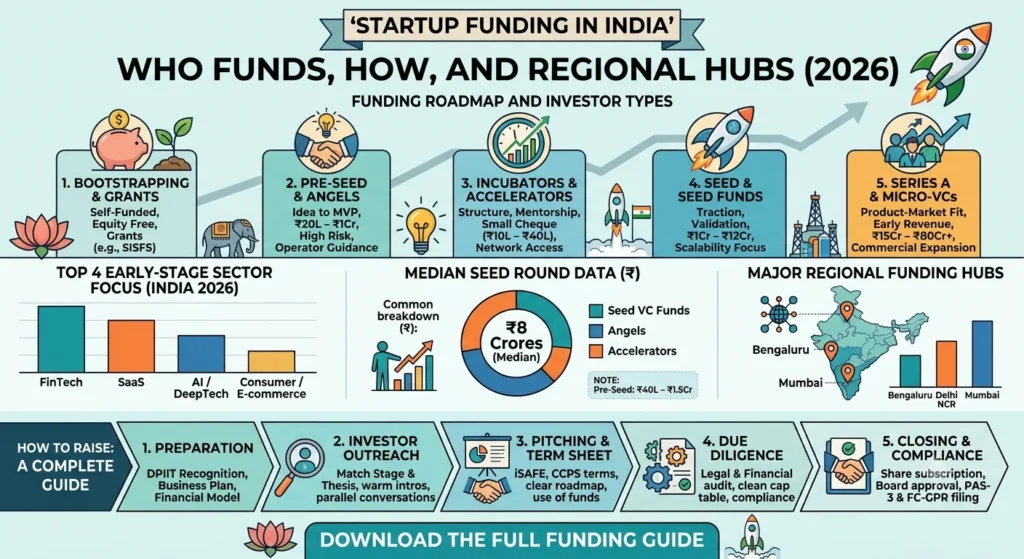
| Angel networks and platforms | Indian Angel Network, Inflection Point Ventures, Venture Catalysts, LetsVenture | Idea to seed | Online plan or application form on their websites |
| Micro VCs | Blume Ventures, Eximius Ventures, India Quotient, 100X.VC, All In Capital | Pre-seed to seed | Pitch form on the website, or a warm introduction |
| Deeptech specialists | Speciale Invest | Pre-seed to seed | Website contact, or referral from a portfolio founder |
| Accelerators and programs | Peak XV Surge, Accel Atoms, Antler India, Axilor | Seed, or post-MVP | Cohort applications with fixed windows |
| Government schemes | Startup India Seed Fund Scheme, NIDHI-SSS, BIRAC, MeitY TIDE, state programs such as Startup Karnataka and StartupTN | Idea, prototype, early revenue | Through incubators or the scheme’s own portal |
Micro VCs. One 2026 explainer describes them as funds under $40 million that write cheques of roughly $100,000 to $500,000, and says they write most first institutional cheques at pre-seed. Blume Ventures’ 2026 landscape piece counts more than 250 active micro VC and early-stage funds in India based on IVCA data, while Tracxn counts 228, since definitions differ. Eximius calls itself India’s first dedicated pre-seed VC fund. 100X.VC runs a cohort model for pre-seed startups.
Larger programs. Peak XV raised the top of its Surge seed cheque to $5 million in September 2026, which makes it more of a seed-to-Series A program than a first cheque. Surge has also been reorganised inside Peak XV’s wider early-stage team, so check the current application route. Accel Atoms, together with the Google AI Futures Fund, offers up to $2 million of co-investment per startup in its 2026 AI cohort.
Government support. The Startup India Seed Fund Scheme (SISFS) offers up to ₹20 lakh as a milestone-based grant for proof of concept and up to ₹50 lakh as debt or convertible debentures for market entry. It runs through DPIIT-recognised incubators, and eligible startups must be DPIIT-recognised and no more than two years old. Reports say the last startup application window closed on 31 May 2026 (one source says 15 May), so check seedfund.startupindia.gov.in for any new call. NIDHI-SSS, a DST scheme, offers up to ₹50 lakh to technology startups through selected incubators.
What do they fund?
Many funds call themselves sector agnostic, but most lean toward a few areas. AI and AI-enabled software is the most frequently named theme across the new funds and programs checked for this guide. VentureNest, a new India-focused early-stage fund, lists fintech, B2B SaaS, consumer and D2C, healthtech, agritech and AI. Speciale Invest focuses on deeptech, including space, robotics and semiconductors. Funding roundups also show seed rounds going to hardware-first startups, which suggests investors are more comfortable with long development cycles when the technical advantage is real.
The practical point is simple. Read each fund’s portfolio before you write to them. If they have backed three fintech startups and no consumer brands, a consumer pitch will probably go nowhere.
How to reach and approach them
- Set up the basics. Register a company (a private limited company is the usual route for equity funding) and get DPIIT recognition, which SISFS requires. Keep your cap table clean.
- Build a shortlist of 15 to 25 investors. Match on sector, stage and cheque size. Note who at each fund leads deals in your area.
- Look for a warm introduction first. Ask a portfolio founder, a mentor or an incubator manager. Write a short note they can forward in one click.
- If you go cold, keep it to about 150 words. Say what the product does, who it is for, one proof point (users, revenue or pilots), the round size and a link to a short deck. Put the proof point in the first two lines.
- Use application forms where they exist. Indian Angel Network, Inflection Point Ventures and 100X.VC all take applications through their websites.
- Apply to cohort programs inside their windows. Surge, Atoms, Antler and Axilor run fixed application periods.
- Follow up once. If you hear nothing, write again after one to two weeks with a single real update, such as a new customer or a shipped feature.
What to have ready
Keep a 10 to 12 slide deck covering problem, solution, market, traction, business model, team and the ask. Add a one-page summary for people who will not open the deck, and a simple plan showing what the money buys and how long it lasts. Be ready to explain who your first 100 customers are and how you will reach them.
Common mistakes
Raising too early is the biggest one. With no product and no users, a grant, an incubator or an accelerator usually fits better than a VC cheque. Mass-emailing 200 investors with the same message is another, because generic emails are easy to spot. Founders also tend to ask for an amount with no reason behind it. A round sized to reach one clear milestone, such as the first 1,000 paying users, is easier to defend than one sized to “give us 18 months”. Finally, check the investor too. Ask founders in their portfolio how they behave when things go badly.
My Take
If I were starting today, I would shortlist ten investors and spend more time on a sharp one-page summary than on the deck. I would apply to a government scheme or an incubator in parallel, because they add credibility and a network, not just money. And I would raise the smallest amount that proves one clear thing. In a market where investors want traction even at pre-seed, a small round with real proof beats a large round with a story.
Frequently Asked Questions
1. What is pre-seed funding? It is the first outside money a startup raises, usually before it has real traction, to turn an idea or prototype into a working product with first users.
2. How much can an early-stage Indian startup raise? Commonly quoted ranges are ₹25 lakh to ₹2 crore at pre-seed and ₹2 crore to ₹10 crore at seed. Actual rounds vary widely by sector and founder track record.
3. What is the difference between angels and micro VCs? Angels invest personal money, often through a network or platform. Micro VCs invest from a small pooled fund, usually writing cheques of about $100,000 to $500,000.
4. Do I need DPIIT recognition to raise money? Not for angel or VC rounds in general, but SISFS requires it.
5. Is the Startup India Seed Fund Scheme open now? Reports say the last startup application window closed on 31 May 2026. Check seedfund.startupindia.gov.in for any new call.
6. Which sectors are investors backing in 2026? AI, fintech, B2B SaaS, consumer and D2C, healthtech, agritech and deeptech all feature in the funds and programs checked for this guide.
7. How do I contact investors? Use a warm introduction where possible. Otherwise use the fund’s website form or send a short, specific cold email.
8. How many investors should I contact? Start with 15 to 25 that match your sector and stage. Fit matters more than volume.
9. Can I raise money with no revenue? Yes, many pre-seed rounds are pre-revenue, but you still need a prototype, a strong founding team or early user signals.
10. What do investors look for at pre-seed? Execution discipline, early traction and a clear way to make money, according to a 2026 Eximius Ventures report on India’s pre-seed market.
Disclaimer: This article is for general information and is not investment, legal or tax advice. Fund details, cheque sizes and scheme rules change often. Confirm everything on official websites and with a qualified advisor before acting.

Shuchi founded Finance Checks after spending 16+ years working in corporate, managing operations and distribution. She managed her own finances, learned and read regularly and helped people make sense of their savings, loans, insurance, and investments.
She started this site to offer the kind of clear, honest financial guidance she wished was more available when she was learning to manage her own money. Every article is researched personally, checked against official sources such as the Reserve Bank of India, SEBI, or the Income Tax Department, and revisited whenever regulations or figures change. She is upfront about how the site earns money through ads and select affiliate partnerships, and she does not let either influence what she actually recommends to readers.