
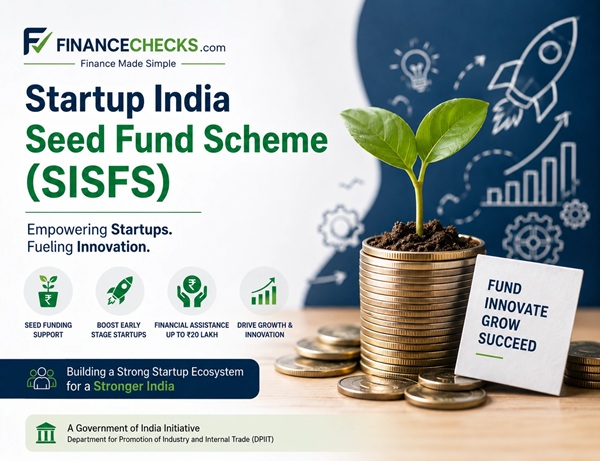
Startup India Seed Fund Scheme (SISFS): The Complete Guide Every Indian Founder Should Read Before Applying

If you have ever tried to raise money for a business idea that exists only on paper, you already know the problem. Investors want to see a working product. Banks want collateral. Your family has already lent you what they can. And your idea, no matter how good, is sitting in a notebook because you cannot afford to build even a basic prototype.
This is exactly the gap the Government of India tried to close when it launched the Startup India Seed Fund Scheme, better known by its short form, SISFS. It is one of the most talked about startup schemes in the country, yet most founders only know the surface level details. They have heard the number twenty lakh, or fifty lakh, floating around, but they do not actually understand how the money works, who gives it, what it can and cannot be used for, and why so many applications get rejected before they even reach an evaluation committee.
This guide is written to fix that. We are going to walk through SISFS the way a founder needs to understand it, not the way a government notification describes it.

What Exactly Is the Startup India Seed Fund Scheme
SISFS is a central government scheme run by the Department for Promotion of Industry and Internal Trade, commonly called DPIIT. It was launched in April 2021 with a total outlay of nine hundred forty five crore rupees, and the idea behind it was fairly simple. Early stage startups fail not because their ideas are bad, but because they run out of money before they can prove the idea works. Angel investors and venture capital firms usually wait for some kind of proof, a working prototype, early users, some traction. Banks will not touch a business with no assets to secure a loan against. That leaves a founder stuck in what people in the startup world call the valley of death, the stage between having an idea and having something fundable.
SISFS was designed to sit exactly in that gap. It gives money to startups so they can build a proof of concept, test it, refine it, and get it ready for the market, before they go anywhere near an investor.
One detail that surprises a lot of founders when they first look into this scheme is that the government does not hand out this money directly. The funds are routed through incubators that have been approved by DPIIT. So when people say the government is giving seed money to startups, what is actually happening is that DPIIT gives money to a network of incubators, and those incubators run their own evaluation process to decide which startups within their region or sector receive the funding. This structure matters a lot, and we will come back to why later in this article.
Why the Government Built Startup India Seed Fund Scheme in the First Place
India has been pushing hard to build a startup culture since 2016, when the broader Startup India initiative was first announced. Over the years, DPIIT recognised startups have crossed two lakh in number, and this ecosystem has generated well over twenty lakh direct jobs. But somewhere along the way, policymakers noticed a pattern. A large number of promising ideas were dying at the earliest stage simply because founders could not afford to build anything to show. Not because the market did not want the product, but because there was no capital available before there was something concrete to evaluate.
SISFS exists to catch these ideas before they die. The scheme is meant to fund roughly three thousand six hundred startups through around three hundred incubators spread across the country, over a four year period starting April 2021.
Startup India Seed Fund Scheme: How Much Money Can You Actually Get
This is where most blog posts get lazy and just throw numbers at you without explaining the structure. Let us actually break this down properly, because the structure changes how you should think about your application.
SISFS support comes in two components, and they are meant for two different stages of your startup journey.
The first component is a grant of up to twenty lakh rupees. This is meant for the earliest stage of your business, when you are still validating whether your idea actually works. This money is used for building a proof of concept, developing your first prototype, and running product trials. The important thing to understand here is that this is a grant, not a loan. You do not repay it, and you do not give away equity for it. The incubator releases this money in instalments, tied to specific milestones you agree to when your application is approved. You do not get twenty lakh rupees in one shot on day one. You get a portion when you hit milestone one, another portion when you hit milestone two, and so on.
The second component goes up to fifty lakh rupees, and this is meant for a startup that has already validated its idea and is now trying to enter the market or scale up. This money usually comes through convertible debentures or a debt linked instrument, not as a straightforward grant. That means the terms are different, and you should read the fine print carefully before assuming this money works the same way as the twenty lakh grant. The incubator sets the repayment or conversion terms at the time of approval, and the tenure can run up to five years.
A single startup can, over its lifecycle, access both components as it moves from validation to market entry, though not necessarily from the same incubator or in the same application cycle.
There is also a rule that founders rarely mention. No more than twenty percent of the total money given to an incubator can be handed out purely as grants. This exists so that incubators cannot simply distribute the entire fund as free money without pushing startups toward the more structured, milestone based instruments. It is worth knowing this because it explains why some incubators are more conservative with the twenty lakh grant component than others.
There is one more piece of the puzzle that rarely makes it into founder facing explanations, but it helps you understand why incubators behave the way they do. Incubators themselves receive a management fee equal to five percent of the seed fund grant sanctioned to them. So if an incubator is approved for one crore rupees in seed fund, the government’s total assistance actually works out to a little more once this fee is added. This is not money that comes out of your startup’s allocation, but it does shape how seriously incubators treat their SISFS mandate, since running the programme properly is also how they earn this fee.
Who Can Actually Apply for Startup India Seed Fund Scheme
Eligibility for SISFS is stricter than most founders expect, and this is where a lot of applications fail before they are even read properly.
To apply, your startup needs to be recognised by DPIIT. If you have not gone through DPIIT recognition yet, you cannot apply for SISFS at all, so this has to be your very first step before you think about seed funding.
Your business should not be older than two years from the date of incorporation at the time you apply. This scheme is genuinely built for early stage companies, not businesses that are three or four years into operation and looking for growth capital.
Indian promoters typically need to hold a majority stake in the company, in line with the broader DPIIT recognition norms that SISFS eligibility is built on. If you have a foreign co-founder, that is completely fine, but the company generally needs to remain majority owned and controlled by Indian citizens. It is worth confirming the exact shareholding threshold with your incubator or on the DPIIT recognition guidelines at the time you apply, since this sits under the recognition criteria rather than being a separate SISFS specific number.
Your idea needs to involve some kind of technology driven solution, whether that is in the product itself, the business model, the way you deliver your service, or how you reach customers. A purely traditional trading or retail business without any innovation angle is unlikely to qualify.
There is also a funding cap that trips people up. If your startup has already received more than ten lakh rupees in monetary support from any central or state government scheme, you become ineligible for the SISFS grant. This catches founders off guard because they assume stacking government schemes is always a good idea. With SISFS, it can actually disqualify you.
The scheme is sector agnostic on paper, which means startups from any industry can technically apply. In practice, though, preference tends to go toward startups working in areas like social impact, water and waste management, financial inclusion, agriculture, food processing, biotechnology, healthcare, education, energy, mobility, defence, space, railways, and textiles. If your startup falls in one of these categories, you are not guaranteed selection, but you are competing in a pool where the evaluation committees are actively looking for solutions like yours.
One more thing worth knowing. The grant cannot be used for certain purposes even if you are approved. It cannot go toward renting or building physical office space, it is not meant to cover cash prizes or benefits you might have already received from competitions, and it cannot be used to pay for lab facilities or as a monthly personal allowance for founders. The money has to go toward the specific milestones you outlined in your application.
Application Process for Startup India Seed Fund Scheme
The entire process happens online through the official Startup India Seed Fund portal. Here is what the journey typically looks like from start to finish.
You begin by making sure your DPIIT recognition is in place. Without this certificate, you cannot move forward, so treat this as a prerequisite rather than a step in the SISFS process itself.
Once that is sorted, you create your application on the seed fund portal and fill in details about your startup, your team, your product, and your funding requirement. This is also where you choose which incubators you want to apply to. Here is a detail that catches a lot of founders by surprise: you can apply to a maximum of three incubators, and you have to rank them in order of preference. This ranking actually matters. If two incubators on your list both decide to select you, the funding will come from whichever one you ranked higher. If your first preference rejects you but your second preference accepts you, the funding comes from the second one.
This means your choice of incubators is not a minor administrative detail, it is a strategic decision. Look at which incubators focus on your sector, which ones have a track record of supporting startups at your stage, and which ones are located in a region that makes sense for your operations. Applying to three incubators that have nothing to do with your industry just because they are well known is a common and avoidable mistake.
After you submit your application, it gets shared with your selected incubators. Each incubator has something called an Incubator Seed Management Committee, or ISMC, which is the body that actually reviews applications and decides who gets funded. If your application is incomplete, you will get a prompt to fix it and resubmit, so pay close attention to any notifications from the portal.
The ISMC evaluates applications against a defined set of criteria. They look at whether there is a genuine need for your idea and whether it addresses a real market gap. They assess the feasibility of your technical claims and whether your roadmap for building and validating your product actually makes sense. They also look at your team’s capability to execute, your plan for using the funds, how relevant your sector is to current priorities, and whether you have received prior support and used it responsibly.
If your application looks promising on paper, you may be called in to present in front of the ISMC. This is essentially a pitch, so treat it with the same seriousness you would treat a pitch to a venture capital fund. Committees respond far better to specific numbers than vague statements. Saying you will use the funds for marketing tells them nothing. Saying you plan to use a defined amount to acquire a specific number of customers through a pilot over a set number of weeks, with a clear metric you expect to hit, tells them you actually know what you are doing.
The ISMC is expected to complete its evaluation and select startups within forty five days of receiving a completed application. Once selected, you will receive your funding through the incubator that selected you, based on the preference order you originally submitted. According to the scheme’s own guidelines, the first instalment of the grant is meant to reach the selected startup’s bank account within sixty days of the incubator receiving the application, provided the legal agreement between the startup and the incubator has already been signed. Subsequent instalments are then released as you clear each milestone and submit your utilisation certificate and progress update.
Read More About :
Startup India Seed Fund Scheme : A Word on Timing and Application Windows
Here is something that a lot of blog posts either skip or get wrong, and it matters a great deal if you are reading this hoping to apply right away. Applications under SISFS are not always open on a rolling, anytime basis. The scheme has gone through cycles, and the official seed fund portal has, at various points in 2026, listed a final deadline for startup applications under the current round of funding, with incubators given additional time after that to complete their selection process.
Because scheme windows, corpus availability, and deadlines can change without much warning, the only reliable way to know whether applications are currently open is to check the official Startup India Seed Fund portal directly before you start preparing your documents. Do not rely on any third party blog, including this one, for the exact current deadline. Treat everything in this article as a guide to how the scheme works structurally, and treat the official portal as your source of truth for whether a window is open right now.
Startup India Seed Fund Scheme: Documents and Preparation Checklist
Founders who get funded are almost always the ones who treat this like a serious institutional funding process rather than a government form to be filled out casually. Here is what you should have ready before you start your application.
You need your DPIIT recognition certificate, since this is non negotiable. You need your certificate of incorporation and basic company registration documents. You need a clear pitch deck that walks through the problem you are solving, your proposed solution, the size of the market you are targeting, and your business model. You need basic financial projections, and yes, this is expected even from a very early stage company, because it shows the committee you have thought about numbers rather than just the idea. You need founder profiles that show relevant background or capability to execute. You need a clear note on your product or prototype, even if it is still rough. And you need a specific, milestone based plan for how you intend to use the seed funds, because vague fund utilisation plans are one of the most common reasons applications get rejected at the evaluation stage.
Why Startup India Seed Fund Scheme Is Worth the Effort
Beyond the money itself, there is a credibility angle to SISFS that founders often underestimate. Getting selected by a DPIIT approved incubator under a government scheme sends a signal to future investors that your business model has already survived a structured evaluation process. Angel investors and early stage venture capital funds do pay attention to this kind of validation when they are deciding whether to take a closer look at a startup.
There is also the mentorship angle. Because the funding comes through incubators rather than directly from the government, selected startups typically get access to the incubator’s broader ecosystem, which can include mentorship, help with intellectual property protection, introductions to potential customers or partners, and general startup guidance that a founder working alone would have to figure out through trial and error.
And finally, because SISFS is specifically built for startups within two years of incorporation, you are not competing against companies with years of traction and existing revenue. You are being evaluated against peers at a genuinely comparable stage, which makes the odds far more reasonable than pitching to a private investor who is comparing you against every company they have ever funded.
Common Mistakes That Get Applications Rejected
A large share of rejected applications share the same handful of problems. Founders apply before securing DPIIT recognition, which means the application cannot even be processed. Founders pick incubators based on brand recognition rather than sector fit, which reduces their actual chances of being selected. Founders submit vague fund utilisation plans without specific numbers or timelines. Founders undersell their technical feasibility by not clearly explaining how they intend to build and validate their product. And in some cases, founders simply are not aware that receiving more than ten lakh rupees from another government scheme makes them ineligible, and they find this out only after being rejected.
Avoiding these mistakes does not guarantee selection, since the ISMC evaluation is genuinely competitive, but it does mean your application will actually be judged on the merit of your idea rather than disqualified on a technicality.
Frequently Asked Questions about Startup India Seed Fund Scheme
Is the Startup India Seed Fund Scheme a loan or a grant? It depends on which component you are applying for. The support of up to twenty lakh rupees is a grant with no repayment or equity dilution. The support of up to fifty lakh rupees is usually structured as a convertible or debt linked instrument, which does come with repayment or conversion terms set by the incubator.
Can I apply for Startup India Seed Fund Scheme (SISFS) without DPIIT recognition? No. DPIIT recognition is a mandatory prerequisite. You need to complete this step before you are even able to submit a SISFS application.
How many incubators can I apply to under this scheme? You can apply to a maximum of three incubators listed as disbursing partners under SISFS, and you need to rank them in order of preference at the time of application.
Does Startup India Seed Fund Scheme (SISFS) fund every sector equally? The scheme is technically sector agnostic, meaning any industry can apply, but evaluation committees tend to give preference to startups working in areas like healthcare, agriculture, financial inclusion, clean energy, water and waste management, education, mobility, and similar impact driven sectors.
What happens if my startup has already received government funding before? If your startup has received more than ten lakh rupees in monetary support from any central or state government scheme in the past, you become ineligible for the SISFS grant component.
How long does it take to get selected after applying? The Incubator Seed Management Committee is expected to evaluate applications and announce selections within forty five days of receiving a complete application, though this can vary depending on the incubator’s internal process and volume of applications.
Can a startup with a foreign co-founder apply? Yes, as long as Indian promoters hold at least fifty one percent of the shareholding in the company at the time of application.
Is there a fee to apply for SISFS? No. There is no fee charged by the incubator or the government to apply for or receive funding under this scheme. Be cautious of anyone asking for money in exchange for guaranteed selection.
What can the seed fund not be used for? It cannot be used to build or rent physical office facilities, cover cash prizes from competitions, pay for lab facilities, or serve as a personal monthly allowance for founders. The funds must go toward the specific milestones agreed upon during approval.
Where can I check if applications are currently open? The only reliable source is the official Startup India Seed Fund portal. Scheme windows and deadlines have changed multiple times, so always verify current status there before preparing your application.
Disclaimer
This article is written purely for general informational and educational purposes. It is based on publicly available information about the Startup India Seed Fund Scheme at the time of writing and is intended to help founders understand how the scheme works in principle. Scheme guidelines, funding amounts, eligibility criteria, application deadlines, and incubator lists are subject to change at the discretion of DPIIT and the Government of India, and such changes may not be reflected here immediately.
This content does not constitute financial, legal, or professional advice, and it should not be treated as a substitute for verifying details directly on the official Startup India Seed Fund portal or consulting a qualified professional before making any funding related decisions. Neither the author nor the publisher guarantees selection, approval, or disbursement of funds under this scheme, as all such decisions rest solely with the respective DPIIT approved incubators and the Expert Advisory Committee overseeing the scheme. Readers are strongly encouraged to confirm all figures, deadlines, and eligibility conditions on the official government portal before applying.

Shuchi founded Finance Checks after spending 16+ years working in corporate, managing operations and distribution. She managed her own finances, learned and read regularly and helped people make sense of their savings, loans, insurance, and investments.
She started this site to offer the kind of clear, honest financial guidance she wished was more available when she was learning to manage her own money. Every article is researched personally, checked against official sources such as the Reserve Bank of India, SEBI, or the Income Tax Department, and revisited whenever regulations or figures change. She is upfront about how the site earns money through ads and select affiliate partnerships, and she does not let either influence what she actually recommends to readers.


[…] Startup India Seed Fund Scheme (SISFS) : The Complete Guide Every Indian Founder Should Read Before … […]
[…] Startup India Seed Fund Scheme (SISFS): The Complete Guide Every Indian Founder Should Read Before A… […]
[…] Startup India Seed Fund Scheme (SISFS): The Complete Guide Every Indian Founder Should Read Before A… […]