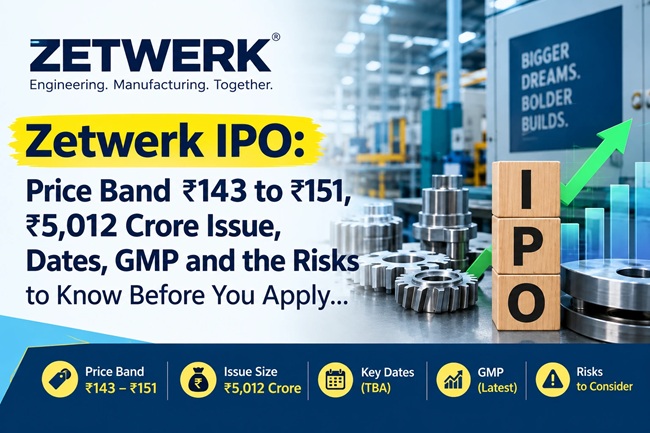
Zetwerk IPO: Price Band ₹143 to ₹151, ₹5,012 Crore Issue, Dates, GMP and the Risks to Know Before You Apply

By the FinanceChecks.com Editorial Team | Published October 12, 2026 | Last reviewed October 12, 2026 | 10-minute read
Here is the sentence that makes the Zetwerk IPO interesting: a manufacturing platform that reported a loss of about ₹1,606 crore in FY26 is asking the market for ₹5,012 crore at a valuation of roughly ₹25,583 crore. That is not a contradiction, and it is not automatically a warning sign either. Fast-growing companies often lose money while they scale, and investors have to decide how much future profit they are willing to pay for today. But it does mean this IPO deserves a closer read than the headline “price band set” suggests.
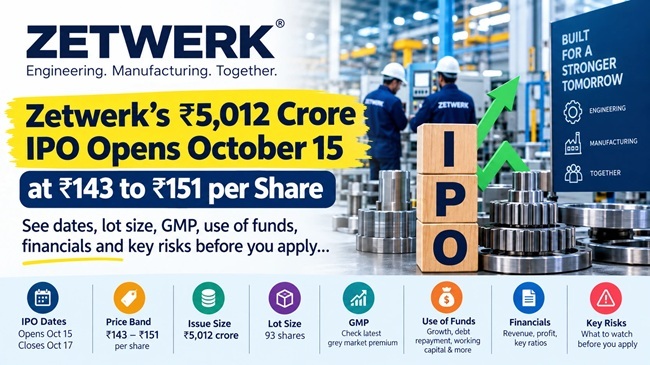
Zetwerk Manufacturing Business Ltd has fixed its price band at ₹143 to ₹151 per share, and the issue opens on October 15. This guide covers the dates, the lot size, what the money will be used for, the numbers behind the business, what the grey market premium really tells you, and the risks worth weighing before you click apply.
Quick Answer
Zetwerk’s IPO is a ₹5,012.33 crore book-built issue, made up of a fresh issue of ₹2,830 crore and an offer for sale of about 14.45 crore shares worth ₹2,182 crore at the upper price. It opens on October 15 and closes on October 19, with anchor bidding on October 14, allotment expected on October 21 and listing on the BSE and NSE on October 23. The lot size is 99 shares, so a retail bid costs ₹14,949 at the upper end of ₹151. About ₹2,160 crore of the fresh issue is meant to repay debt, and the offer for sale proceeds go to selling shareholders, not to the company. The company is loss-making, so its price-to-earnings ratio is not meaningful, and its offer documents state there are no directly comparable listed peers. The grey market premium reported around ₹24 to ₹30 is unofficial and can change quickly.
About This Guide
This guide was compiled by the FinanceChecks.com editorial team using the red herring prospectus details reported by Inc42, Entrackr, Upstox and PTI-based coverage, plus IPO tracking sites for the financial summary and application details. Figures for revenue and profit come from IPO tracking sites that reproduce the prospectus, so please confirm them in the official red herring prospectus on the BSE, NSE or SEBI websites before you decide. This article is for information and is not a recommendation to subscribe or avoid.
The IPO at a Glance
| Detail | Information |
|---|---|
| Company | Zetwerk Manufacturing Business Ltd (Bengaluru) |
| Price band | ₹143 to ₹151 per share |
| Total issue size | ₹5,012.33 crore at the upper band |
| Fresh issue | ₹2,830 crore (about 18.75 crore shares) |
| Offer for sale | About 14.45 crore shares, ₹2,182.33 crore at the upper band |
| Post-issue valuation | About ₹25,583 crore (roughly $2.7 billion) at the upper band |
| Lot size | 99 shares |
| Minimum retail investment | ₹14,949 at the upper band |
| Investor quota | QIB 75%, non-institutional 15%, retail 10%, plus a small employee reservation |
| Listing | BSE and NSE |
Key Dates
| Event | Date |
|---|---|
| Anchor investor bidding | October 14, 2026 |
| IPO opens | October 15, 2026 |
| IPO closes | October 19, 2026 |
| Allotment finalised (expected) | October 21, 2026 |
| Listing (tentative) | October 23, 2026 |
What Zetwerk Actually Does
Zetwerk was founded in 2018 by Amrit Pratik Acharya, Srinath Ramakkrushnan, Vishal Chaudhary, Ankit Fatehpuria and Rahul Sharma. It describes itself as a tech-led manufacturing platform that connects industrial customers with its own factories and with third-party suppliers, and it makes things such as metal structures, electrical equipment and other industrial products to order. It has 26 owned manufacturing facilities across India, the US, Germany and Spain.
The business has two main parts: a Manufacturing Business, and an Ecosystem Business branded Terra91. The manufacturing arm is the growth driver, with revenue reported to have risen from about ₹6,082 crore in FY24 to about ₹9,375 crore in FY26, which was close to 59% of total revenue that year. Zetwerk also discontinued its civil infrastructure business in FY26 as part of a strategic realignment.
Where the Money Goes
It helps to separate the two halves of this IPO, because only one of them reaches the company.
The fresh issue of ₹2,830 crore is new money for Zetwerk. The company plans to use ₹2,160 crore, about 76% of it, to repay or prepay borrowings of the company and certain subsidiaries, and the rest is for acquisitions that have not yet been identified and general corporate purposes. The offer for sale of ₹2,182 crore is different: those shares are being sold by existing shareholders, so that money goes to them and not to the business.
The selling shareholders include co-founders Amrit Pratik Acharya and Srinath Ramakkrushnan, who are each selling up to 1.42 crore shares, the promoter group entity Creovate Innovation, and venture funds linked to Peak XV, Accel India, Lightspeed and Kae Capital. Early investors selling part of their stake is normal in IPOs and is not by itself a bad sign, but it is worth knowing that a large part of this issue is an exit.
The size of the issue also changed. In August the company filed updated draft papers proposing a fresh issue of ₹2,600 crore and an offer for sale of 9.68 crore shares, and the final structure raised the fresh issue to ₹2,830 crore and the sale to 14.45 crore shares, an increase of about 49% in the shares being sold.
You May Also Like To Read About:
- Aditya Birla Renewables Seeks $1.5 Billion in Rupee Loans for the Shell Spring Energy Deal
- Ather Energy Shares Rally 130% in a Year: BOBCAPS Sees 19% Upside, Sets ₹1,680 Target Price
- Eternal Shares Rally 36% in Six Months: Is Zomato’s Parent a Buy With 22% Upside Ahead?
- Amazon Layoffs: At Least 100 Employees in India Hit by Latest Global Job Cuts: What We Know and What Affected Employees Should Do
- VinFast to Set Up 50+ Electric Two-Wheeler Showrooms in India: 15 States, 34 Cities and EV Market Plans
The Numbers Behind the IPO
The financial summary, as reproduced by IPO tracking sites from the prospectus, shows a company growing in size but not yet earning a profit.
| Period | Total income | Loss after tax |
|---|---|---|
| FY24 | ₹12,523 crore | ₹918 crore |
| FY25 | ₹11,492 crore | ₹371 crore |
| FY26 | ₹16,101 crore | ₹1,606 crore |
| April to June 2026 | ₹4,196 crore | ₹733 crore |
Total borrowings were reported at about ₹1,942 crore as of June 2026, and net worth at about ₹4,094 crore, down from about ₹4,814 crore in March 2026. Adjusted operating profit, or EBITDA, was reported as a loss of about ₹354 crore in FY26 and a profit of about ₹141 crore for the June 2026 quarter.
Two points are worth noting. Revenue growth in FY26 was strong, about 40% over FY25, which supports the growth story. But losses also grew, and a gap between a positive operating profit and a large net loss usually means there are costs below the operating line, such as interest, depreciation, exceptional items or the discontinued business. The prospectus explains these, and they are the first thing a careful reader should check.
What the Valuation Tells You
At the upper price band the company would be valued at about ₹25,583 crore after the issue. Because the company is making losses, its price-to-earnings ratio is not meaningful, and a negative ratio should not be read as cheap. The offer documents also say there are no comparable listed peers, which makes it harder to judge whether the price is fair, since the usual method of comparing with similar listed companies is not available. Investors are therefore pricing the company mostly on its growth, order book and the path to profitability.
What the Grey Market Premium Says, and Does Not Say
Tracking sites reported a grey market premium of about ₹24 on the morning of October 12, and another listed it around ₹30, which would imply a listing price between roughly ₹175 and ₹181 against the ₹151 upper band. The grey market is an unofficial, unregulated market where participants trade expectations before listing. These numbers move with sentiment, vary by source and have often been wrong in both directions, so treat them as a mood indicator and not as a forecast of your return. They should not decide whether you apply.
Risks and Strengths in One Place
| Strengths | Risks |
|---|---|
| Large and growing revenue, with FY26 income of over ₹16,000 crore | Net losses in each of the last three years, with FY26 the largest |
| Manufacturing business growing about 50% in FY26 | Thin operating margins, which leave little room for error |
| Global footprint of 26 owned facilities | Customer concentration: the top 10 customers were about 35.9% of FY26 revenue |
| About 76% of fresh proceeds will cut debt | Reliance on third-party suppliers for capacity, raw materials and quality |
| Backed by well-known investors and a large banker group | Rising working capital needs due to inventory |
| Strong underwriters: Kotak, Morgan Stanley, Goldman Sachs, Avendus, JM Financial, HSBC and Pantomath | A large offer for sale, so a big part of the issue is existing holders selling |
How Much You Can Bid
Using the 99-share lot and the standard SEBI application limits, a retail investor can apply for one lot at ₹14,949 up to a maximum of ₹2 lakh, which works out to 13 lots, or 1,287 shares, costing about ₹1,94,337 at the upper band. Bids above ₹2 lakh fall in the non-institutional category, starting at 14 lots, and the larger non-institutional category begins at about ₹10 lakh, which is 67 lots. Retail investors apply through their broker or bank using UPI, and the money is blocked until allotment. Confirm the exact limits in the prospectus.
Common Mistakes Investors Make With IPOs Like This
The most common mistake is treating the grey market premium as guaranteed listing gains, then applying only because the number looks attractive. Another is ignoring the offer for sale, since a big OFS means the money does not fund the company. People also read a large revenue figure as profit, when the company is still losing money. Many applicants apply at the upper price band without comparing the valuation and the risks, or put in more than they can afford to lock in. And some skip the prospectus entirely, relying on short summaries, even though the risk factors and the notes to the financials are where the details sit.
My Take
The most useful way to read this IPO is as a bet on operating leverage. Zetwerk has shown it can grow, and its manufacturing arm is expanding quickly. The open question is whether that growth turns into profit once the debt is reduced, the discontinued business is behind it and margins improve. The quarter ended June 2026 shows a positive operating profit, which is encouraging, but it is a single quarter and the net loss remained large.
For most investors, the sensible approach is neither enthusiasm nor dismissal. Decide how much risk you are comfortable with in a loss-making company with no listed peers, size your bid accordingly, and read the risk factors in the prospectus before you apply. Some independent reviews have taken a cautious stance on the issue because of its losses and thin margins, and others will see the scale and growth as worth paying for. Both views are reasonable, and neither is a substitute for your own research.
Frequently Asked Questions
1. What is the Zetwerk IPO price band? ₹143 to ₹151 per share.
2. When does the Zetwerk IPO open and close? It opens on October 15, 2026 and closes on October 19, 2026, with anchor bidding on October 14.
3. What is the issue size? About ₹5,012 crore at the upper band, made up of a fresh issue of ₹2,830 crore and an offer for sale of about 14.45 crore shares worth about ₹2,182 crore.
4. What is the lot size and minimum investment? The lot size is 99 shares, so the minimum retail investment is ₹14,949 at the upper price of ₹151.
5. When is allotment and listing? Allotment is expected on October 21, and listing is tentatively set for October 23 on the BSE and NSE.
6. How will Zetwerk use the money? About ₹2,160 crore of the fresh issue is meant to repay or prepay borrowings of the company and its subsidiaries, with the rest for acquisitions that are not yet identified and general corporate purposes. The offer for sale proceeds go to the selling shareholders.
7. Is Zetwerk profitable? No. The company reported net losses in FY24, FY25 and FY26, including a loss of about ₹1,606 crore in FY26, although adjusted operating profit turned positive in the June 2026 quarter.
8. What is the Zetwerk IPO grey market premium? Tracking sites reported figures around ₹24 to ₹30 on October 12. The grey market is unofficial and these numbers change quickly and are not a guarantee of listing gains.
9. Who is selling shares in the offer for sale? Co-founders Amrit Pratik Acharya and Srinath Ramakkrushnan, the promoter group entity Creovate Innovation, and funds linked to Peak XV, Accel India, Lightspeed and Kae Capital.
10. Should I apply for the Zetwerk IPO? That depends on your goals and risk tolerance, and this article does not recommend either way. Read the red herring prospectus, check the risk factors, size your bid to what you can afford to lose, and consider speaking to a SEBI registered adviser.
How We Verified This Information
This guide was researched using reports from Inc42, Entrackr, Upstox and PTI-based coverage of the price band announcement, the August 2026 updated draft prospectus coverage, and IPO tracking sites for the financial summary, lot size and grey market data. Grey market premiums and some financial figures come from secondary sources and differ across sites, so we gave ranges and recommend checking the official prospectus.
Disclaimer
This article is for general informational purposes only and does not constitute investment advice or a recommendation to subscribe to, buy, sell or hold any security. IPOs carry risk, including the loss of the entire amount invested, and listing prices can fall below the issue price. Figures are drawn from public reports and IPO tracking sites and may differ from the official prospectus. Readers should read the red herring prospectus and consult a SEBI registered investment adviser before investing. FinanceChecks.com is not a SEBI registered investment adviser and is not affiliated with Zetwerk or any bank or investor mentioned.
Last reviewed and fact-checked on October 12, 2026 by the FinanceChecks.com Editorial Team.

Shuchi founded Finance Checks after spending 16+ years working in corporate, managing operations and distribution. She managed her own finances, learned and read regularly and helped people make sense of their savings, loans, insurance, and investments.
She started this site to offer the kind of clear, honest financial guidance she wished was more available when she was learning to manage her own money. Every article is researched personally, checked against official sources such as the Reserve Bank of India, SEBI, or the Income Tax Department, and revisited whenever regulations or figures change. She is upfront about how the site earns money through ads and select affiliate partnerships, and she does not let either influence what she actually recommends to readers.



[…] Zetwerk IPO: Price Band ₹143 to ₹151, ₹5,012 Crore Issue, Dates, GMP and the Risks to Know Bef… […]