
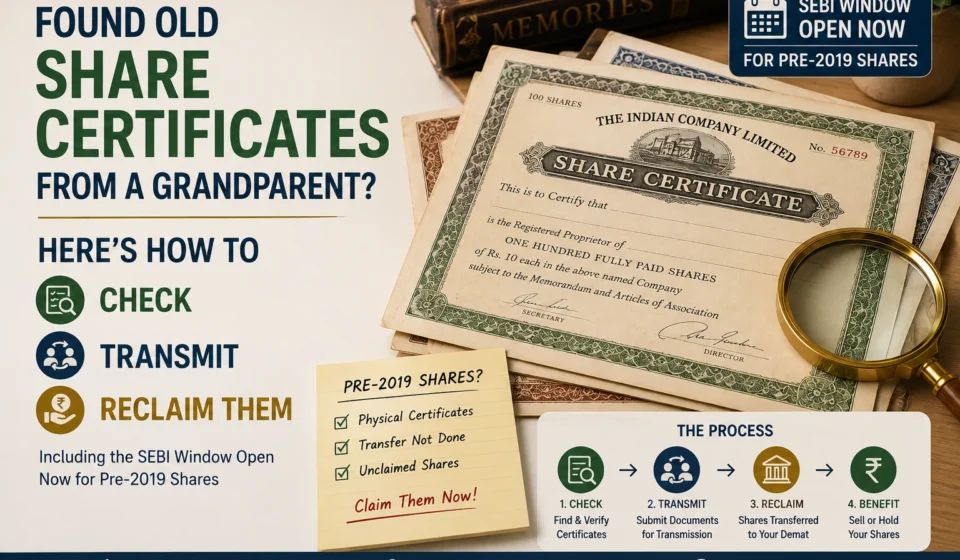
You Found Your Grandparents’ Old Share Certificates. Here’s How to Actually Claim Them

Ananya was clearing out her late grandfather’s steel almirah when she found a small bundle of yellowing paper certificates, Reliance, Tata Steel, a couple of company names she didn’t even recognize anymore, some dating back to the early 1990s. Her first thought was excitement. Her second thought, almost immediately after, was “now what do I even do with these?” The company names on some certificates weren’t showing up when she searched online. The registrar mentioned on one certificate didn’t seem to exist anymore either.
This exact scenario plays out in thousands of Indian families every year, someone discovers old physical share certificates, often worth a meaningful amount today given how long they’ve compounded, and has no idea where to start. The good news is that these shares aren’t lost. The process to reclaim them is well-defined, and right now, there’s actually a rare, time-limited window making an old, historically messy part of this process considerably easier.
First, Understand the Difference Between Transfer and Transmission
This distinction trips a lot of people up early on. A “transfer” of shares is a voluntary act, one person selling shares to another. What you’re doing with inherited shares is a “transmission,” a legal transfer of ownership triggered by the original holder’s death, governed by succession law rather than a sale. This isn’t just terminology, the documents and process required for each are genuinely different, and using the wrong term when contacting a registrar can send you down the wrong process entirely.

Step 1: Figure Out Where the Shares Actually Are Right Now
Before anything else, you need to establish whether these shares are still sitting with the company’s Registrar and Transfer Agent, commonly RTAs like KFintech, Link Intime, Alankit, Bigshare, or Cameo, or whether they’ve already been moved to the Investor Education and Protection Fund, or IEPF.
Under the Companies Act, 2013, if dividends on shares go unclaimed for 7 consecutive years, both the unclaimed dividend and the underlying shares are transferred to the IEPF, a government-administered fund. This doesn’t mean you’ve lost ownership, it just means an extra layer of government process now sits between you and your shares. You can check whether specific holdings have been moved to IEPF through the official MCA IEPF portal, searching by the shareholder’s name, the company name, or the folio number printed on the physical certificate.
If the company itself has since merged, been renamed, or delisted, which is common for certificates this old, the RTA can usually help trace the current, successor entity your shares now legally belong to.
Step 2: If the Shares Are Still With the Company (Not Yet in IEPF)
If your search shows the shares haven’t been moved to IEPF, the process is more straightforward, transmission directly through the company’s RTA. You’ll need:
A death certificate of the original shareholder, attested. If a nominee was registered on the account, the process is considerably simpler, largely just the transmission request form and the death certificate. If no nominee was registered, which is extremely common for older holdings from the 1980s and 90s, you’ll need additional documentation establishing your legal right to inherit, covered below.
Step 3: If the Shares Have Already Moved to IEPF
If your search on the MCA IEPF portal shows the shares now sit with the fund, you’ll need to file Form IEPF-5, the standard claim form for recovering unclaimed shares and dividends. The broad process looks like this: file IEPF-5 online, then submit the required physical documents to the company’s Nodal Officer, who forwards a verification report to the IEPF Authority. Once approved, the shares are credited directly to your demat account.
Since final credit only happens in demat form under this process, you’ll need to have a demat account already open in your name before your claim can be completed.
What You Need If There Was No Nominee
This is where things get more involved, and it’s genuinely the most common scenario for shares this old, since nomination for share certificates wasn’t as widely understood or emphasized decades ago as it is now.
If the total value of the securities is relatively modest and there’s no will, many companies will accept a simpler transmission request supported by a legal heir certificate, along with the death certificate. If the securities are worth more than roughly 2 lakh rupees and there’s no will, you’ll typically need a succession certificate, obtained by filing a petition in civil court along with the death certificate, proof of your relationship to the deceased, and details of the assets involved. This process usually takes 3 to 6 months, depending on the court, the complexity of the estate, and whether any other family member raises an objection.
If a will does exist, you’ll generally need a legal heirship certificate from the appropriate authority, a No Objection Certificate from all other legal heirs in your favour, and in some cases, an affidavit confirming the will’s authenticity from a witness, or a death certificate if that witness has also since passed away.
If the Original Certificates Are Lost or Damaged
Sometimes the certificates themselves haven’t survived decades of storage well, or were never actually found, only records or old dividend warrants referencing them. In this case, you’ll first need to obtain a duplicate share certificate from the company or RTA, which typically involves filing a police complaint or FIR for the lost certificate, a public newspaper notice, and an indemnity bond. Once the duplicate is issued, you can proceed with the transmission or IEPF-5 claim process as usual. Both the duplicate certificate process and an IEPF-5 filing can often be initiated in parallel rather than waiting for one to finish before starting the other.
A Major Window That’s Open Right Now: SEBI’s Special Regularisation Window
Here’s something genuinely worth knowing if your grandparents’ shares involve any transfer or purchase that happened before April 1, 2019. SEBI made dematerialisation mandatory for all share transfers from that date onward, and many older transfer requests, including some transmission cases, got rejected, returned, or simply left incomplete over the years due to documentation gaps that were common with older paperwork standards.
To address this, SEBI opened a special one-year window, running from February 5, 2026 to February 4, 2027, specifically allowing investors to re-lodge these old, previously stuck transfer requests for physical securities bought or sold before April 1, 2019. If you’re dealing with a case where a family member’s transfer attempt was rejected years ago due to incomplete paperwork, and you assumed that was a dead end, this window is a genuine second chance to resolve it, but only within this specific one-year period.
A few important conditions apply. Shares regularised through this window are credited only in demat form, with a mandatory one-year lock-in from the date of registration, meaning you won’t be able to sell, transfer, or pledge them for a year after the claim is approved. Cases where the original share certificate has gone missing entirely aren’t eligible under this specific window, and neither are securities that have already been moved to IEPF, or holdings involved in an active legal dispute, which would need to go through the courts or the NCLT first.
For NRIs Discovering Inherited Shares From Abroad
If you’re an NRI who’s discovered a parent or grandparent’s old shareholding, you don’t need to be physically present in India to file a claim. Documents can generally be executed abroad, provided they’re properly notarised or apostilled as required by the specific company or RTA involved.
A Quick Reference: Which Path Applies to You
| Your Situation | What You’ll Likely Need |
|---|---|
| Nominee was registered, shares still with company | Death certificate + transmission request form |
| No nominee, securities under ~₹2 lakh, no will | Legal heir certificate + death certificate |
| No nominee, securities over ~₹2 lakh, no will | Succession certificate from civil court (3-6 months) |
| A will exists | Legal heirship certificate + NOC from all legal heirs + witness affidavit |
| Shares already moved to IEPF | Form IEPF-5 + supporting documents + demat account |
| Original certificate lost | Duplicate certificate process (FIR, newspaper notice, indemnity bond) first |
| Transfer was rejected pre-April 2019 | SEBI’s special window (open till Feb 4, 2027) |
About This Guide
This article reflects the general framework for share transmission and IEPF claims under the Companies Act, 2013, and SEBI’s special window for physical securities transfer and dematerialisation, announced via circular dated January 30, 2026 and open from February 5, 2026 to February 4, 2027. Exact document requirements and timelines can vary by company, RTA, and the specific circumstances of the estate, so please verify current requirements directly with the relevant RTA or consult a professional experienced in share transmission and IEPF claims for guidance specific to your situation.
Common Mistakes People Make With Inherited Shares
Assuming old, small-looking shareholdings aren’t worth the effort is a genuinely costly mistake. Shares purchased for a modest amount in the 1980s or 90s, especially in companies that have grown significantly or issued bonus shares and splits over the decades, can be worth considerably more today than the original certificate’s face value suggests.
Confusing transfer with transmission, and approaching the RTA with the wrong request type, is another common source of delay. Being clear about which process you actually need from the start avoids unnecessary back and forth.
People also frequently give up after a single rejected application from years ago, not realising that documentation-related rejections from before April 2019 may now be eligible for resolution through SEBI’s current special window, rather than being a permanently closed door.
Finally, missing the relatively narrow filing windows involved, whether that’s SEBI’s one-year special window or general diligence in checking the IEPF portal before the 7-year unclaimed dividend threshold quietly moves a holding out of the company’s direct control, can add months of avoidable extra process later.
My Take
Finding old share certificates in a family almirah feels like stumbling onto a small mystery, and the paperwork involved can feel intimidating enough that plenty of families simply let it sit, unclaimed, for years longer than necessary. The process is genuinely more procedural than complicated once you know which path applies to your specific situation, nominee or no nominee, still with the company or moved to IEPF, pre- or post-2019 transfer. Given that SEBI’s current special window closes on February 4, 2027, if your family’s situation involves an old rejected transfer, this is a genuinely good year to actually finish what got left incomplete, rather than letting it sit for another decade.
Frequently Asked Questions
1. What should I do first if I find old physical share certificates? Note down the folio number and company name from the certificate, then check the MCA IEPF portal to see if the shares have already been transferred to the Investor Education and Protection Fund due to unclaimed dividends.
2. What is the difference between share transfer and share transmission? Transfer is a voluntary sale of shares between parties. Transmission is the legal transfer of shares to heirs following the original holder’s death, governed by succession law rather than a sale transaction.
3. Do I need a demat account to claim inherited shares? Yes, in almost all cases. Whether shares are transmitted directly by the company or recovered through an IEPF claim, they are typically credited only in demat form, so you’ll need a demat account in your name before completing the process.
4. What if my grandparent didn’t register a nominee for their shares? You’ll generally need either a legal heir certificate for smaller holdings, or a succession certificate from a civil court for holdings over roughly 2 lakh rupees, unless a will exists, in which case a legal heirship certificate and NOC from other heirs is typically required instead.
5. What is IEPF and why were my family’s shares transferred there? IEPF, the Investor Education and Protection Fund, is a government fund that shares and dividends are transferred to after 7 consecutive years of unclaimed dividends, as required under the Companies Act, 2013. Ownership isn’t lost, but an additional claim process through Form IEPF-5 becomes necessary.
6. What is SEBI’s special window for physical shares in 2026? It’s a one-year window, open from February 5, 2026 to February 4, 2027, allowing investors to re-lodge previously rejected or incomplete transfer and dematerialisation requests for physical shares bought or sold before April 1, 2019.
7. What happens if the original share certificate is lost? You’ll need to obtain a duplicate certificate from the company or RTA first, typically involving a police complaint, a newspaper notice, and an indemnity bond, before proceeding with the transmission or IEPF claim process.
8. Can I claim my deceased grandparent’s shares if I live outside India? Yes, NRIs can file these claims without being physically present in India, provided documents are properly notarised or apostilled as required by the company or RTA involved.
9. How long does it take to recover shares through an IEPF claim? Timelines vary considerably based on documentation completeness and whether transmission is also required, but the process generally takes several months from filing to shares being credited to your demat account.
10. Are shares transferred through SEBI’s special window immediately sellable? No, shares regularised through this window are subject to a mandatory one-year lock-in from the date of registration, during which they cannot be sold, transferred, or pledged.
Disclaimer
This article is for informational and educational purposes only and does not constitute legal advice. Share transmission and IEPF claim requirements can vary based on individual circumstances, company-specific policies, and RTA procedures, and are subject to regulatory changes. Please consult a qualified legal professional or a specialist in share transmission and IEPF claims for guidance specific to your situation.

Shuchi founded Finance Checks after spending 16+ years working in corporate, managing operations and distribution. She managed her own finances, learned and read regularly and helped people make sense of their savings, loans, insurance, and investments.
She started this site to offer the kind of clear, honest financial guidance she wished was more available when she was learning to manage her own money. Every article is researched personally, checked against official sources such as the Reserve Bank of India, SEBI, or the Income Tax Department, and revisited whenever regulations or figures change. She is upfront about how the site earns money through ads and select affiliate partnerships, and she does not let either influence what she actually recommends to readers.



[…] You Found Your Grandparents’ Old Share Certificates. Here’s How to Actually Claim Them […]