
Jio Platforms IPO: Final Subscription 22.19x, Day-wise GMP, Allotment Date, Listing Date and Share Price Outlook

By Shuchi, FinanceChecks.com | Published 23 October 2026 | Data as of 7:30 PM IST on 23 October 2026 | Category: Stock Market | Reading time: about 12 minutes
Neha, a 36-year-old HR manager in Pune, applied for one lot of the Jio Platforms IPO on the first morning. She did it from her phone in about two minutes, approved the UPI mandate, and then did what most of us do after applying for a big IPO: she checked the grey market premium eleven times that day.
By evening, the issue was fully subscribed. By Day 2, her office group chat was full of confident predictions about listing prices. By Day 3, someone had forwarded her a “guaranteed allotment” link, which she wisely ignored. Now she has three questions: Will I get shares? When will they list? And should I sell on day one or hold?
Those are the questions this guide answers. Below are the final subscription numbers category by category, how demand built up over three days, what the grey market premium has been saying, the allotment and listing timeline, and a calm look at what the numbers could mean for the listing price. I will not give you a price prediction, because nobody honestly can. What I can give you is the facts, the scenarios and a way to decide.
Quick Answer
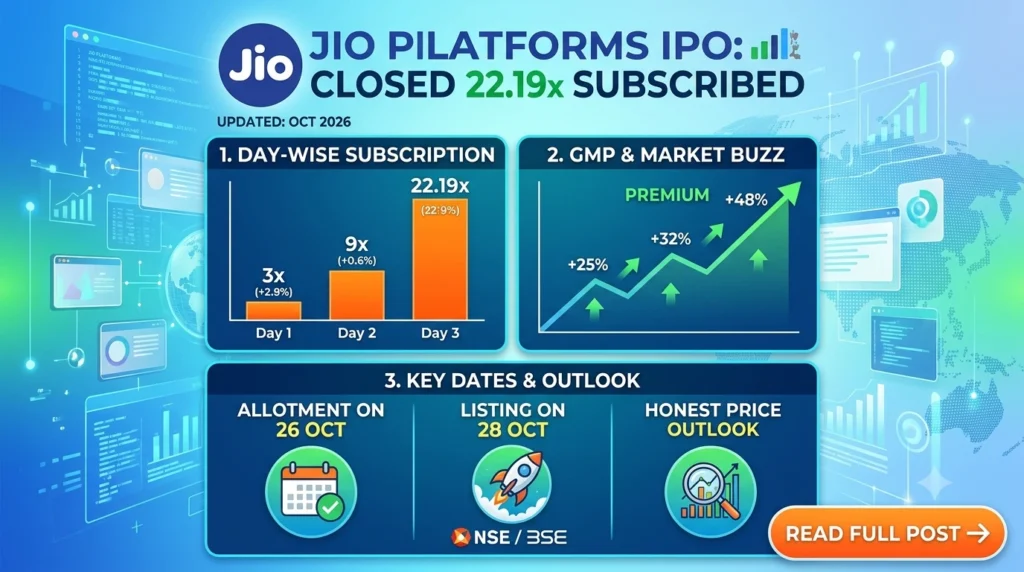
The Jio Platforms IPO closed on 23 October 2026 with an overall subscription of 22.19 times. Qualified institutional buyers bid 70.55 times their quota, non-institutional investors 14 times, retail investors 2.72 times, Reliance shareholders 7.6 times and employees 2.93 times. The price band was ₹1,065 to ₹1,119 per share with a lot of 12 shares. Allotment is expected on Monday, 26 October, refunds and share credit on 27 October, and listing on Wednesday, 28 October on NSE and BSE. The grey market premium was about ₹235 to ₹240 on the final day, which implies a listing price near ₹1,354 to ₹1,359, but GMP is unofficial and can change quickly.
About This Guide
This article is written by the editorial desk of FinanceChecks.com, an independent Indian personal finance publication, for retail investors who applied to the Jio Platforms IPO or are deciding what to do after listing. Subscription data comes from NSE figures as reported by IPO trackers and financial media on 21, 22 and 23 October 2026, and figures vary slightly by source and time of day, so I have noted ranges where they differ. Grey market premium is informal and unregulated. Valuation and analyst views come from brokerage commentary reported in the press. We have no commercial relationship with Reliance, Jio Platforms or any broker. This is educational content and not investment advice. I will update the numbers after allotment and listing.
Jio Platforms IPO Issue Snapshot
| Detail | Information |
|---|---|
| Issue size | About ₹30,213 crore, all fresh issue (no offer for sale) |
| Shares on offer | About 27 crore equity shares |
| Price band | ₹1,065 to ₹1,119 per share |
| Lot size | 12 shares |
| Minimum bid | About ₹12,780 at the lower end and ₹13,428 at the upper end |
| Bidding dates | 21 to 23 October 2026 |
| Basis of allotment | Monday, 26 October 2026 |
| Refunds and share credit | Tuesday, 27 October 2026 |
| Listing | Wednesday, 28 October 2026, on NSE and BSE |
| Use of proceeds | Reported to be repayment of foreign currency debt |
| Market value at upper band | About ₹10.3 lakh crore, roughly $108 billion, on about 920 crore shares after the issue |
The retail portion was about 31.5 percent of the shares on offer, with separate reservations for Reliance Industries shareholders (about 8.27 percent) and employees (about 1.74 percent). The anchor book raised about ₹8,110 crore, and media reports said institutional demand for the anchor portion exceeded ₹2.5 lakh crore.
Jio Platforms IPO Day-wise Subscription: How Demand Built Up
| Category | Day 1 (21 Oct) | Day 2 (22 Oct, about 5 PM) | Day 3 final (23 Oct, 7 PM) |
|---|---|---|---|
| Overall | About 3.0 to 3.2x | About 5.24x | 22.19x |
| QIB | 9.42x | About 12.44x | 70.55x |
| Non-institutional (NII) | About 1.7x | About 5.57x | 14.00x |
| Retail | 0.73x | About 1.49x | 2.72x |
| RIL shareholders | About 1.46x | Higher than Day 1 | 7.6x |
| Employees | About 1.36x | Higher than Day 1 | 2.93x |
Day 1 numbers differ across reports because they were taken at different times, with the overall figure reported between about 3.0 and 3.2 times. The issue was fully subscribed in about 100 minutes of opening, driven by institutional demand.
A quick note on how to read this pattern. Retail and shareholder bids often come early, while institutions tend to bid heavily on the last day. That is exactly what happened here: QIB demand jumped from about 12 times on Day 2 to over 70 times on Day 3. Strong institutional demand does not guarantee listing gains, but it tells you that large funds wanted the shares at this price.
Day-wise Grey Market Premium (GMP)
| Date | GMP (₹) | Premium over ₹1,119 | Indicative listing price |
|---|---|---|---|
| 3 October (before launch) | About ₹125 | About 11% | About ₹1,244 |
| Day 1, 21 October | About ₹250 | About 22% | About ₹1,369 |
| Day 2, 22 October | About ₹247 to ₹249 | About 22% | About ₹1,366 to ₹1,368 |
| Day 3, 23 October | About ₹235 to ₹240 | About 21% | About ₹1,354 to ₹1,359 |
The trend is a premium that doubled after the issue opened and then eased slightly by the final day. GMP is quoted by informal dealers, it is not published by any exchange and it can change within hours. Treat it as a mood indicator, not as a forecast and certainly not as something that affects your chances of allotment.
Will You Get Allotment? The Retail Maths
Retail investors bid 2.72 times the shares reserved for them. The retail quota was about 8.50 crore shares, which is about 70.86 lakh lots of 12 shares.
Here is how to think about your odds. If every retail bidder had applied for exactly one lot, the chance of getting a lot would be about 1 in 2.72, or roughly 37 percent. In reality, many bidders applied for several lots, which means the number of applicants was lower than the subscription multiple suggests, and the odds per applicant can be better than 37 percent. The registrar’s final application count decides the real figure, so the number of valid applications will tell you more than the headline.
SEBI’s retail rule is the same as always. If valid retail applications are more than the number of lots available, a computerised lottery picks the winners and each gets one lot. If applications are fewer than lots, every valid bidder gets at least one lot and the rest is shared proportionately. Allotment in the non-institutional category, subscribed 14 times, depends on the basis of allotment published for the issue. If you applied as a Reliance shareholder, you applied in a separate category that was subscribed 7.6 times.
If you want a refresher on why applications get rejected, my guide on why IPO allotment does not happen covers the ten usual reasons.
Allotment and Listing Timeline, and How to Check Your Status
The expected sequence is as follows.
| Date | Event |
|---|---|
| Monday, 26 October | Basis of allotment finalised, allotment status available |
| Tuesday, 27 October | Refunds begin, shares credited to demat accounts of allottees |
| Wednesday, 28 October | Listing and first day of trading on NSE and BSE |
To check your allotment status, you can use the NSE IPO bid page, select Equity and SME IPO bid details, choose the Jio Platforms symbol and enter your PAN or application number. You can also use the registrar’s website, KFin Technologies, select Jio Platforms Ltd and enter your application number, PAN or demat account details. Only use official sites, and ignore any link sent to you on WhatsApp or Telegram.
The Company Behind the Issue
Jio Platforms is the digital and telecom arm of Reliance Industries. Reported revenue from operations was about ₹1,09,558 crore in FY24, ₹1,28,218 crore in FY25 and ₹1,46,885 crore in FY26, a rise of about 14.6 percent in the last year, with an EBITDA margin of about 51.9 percent in FY26 against about 50 percent a year earlier.
At the upper end of the price band, the company is valued at about ₹10.3 lakh crore, which works out to roughly 33 times its FY26 earnings by one broker’s calculation. That is a rich multiple for a mature telecom business, and the argument for it rests on growth in average revenue per user, digital services, home broadband and expected future tariff increases.
One more number is worth knowing. The issue is about 27 crore shares out of roughly 920 crore after the IPO, so only about 2.9 percent of the company is being sold to the public. That is my calculation from the reported figures. A small free float can mean sharp price swings in the early days of trading.
What Are Analysts Saying?
Views are mostly positive but cautious about expectations.
Motilal Oswal Financial Services has said it is positive on the issue, because the offer is priced at about 11 times FY28 EV to EBITDA, which it calls reasonable, and because the entire issue is fresh, which helps the balance sheet. Its wealth management research head said the stock could see a listing pop of about 10 to 15 percent.
Emkay Global and Swastika Investmart have both given a Subscribe rating. Emkay’s estimates put the issue at about 31.7 to 33.3 times earnings and about 15.0 to 15.6 times EV to EBITDA. Both firms mention the large subscriber base, digital services and the potential for higher ARPU. The same reports remind readers that strong subscription and positive ratings do not guarantee listing gains.
Note that brokerages often rate IPOs positively, and valuation measures differ widely depending on whether you look at price to earnings or EV to EBITDA and which year you use. Look at the reasoning, not just the rating.
Share Price Outlook: What the Numbers Imply (This Is Not a Forecast)
Nobody can predict a listing price. What I can show you is a simple scenario table based on the upper price band of ₹1,119 and one lot of 12 shares. These are illustrations, not predictions.
| If it lists at | Approximate price | Gain or loss on one lot of 12 shares |
|---|---|---|
| 5% below issue price | About ₹1,063 | Loss of about ₹671 |
| At the issue price | ₹1,119 | About ₹0 |
| 10% above | About ₹1,231 | Gain of about ₹1,343 |
| 15% above (top of one broker’s view) | About ₹1,287 | Gain of about ₹2,014 |
| About 21% above (GMP-implied) | About ₹1,354 | Gain of about ₹2,820 |
Before you decide how much to read into this, keep a few things in mind. Grey market premiums can disappear overnight. Several recent IPOs have listed well and then fallen sharply, including one that dropped about 31 percent from its post-listing high within weeks. A big, popular issue can also see heavy selling on day one from investors who took gains.
On the other side, the issue had very strong institutional demand, a large anchor book, a fresh-issue structure that helps deleveraging, and a low free float that can amplify moves in either direction.
Hold or Sell on Listing Day? A Way to Decide
I cannot tell you which is right, but I can suggest you decide before listing day, not during it. Ask yourself three questions.
- Why did I apply? If it was for a listing gain, you may already have a target and a stop in mind. If it was to own Jio for years, then the first day’s price matters less.
- How much of my portfolio is this? One lot is small, but if you applied with borrowed money or a large share of savings, a sharp fall would hurt more.
- What would make me change my mind? Write it down. A fall below the issue price, a particular gain, or a change in the business could all be triggers.
If you got shares and plan to hold them for the long term, remember that the business case rests on tariffs, ARPU growth, digital services and debt reduction, all of which play out over years and not days.
Risks to Keep in Mind
The main risks are a rich valuation at about 33 times earnings, a telecom industry that is capital-hungry and regulated, competition and the pace of tariff increases, high debt that the issue only partly addresses, and a market that has been volatile because of the RBI’s recent rate hike, higher bond yields and global uncertainty. A stock that is popular at the IPO stage can still disappoint.
Common Mistakes to Avoid
The most common mistakes around a big IPO like this are treating GMP as a promise, selling in a panic in the first minutes of trading, applying through a link you received on social media, assuming that heavy subscription means a guaranteed gain, and ignoring the fact that retail allotment is a lottery. Another is falling for scam groups that claim they can guarantee you allotment or give you a “sure shot” listing tip. No such service exists, and these groups are often used to steal money or personal details. Check allotment only on the NSE, BSE or registrar sites.
My Take
I have watched many large IPOs, and the pattern is usually the same. The numbers on subscription day are exciting, the premium makes everyone feel clever, and then listing day arrives and reminds us that the market sets the price, not the grey market. What impressed me about this issue is the institutional demand, the fresh-issue structure and the clear use of proceeds. What gives me pause is the price, about 33 times earnings, and the small free float.
My advice is the same as always: separate the company from the stock. Jio is a business with a huge customer base and serious earning power. Whether the shares are a good buy at ₹1,119, or at ₹1,350, is a different question, and the answer depends on your time horizon.
If you did not get allotment, do not feel bad about it. A lottery cannot be gamed, and there will be other chances to own Jio in the market, probably at a price set by supply and demand rather than by a pricing committee.
Frequently Asked Questions
1. What was the final subscription of the Jio Platforms IPO? The issue closed on 23 October 2026 at 22.19 times overall. Qualified institutional buyers bid 70.55 times, non-institutional investors 14 times, retail investors 2.72 times, Reliance shareholders 7.6 times and employees 2.93 times.
2. What was the Jio Platforms IPO subscription on Day 1 and Day 2? On Day 1 the issue was subscribed about 3 to 3.2 times, with QIBs at 9.42 times and retail at 0.73 times, and it was fully subscribed within about 100 minutes of opening. On Day 2, it reached about 5.24 times by 5 PM, with QIBs at about 12.44 times and retail at about 1.49 times.
3. What is the Jio Platforms IPO price band and lot size? The price band is ₹1,065 to ₹1,119 per share and the lot size is 12 shares. At the upper band, one lot costs about ₹13,428.
4. What is the Jio Platforms IPO GMP today? On the final day, 23 October, the grey market premium was about ₹235 to ₹240 per share, which is about 21 percent over the upper band and implies a listing price of around ₹1,354 to ₹1,359. GMP is unofficial and can change quickly.
5. When is the Jio Platforms IPO allotment date? The basis of allotment is expected on Monday, 26 October 2026. Refunds and share credit to demat accounts are expected on 27 October.
6. When will Jio Platforms list on the stock exchanges? The tentative listing date is Wednesday, 28 October 2026, on NSE and BSE.
7. How can I check Jio Platforms IPO allotment status? Use the NSE IPO bid page by selecting the Jio Platforms symbol and entering your PAN or application number, or use the KFin Technologies registrar website. Avoid any link sent through social media or messaging apps.
8. What are my chances of getting allotment in the retail category? Retail was subscribed 2.72 times. If every applicant bid for one lot, the odds would be roughly 1 in 2.7, but the actual odds depend on how many valid applications there were, because many bid for multiple lots. If applications exceed lots, a lottery decides.
9. What will be the Jio Platforms share price on listing day? Nobody can say for sure. GMP implies around ₹1,354, and one brokerage expects a listing gain of about 10 to 15 percent, but premiums can fall or vanish, and some large IPOs have listed flat or lower. Treat all numbers as indications and not predictions.
10. Should I sell Jio Platforms shares on listing day or hold them? That depends on why you applied, how much of your portfolio it represents and your time horizon. Decide in advance, write down your plan and avoid reacting to the first few minutes of trading. For personal advice, speak to a SEBI-registered investment adviser.
Disclaimer
This article is for general information and education only. It is not investment, tax or legal advice and does not recommend buying, selling or holding any security. Grey market premium is unofficial and unregulated. IPO dates, subscription figures and valuation estimates are taken from public sources and may change or be revised. Investments in securities are subject to market risk, and you can lose some or all of your capital. Read the Red Herring Prospectus and consult a SEBI-registered investment adviser before making any decision.
Sources Consulted
NSE subscription data as reported by Upstox, HDFC Sky, IPO Guru, IPOji, Chittorgarh and IPO Watch (21 to 23 October 2026). Day 1 and Day 2 reports from Tribune and ANI, Ventura Securities, IndiaIPO and India Infoline. Valuation and financial summary from SMC Trade Online. Brokerage views from Motilal Oswal Financial Services as reported by Business Today, and from Emkay Global and Swastika Investmart as reported by 5paisa.

Shuchi founded Finance Checks after spending 16+ years working in corporate, managing operations and distribution. She managed her own finances, learned and read regularly and helped people make sense of their savings, loans, insurance, and investments.
She started this site to offer the kind of clear, honest financial guidance she wished was more available when she was learning to manage her own money. Every article is researched personally, checked against official sources such as the Reserve Bank of India, SEBI, or the Income Tax Department, and revisited whenever regulations or figures change. She is upfront about how the site earns money through ads and select affiliate partnerships, and she does not let either influence what she actually recommends to readers.



[…] an independent Indian personal finance publication, for investors who applied to the Jio Platforms IPO and for those following the listing. Listing details come from Business Standard, Upstox and Free […]