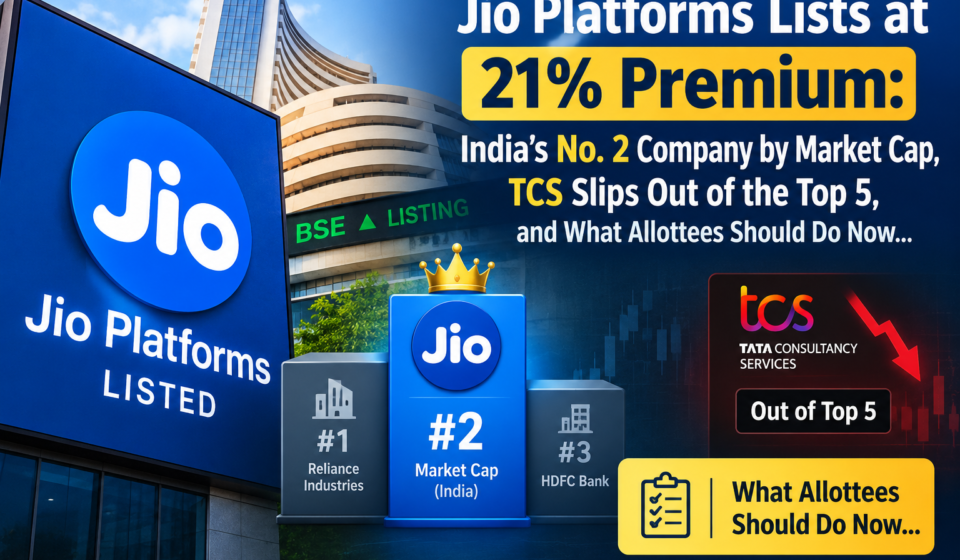
Jio Platforms Lists at 21% Premium: India’s No. 2 Company by Market Cap, TCS Slips Out of the Top 5, and What Allottees Should Do Now

Listing-day update by Shuchi, FinanceChecks.com | Published 28 October 2026 | Figures as of about 10:15 AM IST on listing day | Category: Stock Market | Reading time: about 11 minutes
Neha, a 36-year-old HR manager in Pune, woke up this morning to a notification that read like a small lottery win: her single lot of Jio Platforms shares had been credited to her demat account. She had applied for one lot of 12 shares on the first morning of the IPO, paid ₹13,428, and then waited, anxious about whether the lottery would favour her.
At 9:55 AM she watched the stock open at ₹1,358. That is ₹239 above the issue price of ₹1,119 for each share, or ₹2,868 on her lot, a gain of 21.36 percent in a week. Then the screen did something that surprised her: the price barely moved. It sat at ₹1,358, then ₹1,357, and she realised that for the first time, she had to decide what to do next.
If you are in Neha’s position, or you missed allotment and are watching the price, this guide covers what has happened, how the grey market premium performed, what the listing means for India’s market cap rankings, and a calm way to think about holding or selling. I will not tell you what to do with your shares. I will give you the facts and the questions that matter.
Quick Answer
Jio Platforms listed on 28 October 2026 at ₹1,358 on both the BSE and NSE, a premium of 21.36 percent over the IPO price of ₹1,119. At that price its market capitalisation was about ₹12.5 lakh crore, which made it India’s second-most valuable listed company after Reliance Industries (about ₹16.15 lakh crore), narrowly ahead of Bharti Airtel (about ₹12.18 lakh crore). Pre-listing estimates based on the previous day’s prices show TCS slipping from the top five to sixth place. The stock traded roughly flat after listing, even as the Sensex fell about 850 points and oil topped $115. Whether to hold or sell depends on why you applied, how much of your portfolio it represents and your time horizon.
About This Guide
This article is written by the editorial desk of FinanceChecks.com, an independent Indian personal finance publication, for investors who applied to the Jio Platforms IPO and for those following the listing. Listing details come from Business Standard, Upstox and Free Press Journal reports on 28 October 2026, with market cap rankings from Business Standard BSE data and a Hans India estimate based on 27 October closing prices. Prices move every second during trading, so all figures are snapshots from the opening hour, and I will update the closing numbers. We have no commercial relationship with Reliance, Jio Platforms or any broker. This is educational content and not investment advice.
Listing Snapshot
| Detail | Figure |
|---|---|
| IPO issue price | ₹1,119 per share |
| Listing price on NSE and BSE | ₹1,358 |
| Listing premium | 21.36 percent |
| Gain per share | ₹239 |
| Gain on one lot of 12 shares | ₹2,868, on an investment of ₹13,428 |
| Trading just after listing | About ₹1,357, down about 0.07 percent |
| Market cap at listing | About ₹12,50,586 crore (₹12.5 lakh crore) |
| IPO valuation at the upper band | About ₹10.3 lakh crore |
| Rank by market cap at listing | Second, after Reliance Industries |
| Listing ceremony | Attended by Akash Ambani and Isha Ambani, among other family members |
Did the Grey Market Premium Get It Right?
For once, it did, and quite closely. Here is how the unofficial premium moved through the IPO and what happened on listing day.
| When | GMP (₹) | Indicative listing price |
|---|---|---|
| Day 1, 21 October | About ₹245 to ₹250 | About ₹1,364 to ₹1,369 |
| Day 2, 22 October | About ₹244 to ₹249 | About ₹1,363 to ₹1,368 |
| Day 3, 23 October | About ₹235 to ₹240 | About ₹1,354 to ₹1,359 |
| Listing day, 28 October | Actual listing | ₹1,358 |
The final-day premium of ₹235 to ₹240 pointed to a listing between ₹1,354 and ₹1,359, and the stock opened at ₹1,358. One brokerage had expected a listing pop of about 10 to 15 percent, which would have meant roughly ₹1,231 to ₹1,287, so the actual listing came above that range.
A caution before you read too much into this. GMP is unofficial and unregulated, and it has missed badly on other IPOs. It was accurate here partly because the demand was so overwhelmingly institutional and so well known in advance. Do not assume it will work next time.
You May Also Like To Read About:
The Ranking Story: No. 2, Telecom Crown and TCS
The headline that has travelled furthest is about rankings, so let me separate what is confirmed from what is estimated.
Business Standard, citing BSE data, reported that at listing Jio Platforms was India’s second-most valuable listed company with a market cap of ₹12.5 trillion, behind Reliance Industries at ₹16.15 trillion. It reported Bharti Airtel as the third-most valuable at ₹12.18 trillion. That makes Jio the largest listed telecom company in India by market value, though only by a narrow margin.
The top five picture comes from a pre-listing estimate by the Hans India, based on 27 October prices and a listing near the grey market price.
| Rank (estimated) | Company | Approximate market cap |
|---|---|---|
| 1 | Reliance Industries | ₹16.2 lakh crore |
| 2 | Jio Platforms | About ₹12.5 lakh crore at ₹1,358 |
| 3 | Bharti Airtel | About ₹12.2 to ₹12.35 lakh crore |
| 4 | HDFC Bank | About ₹10.5 lakh crore |
| 5 | ICICI Bank | About ₹10 lakh crore |
| 6 | TCS | About ₹9 lakh crore |
The same report noted that this would leave India’s top five without a single company from the Tata Group or the Adani Group, and that TCS, which was among the top five, would slip to sixth. That is an estimate that depends on closing prices, so check the BSE ranking at the end of the day.
Two points are worth knowing. First, Jio’s lead over Airtel is thin. On the figures reported, Jio’s ₹12.5 lakh crore is only about 2.7 percent ahead of Airtel’s ₹12.18 lakh crore. By my calculation, if Airtel’s price stayed where it was, Jio would fall back to third place if its share price dropped below roughly ₹1,320. Both stocks move every day, so the rankings can flip. Second, Jio needed to list at around ₹1,342 or higher to overtake Airtel, and it cleared that level.
Reliance Group vs Tata Group: A Number to Handle with Care
Some reports say Reliance has overtaken the Tata Group to become India’s most valuable group after the listing, with CNBC-TV18 reporting the shift. India TV put the combined market value of all 32 listed Tata Group companies at about ₹25.7 lakh crore as of 27 October, and said the Reliance Group’s valuation could cross ₹27 lakh crore.
Here is the catch. Reliance Industries still holds a majority stake in Jio Platforms after the listing. Adding RIL’s ₹16.15 lakh crore and Jio’s ₹12.5 lakh crore double-counts the part of Jio that RIL already owns, because RIL’s market value already reflects its Jio holding. The group comparison is a fair headline, but it overstates the value that outside shareholders can actually claim.
Why This IPO Was Different: The Numbers Behind the Debut
| Item | Detail |
|---|---|
| Issue size | ₹30,213 crore, all fresh issue, described as India’s largest IPO |
| Overall subscription | 22.19 times, with bids for about 438 crore shares against 19.75 crore on offer |
| QIB category | 70.55 times |
| Non-institutional | 14.09 times |
| Retail | 2.72 times |
| Reliance shareholders | 7.60 times |
| Employees | 2.93 times |
| Anchor round | ₹8,109.85 crore from 212 anchor investors, with demand above ₹2.5 lakh crore, more than 30 times what was on offer |
| Applications | More than one crore, reported as the first IPO in the world to cross that mark |
| Pace | Fully subscribed within about 100 minutes of opening |
The business itself is large. Reported company figures show 533.3 million subscribers as of June 2026 and nearly 60 percent of India’s data traffic. For the quarter ended 30 June 2026, Jio Platforms reported a net profit of ₹7,764.1 crore on revenue of ₹40,197.9 crore. Most of the IPO proceeds, reported at up to ₹27,500 crore, are meant to repay or prepay borrowings of Reliance Jio Infocomm, with the remainder for general corporate purposes. Business Standard describes the use of proceeds more generally as partly repaying telecom subsidiary debt, so treat the exact figure as a reported number and check the prospectus.
The Market Backdrop on Listing Day
Jio listed on a rough day. Business Standard reported the Sensex plunging about 850 points and the Nifty slipping below 22,500 around the time of listing, as oil topped $115 and tensions between the US and Iran weighed on sentiment. The Fed decision is also due later today. In other words, the stock held its listing price in a falling market, which says something about the strength of institutional demand, but it also means the next few sessions may be volatile.
What Allottees Can Do Now: A Way to Decide
I cannot say whether to sell or hold. What I can offer is a framework. Decide using these questions, ideally before you look at the price again.
1. Why did I apply? If it was for a listing gain, you have one. A 21 percent gain in a week is large by any standard, and booking part of it is a reasonable choice. If you applied to own Jio for years, today’s price matters less than what the business earns over time.
2. How big is this in my portfolio? One lot is small for most people. If you took a large position, consider whether a sharp fall would hurt.
3. What would change my mind? Write down a price or event that would make you sell or add, so you are not deciding in the middle of a swing.
4. Could I split the decision? Some investors sell part to lock in the gain and keep part for the long term. That is not a strategy that wins every time. It simply reduces regret.
A few facts to keep in mind. Listed equity shares sold within a year attract short-term capital gains tax, along with brokerage and other charges, so check the current rate before you sell. Anchor investor shares are usually subject to staggered lock-ins of about 30 and 90 days from allotment, which would fall roughly around late November and late January, so confirm the exact dates in the prospectus. When locked-in shares become free to sell, extra supply can sometimes weigh on a stock. And the free float is small: only about 2.9 percent of the company was sold to the public by my calculation (27 crore new shares out of about 921 crore after the issue), which can make prices swing more than usual.
What If You Did Not Get Shares?
You can still buy in the market, but be clear about what you are buying. At ₹1,358 the valuation is about 21 percent higher than at the IPO price. One broker’s pre-IPO calculation put the issue at roughly 33 times FY26 earnings, and scaling that to the listing price gives roughly 40 times, which is my rough estimate and not an official figure. That is a rich multiple for a mature telecom business, and it rests on expected growth in revenue per user, tariff increases, digital services and debt reduction. Paying a premium after a big rise is a different decision from applying at the issue price.
If you want to own the stock for the long term, consider staggered buying instead of a single large purchase, and keep position size modest.
Risks to Keep in Mind
The main risks are a high valuation after the listing gain, dependence on tariff hikes and revenue per user growth, heavy capital spending in telecom, regulatory and competitive pressures, and a market that is under stress from oil prices, foreign selling and geopolitical tension. Also note that telecom typically makes up roughly three-quarters or more of the company’s revenue, according to one report, so the valuation rests heavily on the connectivity business and not on newer digital ventures.
Common Mistakes to Avoid
The most common mistakes after a big listing are selling in a panic in the first minutes, buying more at the top because the premium looks like proof, treating the grey market premium as a promise, putting too large a share of your savings into one stock, and falling for scams. Fraudsters love blockbuster IPOs and will offer “Jio shares at a discount”, “pre-listing allotment” or “guaranteed targets” in WhatsApp and Telegram groups. No such service is real. Buy and sell only through your registered broker and check any tip against SEBI’s registration lists.
My Take
I have watched many big IPOs, and what I notice about this one is how well the numbers lined up. The demand was institutional and well known in advance, the grey market premium was close, and the stock opened almost exactly where the final-day premium suggested. There is no mystery in this listing.
The harder question is what happens from here. The listing premium is a fact. The valuation is a judgment. At roughly 40 times earnings on my rough scaling, the stock is priced for strong growth, and growth in telecom depends on tariffs, which depend on competition and regulation.
If you applied for a listing gain, you have it, and taking some of it is not a failure. If you applied for the long term, remember that the next several years will be decided by earnings, not by the first day’s price. Either way, decide in advance, and do not let a headline about rankings make the decision for you.
Frequently Asked Questions
1. What was the Jio Platforms listing price? Jio Platforms listed at ₹1,358 on both the BSE and NSE on 28 October 2026, a premium of 21.36 percent over the IPO price of ₹1,119.
2. How much profit did IPO allottees make on listing? About ₹239 per share, or ₹2,868 on one lot of 12 shares, on an investment of ₹13,428 at the upper price band, before taxes and charges.
3. What is Jio Platforms’ market cap after listing? About ₹12.5 lakh crore at the listing price, which made it India’s second-most valuable listed company after Reliance Industries.
4. Is Jio now larger than Bharti Airtel? At listing, yes. Business Standard reported Jio’s market cap at about ₹12.5 trillion and Airtel’s at about ₹12.18 trillion. The gap is narrow, and rankings change with daily share prices.
5. Did TCS drop out of the top five most valuable companies? A pre-listing estimate based on 27 October prices placed TCS sixth, behind Reliance, Jio, Bharti Airtel, HDFC Bank and ICICI Bank. Check the BSE ranking at market close for confirmation.
6. Was the Jio IPO grey market premium accurate? It was close. The final-day premium of about ₹235 to ₹240 implied a listing near ₹1,354 to ₹1,359, and the stock listed at ₹1,358. GMP is unofficial and has been wrong on other IPOs.
7. Should I sell Jio Platforms shares after listing? That depends on why you applied, your portfolio and your time horizon. Many investors book a partial gain and keep the rest, but this is general information and not advice. A SEBI-registered investment adviser can help with personal decisions.
8. Can I still buy Jio Platforms shares in the market? Yes, through your demat account. The price now includes the listing gain, and the valuation is higher than at the IPO, so consider staggered buying and keep your position size modest.
9. When do anchor investor lock-ins end? Anchor shares typically have a staggered lock-in of about 30 and 90 days from allotment. Check the prospectus for the exact dates, since lock-in expiries can add supply to the market.
10. Is Reliance now bigger than the Tata Group? Reports say the Reliance Group’s combined listed value has passed the Tata Group’s, but that comparison double-counts Jio, because Reliance Industries still owns a majority stake in it. Treat the group totals with caution.
Disclaimer
This article is for general information and education only. It is not investment, tax or legal advice and does not recommend buying, selling or holding any security. Prices, market caps and rankings are snapshots from the first hour of trading on 28 October 2026 and change continuously. Grey market premium is unofficial and unregulated. Investments in securities are subject to market risk, and you can lose some or all of your capital. Consult a SEBI-registered investment adviser before making decisions.
Sources Consulted
Business Standard, “Jio Platforms lists at 21% premium, becomes India’s 2nd-most valuable firm” (28 October 2026). Upstox listing live updates (28 October 2026). Free Press Journal on the listing and market cap. The Hans India, “Jio set to debut as 2nd most valuable listed company” and India TV News on pre-listing market cap estimates and group comparisons. Subscription and anchor data from NSE figures as reported by Business Standard, Communications Today and HDFC Sky. Quarterly results and subscriber figures as reported by Business Today and Inc42. Use-of-proceeds details from PSU Connect and Business Standard.

Shuchi founded Finance Checks after spending 16+ years working in corporate, managing operations and distribution. She managed her own finances, learned and read regularly and helped people make sense of their savings, loans, insurance, and investments.
She started this site to offer the kind of clear, honest financial guidance she wished was more available when she was learning to manage her own money. Every article is researched personally, checked against official sources such as the Reserve Bank of India, SEBI, or the Income Tax Department, and revisited whenever regulations or figures change. She is upfront about how the site earns money through ads and select affiliate partnerships, and she does not let either influence what she actually recommends to readers.