
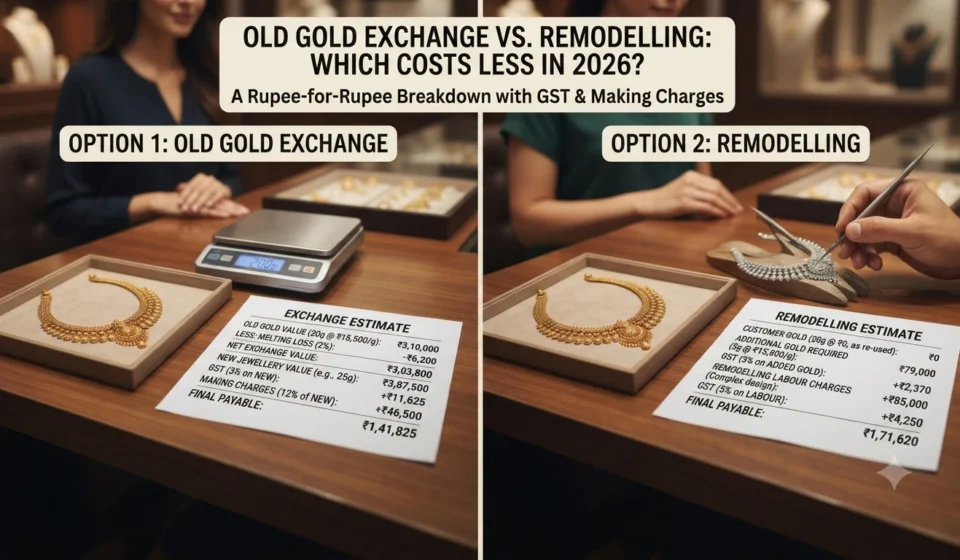
Old Gold Exchange vs Remodelling in 2026: Which Costs Less? Charges, GST and a Rupee Example

Nov 18, 2026 · @Shuchi Sharma
Quick Answer: Remodelling and exchange can cost about the same when GST is charged only on the making charges and any extra gold you add. The gap opens up if your jeweller charges GST on the full value of the new piece, or if melting loss and making charges are set high. In our worked example, the same 20 g piece costs ₹39,351 in one case and ₹46,649 in the other. Before you decide, ask each jeweller for an itemised quote that shows the GST calculation.
About This Article
Author: Shuchi Sharma
Published: 18 November 2026
How we reported this: We compared 2026 guides on GST, making charges and exchange practice, and we point out where they disagree. The rupee example uses the 22 karat gold rate reported on 16 November 2026 and assumptions that are labelled as such. Jeweller practices and local rates vary, so use the numbers to compare quotes, not as a price list.

Exchange vs remodelling: what is the difference?
With remodelling, you give your old jewellery to a jeweller to melt and remake. You still own the gold, and the jeweller does a service for you. This is treated as job work, and the job-work charges attract 5% GST rather than the 3% that applies to buying gold.
With an exchange, the jeweller takes your old piece at its gold value and credits that against a new piece. You then pay making charges and GST on the new piece, and the question is how the GST is worked out.
GST in 2026: what applies
Buying gold jewellery attracts 3% GST on the value of the gold and 5% GST on the making charges. These rates were left unchanged in the September 2025 GST rate rationalisation. For remodelling, you pay 5% on the job-work charges plus 3% on any extra gold you buy to top up the piece.
For exchange, the guides we read do not agree:
- Some say GST is not charged on the value of the old gold, only on the making charges and the extra gold added to the new piece.
- CalcGuru says GST is charged on the full value of the new piece, and that your old gold is only a way of paying, not a discount.
We could not settle this from published sources, and it changes the bill by thousands of rupees, which is why the worked example below shows both. Ask the jeweller to put the GST calculation on the estimate.
You May Also Like To Read About:
- Can Married Daughters Keep Gold Jewellery at Their Parents’ Home? What the Delhi ITAT Ruling Means for Your Family
- Gold, Silver or Stocks: Which Is the Better Bet Right Now?
- How to Invest in Gold Without Ever Holding Physical Gold: A Complete Guide
- How Much Gold Can Your Family Legally Keep at Home Without Proof?
Other charges that decide the final bill
Making charges. One 2026 guide puts them at 8% to 25% or more of the gold value, with bridal and temple pieces at the higher end. Making charges and GST are not refunded when you sell or exchange later.
Melting loss or wastage. Jewellers often deduct 2% to 5% when they melt old gold. A 2026 guide says this is partly real loss and partly margin, and suggests negotiating it down to 2% to 3%. This range comes from consumer guides, not a regulator.
Net weight. The same guide suggests asking for making charges on the net weight (new piece minus old gold), not the gross weight of the new piece.
Worked example in rupees
These numbers are illustrative. We assume a 20 g piece in 22 karat gold at ₹12,540 per gram (the rate reported on 16 November 2026), a 3% melting loss and a 12% making charge. Your jeweller’s numbers will differ.
| Step | Remodel (job work) | Exchange, GST on value addition only | Exchange, GST on full new piece |
|---|---|---|---|
| Value of new 20 g piece | ₹2,50,800 | ₹2,50,800 | ₹2,50,800 |
| Old gold after 3% melting loss | ₹2,43,276 (19.4 g) | ₹2,43,276 credit | ₹2,43,276 credit |
| Extra gold to reach 20 g | ₹7,524 | ₹7,524 | included in full value |
| Making charge at 12% | ₹30,096 | ₹30,096 | ₹30,096 |
| GST on extra gold at 3% | ₹226 | ₹226 | not applicable |
| GST on making at 5% | ₹1,505 | ₹1,505 | ₹1,505 |
| GST on full gold value at 3% | not applicable | not applicable | ₹7,524 |
| You pay | ₹39,351 | ₹39,351 | ₹46,649 |
The lesson is that the label matters less than how the bill is built. When GST applies only to the value addition, remodelling and exchange come out the same. When GST is charged on the whole new piece, the exchange costs about ₹7,300 more here. Two other levers matter just as much: each 1 percentage point of making charge changes this bill by about ₹2,633 including GST, and each 1% of melting loss costs about ₹2,508.
Which should you choose?
| Remodelling | Exchange | |
|---|---|---|
| Best when | You like the gold but want a new design | You want a ready-made piece or more gold weight |
| You pay | Job-work charge plus 5% GST, and any gold you top up | Making charges and GST on the new piece, minus melting loss |
| Watch for | Whether the jeweller takes job work, and the wastage deduction | How the GST is calculated, and any wastage deduction |
| Good for | Keeping the same gold in a new shape | Quick swaps at brands with ready designs |
Wedding-season checklist
- Get at least two written quotes. Ask for making charge, wastage percentage, GST lines and the final amount, for both exchange and remodelling.
- Ask for a purity test in writing. Old jewellery may carry no recent hallmark, and your credit depends on the karat the jeweller measures.
- Check the rate used. The gold rate changes daily and has been falling, so confirm which day’s rate is applied to your old gold.
- Negotiate wastage and making charges. Some brands run festival offers that waive wastage, so ask.
- Pay by banking channel for large amounts. Cash payments of ₹2 lakh or more are restricted under Section 269ST, so confirm the current rules with your jeweller or accountant.
- Keep the invoice. It shows the gold weight, charges and GST, which you will want if you resell later.
Common mistakes
The most common mistake is comparing only the making charge percentage. A lower percentage on a higher gross weight can cost more than a higher percentage on net weight. The second is ignoring melting loss, which comes straight out of your gold. The third is assuming an exchange reduces the GST. According to CalcGuru, it may not, so compare the full final bill.
My Take
If you love the gold you have and only want a new design, ask for a remodelling quote first, because it keeps the tax on the labour and any top-up gold. If you want a specific ready-made piece, an exchange is simpler. In both cases the winner is the jeweller who gives the most transparent bill, not the one with the nicest offer headline.
Frequently Asked Questions
1. Is it cheaper to exchange old gold or remodel it? It depends on the jeweller’s making charge, melting loss and how GST is applied. In our example the two cost the same when GST is charged only on the value addition.
2. What GST applies to gold jewellery in 2026? 3% on the gold value and 5% on making charges, unchanged by the September 2025 GST rationalisation.
3. What GST applies when I remodel old gold? Remodelling is treated as job work, so 5% GST applies to the job-work charges. Any extra gold you add is charged at 3%.
4. Is GST charged on the value of my old gold in an exchange? Sources disagree. Some say no, others say GST is charged on the full value of the new piece. Ask the jeweller to show the calculation.
5. How much melting loss is normal? Consumer guides quote 2% to 5% as typical and suggest negotiating to 2% to 3%.
6. Do I get my making charges back when I sell later? No. You recover only the gold value, and the making charges and GST you paid are not refunded.
7. Should I ask for making charges on net weight? A 2026 guide suggests it can save money. Ask the jeweller what weight the charge is applied to.
8. Is there tax when I exchange old gold? An exchange can be treated as a sale of your old gold, so capital gains rules may apply, especially for inherited or older gold. Speak to a chartered accountant.
9. Can I pay in cash? Large cash payments are restricted. Section 269ST limits cash receipts of ₹2 lakh or more, so use a banking channel and confirm current rules.
10. Is the example in this article a price quote? No. It is an illustration using the 16 November 2026 rate and assumed charges. Get written quotes from your jewellers.
Disclaimer: This article is general information and not tax, legal or investment advice. Gold rates, GST treatment and jeweller practices vary and change. Confirm details with your jeweller and a qualified advisor.
Sources
- Bajaj Finserv, GST impact on gold prices and jewellery: https://www.bajajfinserv.in/4-ways-gst-affects-gold-jewellery
- Pine Labs, GST rate on gold in 2026: https://www.pinelabs.com/blog/gst-rate-on-gold-in-2026-what-every-buyer-should-know
- CalcGuru, exchanging old gold jewellery, capital gains, GST and cash rules: https://calcguru.in/exchange-old-gold-jewellery-capital-gains-gst/
- WealthView, GST on buying and selling gold, job work treatment: https://wealthview.co.in/gst-on-gold-purchase-sale/
- IPO Market, gold making charges explained 2026: https://www.ipomarket.in/news/gold-making-charges-explained-india
- Unwind Logic, hidden charges in gold jewellery: https://www.unwindlogic.com/hidden-charges-in-gold-jewellery-complete-guide/
- Biswakarma Gold, sell vs exchange guide: https://blog.biswakarmagold.com/gold-resale-value-india-sell-vs-exchange/
- Upstox, gold rates for 16 November 2026: https://upstox.com/news/personal-finance/commodities/gold-silver-rates-today-november-16-gold-780-below-its-nov-9-peak-silver-down-9-5-from-nov-5-high/article-203513/

Shuchi founded Finance Checks after spending 16+ years working in corporate, managing operations and distribution. She managed her own finances, learned and read regularly and helped people make sense of their savings, loans, insurance, and investments.
She started this site to offer the kind of clear, honest financial guidance she wished was more available when she was learning to manage her own money. Every article is researched personally, checked against official sources such as the Reserve Bank of India, SEBI, or the Income Tax Department, and revisited whenever regulations or figures change. She is upfront about how the site earns money through ads and select affiliate partnerships, and she does not let either influence what she actually recommends to readers.



[…] Old Gold Exchange vs Remodelling in 2026: Which Costs Less? Charges, GST and a Rupee Example […]
[…] Old Gold Exchange vs Remodelling in 2026: Which Costs Less? Charges, GST and a Rupee Example […]