
How to Invest in Gold Without Ever Holding Physical Gold: A Complete Guide

Meena’s mother has kept every gold coin she’s ever bought in a locker, and every time Meena visits, she hears the same story about how safe and reliable gold has always been for the family. Meena believes it too, gold has genuinely done well over the decades, but she isn’t interested in locker rent, insurance premiums, making charges, or the low-level anxiety of owning something valuable enough to worry about at home. She wanted gold’s returns without gold’s baggage, and when she started looking into it, she realized she didn’t actually have to choose between the two anymore.
This is a genuinely common position for younger, digitally comfortable investors in India today, wanting exposure to gold as an asset class without the practical headaches that come with owning it physically. The good news is that India now has several well-established, regulated ways to do exactly this. Here’s everything you need to know, from what these options actually are, to their costs, taxes, and exactly how you’d sell when the time comes.
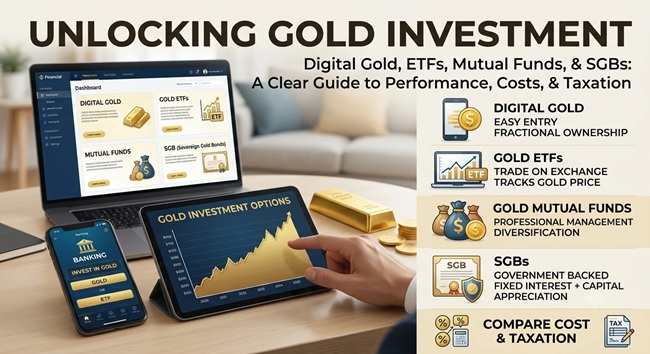
Quick answer: You can invest in gold without holding it physically through four main routes: Digital Gold, bought through apps and backed by vaulted physical gold; Gold ETFs, exchange-traded funds tracking gold prices, bought through a demat account; Gold Mutual Funds, which invest in Gold ETFs on your behalf; and Sovereign Gold Bonds (SGBs), government-issued securities denominated in gold, though new SGB issuances have been paused since February 2024. Each option differs meaningfully in cost, minimum investment, regulation, and most importantly, taxation, with Gold ETFs currently offering the shortest holding period for favorable tax treatment and SGBs offering the strongest tax benefit if held to maturity, but only for original subscribers.

Why Consider Gold Without Holding It Physically
Physical gold, jewellery, coins, or bars, comes with a set of costs and risks that don’t show up on the price tag but affect your actual returns over time. There’s making charges if it’s jewellery, which you generally never fully recover when you sell. There’s the ongoing cost of secure storage, whether that’s a bank locker with its annual rent or a home safe with its own risks. There’s the ever-present concern of theft. And there’s a practical hassle at the point of sale too, getting the purity verified, negotiating with a jeweller, and often getting a price slightly below the prevailing market rate.
Non-physical gold investment options solve most of these problems at once. You get gold price exposure, and in some cases returns that beat gold’s own price movement, without storage costs, theft risk, or making charges eating into your investment from day one.
Option 1: Digital Gold
Digital gold lets you buy 24-karat, 99.9% pure gold online through platforms like MMTC-PAMP, SafeGold, or Augmont, often integrated directly into UPI apps and payment platforms. When you buy digital gold, the platform actually purchases and vaults an equivalent amount of physical gold on your behalf, so your investment is genuinely backed by real gold sitting in a secure vault, not just a number on an app.
The standout feature here is accessibility. Digital gold can be purchased for as little as ₹1, making it the lowest entry point of any gold investment option by a wide margin, and it’s genuinely useful for someone wanting to build a gold holding gradually, a little at a time, without needing a demat account or any other formal investment infrastructure.
The catch worth understanding clearly is regulatory oversight. Digital gold currently sits in something of a regulatory gap in India. SEBI has specifically prohibited its own regulated entities, brokers and mutual fund distributors, from offering digital gold as a product, though this hasn’t banned digital gold itself, since no dedicated regulatory framework currently governs it directly. The platforms themselves are generally reputable, backed by established bullion and precious metals companies, but this is a meaningfully different regulatory position compared to Gold ETFs or SGBs, which sit under clear, established regulatory frameworks. It’s worth knowing this distinction rather than assuming all “paper gold” options carry identical oversight.
Option 2: Gold ETFs
A Gold ETF, or Exchange Traded Fund, is a fund that holds physical gold as its underlying asset and issues units that trade on stock exchanges exactly like shares of a company. Each unit typically represents a small, standardized fraction of a gram of gold, and the fund’s price moves in line with domestic gold prices, minus a small annual expense ratio, generally in the range of 0.4% to 0.8%.
To invest in a Gold ETF, you need a demat and trading account, the same setup you’d use for buying stocks. Once that’s in place, you can buy or sell Gold ETF units during regular market hours, giving you considerably more liquidity and flexibility than physical gold or SGBs offer. As of early 2026, there are over a dozen Gold ETFs available on Indian exchanges, with combined assets under management well into the tens of thousands of crores, reflecting how mainstream this option has become.
The minimum investment here is genuinely low, often achievable for a few hundred rupees depending on the specific ETF’s unit price at the time, making it accessible without requiring a large upfront commitment.
Option 3: Gold Mutual Funds (Fund of Funds)
Gold Mutual Funds, technically structured as Fund of Funds, invest your money into Gold ETFs on your behalf, rather than holding gold directly themselves. This is a useful option specifically if you don’t already have a demat account and don’t want to open one purely for gold exposure, since Gold Mutual Funds can be bought the same way you’d buy any other mutual fund, through a fund house or investment platform, with no demat account required.
The trade-off is a marginally higher overall cost, since you’re effectively paying two layers of fund management, the underlying Gold ETF’s expense ratio plus the Fund of Fund’s own additional charge, making this option slightly less cost-efficient than investing in a Gold ETF directly if you’re comfortable with the demat account requirement.
Option 4: Sovereign Gold Bonds (SGBs)
Sovereign Gold Bonds are government securities issued by the Reserve Bank of India on behalf of the Government of India, denominated in grams of gold. Beyond simply tracking gold’s price, SGBs pay an additional 2.5% annual interest on your initial investment, paid out twice a year, which is a genuine, distinctive advantage no other option on this list offers. SGBs carry an 8-year tenure, with an option to exit early starting from the fifth year onward, on specific interest payment dates through the RBI’s redemption window.
Here’s the important update worth knowing clearly: new SGB tranches have not been issued since February 2024. This means you currently cannot subscribe to a fresh SGB issuance directly from the RBI. You can still acquire SGBs through the secondary market, buying existing bonds from other investors on the stock exchange, since previously issued SGBs remain listed and tradeable, but this comes with a meaningfully different tax treatment compared to bonds bought at original issuance, covered in detail below.
Comparing the Four on Cost and Accessibility
Digital gold wins clearly on minimum investment, letting you start with just ₹1, but sits in a comparatively unclear regulatory position. Gold ETFs offer a strong balance of low cost, high liquidity through stock exchange trading, and clear SEBI regulation, though they require a demat account. Gold Mutual Funds offer similar exposure without needing a demat account, at a slightly higher ongoing cost. SGBs offered the strongest overall value proposition, combining gold price tracking with additional interest income and government backing, but are no longer available as a fresh purchase, only through the secondary market or by holding bonds issued previously.
How Each Option Is Actually Taxed
This is where the differences between these four options matter most, and it’s an area where getting the details right can genuinely change your after-tax returns by a meaningful margin.
Gold ETFs are classified as listed securities, and this classification works in your favour. If you sell within 12 months of purchase, your gain is taxed as short-term capital gain at your regular income tax slab rate. If you hold beyond 12 months, it qualifies as long-term capital gain, taxed at a flat 12.5%, without the benefit of indexation. This 12-month threshold makes Gold ETFs the most tax-efficient option among the four for investors who don’t intend to lock in for the very long term, since physical gold, digital gold, and Gold Mutual Funds all require a longer holding period to reach the same favourable long-term rate.
Gold Mutual Funds are treated as unlisted for this purpose, and require a 24-month holding period to qualify for long-term capital gains treatment. Once past that threshold, the same 12.5% flat rate applies, without indexation. Sell before 24 months, and your gain is taxed at your regular slab rate instead.
Digital gold follows rules similar to physical gold, since despite being purchased digitally, it’s still legally treated as an unlisted, non-security asset. It also requires a 24-month holding period for long-term treatment, taxed at 12.5% beyond that point, with sales before 24 months taxed at your slab rate.
SGBs have genuinely favourable tax treatment, but with an important condition attached. If you’re the original subscriber, meaning you bought the bond directly from the RBI at the time it was issued, and you hold it all the way to maturity, the capital gain on that maturity amount is completely tax-free. This is the single strongest tax benefit among all four options. However, if you bought the SGB from the secondary market rather than at original issuance, or if you exit before maturity even as an original subscriber, the capital gain is taxed at 12.5%. Separately, the periodic 2.5% annual interest SGBs pay out is always taxable at your income tax slab rate, regardless of whether you’re an original subscriber or a secondary market buyer, and regardless of how long you’ve held the bond.
Does Investing in Gold This Way Actually Save You Tax?
It’s worth being direct about this: none of these four options offer a Section 80C deduction or any similar upfront tax-saving benefit at the time of investment. What they offer instead is favourable capital gains treatment once you sell, particularly Gold ETFs with their shorter 12-month path to the lower long-term rate, and SGBs with their genuinely tax-free maturity benefit for original subscribers who hold to term. If your specific goal is reducing this year’s taxable income through an investment, gold in any of these forms isn’t built for that purpose the way instruments like PPF or ELSS mutual funds are. Gold here should be evaluated primarily as a portfolio diversification and inflation-hedging tool, with tax efficiency as a secondary consideration for when you eventually sell.
Also Read About:
How to Actually Sell Each Option
Selling digital gold typically means selling it back to the same platform you bought it from, at their prevailing buyback rate, which is usually close to but occasionally slightly below the live market price. The process is generally instant, with proceeds credited directly to your linked bank account.
Selling a Gold ETF works exactly like selling a stock, place a sell order through your broker’s app or platform during market hours, and the transaction settles the same way any other exchange trade would, with proceeds credited to your linked bank account within the standard settlement cycle.
Selling a Gold Mutual Fund unit works like redeeming any other mutual fund, submit a redemption request through your fund platform, and the amount based on that day’s NAV gets credited to your account within the fund’s standard redemption timeline.
Selling an SGB depends on timing and how you acquired it. If you’re within the RBI’s premature redemption window, available from the fifth year onward on specific interest payment dates, you can redeem directly through the RBI process, usually facilitated by your bank or the platform you hold the bond through. Alternatively, since SGBs are listed on stock exchanges, you can sell them on the secondary market at any time if you hold them in demat form, though the price you get may trade at a premium or discount to the actual gold price depending on market demand for that specific bond.
Benefits Worth Highlighting
Beyond avoiding storage and theft risk, all four options offer genuine fractional investment, letting you build a gold position gradually rather than needing a large lump sum upfront, which is a meaningful advantage over physical gold, where a full coin or a piece of jewellery often demands a much larger single purchase. Purity is also guaranteed and standardized across Digital Gold, Gold ETFs, and Gold Mutual Funds, removing a genuine point of concern that exists with physical gold purchases from less established sellers. SGBs additionally offer sovereign backing and a real yield on top of gold’s price movement, something no physical or digital gold purchase can match.
Drawbacks Worth Weighing Honestly
Digital gold’s regulatory ambiguity is worth taking seriously, particularly for larger investments, given that established, SEBI-regulated alternatives like Gold ETFs exist and cover much of the same use case with clearer oversight. Gold ETFs and Gold Mutual Funds both carry an ongoing expense ratio that quietly reduces your returns year after year, unlike a one-time cost. SGBs, despite their strong tax and interest advantages, are no longer available as fresh issuances, and secondary market purchases lose the full tax-free maturity benefit that made them so attractive in the first place. None of these four options, unlike physical gold, gives you something you can physically hold, wear, or gift in a form your family might culturally expect, which for some households remains a genuinely relevant consideration beyond pure investment logic.
What’s the Actual Minimum Investment Across These Options
Digital gold has the lowest entry point by a wide margin, starting at roughly ₹1 on most platforms, making it accessible to literally any budget. Gold ETFs typically require a few hundred rupees for a single unit, depending on the specific fund and prevailing gold prices, putting it within easy reach for most investors once a demat account is in place. Gold Mutual Funds generally allow small systematic investments, similar to a regular SIP, often starting around ₹500 a month if you choose to invest gradually rather than as a lump sum. SGBs, where available through the secondary market, require a minimum of 1 gram, which at current gold prices translates to a considerably larger upfront amount compared to the other three options, making it the least accessible for someone wanting to start with a very small sum.
Which Option Actually Suits You
If you want the lowest possible entry point and don’t mind the comparatively less regulated environment, digital gold works well for small, gradual accumulation, particularly if you’re just getting started and want to build the habit before committing larger amounts elsewhere. If you already have, or are comfortable opening, a demat account and want the most tax-efficient, highly liquid option with clear regulatory oversight, Gold ETFs are generally the strongest all-round choice for most investors today. If you’d rather avoid a demat account altogether and are comfortable with a slightly higher ongoing cost, Gold Mutual Funds achieve much the same outcome. And if you’re specifically drawn to the extra interest income and the strongest tax treatment available, and you’re comfortable either waiting for a future fresh SGB issuance or accepting the reduced tax benefit of buying on the secondary market today, SGBs remain worth considering as part of a longer-term allocation.
Common Mistakes People Make With Paper Gold
The most frequent mistake is treating all four options as functionally identical simply because they’re all broadly labelled “digital” or “paper” gold, without checking the meaningfully different holding periods each requires to reach favourable long-term tax treatment.
Another common mistake is buying SGBs from the secondary market while assuming the same tax-free maturity benefit applies as it would for an original RBI subscriber, not realizing this benefit is specifically restricted to those who bought at original issuance and held to maturity.
A third mistake is treating digital gold purchased through a lesser-known or newly launched app the same way as an established, well-backed platform, without doing basic diligence on the platform’s vaulting partner and buyback terms, given the comparatively lighter regulatory environment this category currently operates within.
My Take
For most people starting out, I’d lean toward Gold ETFs as the default choice, the combination of low cost, genuine liquidity, a shorter path to favourable tax treatment, and clear SEBI oversight covers most of what people actually want from gold exposure without the complications physical gold brings. Digital gold has its place for very small, habitual investing, particularly for someone not yet ready to open a demat account, but I’d treat it as a starting point rather than a long-term core holding given the regulatory gap it currently sits in. SGBs, frustratingly, are genuinely the best option on paper right now for long-term holders specifically because of the tax-free maturity benefit, but with no fresh issuances since February 2024, that door has been closed for new investors for a while now, worth watching in case issuances resume.
Frequently Asked Questions
What is the easiest way to invest in gold without buying physical gold? Digital gold is generally the easiest starting point, since it can be bought for as little as ₹1 through apps without needing a demat account, though Gold ETFs offer better regulatory oversight and tax efficiency for those comfortable opening one.
What is the minimum investment required for Gold ETFs? Gold ETFs typically require just a few hundred rupees for one unit, depending on the specific fund and prevailing gold prices, making them accessible to most investors once a demat and trading account is set up.
Are Sovereign Gold Bonds still available for purchase? New SGB tranches have not been issued since February 2024. You can still acquire SGBs through the secondary market on stock exchanges, but this comes with different tax treatment compared to bonds bought at original issuance.
How are Gold ETFs taxed in India? Gold ETFs held for less than 12 months are taxed at your income tax slab rate as short-term capital gains. Beyond 12 months, gains qualify as long-term capital gains, taxed at a flat 12.5% without indexation.
Is the maturity amount from Sovereign Gold Bonds tax-free? Only for original subscribers who bought directly from the RBI at issuance and hold the bond until its full maturity. Secondary market buyers, and even original subscribers who exit before maturity, are taxed at 12.5% on the capital gain instead.
Is digital gold regulated by SEBI or RBI in India? No dedicated regulatory framework currently governs digital gold directly. SEBI has specifically barred its own regulated entities, brokers and mutual fund distributors, from offering digital gold, though the product itself isn’t banned and is offered by independent bullion and fintech platforms.
How do I sell a Gold ETF? You sell a Gold ETF the same way you’d sell a stock, by placing a sell order through your broker’s trading platform during market hours, with proceeds credited to your linked bank account after settlement.
Does investing in gold ETFs or digital gold help save income tax? No. None of these options offer a Section 80C deduction or any upfront tax-saving benefit at the time of investment. Their tax advantage comes from favourable capital gains treatment when you eventually sell, not from reducing your taxable income in the year you invest.
What is the difference between Gold ETFs and Gold Mutual Funds? Gold ETFs are traded directly on stock exchanges and require a demat account, while Gold Mutual Funds invest in Gold ETFs on your behalf and can be bought without a demat account, though typically at a marginally higher overall cost due to an additional layer of fund management.
How is the annual interest from Sovereign Gold Bonds taxed? The 2.5% annual interest paid on SGBs is always taxable at your regular income tax slab rate, regardless of whether you’re an original subscriber or bought the bond on the secondary market, and regardless of your holding period.
Disclaimer: This article is for general informational and educational purposes only and does not constitute investment or tax advice. Gold prices, taxation rules, and product availability are subject to change, and digital gold currently operates without a dedicated regulatory framework in India. Please consult a qualified financial advisor before making gold investment decisions.

Shuchi founded Finance Checks after spending 16+ years working in corporate, managing operations and distribution. She managed her own finances, learned and read regularly and helped people make sense of their savings, loans, insurance, and investments.
She started this site to offer the kind of clear, honest financial guidance she wished was more available when she was learning to manage her own money. Every article is researched personally, checked against official sources such as the Reserve Bank of India, SEBI, or the Income Tax Department, and revisited whenever regulations or figures change. She is upfront about how the site earns money through ads and select affiliate partnerships, and she does not let either influence what she actually recommends to readers.