
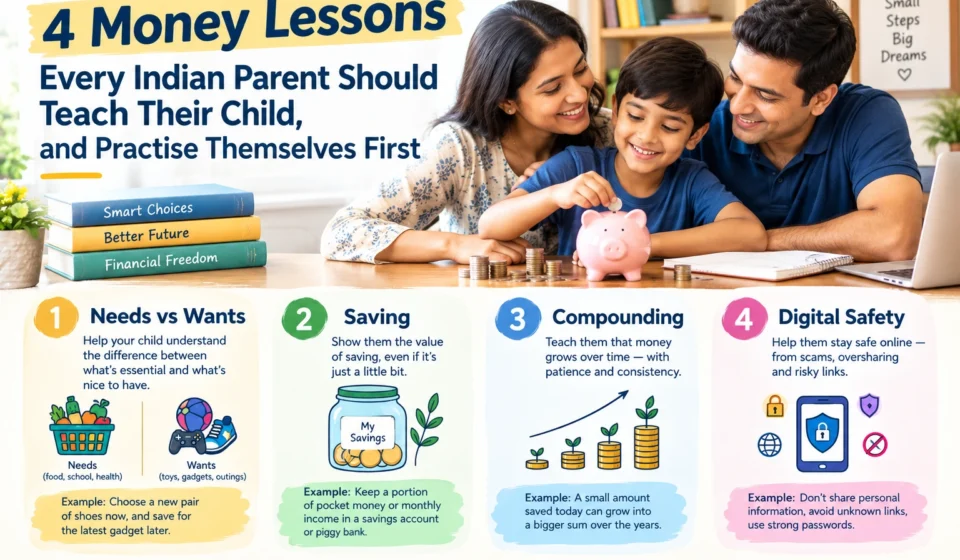
4 Money Lessons Every Indian Parent Should Teach Their Child, and Practise Themselves First

By the FinanceChecks.com Editorial Team | Published October 14, 2026 | Last reviewed October 14, 2026 | 12-minute read
Your child is already learning about money. Not from a lesson or a worksheet, but from watching you at the billing counter, from seeing you tap “buy now” during a festive sale, from overhearing the EMI conversation at dinner, and from noticing which questions get a calm answer and which ones get a sigh. The uncomfortable truth about teaching children money habits is that the lesson that sticks is rarely the one you say out loud. It is the one they see you live.
That is why this guide pairs each lesson with a second column: what you need to do yourself. Four ideas cover most of what a child needs before adulthood, and each one works better when the adults at home follow it too. We also cover what Indian rules allow for children’s bank accounts, simple rupee examples you can use at home, and the mistakes that quietly undo good intentions.

Quick Answer
The four most useful money lessons to teach a child are: first, the difference between needs and wants and the value of waiting; second, a save-spend-give habit that starts with paying yourself first; third, that money grows with time through compounding and shrinks with inflation, which is the reason to start early; and fourth, that digital money needs guard rails, including protecting your PIN and OTP, spotting scams, and understanding that borrowing has a price. Children learn far more from what parents do than from what they say, so each lesson works best when you follow it yourself: pause before impulse purchases, automate your own savings, invest early and regularly, and stay careful with digital payments and EMIs. In India, a child of any age can have a savings account through a guardian, and from age 10 a child can open and operate one independently within limits set by the bank, under RBI rules effective July 1, 2025.
About This Guide
This guide was compiled by the FinanceChecks.com editorial team using the Reserve Bank of India’s circular on deposit accounts for minors (April 21, 2025, effective July 1, 2025) as reported by Business Standard, banks’ and financial education publishers’ guides to teaching children about money, and our own rupee illustrations. Suggested pocket money amounts and splits are rules of thumb used in parenting guides, not official guidance, and every family’s budget and values are different. Where tax is mentioned, it is general information, and a chartered accountant can advise on your own case.
The Rule That Makes All Four Work
Children copy behaviour faster than they absorb advice. A parent who tells a child to wait for what they want, then buys a gadget on impulse the same evening, has taught the second lesson, not the first. This does not mean you must be perfect. It means being honest about trade-offs (“We are choosing the cheaper option because we are saving for your fees”) and visibly applying your own rules, which is more convincing than any lecture.
Lesson 1: Needs, Wants and the Value of Waiting
What to teach. A need is something required for life and school, such as food, books, a school bag and basic clothes. A want is something nice to have, such as the branded sneakers, the latest game or an extra toy. Parents generally cover needs, and wants are what a child saves for. The second half of the lesson is the one that matters most: waiting, comparing and choosing are skills, and they are built by making real choices with limited money.
How to teach it. Let your child plan a small purchase. If they want a ₹2,400 gadget and save ₹60 a week, it takes 40 weeks, and that number makes the cost of a want visible in time, not just rupees. Take them shopping and let them compare prices of similar items. If they pick the pricier branded version, they pay the difference from their own pocket money. Introduce opportunity cost in plain words: if you spend ₹200 on snacks, you cannot also spend that ₹200 on a book.
Your turn. Adopt a 24-hour rule for purchases above a set amount and let your child see you use it. During sale season, say out loud, “This is on sale, but do we need it?” Discuss a purchase you decided not to make. The festive sale pressure we covered in our guides to sale scams and how to compare platforms is the perfect live example.
Lesson 2: Save, Spend, Give: Pay Yourself First
What to teach. When money comes in, whether pocket money, a gift or Diwali cash from relatives, it is divided before it is spent. A simple three-part split works for most children: part to spend, part to save, and part to give to someone else, such as a charity or a gift for a family member. The order matters. Saving is set aside first, not from what is left over.
How to teach it. Start with a gullak, a physical piggy bank, so the pile can be seen growing. A starting point, which is only an example, is ₹200 a week split into ₹100 to spend, ₹60 to save and ₹40 to give. Pay in smaller notes so the child sees the stack grow and shrink. Link the saving to a goal, because a vague aim to “save” is far weaker than saving for a specific item. As they grow, move the saved money into a bank account.
Under RBI rules, a minor of any age can have a savings or term deposit account through a natural or legal guardian, and a child aged 10 or older can open and operate one independently, within the amounts and terms the bank sets, with the account not allowed to be overdrawn. These rules were consolidated in RBI’s directions and took effect on July 1, 2025, and each bank decides its own limits, so ask your bank what it offers. When the child turns 18, the bank must collect fresh operating instructions and a specimen signature.
Your turn. Do the same thing yourself: automate a transfer to savings or a SIP on salary day so saving happens before spending. Keep an emergency fund and let your child know it exists, without the numbers if you prefer. Tell them what you are saving for, and let them see the goal move closer.
| Age | A suitable first step | The skill it builds |
|---|---|---|
| 5 to 7 | A gullak and simple coin counting | That money has value and can be saved |
| 8 to 10 | A small weekly allowance and a spend-save-give split | Planning and delayed gratification |
| 11 to 13 | A bank account with the guardian and a savings goal | Banking basics and tracking |
| 14 to 17 | A teen account with limits, a simple budget and a first investment with you | Responsibility and long-term thinking |
Lesson 3: Money Grows With Time, and Shrinks With Inflation
What to teach. Two forces work on money over the years. Compounding makes savings grow, because you earn returns on your earlier returns. Inflation makes the same rupee buy less over time. Understanding both is the strongest case for starting early and for not keeping everything in cash.
How to teach it. Use the Rule of 72: divide 72 by the annual return to estimate how many years it takes money to double. At an assumed 8% a year, money doubles roughly every nine years, so ₹2,000 at age 10 becomes about ₹4,000 at 19, ₹8,000 at 28 and ₹16,000 at 37. These are illustrations, not promises. Then show the other side: at 6% inflation, a ₹20 snack costs about ₹30 in seven years, which is why a drawer full of cash loses value.
For parents who want to put money away for a child, India offers several routes, and the right one depends on your goal and risk appetite. The Sukanya Samriddhi Yojana is a government small savings scheme for a girl child, with a rate set quarterly, and the current quarter’s rate is 8.2%, so check the latest figure. NPS Vatsalya is a pension account for minors operated by a guardian that is meant to convert to a regular NPS account at 18. Mutual fund investments can be made in a minor’s name through a guardian, and a PPF account can also be opened for a minor. Read the rules of each before choosing, and keep in mind that long-term equity investments carry market risk.
A note on tax: money you gift to your child is generally tax-free in their hands, but income earned on money gifted by a parent to a minor child is generally added to the parent’s income for tax purposes, with a small exemption per child. A chartered accountant can tell you how this applies to you.
Your turn. Start your own SIP if you have not, and raise it when your income rises, as we discussed in our guide to SIP step-ups. Show your child a simple statement of your own long-term investment and explain that you are not touching it. And avoid the habit of parking all savings in a low-interest account for years, since inflation will quietly eat it.
Lesson 4: Digital Money Needs Guard Rails, and Borrowing Has a Price
What to teach, part one: protect the money. Children now meet money through phones, games and apps before they meet cash. The basics to teach are: your PIN and OTP are secret and are never shared with anyone, including friends, “support staff” and people in games; real offers do not arrive in forwarded links; and no one needs your PIN to give you money. Scams aimed at young people often come as free game currency, prize draws or fake sale links, and the red flags are the same as in the festive scams we covered: urgency, a link, and a request for an OTP or payment.
Set up parental controls on devices and accounts, and talk about in-app purchases and what they cost. If your child has a bank account, set small limits and check the statements together once a month, which turns a boring statement into a lesson.
What to teach, part two: borrowing costs money. A child should understand, in simple terms, that when you borrow you pay back more than you took. The idea can be introduced in a family-sized way: if a sibling borrows ₹100 and returns ₹110, that extra ₹10 is the cost. Older teens should hear what “no-cost EMI” and “buy now, pay later” really are, which is a loan, and that missed payments hurt a credit score. A credit card is a loan with a limit, not extra income.
Your turn. Model the habits yourself. Never share an OTP, even with a “bank officer” who sounds convincing, and verify links before you click. Let your child see you read the fine print on an EMI, pay a credit card balance in full and avoid borrowing for wants. If you make a mistake, such as paying a late fee, say so and explain what you will do differently.
The Parent Mirror Checklist
| Lesson | What your child sees | What to model |
|---|---|---|
| Needs vs wants | You buy on impulse during sales | Use a 24-hour rule and say your reasoning aloud |
| Save, spend, give | You spend first and save what is left | Automate savings on payday and give regularly |
| Money grows with time | Money sits idle in a savings account | Invest regularly and increase it as income rises |
| Digital money and borrowing | You share OTPs or take EMIs casually | Guard your PIN and OTP, verify links and borrow carefully |
Common Mistakes Parents Make
The most common mistake is hiding money from children entirely, which leaves them to learn from friends and social media. A related one is the opposite: sharing every worry about money, which can make children anxious and avoidant. Parents also tie pocket money to behaviour and take it away as a punishment, which confuses money management with obedience and weakens the habit you are building. Others rescue every bad choice, so the child never feels the consequence of spending a month’s money in a day. Some give cash without any rules, and some compare their child with friends who get more. And many invest in a child’s name without understanding the tax rules or the lock-ins, or let teenagers use their own cards and UPI without any supervision.
My Take
What I would underline is how modest the goal is. You are not raising a financial expert. You are helping a child build four habits: pause before spending, save before spending, let money grow over time, and protect money in a digital world. None of these needs a large income, and all of them are learned fastest at home, by watching.
The most useful thing a parent can do this week is to pick one of the four and change one visible habit of their own. Set up the automatic transfer, try the 24-hour rule on your next big purchase, or sit down with your child and look at a real bank statement together. Children remember what they saw.
Frequently Asked Questions
1. At what age should I start teaching my child about money? Around age five, once they understand counting and that things cost different amounts. A gullak and simple wants-versus-needs conversations are enough at first.
2. How much pocket money should I give? There is no official figure. Parenting guides suggest small weekly amounts that grow with age, tied to clear rules about what the money covers. Choose an amount that fits your budget and expectations.
3. Can my child have a bank account? Yes. Under RBI rules, a minor of any age can have a savings or term deposit account through a guardian, and a child aged 10 or above can open and operate one independently within the limits the bank sets.
4. Should I take away pocket money as a punishment? It is generally better not to, since it mixes money skills with behaviour. Use separate consequences for behaviour and keep pocket money as a learning tool.
5. How do I explain investing to a child? Start with the Rule of 72 and a simple example of money doubling over time, and explain that markets go up and down. For teens, invest a small amount together and review it regularly.
6. What savings and investment options exist for children in India? Common options include a bank savings account, Sukanya Samriddhi Yojana for a girl child, NPS Vatsalya for minors, PPF in a minor’s name and mutual funds through a guardian. Each has its own rules, returns and risks.
7. Is a gift of money to my child taxable? Gifts from parents are generally tax-free in the child’s hands, but income earned on that money by a minor is generally added to the parent’s income for tax, with a small exemption per child.
8. How do I protect my child from online money scams? Teach them never to share a PIN or OTP, to avoid links in free-offer messages, and to ask you before buying or clicking. Use parental controls and review the account together.
9. How do I teach a child about debt? Explain that borrowing means paying back more than you took, and show examples such as an EMI. With teenagers, discuss no-cost EMI, buy now pay later and credit scores.
10. What if my child makes a bad money decision? Let them feel a small consequence, such as running out of pocket money before the month ends, and then talk about what to change. Small mistakes at a young age are the cheapest way to learn.
How We Verified This Information
This guide was researched using the RBI circular on deposit accounts of minors dated April 21, 2025, as reported by Business Standard and summarised by banks, along with parenting and financial education guides from banks and publishers on needs versus wants, pocket money and saving habits. The rupee examples are our own illustrations using simple assumptions. Scheme rates and rules for Sukanya Samriddhi, NPS Vatsalya and minors’ investments can change, so please confirm the current terms before investing.
Disclaimer
This article is for general informational purposes only and does not constitute financial, investment, tax or parenting advice. Pocket money amounts, splits and returns used in examples are illustrations, not recommendations. Investments are subject to market risks, and tax and scheme rules can change. Readers should check current terms with their bank or scheme provider and consult a qualified financial adviser or chartered accountant for their own situation. FinanceChecks.com is not a SEBI registered investment adviser.
Last reviewed and fact-checked on October 14, 2026 by the FinanceChecks.com Editorial Team.

Shuchi founded Finance Checks after spending 16+ years working in corporate, managing operations and distribution. She managed her own finances, learned and read regularly and helped people make sense of their savings, loans, insurance, and investments.
She started this site to offer the kind of clear, honest financial guidance she wished was more available when she was learning to manage her own money. Every article is researched personally, checked against official sources such as the Reserve Bank of India, SEBI, or the Income Tax Department, and revisited whenever regulations or figures change. She is upfront about how the site earns money through ads and select affiliate partnerships, and she does not let either influence what she actually recommends to readers.