

Top 10 Reasons IPO Allotment Does Not Happen (and What Improves Your Chances)

By Shuchi, FinanceChecks.com | Published 21 October 2026 | Category: Stock Market | Reading time: about 11 minutes
Meera, a software tester in Indore, applied for five IPOs in a single year. She put in the money on time, picked the cut-off price, and checked her status every morning. Five times the message was the same: not allotted. By the fifth one she was convinced that her broker was cheating her, or that her PAN was cursed.
Neither was true. Two of her five applications were simply unlucky draws in heavily subscribed issues. The other three had quiet, fixable problems that she never noticed: a UPI mandate she approved after the window had closed, a second application filed from her husband’s account on her own PAN, and a bid placed below the final issue price. Nobody told her, because the system does not send a friendly note saying “this is why”.
If you have ever stared at the words “non-allotted” and wondered what went wrong, this guide is for you. I will explain the ten real reasons IPO allotment does not happen, which ones are bad luck and which ones are your own doing, and what you can legitimately do to improve your chances.
Quick Answer
Most IPO applications fail for one of two reasons. Either the issue was oversubscribed and the computerised retail lottery did not pick your application, or your application was rejected because of a technical error such as an unapproved UPI mandate, a PAN or demat mismatch, a duplicate application on the same PAN, or a bid below the final issue price. You cannot change the lottery, but you can avoid every rejection reason by applying once per PAN, bidding at the cut-off price, approving your UPI mandate early, and keeping your details identical across PAN, bank and demat.
About This Guide
This article is written by the editorial desk of FinanceChecks.com, an independent Indian personal finance publication, for retail investors who apply to mainboard IPOs through a demat account. The rules described here come from SEBI’s IPO regulations and the practical process followed by stock exchanges and registrars such as KFintech and MUFG Intime. Rules were checked against current public sources in October 2026. IPO processes change from time to time, so always read the Red Herring Prospectus and the basis of allotment published for the specific issue before you apply. This is educational content and not investment advice.
First, Understand How Allotment Actually Works
Before the ten reasons, you need the basic picture, because every reason sits on top of it.
When a company opens a mainboard IPO, it divides the shares among investor categories. The retail category is for individual investors bidding up to ₹2 lakh in total. In most mainboard book-built issues, not less than 35 percent of the shares are kept aside for retail investors. The rest goes to non-institutional investors (often called HNIs, bidding above ₹2 lakh) and qualified institutional buyers such as mutual funds and insurers.
| Category | Who it is for | Typical share of the issue | How allotment works when oversubscribed |
|---|---|---|---|
| Retail Individual Investor (RII) | Individuals bidding up to ₹2 lakh | Not less than 35 percent in most issues | Computerised lottery, minimum one lot per winner |
| Small NII (sNII) | Bids from ₹2 lakh to ₹10 lakh | Part of the non-institutional quota | Basis of allotment published in the offer document |
| Big NII (bNII) | Bids above ₹10 lakh | Larger part of the non-institutional quota | Basis of allotment published in the offer document |
| Qualified Institutional Buyer (QIB) | Mutual funds, insurers, banks, FPIs | Up to 50 percent in most issues | Proportionate, after the anchor portion |
The important point for you as a retail investor is this. If the number of valid retail applications is lower than the number of lots on offer, everyone gets at least one lot and the leftover is shared proportionately. If the number of valid applications is higher than the number of lots, SEBI requires a computerised lottery, and every valid application gets exactly one entry. Winners receive one lot, never a fraction of a lot.
After bidding closes, the registrar finalises the basis of allotment, unblocks your money or credits shares, and the shares list within three working days of the issue closing. Your bank balance is only blocked, not debited, until shares are actually allotted.
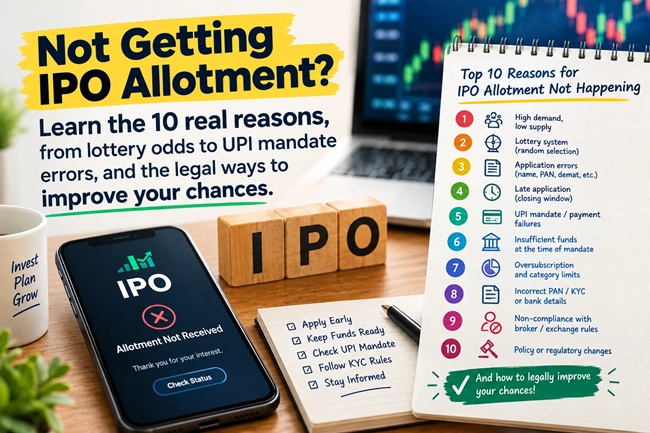
The Top 10 Reasons IPO Allotment Does Not Happen
1. The retail category was oversubscribed and you lost the lottery
This is the number one reason, and it is nobody’s fault. When a popular IPO is subscribed 30 or 50 times in the retail category, only about one in thirty or one in fifty valid applications can win a lot.
Here is a worked example you can do on paper. Suppose an issue reserves 50 lakh shares for retail and the lot size is 100 shares. That gives 50,000 lots. If 12 lakh valid retail applications come in, your chance of winning a lot is 50,000 divided by 12,00,000, which is about 4.2 percent. That is roughly one chance in 24.
This is why a string of “non-allotted” messages does not mean you did anything wrong. It usually means you applied to hot issues, and hot issues are exactly where the lottery is toughest. Think of the retail lottery like a raffle where every valid ticket has the same odds, no matter how much money you put behind it.
2. Your UPI mandate was not approved before bidding closed
When you apply through UPI, your broker sends a blocking request to your UPI app. You must open the app and approve it within the time limit. If you ignore it, approve it late, or the request expires, the bid is treated as incomplete and never reaches the lottery.
This is the most common avoidable mistake I see among first-time applicants, because it feels like you have already applied. You clicked submit in the broker app, so you assume you are done. You are not done until the mandate is approved. Always check that the bid status in your broker app shows the amount as blocked.
3. Insufficient funds or funds not blocked in time
ASBA means the application amount stays in your own bank account but is held back. If your balance is short on the day of blocking, or you spend the money elsewhere before the block is confirmed, the application is rejected. A common trap is applying for the maximum amount, then paying a credit card bill or an EMI from the same account while the block is still pending.
Keep a small cushion above the application amount in the account you use, and do not touch it until allotment is done.
4. Duplicate application on the same PAN
SEBI and the exchanges allow only one application per PAN in the retail category. The check is done on the PAN of the first or sole bidder. If you apply from two different broker accounts, or from a joint account where you are the first holder, using the same PAN, the duplicates are flagged and rejected. In some cases all of them are rejected, not just the extra ones.
Some investors think applying twice doubles their chance. It does not. It risks cancelling the application you had. Apply once per PAN, from one demat account.
5. PAN, name or demat details do not match
The exchange validates your PAN with the Income Tax database and matches it against the name and details in your demat account. If your PAN is inoperative because it is not linked with Aadhaar, if the name on your PAN differs from the demat account, or if the DP ID and client ID are typed wrongly, the application is rejected.
A mismatch can be as small as an initial or a spelling after marriage or a name change. If you have changed your name or your PAN status is uncertain, fix it with your broker and the Income Tax portal before you apply, not after.
6. Your bid was below the final issue price
IPOs are priced within a band, for example ₹300 to ₹315. The final issue price is fixed after bidding closes, often at the top of the band in strong demand. If you bid at ₹300 and the final price is ₹315, your bid is below the issue price and cannot be allotted.
Retail investors can choose the cut-off price option, which means you agree to pay whatever the final issue price turns out to be within the band. In a lottery, a bid at cut-off or at the upper end of the band stays valid whatever price is finalised. Choose it unless you have a very specific reason not to.
7. You applied in the wrong category or crossed the ₹2 lakh limit
Retail means the total bid value is up to ₹2 lakh. If you bid for more lots and cross ₹2 lakh, your application is treated as a non-institutional bid, where the competition and the rules are different. Many people do this by mistake on the last day, adding an extra lot “just in case”, and then wonder why their allotment pattern changed.
Also be careful with special quotas. If you tick the employee or shareholder category without being eligible, your application is liable to be rejected.
8. Your demat account is inactive, frozen or incorrectly entered
Shares are credited to the demat account you named in the bid. If that account is closed, frozen, suspended, or the client ID is wrong, the allotment cannot be completed. This happens more often than you might expect, especially with old accounts that were opened years ago and never used.
Before a big IPO, log in to your demat account and confirm that it is active and that the details are correct.
9. Technical failures in the last-hour rush
On the final day, a large number of investors apply in the last few hours. Bank servers slow down, UPI requests time out, and broker apps lag. A bid that looks submitted may never reach the exchange, or may fail at the mandate stage.
Time of application does not give you a better place in the lottery. Applying at 10 AM and applying at 4 PM carry identical odds. The only reason to apply earlier is that you leave yourself room to fix a problem if something goes wrong.
10. KYC and account-type issues
Minor, HUF, joint holder, and corporate applications follow special rules. A joint demat account is checked against the first holder’s PAN. An HUF must apply with the HUF’s own PAN and a matching bank account. A KYC that is not fully validated, or a bank account that is not allowed for ASBA on the platform you use, can also lead to rejection.
If your situation is not a plain single-holder individual account, check the process with your broker in advance.
Quick Diagnosis: What Your Status Probably Means
Registrars word their messages differently, so treat this table as a guide and not a rulebook.
| What you see | What it usually means | What to do |
|---|---|---|
| Non-allotted, application found | You were a valid bidder, but the lottery did not select you | Nothing wrong. Wait for unblocking, apply to the next issue |
| Application not found | Your bid may not have reached the exchange, or the PAN or demat details did not match | Check your broker’s bid status and your PAN and demat details |
| Application rejected | A technical or eligibility error, such as duplicate PAN, mismatch, or low bid | Ask your broker for the exact rejection code |
| Funds still blocked after a few days | Unblocking is processed after finalisation of allotment | Raise a request with your bank or broker if it takes longer than the stated timeline |
What Genuinely Improves Your Chances
Let me be straightforward. In a retail lottery, nothing you do can make your single application stronger. A larger bid, a favourite broker, or an early time of bidding does not move you ahead. What you can do is make sure your application stays in the pool, and increase the number of legitimate entries in the family.
- Apply once per PAN and bid at the cut-off price so you are not rejected on a technicality.
- Approve your UPI mandate immediately and confirm that the amount is blocked.
- Apply from your family’s own PANs. If your spouse, adult children or parents have their own demat accounts, PANs and bank accounts, each can apply separately and each gets a separate entry. This is legal, as long as each person applies with their own PAN and their own money, and the decision to apply is genuinely theirs. Never use someone else’s account without their knowledge.
- Bid for just one lot in the retail lottery. A bid for several lots does not improve your odds when the issue is heavily oversubscribed, and you are tying up more money.
- Look at subscription numbers across the three bidding days. Issues with moderate demand give you better odds than the headline issue everyone is chasing.
- Do not chase grey market premium. Grey market premium tells you what traders expect on listing day, not how likely you are to be allotted.
When retail is only mildly oversubscribed, say around 1.5 times, bidding for more lots can matter, because proportionate allotment may give you more than one lot. When it is subscribed many times over, one lot is all the lottery can give you.
Myths That Cost People Money and Sleep
Some beliefs about IPO allotment refuse to die. The most common one is that a particular broker gets you shares more often than another. Under SEBI’s process, the registrar runs a single computerised lottery, and I could not find any official data showing different allotment rates by broker. Another myth is that applying from multiple accounts on the same PAN doubles your chance. It does the opposite. A third myth is that a bigger investment gives you a larger chance. In the retail category it does not.
Common Mistakes to Avoid
The mistakes I see most often are approving UPI mandates late, applying twice on one PAN, bidding below the cap price, exceeding ₹2 lakh by accident, applying with a demat account that has not been used for years, and treating a non-allotment as a signal about the quality of the investor. Another costly mistake is applying for every IPO without reading the offer document, because you are afraid of missing out. Allotment is only the first step. A company priced too aggressively can fall below its issue price after listing, so a lost lottery is sometimes a blessing.
Try This Before Your Next IPO
Here is a short self-check you can run in five minutes.
- Is the PAN linked with Aadhaar and operative?
- Does the name on PAN, bank and demat match exactly?
- Is my demat account active, and have I typed the DP ID and client ID correctly?
- Is the total bid within ₹2 lakh, and have I chosen cut-off?
- Do I have a small cushion in my bank account above the bid amount?
- Have I approved the UPI mandate and seen the “blocked” status?
- Am I applying only once on this PAN?
If you can answer yes to all seven, you have done everything within your control. The rest is the draw.
My Take
After years of watching retail investors handle IPOs, here is what I believe. The lottery is not the part to worry about, because you cannot influence it. The rejections are the part to worry about, because they are entirely preventable and they hurt the most: you did the work, put the money aside, and lost your place for a typing error.
I also think investors give allotment too much emotional weight. Getting a lot in a hot IPO feels like a win, and missing it feels like a loss. But the real question is whether you would be happy to hold that business at that price for several years. Apply to the IPOs you would be comfortable owning, apply carefully, and treat any allotment as a bonus and not a salary.
Frequently Asked Questions
1. Why did I not get IPO allotment even though I applied correctly? Most often because the retail category was oversubscribed and the computerised lottery did not select your application. With a valid application, you had the same chance as every other retail bidder, but only a fraction of valid applications can win in a heavily subscribed issue.
2. How is IPO allotment decided for retail investors? If valid applications exceed the number of lots available, a computerised lottery selects the winners and each gets one lot. If applications are fewer than the lots on offer, every valid bidder gets at least one lot and the remainder is distributed proportionately.
3. Does applying for more lots increase my IPO allotment chances? In a heavily oversubscribed retail lottery, no. Every valid application is one entry, and winners get one lot. In a mildly oversubscribed issue, bidding for more lots can lead to a larger proportionate allotment.
4. Can I apply for an IPO multiple times from the same PAN? No. Only one application per PAN is allowed in the retail category, and duplicates are liable to be rejected. To make more legitimate entries, family members can apply using their own PANs, demat accounts and bank accounts.
5. What is the cut-off price in an IPO and should I choose it? Cut-off means you agree to pay whatever final issue price is decided within the price band. Retail investors choose it so the bid stays valid even if the price is fixed at the top of the band. Most retail investors should choose it.
6. Does the broker I use affect IPO allotment? Under SEBI rules, retail allotment in an oversubscribed issue is a computerised lottery run by the registrar. I could not find any official evidence that one broker gets better allotment than another.
7. How do I check IPO allotment status? You can check on the registrar’s website using your PAN, application number or DP ID and client ID, on the BSE or NSE allotment page for mainboard issues, or in your broker’s app. The registrar’s name is given in the IPO details.
8. When does the money get unblocked if I do not get allotment? Funds blocked through ASBA are released after the basis of allotment is finalised, usually within a day or two, and shares list within three working days of the issue closing. If the block remains much longer, contact your bank or broker.
9. What happens if my IPO application gets rejected? The blocked amount is released and no shares are allotted. Ask your broker for the rejection reason, correct the issue, and apply to the next IPO. A rejection does not affect your credit score or your eligibility for future IPOs.
10. Is there any legal way to improve my IPO allotment chances? Yes. Apply once per PAN, bid at cut-off, approve the UPI mandate early, keep your PAN, bank and demat details consistent, and let family members with their own PANs and accounts apply separately. These steps keep you in the pool and increase the number of genuine entries, but they cannot override the lottery.
Disclaimer
This article is for general information and education only. It is not investment, tax or legal advice, and it does not recommend any IPO. IPO rules, quotas and timelines can change, and each issue has its own offer document. Read the Red Herring Prospectus and consult a SEBI-registered investment adviser before investing. Investments in securities are subject to market risk, and you can lose some or all of your capital.

Shuchi founded Finance Checks after spending 16+ years working in corporate, managing operations and distribution. She managed her own finances, learned and read regularly and helped people make sense of their savings, loans, insurance, and investments.
She started this site to offer the kind of clear, honest financial guidance she wished was more available when she was learning to manage her own money. Every article is researched personally, checked against official sources such as the Reserve Bank of India, SEBI, or the Income Tax Department, and revisited whenever regulations or figures change. She is upfront about how the site earns money through ads and select affiliate partnerships, and she does not let either influence what she actually recommends to readers.



[…] Top 10 Reasons IPO Allotment Does Not Happen (and What Improves Your Chances) […]