
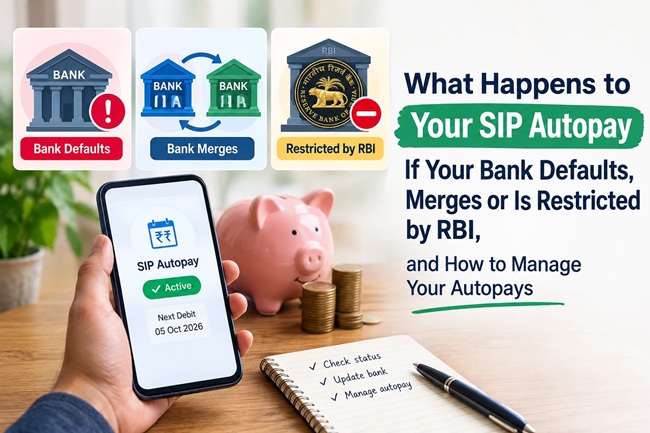
What Happens to Your SIP Autopay If Your Bank Defaults, Merges or Is Restricted by RBI, and How to Manage Your Autopays

Your SIP does not actually live inside your bank. It lives with the fund house, and the only thing connecting the two is an autopay instruction that pulls money from your bank account every month. That connection is the weak link. If your bank merges with another, changes your account details, has its operations restricted by the RBI, or your account is frozen, the SIP debit can fail even though your mutual fund investments are perfectly safe.
The same applies to every other autopay linked to that account: loan EMIs, insurance premiums, subscriptions and utility bills. This guide explains what happens to each in these situations, how your money is protected, and a practical plan for managing autopays so a banking problem never turns into a missed investment or a credit score problem.
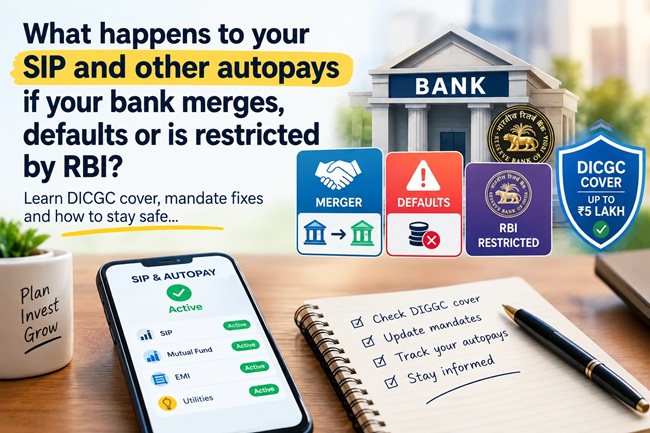
Quick Answer
Mutual fund units are held with the fund house and its trustee, not with your bank, so a bank failure, merger or RBI restriction does not put your existing units at risk. What is at risk is the SIP debit and the payout of redemption proceeds, since both flow through your bank account. If your bank merges, your account number, IFSC or mandate details may change, and the SIP mandate may need to be updated or re-registered. If the RBI places a bank under restrictions, withdrawals can be capped and debits may fail, but deposits are insured up to ₹5 lakh per depositor per bank by DICGC, with insured amounts payable within 90 days of the RBI’s direction. The practical defence is to keep a second bank account with a backup mandate, spread deposits across banks, monitor mandate status, and act immediately on any bank notice.
About This Guide
This guide was compiled by the FinanceChecks.com editorial team using DICGC’s published guide to deposit insurance, the DICGC (Amendment) Act, 2021, RBI’s Digital Payments E-mandate Framework, 2026 issued on April 22, 2026, fund house mandate and bank-change forms, and the facilities offered by MFCentral for updating bank details. Bank restrictions are rare, but the consequences for autopays are the same across almost every scenario, so this guide focuses on what to do rather than on predicting which bank might be affected. We will update it if RBI or SEBI change mandate or deposit insurance rules.
First, the Good News: Your Mutual Fund Units Are Not Held by Your Bank
A common fear is that if a bank collapses, the mutual fund investments made through it are lost. This is not how mutual funds work. Units are recorded in your folio with the fund house through its registrar and are backed by the scheme’s assets, held separately by a custodian and overseen by a trustee. Your bank account is simply the channel through which money moves in when you buy and out when you redeem.
That distinction shapes everything that follows. A problem with your bank can interrupt the flow of new money into your SIP and can delay redemption payouts into that account, but it does not erase the units you already own.
Scenario 1: Your Bank Merges With Another Bank
When one bank is merged into another, customers of the merging bank typically become customers of the acquiring bank. In several past public sector bank mergers, customers received new account details or updated IFSC and MICR codes, and old cheque books and codes were phased out after a transition period.
For your SIP, the risk is a mismatch. The mandate registered with your fund house carries the old bank and IFSC details. If those details change and the mandate is not updated, the debit can be rejected and the instalment fails.
What to do: as soon as your bank announces a merger, note the effective date and the new account and IFSC details. Update your bank IFSC or bank account with your fund house or through MFCentral, which offers services to update bank IFSC, register multiple bank mandates and change bank account details. Register a fresh mandate on the new details before the old one stops working, and confirm the new mandate is active before cancelling the old one. Fund house forms note that an existing SIP continues if a change-of-bank request is rejected as not being in good order, so a rejected request does not by itself cancel your SIP, but it also means the debit keeps hitting the old details.
Scenario 2: Your Bank Is Placed Under RBI Restrictions or a Moratorium
Sometimes a bank in financial distress is placed under All-Inclusive Directions by the RBI under Section 35A of the Banking Regulation Act, often called a moratorium. This can cap how much depositors may withdraw and restrict the bank’s operations. In past cases, withdrawal caps have ranged widely: Yes Bank customers were initially capped at ₹50,000 in March 2020 and the restriction was lifted within about two weeks, while Lakshmi Vilas Bank customers faced a ₹25,000 cap in November 2020 before its merger with DBS Bank, and PMC Bank customers faced far tighter and longer restrictions.
For your SIP, the effect depends on how the restriction is worded, but the practical outcome is that debits can fail or be limited while the direction is in force. Redemption proceeds paid into that bank account may also be delayed or capped.
How your deposits are protected. The Deposit Insurance and Credit Guarantee Corporation (DICGC) insures deposits of up to ₹5 lakh per depositor per bank, covering both principal and interest across savings, fixed, current and recurring accounts held in the same capacity. Since the DICGC (Amendment) Act, 2021, when a bank is placed under All-Inclusive Directions, the bank must submit depositor details to DICGC within 45 days, and DICGC settles insured claims within 90 days of the direction. The ₹5 lakh limit applies separately to each bank, so if you hold ₹7 lakh in one bank, only ₹5 lakh is insured, whereas ₹4 lakh in each of two banks would be fully insured. If a bank is merged or reconstructed instead, deposits generally transfer to the acquirer under the scheme, and DICGC pays the difference between the insured amount and what the depositor receives under the scheme.
Scenario 3: Your Account Is Frozen or “Locked” by an Authority
Not every frozen account involves a failing bank. An account can also be frozen or restricted because of a court or authority order, incomplete KYC, suspected fraud or a dormant account. This is different from a bank-wide restriction, but the effect on autopays is the same: debits fail. If you suspect a freeze, contact the bank immediately to find out the reason, since an account frozen for KYC reasons can usually be restored quickly once documents are updated, whereas one frozen by an order needs to be resolved through the issuing authority.
You May Also Like To Read About:
- Your Rights When a Bank Charges Hidden Fees or Deducts Money Without Consent: Types of Hidden Charges and How to Spot Them
- Your Rights If You Are a Victim of UPI or Online Banking Fraud: RBI Zero Liability Rules and Reporting Timelines Explained
- How to Manage Your SIP and Investments During a War, Natural Calamity or Market Crash: What to Do and How to Balance Your Portfolio
What Happens to the SIP When a Debit Fails
A failed debit means the instalment for that month is not purchased. Fund houses generally do not penalise you for it, but the failure has consequences. You miss buying units for that month, banks may charge a fee for a failed or returned debit, and many fund houses cancel a SIP after several consecutive failures, a limit that varies by fund house and is set out in the scheme documents. The safest assumption is that repeated failures will end the SIP, so do not let a banking issue sit unresolved for more than a cycle or two.
For other autopays, the consequences are usually more serious than for a SIP. A failed loan EMI can attract late fees and damage your credit score, and a failed insurance premium can lead to a policy lapsing once the grace period ends. This is why it is worth treating all autopays as one system, not just the SIP.
Understanding the Two Types of Mandates
| Type | How It Works | Best For | Watch Out For |
|---|---|---|---|
| Bank e-mandate (NACH) | Standing instruction registered between your bank account and the fund house through the banking system | Regular SIPs at higher amounts | Takes time to register; tied to specific account and IFSC details |
| UPI AutoPay | Recurring payment linked to your UPI ID and processed through UPI apps or bank UPI | Convenience and quick setup | Depends on the linked bank account and app; subject to UPI limits |
Under RBI’s Digital Payments E-mandate Framework, 2026, both NACH and UPI AutoPay mandates are covered. Initial registration still requires full authentication, while each recurring debit is protected by a mandatory pre-debit alert at least 24 hours in advance and a zero-liability protection if you promptly report an unauthorised debit. Limits apply to how large a debit can go through without additional authentication, so check the current limit on your app or with your bank if your SIP is large.
How to Manage Your Autopays: A Practical Plan
Build an autopay inventory. List every recurring debit tied to each bank account: SIPs, loan EMIs, insurance premiums, credit card auto-pay, subscriptions, rent and utilities. Note the amount, date, mandate type and the bank account used. Most people are surprised by how many exist.
Keep a backup account. Hold a second savings account at a different bank, ideally one that is unlikely to be affected by the same issues, and keep a modest balance in it. This gives you a fallback for the most important debits.
Register a backup mandate for critical payments. For the SIPs and EMIs that matter most, having a mandate ready on the second account means you can switch quickly rather than waiting days or weeks for fresh registration, which can take time to complete.
Stay within the insured limit per bank. If your total deposits at one bank exceed ₹5 lakh, consider spreading the excess across another bank, remembering that different types of deposits in the same bank and capacity are added together.
Pick SIP dates that give you a buffer. Choose a SIP date a few days after your salary or main income arrives, so a delay does not trigger a failure.
Watch for bank communications. Read notices about mergers, IFSC changes, KYC updates and account restrictions the day they arrive, not when a debit fails.
Check mandate status regularly. Log in to your fund house portal or MFCentral every few months to confirm each mandate is active and matches your current bank details.
Do not cancel the old mandate first. When switching banks, activate and test the new mandate before cancelling the old one, so there is no gap.
What To Do Step by Step If Your Bank Has a Problem
| Situation | Immediate Action | Follow-up |
|---|---|---|
| Bank announces a merger | Note new account and IFSC details and effective date | Update bank details with the fund house or MFCentral and register a fresh mandate before the old one stops |
| RBI restricts your bank | Check the exact terms of the direction and any withdrawal cap | Move essential autopays to your backup account; pause non-essential SIPs if debits are failing |
| Account frozen | Contact the bank to find the reason | Resolve KYC or order issues; route critical payments through the backup account |
| SIP debit failed | Check the reason in your SIP status or bank alert | Fix the cause and, if needed, register a fresh mandate or make a manual purchase to avoid a gap |
| Redemption proceeds stuck in a restricted account | Ask the fund house about changing the payout bank account | Submit the change-of-bank request with the required proof |
Common Mistakes People Make
The biggest mistake is assuming a bank problem is the fund house’s problem, or vice versa, and not acting on either side. People also forget that IFSC and account changes after a merger must be updated at the fund house, so the SIP quietly fails month after month. Many keep all their deposits, autopays and salary in a single bank, which turns one restriction into a complete disruption. Others cancel the old mandate before the new one is active and lose a month or more of investing. Some ignore failed-debit alerts for several cycles until the SIP is cancelled by the fund house. And too few people list their non-SIP autopays, so a failed EMI or premium is the first sign that something is wrong.
My Take
Bank failures and restrictions in India are uncommon, and the deposit insurance framework is stronger than it was a few years ago, with the ₹5 lakh cover and the 90 day payout deadline. The realistic risk for most investors is not losing money, it is losing continuity. A missed SIP, a bounced EMI or a lapsed policy costs far more than the inconvenience of setting up a second account and a backup mandate.
The most useful habit is to treat autopays as infrastructure. A ten minute inventory, one backup account and a quarterly mandate check are enough to keep your investing and your credit score insulated from almost any banking disruption.
Frequently Asked Questions
1. Do I lose my mutual fund units if my bank fails? No. Units are held in your folio with the fund house, not with your bank. A bank failure can interrupt SIP debits and redemption payouts into that account, but it does not erase your units.
2. What happens to my SIP if my bank merges with another bank? The SIP mandate may fail if your account number or IFSC changes and the fund house is not updated. Update your bank details and register a fresh mandate before the old one stops working.
3. How much of my bank deposit is insured in India? DICGC insures up to ₹5 lakh per depositor per bank, covering principal and interest together across savings, fixed, current and recurring deposits held in the same capacity.
4. How quickly will I get my insured money if my bank is restricted? Under the DICGC (Amendment) Act, 2021, insured claims are to be settled within 90 days of the RBI imposing All-Inclusive Directions, with the bank submitting depositor details within 45 days.
5. Will my SIP be cancelled if the debit fails once? Not usually. Many fund houses cancel a SIP only after several consecutive failed debits, but the number varies by fund house, so fix the cause quickly.
6. Can I change the bank account for my SIP without stopping it? Yes. Most fund houses and MFCentral allow you to change or add a bank mandate. Register the new mandate first, confirm it is active and then cancel the old one.
7. What is the difference between NACH and UPI AutoPay for SIPs? NACH is a standing instruction between your bank account and the fund house through the banking system. UPI AutoPay links the recurring payment to your UPI ID. Both are covered by RBI’s 2026 e-mandate framework.
8. Is the ₹5 lakh insurance limit per account or per bank? It applies per depositor per bank, aggregated across all your accounts in the same capacity at that bank, not per account.
9. What should I do if my account is frozen and my EMI and SIP debits are failing? Contact the bank to find out why, move essential payments to a backup account, and prioritise EMIs and insurance premiums because failures on those carry heavier penalties.
10. How often should I check my autopay mandates? At least every few months, and immediately after any bank merger, IFSC change, KYC update or account change.
Disclaimer
This article is for general informational purposes only and does not constitute financial, legal or banking advice. Deposit insurance limits, timelines, mandate rules and fund house practices are based on DICGC, RBI and fund house information available at the time of writing and may change. Historical examples of bank restrictions are illustrative and do not indicate that any bank is currently at risk. Readers should verify current terms with their bank, fund house and official sources. FinanceChecks.com is not a SEBI registered investment adviser and is not affiliated with any bank or fund house mentioned.

Shuchi founded Finance Checks after spending 16+ years working in corporate, managing operations and distribution. She managed her own finances, learned and read regularly and helped people make sense of their savings, loans, insurance, and investments.
She started this site to offer the kind of clear, honest financial guidance she wished was more available when she was learning to manage her own money. Every article is researched personally, checked against official sources such as the Reserve Bank of India, SEBI, or the Income Tax Department, and revisited whenever regulations or figures change. She is upfront about how the site earns money through ads and select affiliate partnerships, and she does not let either influence what she actually recommends to readers.