
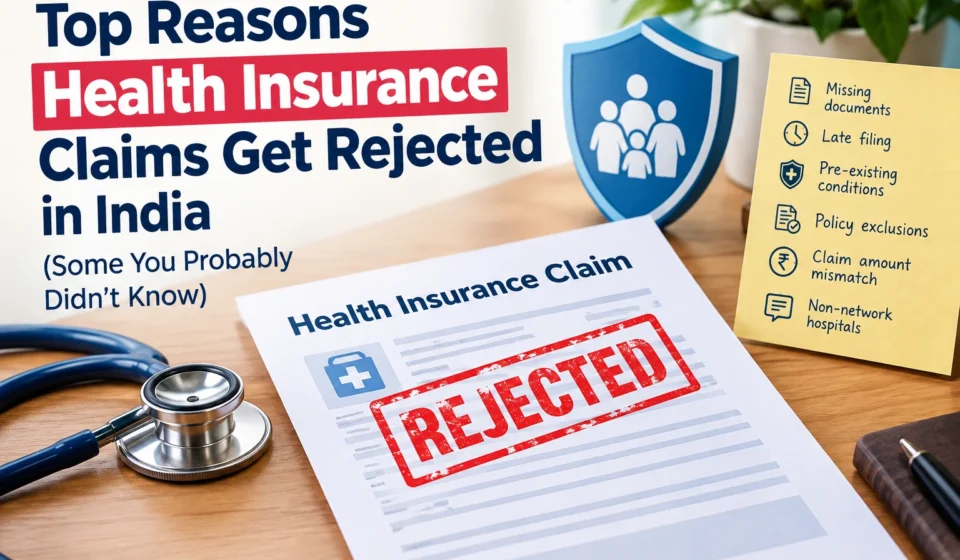
Top Reasons Health Insurance Claims Get Rejected in India (Some You Probably Didn’t Know)

By the FinanceChecks.com Editorial Team | Published September 30, 2026 | Last reviewed September 30, 2026 | 10-minute read
Roughly 1 in every 12 health insurance claims in India gets rejected outright, and a far larger share, by some estimates a quarter to a third, face partial deductions even when they are approved. Most people assume a rejected claim means they did something obviously wrong, lied about a condition, or tried to claim for something excluded. The uncomfortable reality is that many rejections happen for reasons buried in the fine print that policyholders never read closely, and some are genuinely surprising even to people who think they understand their policy well.
This guide walks through the most common reasons claims get rejected, including several that catch even careful, honest policyholders off guard.
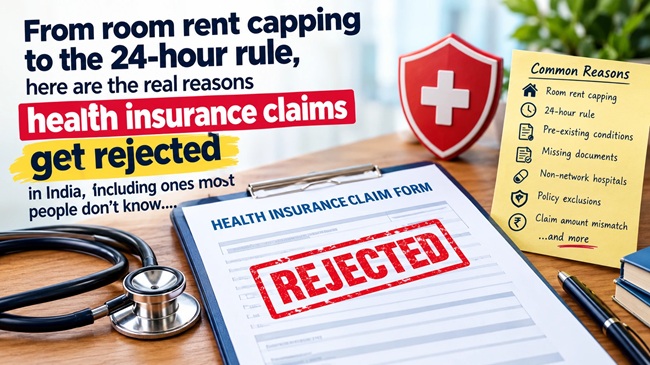
Quick Answer
The most common reasons health insurance claims get rejected in India are non-disclosure of pre-existing conditions, which drives an estimated 15 to 40% of serious insurance rejections depending on the data source, followed by waiting period violations, room rent cap mismatches that trigger proportionate deductions, documentation errors, and policy exclusions. Less commonly known reasons include a hospital not meeting the insurer’s technical definition of a “hospital,” a procedure classified as a listed day-care treatment not actually appearing on your policy’s specific list, an admission lasting less than 24 hours being treated as a non-claimable outpatient visit, and the “reasonable and customary charges” clause letting insurers reduce a payout even when the claim itself is accepted. Under IRDAI’s current moratorium rule, once you have completed 5 years of continuous coverage with the same insurer, your claim generally cannot be rejected for non-disclosure or a pre-existing condition except in cases of proven fraud.
About This Guide
This guide was compiled by the FinanceChecks.com editorial team using IRDAI’s Master Circular on Health Insurance Business, the IRDAI (Protection of Policyholders’ Interests) Operations Regulations, 2024, and published claims data and analysis from insurance industry sources, to help readers understand both the well-known and lesser-known reasons claims get rejected. We cross-check each reason against the specific IRDAI rule or regulation that governs it, since many of these rejections can be challenged successfully once a policyholder knows the regulation that applies. We will update this guide as IRDAI issues further rules on claims processing and policyholder protection.
The Well-Known Reasons (Still Worth Reviewing)
Non-disclosure of pre-existing conditions. This remains the single biggest cause of claim rejection in India by a wide margin. If you had a condition such as diabetes, hypertension, or a heart condition before buying the policy and did not disclose it on the proposal form, an insurer can reject a related claim, sometimes even years later, on the basis that the policy was issued on incomplete information. Health insurance operates on the principle of utmost good faith, which places the disclosure burden squarely on the policyholder at the time of purchase, not on the insurer to investigate later.
Waiting periods not yet completed. Nearly every health policy has an initial waiting period, typically 30 days for most illnesses, along with separate and usually longer waiting periods, commonly 24 to 48 months, specifically for pre-existing diseases and certain conditions like cataracts or joint replacements. A claim filed for a condition still within its applicable waiting period is rejected regardless of disclosure.
Policy exclusions. Every policy carries a list of permanently excluded treatments or circumstances, which can include certain cosmetic procedures, self-inflicted injury, and specific named exclusions that vary by insurer and plan. These are set out in the policy wording document, which most buyers skim rather than read in full.
You May Also Like To Read About:
- Family Floater vs Individual Health Insurance: Which Actually Saves You More
- Health Insurance Claim Rejected? Here’s What to Do Next
- Claim Settlement Ratio Is the Most Misleading Number in Indian Insurance, Here’s What to Check Instead
- Insurance Scams in India Explained: Real Cases, How They Work, and How to Verify a Genuine Policy
The Reasons You Probably Didn’t Know About
Room rent capping can shrink your entire bill, not just the room charge. Many policies include a daily room rent limit, say ₹5,000, and if you occupy a room that costs more, insurers do not simply deduct the difference in room charges. Most policies apply a proportionate deduction across every room-linked expense, including nursing charges, operation theatre charges, and doctor’s fees, calculated as a ratio of your chosen room rent to the eligible limit. A ₹12,000 room against a ₹5,000 cap can mean a much larger overall cut to your payout than most people expect, since the deduction compounds across multiple categories of the bill. IRDAI rules do protect certain items, such as medicines, implants and diagnostics, from this proportionate deduction, but many policyholders do not realise which charges are protected and which are not.
The hospital might not technically qualify as a “hospital.” Your policy does not simply require you to be admitted somewhere called a hospital, it requires the facility to meet a specific regulatory definition, usually involving a minimum number of beds, round-the-clock nursing staff, a qualified medical practitioner on duty, and a dedicated operation theatre if it offers surgical procedures. Smaller nursing homes or clinics that do not meet every element of this definition can result in a claim being denied purely on a technicality, even if the treatment itself was entirely legitimate.
An admission of less than 24 hours can be treated as a non-claim. Most health policies are built around the concept of hospitalisation requiring at least 24 continuous hours of admission. If you are treated and discharged within a shorter window, even for a genuine medical procedure, the claim can be rejected as an outpatient consultation rather than hospitalisation, unless the specific procedure is separately listed as an approved “day-care” treatment on your policy’s own schedule.
Day-care procedures must appear on your specific policy’s list. Modern medical technology has made many procedures, such as certain eye surgeries, dialysis sessions and chemotherapy cycles, completable in just a few hours without an overnight stay. Insurers maintain a list of approved day-care procedures that do not require the usual 24-hour rule, but this list varies by insurer and by plan. A procedure covered as day-care under one insurer’s policy might not appear on another’s list at all, leading to an unexpected rejection.
The “reasonable and customary charges” clause lets insurers second-guess your bill. Many policies include a clause allowing the insurer to pay only what it considers a “reasonable and customary” charge for a given procedure in that specific city or region, rather than the full amount actually billed by the hospital. This can result in a partial deduction even when every other condition of the claim is met, and insurers are not always required to explain in detail how that benchmark figure was calculated.
An existing insurance policy you didn’t mention can void a claim. If you hold more than one health insurance policy and do not disclose this at the time of claim or at renewal, some insurers treat this as a disclosure violation in its own right, separate from any medical non-disclosure, since IRDAI rules require insurers to be informed of other active policies for coordination of benefits.
Illegible or incomplete discharge summaries cause a meaningful share of rejections. This sounds almost too simple to be a real reason, but documentation problems, specifically unclear, handwritten, or incomplete discharge summaries from the treating hospital, have reportedly caused a significant share of reimbursement claim rejections. The fault here often lies with the hospital’s paperwork rather than the patient, but the financial consequence falls on the policyholder regardless.
Non-payable or consumable items are excluded by default, even in otherwise approved claims. Items such as gloves, syringes, gauze and certain disposable surgical consumables are frequently classified as non-payable under standard policy terms, meaning they are deducted from your bill even when the core treatment itself is fully approved. These deductions are individually small but can add up to a noticeable chunk of an otherwise approved claim.
Claim Rejection Reasons at a Glance
| Reason | How Common | Can It Be Challenged? |
|---|---|---|
| Non-disclosure of pre-existing conditions | Very common (15-40% of serious rejections) | Yes, insurer must prove the non-disclosure was material; protection improves significantly after 5 years of continuous coverage |
| Waiting period not completed | Common (around 25% of rejections) | Generally not challengeable if genuinely within the waiting period |
| Room rent cap / proportionate deduction | Very common (affects 25-30% of hospitalisation claims) | Partially; protected items like medicines and implants should not be proportionately deducted |
| Documentation errors | Common (a significant share of reimbursement delays) | Often fixable by resubmitting corrected documents |
| Hospital doesn’t meet technical definition | Less commonly known | Difficult to challenge; worth verifying hospital empanelment before admission |
| Admission under 24 hours, not listed as day-care | Less commonly known | Challengeable if the specific procedure should qualify as day-care under medical practice norms |
| “Reasonable and customary” charge deductions | Less commonly known | Can be challenged by requesting the insurer’s basis for the benchmark figure |
| Non-payable consumables | Common but often overlooked | Generally not challengeable; standard across most policies |
The Rule Most Policyholders Don’t Know Protects Them
IRDAI’s health insurance regulations include a moratorium provision that works strongly in favour of long-term policyholders. Once you have completed a continuous period of coverage with the same insurer, currently set at 5 years, your insurer generally cannot reject a claim on the grounds of non-disclosure or a pre-existing condition, except in cases where fraud can actually be proven. This is a meaningful protection for people who have held the same policy for years and suddenly face a rejection based on an old, undisclosed condition, and it is worth checking your policy’s issue date or last reinstatement date before accepting a non-disclosure rejection at face value.
Separately, under the Insurance Act, 1938, insurers generally cannot repudiate a policy after a certain number of years from issuance except on grounds of established fraud or deliberate suppression of a material fact, a protection that applies more broadly across insurance products and reinforces the same principle: time and continuous coverage genuinely work in a policyholder’s favour.
What to Do If Your Claim Is Rejected
A rejection letter is not necessarily the final word. Start by asking the insurer or Third Party Administrator (TPA) for the specific policy clause under which the claim was rejected, since a vague or unexplained rejection is itself something you can challenge. Request an itemised deduction sheet if the rejection involves a partial payout, so you can verify exactly which charges were reduced and why. If you believe the rejection is incorrect, file a written appeal with the insurer first, since many disputes are resolved at this stage once supporting medical records or corrected documentation are provided. If the insurer does not resolve the issue satisfactorily, you can escalate to the Insurance Ombudsman, a free grievance redressal mechanism specifically for insurance disputes, or file a complaint through IRDAI’s Integrated Grievance Management System.
Common Mistakes Policyholders Make
A frequent mistake is assuming that any mention of a pre-existing condition means automatic, permanent rejection, when in reality most such claims become protected once the applicable waiting period or the 5-year moratorium period has passed. Another common mistake is choosing a hospital room category without checking the policy’s room rent limit beforehand, not realising that the mismatch affects far more than just the room charge itself. People also frequently skip reading the specific list of day-care procedures and non-payable items in their own policy document, assuming all policies apply the same rules, when these lists vary meaningfully between insurers. Finally, many policyholders accept a rejection letter without asking for the specific clause invoked or an itemised deduction breakdown, missing a straightforward first step that often resolves genuine errors.
My Take
What stands out across these reasons is how many of them have nothing to do with dishonesty or wrongdoing on the policyholder’s part. A proportionate room rent deduction, an admission that falls just under 24 hours, or a hospital that technically does not meet a regulatory definition can all reduce or deny a genuinely legitimate claim, and none of these require the policyholder to have done anything wrong beyond not reading a lengthy policy wording document closely enough.
The most useful habit here is reading your policy’s specific schedules, the room rent limit, the day-care procedure list, and the non-payable items list, once, when you buy or renew the policy, rather than discovering them for the first time during a hospital admission when there is no time to make a different choice. It is also worth checking how long you have held your current policy continuously, since the 5-year moratorium rule is a genuinely strong protection that many long-term policyholders do not realise applies to them.
Frequently Asked Questions
1. What is the single most common reason health insurance claims get rejected in India? Non-disclosure of pre-existing medical conditions at the time of buying the policy is consistently the most commonly cited reason, contributing to a significant share of serious rejections.
2. Can a claim be rejected just because the room I chose was more expensive than my policy’s limit? The room itself won’t be the only thing deducted. Most policies apply a proportionate deduction across all room-linked charges, including nursing and doctor’s fees, based on the ratio between your chosen room rent and the policy’s limit.
3. Does every hospital I visit qualify for a health insurance claim? No. The hospital must meet your insurer’s specific technical definition, generally involving a minimum bed count, round-the-clock nursing, a qualified doctor on duty, and an operation theatre for surgical cases. Smaller facilities may not qualify.
4. Can my claim be rejected if I’m admitted and discharged within a day? It can, unless the specific procedure you underwent is listed as an approved day-care treatment on your particular policy, since most policies otherwise require at least 24 hours of hospitalisation.
5. What is the IRDAI moratorium rule, and how does it protect me? After a continuous coverage period of 5 years with the same insurer, your claim generally cannot be rejected for non-disclosure or a pre-existing condition except in cases of proven fraud.
6. What does the “reasonable and customary charges” clause mean? It allows the insurer to pay only what it considers a reasonable amount for a procedure in your city or region, which can result in a partial deduction even when the claim itself is otherwise approved.
7. Are all items in my hospital bill covered by insurance? No. Certain consumable items like gloves, syringes and some disposables are commonly classified as non-payable and excluded from the claim by default, regardless of whether the core treatment is approved.
8. What should I do first if my health insurance claim is rejected? Ask the insurer for the specific policy clause under which the claim was rejected and, if it’s a partial payout, request an itemised deduction sheet before deciding whether to appeal.
9. Where can I escalate a health insurance dispute if the insurer doesn’t resolve it? You can approach the Insurance Ombudsman for free grievance redressal or file a complaint through IRDAI’s Integrated Grievance Management System.
10. Can documentation errors really cause a claim to be rejected? Yes. Illegible or incomplete discharge summaries and similar paperwork issues from the treating hospital have reportedly caused a meaningful share of reimbursement claim rejections, even when the treatment itself was valid.
How We Verified This Information
This guide was researched using IRDAI’s Master Circular on Health Insurance Business, the IRDAI (Protection of Policyholders’ Interests) Operations Regulations, 2024, and the Insurance Act, 1938, cross-referenced against published claims data and industry analysis, rather than relying on a single source. Where a reason for rejection is tied to a specific regulatory protection, such as the moratorium rule, we have named the rule directly so readers can verify it and cite it if they need to challenge a rejection themselves.
Disclaimer
This article is for general informational purposes only and does not constitute legal or insurance advice. Specific policy terms, waiting periods, room rent limits and exclusions vary by insurer and plan, and the applicable regulations can be amended by IRDAI. Readers should refer to their own policy wording document and consult their insurer or a qualified insurance advisor before making decisions, and should contact the Insurance Ombudsman or IRDAI directly for unresolved disputes. FinanceChecks.com is not an insurance company or a licensed insurance advisor.

Shuchi founded Finance Checks after spending 16+ years working in corporate, managing operations and distribution. She managed her own finances, learned and read regularly and helped people make sense of their savings, loans, insurance, and investments.
She started this site to offer the kind of clear, honest financial guidance she wished was more available when she was learning to manage her own money. Every article is researched personally, checked against official sources such as the Reserve Bank of India, SEBI, or the Income Tax Department, and revisited whenever regulations or figures change. She is upfront about how the site earns money through ads and select affiliate partnerships, and she does not let either influence what she actually recommends to readers.